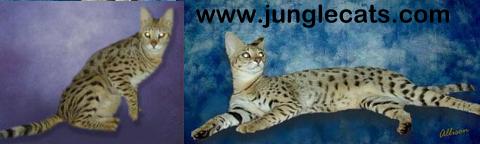
|
Savannah photographs provided by: |
DOMESTIC X SERVAL AND CARACAL HYBRIDS
DOMESTIC X SERVAL HYBRIDS
Serval males raised with domestic females will mate them, though the pregnancy is not always successful and human intervention may be necessary to raise the hybrid "Savannah" kittens. The F1 females are fertile, but the male hybrids of the first three or four generations are infertile (with one or two exceptions) and cannot be used to breed further Savannahs. The serval has three colour forms: melanistic, brown (usual) and white. Savannah breeders are mimicking white servals by introducing the silver gene into the Savannah breed. Black Savannahs are produced by crossing servals with melanistic Bengals. In nature, the cat and the serval don't even recognise each other as potential breeding partners. The likelihood of serval hybrids in the wild is therefore extremely remote.
The first documented serval/domestic hybrid was reported by Suzi Wood in the Long Island Ocelot Club (LIOC) Newsletter, Vol 30 Number 6, Page 15, Nov/Dec 1986. This reported the birth of an 8 oz female hybrid on April 7th 1986. The kitten, named Savannah, was born to a Seal Point Siamese cat and sired by a 30-35 lb serval called "Ernie" in Pennsylvania. Her weight from birth through to placement was comparable to that of an average serval cub of the same timespan. Her rapid growth and weight gain then tapered off, but she remained consistently larger than a domestic kitten of the same age and was 10 lbs at 6 months old.
Savannah's black spotting was an exact duplication of the serval's pattern, but the background colour was greyish-brown. This pattern included ocelli (pale silver spots on the backs of the ears). She had prominent ears, long legs, a "rangy" body conformation and a medium length tail. Like her domestic mother, she was vocal (described as a "talker"), an athletic climber and used the litter tray properly. From the serval side of her ancestry she became an "accomplished hisser and slapper", got her basic body conformation, coat pattern, facial expressions, body language and wariness of strangers. She also preferred a raw meat diet over domestic food. The interaction of domestic/serval ancestry produced her voice type, head shape, medium length tail and an assertive temperament. She was reportedly very affectionate, but disliked any form of restraint.
Suzi Wood wrote, "While it has been rumoured that this type of hybrid was bred some years ago, to date research efforts in Europe as well as here in the US have not been able to document the case. For practical purposes, this kitten is considered a first of its kind. Without comparison model or a standard available, at eight weeks of age the infant's hearing, sight reflexes and coordination were tested. All functions were excellent, as compared to general feline skills." Wood also noted no adverse reactions to the cat flu vaccination. Wood finished the report by stating "This hybrid combination will be known as the Savannah."
The LIOC Newsletter, Vol 33, Number 4, July/Aug 1989 (cover and page 4), carried a cover photo of Savannah (the name of the hybrid female) owned by Suzi and Mike Mutascio. The caption stated that the hybrids were called Savannah cats, in the same way that Geoffroy's/Domestic hybrids are called Safari cats and added that Savannah, the original hybrid, had borne kittens. Savannah, by then 15 lbs and owned by Suzi Mutascio, successfully pair-bonded with a 13 lb champion male Turkish Angora called Albert II, owned by Lori Buchko of Hightstown, New Jersey. Savannah produced 2 large kittens on April 5th, 1989; these being 25% serval ancestry. Prior to her 2nd birthday, Savannah had rebuffed 3 different potential mates for unknown reasons, but was oestrus cycling regularly.
The breeders were not worried about Albert's colouration as they claimed he had proven not to throw white dominant genes. This is a misunderstanding - white is dominant (actually epistatic), but Albert was evidently heterozygous and luck of the draw had resulted in no previous white offspring. Albert also carried red (masked by his dominant white gene), which hybrid breeders at that time considered desirable. Albert's long coat was recessive and also not considered a cause for concern, though a long coat might show up in later generations as a result of carried recessives. Albert's conformation complimented that of the serval - refined "boxed" head, narrow muzzle, copper eyes, large ears and rangy, leggy body. He also had a very good temperament. Albert joined Savannah in her own home and they had bonded within 2 days.
On April 5th 1989, Savannah's 3rd birthday, she produced 2 live kittens and a stillborn kitten. She was an excellent mother. One kitten was a solid white male (proving that Albert did throw the dominant white gene!), the second was a spotted female with mottled areas of red (i.e. a spotted torbie) and the stillbirth was a perfect spotted male with a beige ground colour. All three weighed over 6 oz at birth 11 oz (female) and 11.5 oz (male) at 10 days. Though unspotted, the white kitten had a serval-type body. The LIOC Newsletter May/June 1990 announced that Suzi Mutascio's savannah (serval hybrid) produced 2 kittens, of which one survived. In July/August 1991 it reported on "Mongo", a quarter-serval hybrid owned by Mike and Suzi Mutascio. Mongo's mother was a 50/50 serval-domestic cross and his sire a white Turkish Angora. This accounted for the fact that in each litter to date at least one and sometimes more white males were produced. As is often the case in hybrids, these males had so far been sterile.
The most obvious problem in serval/domestic hybrids is size difference. Typical domestic cats weigh between 8 - 14 lbs with a few reaching 20 lbs. Servals are in the 30 - 40 lb range although the race known as the "Servaline" is smaller as well as being paler, usually with smaller spots.
Unless he has been raised alongside domestic cats, it is not easy to persuade a male serval to mate with a domestic female since the smells and cues are wrong. If is willing, he must then work out how to get things in the right place with a much smaller female! It is possible to mate a domestic male with a serval female if the female is co-operative though domestic females are used by most, if not all, Savannah breeders.
|
Savannah photographs provided by: |
If mating is successful, there is a problem with gestation period. A domestic cat pregnancy is (on average) 63 days. A serval pregnancy is (on average) 74 days i.e. 10 days longer. The hybrid kittens are larger than pure domestic kittens and the domestic female often goes into labour at her normal time - 10 days premature in serval terms. The more "overdue" she can made to be, the better chance the kittens have of surviving. If a serval female is bearing the young, the hybrid kittens are much smaller than serval kittens and she may kill them accidentally or her maternal instinct may fail to recognise them as kittens allowing her predatory instincts to take over. A domestic cat foster mother may be needed. Premature or undersized newborn kittens cannot suckle properly. They will weigh only a couple of ounces and are extremely fragile. They must be bottle fed every two hours, round the clock for the first two weeks of their lives, and then every four hours until they are weaned onto solids. Some must be tube fed or dropper fed until they are able to suckle from a bottle. By the time they are strong enough to suckle from the mother, her milk will have dried up. Other Savannah breeders have reported that they have experienced none of these problems and that all kittens have been born on time and raised by their natural mother so these issues are by no means universal.
At the end of all this, only the F1 females are fertile. The male kittens of the first three or four generations are infertile (with one or two exceptions); since they cannot be used to breed further Savannahs they are homed as pets. It is possible to backcross the hybrids repeatedly to a pure-blooded domestic or pure-blooded serval to get a fertile F1 hybrid male; it is fertile because it is either more than 90% serval or more than 90% domestic. The servals used are all captive bred (servals are bred for the exotic pet market); wild servals are not used.
An additional, and tragic, hazard is that the serval male may kill the female accidentally while gripping the female's neck during coitus. The potential problems make serval hybrids extremely unlikely in the wild.
The popularity of hybrid breeds has a grim downside. While reputable breeders supervise matings and use permitted outcrosses, there are backyard breeders that use any available domestic female including Maine Coons to attain large size (with the downside of the recessive longhaired trait) and moggies because they are cheap and it doesn't matter if the serval stud accidentally kills them during or after mating (his large size and larger teeth can make the mating neck-bite fatal). The worst of this type of breeder simply put several domestic females of any type/breed with a serval stud overnight and hope that some will survive the experience and produce kittens. It is this sort of breeder that brings cat-breeding and hybrids into disrepute.
On 19th September 2009, the British newspaper "The Telegraph" published a typical scare story about "Supercats" dangerous to other pets and even small children, citing fears by animal welfare groups. The factually inaccurate report by Jasper Copping, compared the early generation Savannahs to the "wholly domesticated" later generation Bengal which made it a sloppy piece of reporting.
The report claimed the Savannah (serval hybrid) was the most popular hybrid (it's not - the Bengal, an Asian leopard Cat hybrid, is) grows 3 times larger than a domestic cat and can jump 7ft vertically. It stated the Savannah could grow up to 35lb - compared with around 10lb for atypical cat. This applies to the F1 (first generation) and some F2 (second generation) Savannahs which should be considered exotic pets rather than housecats and homed to experienced owners. The F4 generations onwards will be leggy cats, but be within the normal size range of the domestic cat due to having only a tiny percentage of wild blood remaining. In Britain, the F1savannah and Safari cats fall under the Dangerous Wild Animals Act (DWAA) and cannot be kept as housepets. Many breeders avoid using the Savannah or Bengal breed name for the F1 cats, or are careful to state F1or F2 precisely because of sloppy reporting where comments applicable to F1 cats are applied to the whole breed even though the F4 and later generations are wholly domesticated and within the normal size range for domestic cats. Not many years ago, another daily paper was running similar scare stories about Bengals and claiming they should be fed whole chicks!
Both Peter Neville and Claire Bessant from FAB were quoted as saying the Savannahs were bigger and wilder - a comment applicable to the early generations only, though this did not come across in the report. An RSPCA spokesman (apparently lacking the courage to be named) was quoted regarding dangerous "temperamental characteristics from both domestic cats and the wildcat species" - again comments applicable to F1 and F2cats and not to the later generations.
Owners were quoted as warning that if the cats did not receive "24/7"attention for the first, formative weeks, they could turn feral. Kittens born to wholly domestic parents, whether moggy or Persian, can grow up feral if not socialised during their formative weeks and no cats, whatever the breed, should be left unsupervised with small children.
The sloppy report went on to say that the well-established Bengal (bred from the Asian Leopard Cat) is considerably smaller and considered domesticated, but failed to clarifying that most Bengals in Britain are later generation cats. To make a proper comparison it should have compared F1/F2 "Bengals" (half- and quarter- Asian Leopard Cat) to the F1 and F2 Savannahs and Safari cats in the rest of the article. It should also have looked at F3 and F4 Savannahs. Comparing a first cross hybrid with a cat that is several generations down the line is unhelpful and extremely lazy.
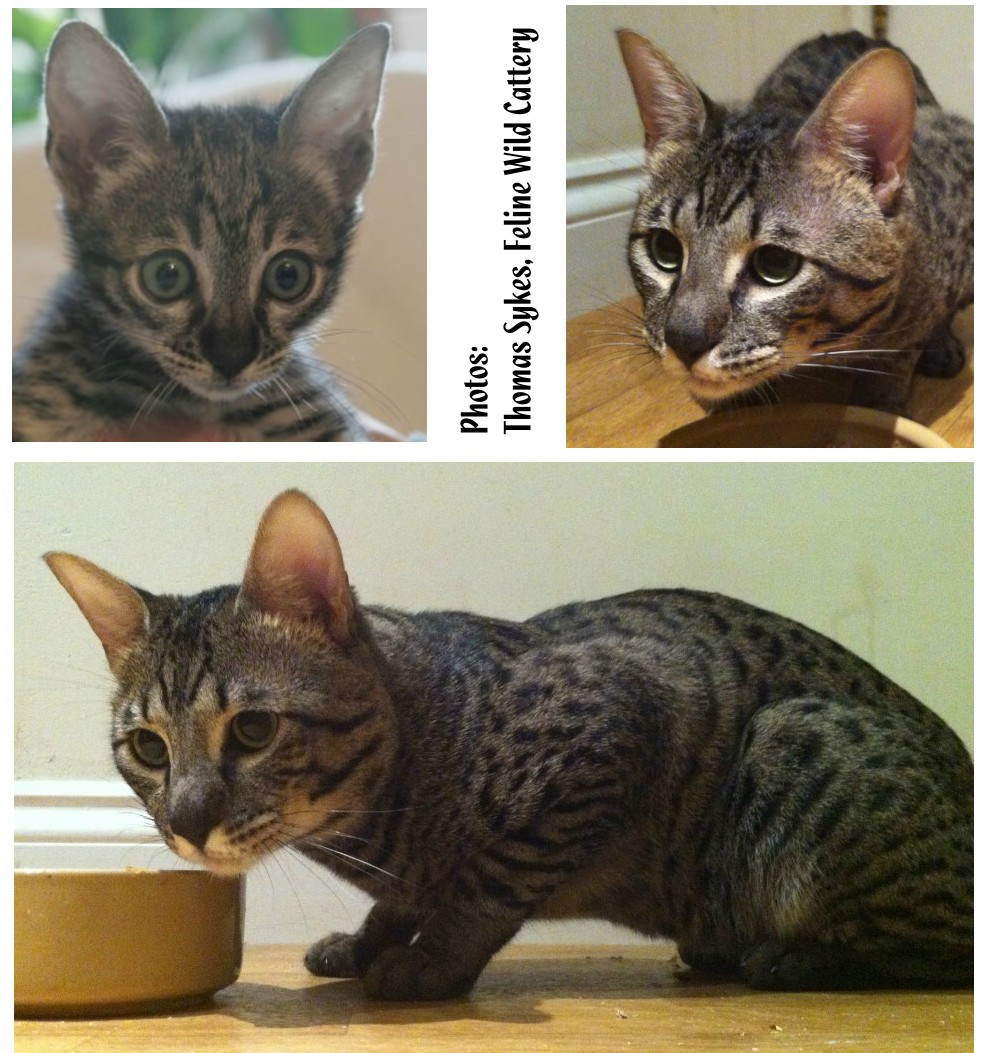
Bengals were used in early Savannah cat breeding and this introduced the pattern known as "charcoal" caused by a gene from the Asian Leopard Cat. Charcoal Savannahs are darker coloured and grey-toned instead of golden-toned. The face is darker, with pale or white "spectacles" and an almost black nose, and the dorsal region is darker. The charcoal gene is associated with Brigitte Cowell's Kirembo Savannahs, an line that has produced some influential stud cats in the UK. These photos were provided by Thomas Sykes, Feline Wild Cattery, in the UK.
|
Charcoal Savannah photographs provided by Thomas Sykes, Feline Wild Cattery
|
The Ashera - Savannah Cats With False Papers
The much hyped and overpriced Ashera announced in 2006 is a rehash of the existing Savannah breed (African serval/domestic hybrid). It appears to be a cross between male servals and female Bengals (Asian leopard cat hybrid). The males would be sterile, but the fertile females could be backcrossed to Bengals. Like the Savannah, it is a tall cat with leopardlike spots and contrasting tiger stripes and is claimed to weigh up to 30 lbs. The breeder, Simon Brodie, was previously involved with Allerca's hypoallergenic cat. Brodie attempted to obtain Savannah females by deception, calling himself Campbell Francis and his firm as Monsenco Capital, however this did not succeed. He claims to have created the Ashera using artificial insemination (rarely successful in cats) and to have found the marker genes for size and pattern (claims that have not been published in peer-reviewed journals). Brodie's previous company, Allerca, claim to have found the genes to make cats hypoallergenic, but their work was not published in peer-reviewed journals.
Cats must be ordered in advance at a cost of upwards of $22,000 with additional costs for hand delivery. Included in the deal are a 10 year consultation contract with an "internationally recognised animal behaviourist" and a 1 year guarantee. Neutering/spaying is mandatory - Brodie doesn't want anyone copying his cats, even if they are nearly identical to an existing breed. Just like the franchise-bred IRCA Ragdolls, they won't be eligible for showing either, because they don't come from a traditional cattery or breeding programme. Buyers and would be breeder beware: having paid your money in advance, will you ever receive your kitten? Brodie's background of defaulting on loans, false accounting and unpaid employees suggests you'd be far better off buying from a Savannah breeder. He plans to franchise the breed, but was convicted of multiple cases of false accounting in the UK relating to another franchise scheme (Cloudhoppers) and has left dozens of unpaid bills in his wake.
In June 2008 it was confirmed that Asheras were Savannahs acquired from a Savannah breeder and re-sold for many times their purchase price. On 17th January 2008, Dutch customs officials at Schiphol Airport confiscated 3 Ashera kittens imported into the Netherlands as the cats might violate the CITES treaty that forbids the sale or trade of protected species and their offspring. One cat had been bought by a Dutch couple for 27,000 euros ($40,000) and the other 2 were in transit via the Netherlands. US cat breeder Chris Shirk identified the 3 seized cats as F1 Savannahs (first generation serval x domestic hybrid) bought from his Pennsylvania-based Cutting Edge Cats cattery for $5,000 - $6,500 and being resold as Asheras for many times that price. LifeStyle Pets/Simon Brodie would not respond to Dutch authorities’ telephone calls or emails about either the seizure or the allegations of reselling F1 Savannahs.
Shirk identified the cats from photos printed in the Dutch press. One of the photos printed in the Dutch media was Shirk’s own online advertising photo (Brodie has previously used serval and Savannah images on his website). Shirk had sold 3 young F1 male Savannahs to Martin Stucki of Oklahoma-based A1 Savannahs, shipping them by air on 11th January 2008. Stucki also refused to answer questions about whom he sold the 3 F1 Savannahs to, but said the buyer did not identify themselves as Brodie (Brodie has previously used other names in when trying to buy Savannah cats). However, he confirmed that Brodie had contacted him in 2007 about purchasing a number of Savannahs. Shirk filed a claim with Dutch authorities to reclaim the cats and provided their pedigree documentation, photos to prove their lineage (and highlight the fraud) and blood samples from the parents of the 3 cats he identified as bred by him. Chicago-based Savannah breeder Cynthia King, also identified photos as being photos of one of Shirk's Savannah cats.
US Fish and Wildlife supervised the taking of blood samples from Shirk's cats. These went directly from the vet surgery to the Dutch Netherlands government. The forensics labs confirmed the DNA tests on the seized "Ashera" kittens showed all 3 to be F1 Savannahs bred by Shirk from a serval and Egyptian Mauowned by Shirk. The cats exported as "Asheras" by Brodie's Lifestyle Pets were Savannahs sold on to unsuspecting buyers for a huge profit. The results were made public in June 2008. In that month, Brodie assumed the name Simon Cadarran, moved to Big Sky, Montana and set up a luxury ski business.
DOMESTIC X CARACAL HYBRIDS
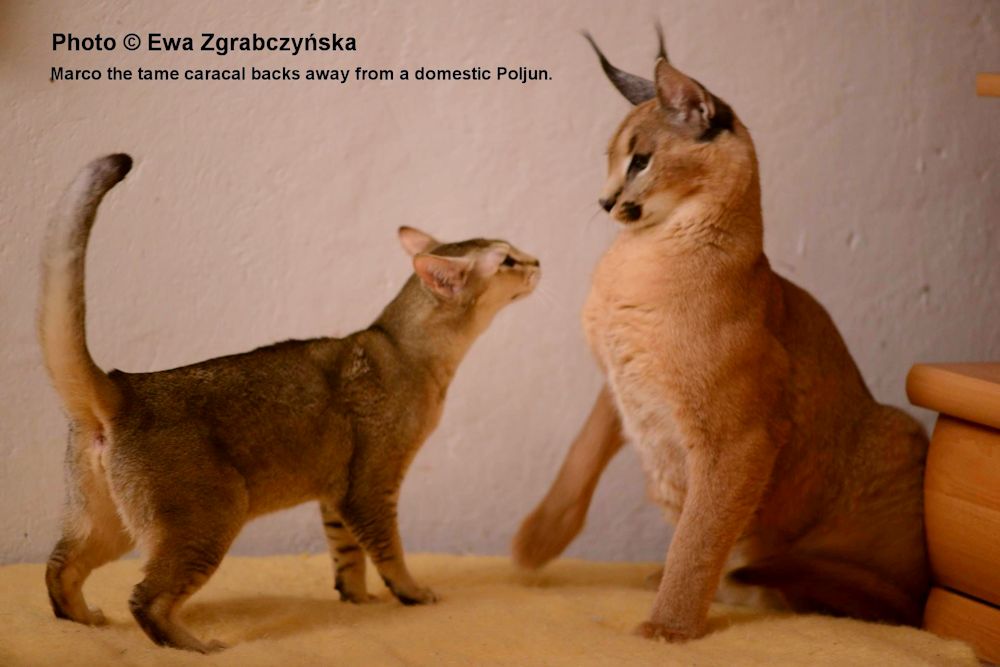
This photo shows the relative sizes of a domestic cat (a Poljun, derived from Bengal and Chausie crosses) and the caracal (Marco, a very tame, captive-bred caracal)
The 1998 Moscow Zoo Caracat
In 1998, I Kusminych and A Pawlowa reported a caracal/domestic hybrid cat at Moscow Zoo ("Ein Bastard von Karakal Hauskatze im Moskauer Zoo" in Der Zoologische Garten Vol. 68, No. 4 (1998)). This article was printed only in German and I have no translated information. Though this sounds a surprising hybrid, domestic cats are crossed with Servals in captivity and the Serval and Caracal are interfertile. A zoo is an artificial environment which would have contributed to this unlikely mating.
The Savannah gives an indication of problems breeders would face should they choose to pursue a caracal hybrid breed. There was apparently an attempt at a caracal x domestic hybrid; a male caracal was housed with a female Snowshoe, but the pair failed to mate (Nikki Matthens, Wild Talk). To regard a domestic cat as a mate, the caracal would have to be raised with domestic cats. The lack of interest in "Caracats" seemed related to the current trend for breeding wild-looking striped and spotted cats; the caracal is more reminiscent of a large Abyssinian with long black ear tufts. Hypothetical caracats and Caracal/Abyssinian crosses were discussed on the Newbreedcats Yahoogroup in November 2003.
The 2005 American Caracat
Details of Joy Geisinger’s caracal x domestic hybrids (Caracats) were published in TICA Trend (June-July 2008) and also in Feline Conservation Federation Journal, Volume 52, Issue 4, July/August 2008. Following Joy Geisinger’s death in 2008, Mike Friese (Feline Conservation Federation) provided further information on the hybrids that he received from Geisinger.
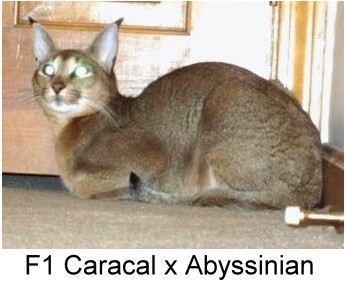 The Caracat is a hybrid of Caracal x Abyssinian domestic with an even-toned coat without spots, stripes, or rosettes. F1 Caracats reach 25- 30 pounds and stand 12" – 14" at the shoulder, and resemble a cougar with tufted ears and dark facial markings with some barred markings on the legs and belly. The tail length is not stated (caracals have short tails). F2 Caracats (75% Abyssinian, 25% Caracal) reach 20 - 25 pounds, stand 10" – 12" at the shoulder, and still resemble a miniature cougar, but have a more domestic temperament than the F1 Caracats.
In 2005 a male Caracal kitten, Mandela was raised with 2 female Abyssinian kittens, Bonnie and Beverly. In May 2007, 8 lb Beverly and 50 lb Mandela produced Hillary and another kitten, the first deliberately bred Caracats (accidental hybrids had been born in Germany to a male domestic and a female caracal). The other kitten died at birth though an F1 male called Jude was born in a subsequent litter (October 2007) along with F1 kittens Jennifer and Monica. Geisinger intended to breed Hillary to an Abyssinian sire called Romeo when Hillary matured in 2008. The caracal male, Mandela, was rehomed in February 2008 to a breeder of Caracal x Chausie hybrids. These F1 Caracats inherited the caracal’s hissy, nervous disposition, destructive tendencies and a screeching call. The fact only one F1 male was born (or survived) is also in accordance with Haldane's Rule - F1 males are either sterile or non-existent.
F2 Caracats with ear tufts and a "moustache" would probably be the best-looking generation since F3 hybrids (much higher percentage of Abyssinian) would resemble overgrown Abyssinian cats. F2 kittens were priced at $8000 (fertile females) and $4000 (infertile males). The males were expected to be infertile for up to 5 generations. The hybrid males were to be sold as neutered, declawed pets while the females would be sold with breeding rights on the basis they would be bred only to registered Abyssinian males. Geisinger wrote that the F2 females would quickly earn back the $8000 price with their first F3 litter - suggesting a commercial enterprise rather than a cat-fancying one.
Joy Geisinger’s husband greatly hated Mandela, the Caracal stud, and the feeling was apparently mutual. Mandela was an exceptionally gentle Caracal, who loved "lap-time" with Joy, and the new owners planned to breed him to a Chausie to maintain the larger size and exotic look (this would also be a safer match than a petite Abyssinian female). Geisinger considered this is a step backwards, as the offspring would be greater than 50% wild cat and not very domesticated. However, the Chausie breed is several generations down the line and Geisinger’s fear would be unfounded if a later generation Chausie is used; some Chausies also have a short tail. She had also claimed that Chausies, Savannahs and Bengals used any domestic female that will tolerate a wild male; something only true of backyard breeders mass-producing unregistered versions of those breeds.
TICA granted experimental breed status for the Caracat and, although it would take years, Geisinger aimed to give the Caracat the same status as the Savannah. This would mean moving beyond the F2s, something she had not previously wanted to do because of the possible loss of caracal looks, however, it is not possible to have a breed comprising F2 cats alone. She knew the F1s would be purchased as fast as she could produce them, but she noted that the breeding process was difficult for the Abyssinian females. The greater size of the caracal, however gentle, meant a mating neck-grip could be lethal to the much smaller domestic female and one of the females had spent around 30 hours in labour because of the size of the hybrid kittens. On May 3rd, 2008, Geisinger wrote to Mike Friese that the F2 generation would be the most marketable Caracats and that she had an Abyssinian stud, Romeo, lined up to breed with her 3 F1 Caracats. She hoped Romeo would pass on his sweet disposition to the F2 offspring. She was certain she would not be able to keep up with the demand for F2 kittens in spite of having 3 F1 Caracat females. The oldest F1 Caracat, Hillary, had already come into season by May 2008 (10.5 months old), but was not bred because she was not fully grown. Monica and Jennifer were not due to come into season until the late summer/early autumn of 2008. Neither Bonnie nor Beverly became pregnant before Mandela left so there were no further F1 kittens. Romeo had attempted to mate Hillary, but his was considerably shorter than Hillary and was unable to manage the neck-hold and intromission at the same time. The only F1 male Caracat Geisinger was able to produce was Barnabus Jude.
In Europe, Poespoes Cattery, planned to acquire one or two F2 females (which would be DNA tested) who will also be backcrossed to a caracal male; this would give F1 females that have a higher percentage of caracal than an F1 caracal/domestic cross and would help establish generations beyond F2 with the desired look. Before this happened, Geisinger died and it was not known what would happen to her caracal/Abyssinian hybrids, nor was there further news of the caracal/Chausie hybrids.
The caracat faces the same gestational mismatch issues found in serval hybrids. The caracal gestation period is 73 days while the Abyssinian gestation period is 63 days. This means hybrids borne by a domestic female will be premature in terms of the caracal. Hence it made sense that an existing Savannah breeder would have the experience and facilities to save the breed following Geisinger's death. Caracats are now bred by Allison Navarro of Jewels of the Nile Savannahs & Caracats. By 2011, there were 6 breeding female crosses and a proven male. The breed is developing slowly with further hybrid offspring expected during 2013.
The 2010 German-Austrian Caracat Project
The Caracat provoked a lot of controversy when a German-Austrian breeding project planned to mate a tame male caracal with Maine Coon females to create a domestic breed that resembled the caracal. Authorities there were concerned this would violate subsection 11b of the Animal Welfare Act and there were also a lot of alarmist stories about taking hybrid kittens from the mother at birth and hand-reared in order to tame them. Other alarmist stories spoke of caesarean sections, tube-feeding and rearing kittens in incubators, all for the sake of profit. Detractors said the F1 hybrids would not use litter-trays and when they reached sexual maturity they would escape, roam or become aggressive.
In 2010, a German-Austrian breeding project was announced, including the establishment of the "International Foundation for Wild and Hybrid Cats" with their own breed standards and breeding guidelines by the breeders. However the project was discontinued and at the end of 2014 all information was removed from the websites of those intending to breed. IFWHC stated that even F1 Caracats adapted well to living in flats.
IFWHC decided to use only the absolute largest Maine Coons, those of "El Dorado" in Austria. Caracals measure about 65 cm length and 45cm shoulder height. The largest of the El Dorado tomcats were 65 cm in length and 45 cm shoulder height and could weigh up to 13 kg. The size of the Maine coon also allowed a long enough gestation to prevent unwanted premature births.
The co-founder of this project was Patrick Ruehl who owned one of the first tame caracals in Germany. He felt that Caracals and Servals were already semi-domesticated, having lived with some indigenous peoples without compulsion, sometimes as pets and sometimes as hunting animals. He had 2 caracal studs available for breeding with domestic cats and said that his caracal stud happily coexisted with a harem of Maine Coon females (and had also lived with a Savannah stud as a “coalition”). Wild caracals will also live in groups or “brotherhoods.”
Ruehl considered the larger Maine Coon a more suitable domestic cat partner compared to the Abyssinian female used in the USA, but would not comment on potential dangers to female domestic cats from the male’s larger canines as he did not want others (by which he seemed to mean backyard breeders and those who put profit before cat welfare) to copy him and throw random domestic females in with less well socialised caracal males in the hope that some of the females survived the mating. Such things had happened in Savannah breeding. He noted that cats, including caracals, learn to bite gently through play and that domestic cat females often solicit and allow mating without any need for the male to grip their necks. This was another reason he considered the Maine Coon more suitable - its longer fur provided additional protection.
He was already an experienced Savannah breeder. Rather than mate a domestic cat to a male serval he preferred to mate the larger F2 Savannahs females because they were larger and they also more easily carried F1 hybrid kittens to about 75 days, about 10 days longer than a female domestic cat, giving the F1 kittens a better start. This more reliably introduced fresh serval genes.
IFWHC drew up a draft Caracat Standard. It called for a large to very large body. In males the ideal shoulder height is 40 - 45 cm, but females were smaller. The body should be long and muscular, especially the hindquarters, which should be strong and pronounced. The ribcage should be broad and the legs should be strong and muscular. The paws should be large with tufts of fur. The tail should be full length, ideally as long as the back from shoulder to root of tail.
The head was required to be large and massive with straight contours, it should be longer than it is wide and have high cheekbones. The nose should be medium-long and the profile curved. The muzzle should be wide, massive and angular. The chin should be massive, pronounced and run in a line with upper lip and nose i.e. it should be blunt. The ears were to be very large, like those of a caracal, with a broad base and run to a point. They should be upright and set high on the head and the distance between the ears was to be no more than the width of a single ear base. The standard required hair furnishings in the ears, as well as extremely pronounced tufts at the tips like the caracal.
The eyes were to be large, oval, set far apart and slightly slanted. At that stage the eye colour would be unrelated to the coat colour. Because the Maine Coon is a long-hair, the Caracat coat could be short-haired or semi-long-haired and these two lengths would be distinct. The F1 generation would all be short-haired, but the F2 generation would also produce semi-long-hair. There was no mention of standardising on a short coat later in breed development.
According to that draft standard, existing F1 Caracats (which referred to the American caracal-Abyssinian hybrids since the Russian Caracats had not yet been developed) had a very balanced, calm nature. They like being around people, but were unobtrusive. They were also very sociable and could be trained. IFWHC’s standard required the same temperament.
The 2014 Russian Caracat
After the death of the original breeder in the USA, the Caracat might have been lost. Below is adapted from on a translation of Karaketov - a new breed of cat to the ICU. The curator of this breeding program is Svetlana Ponomareva
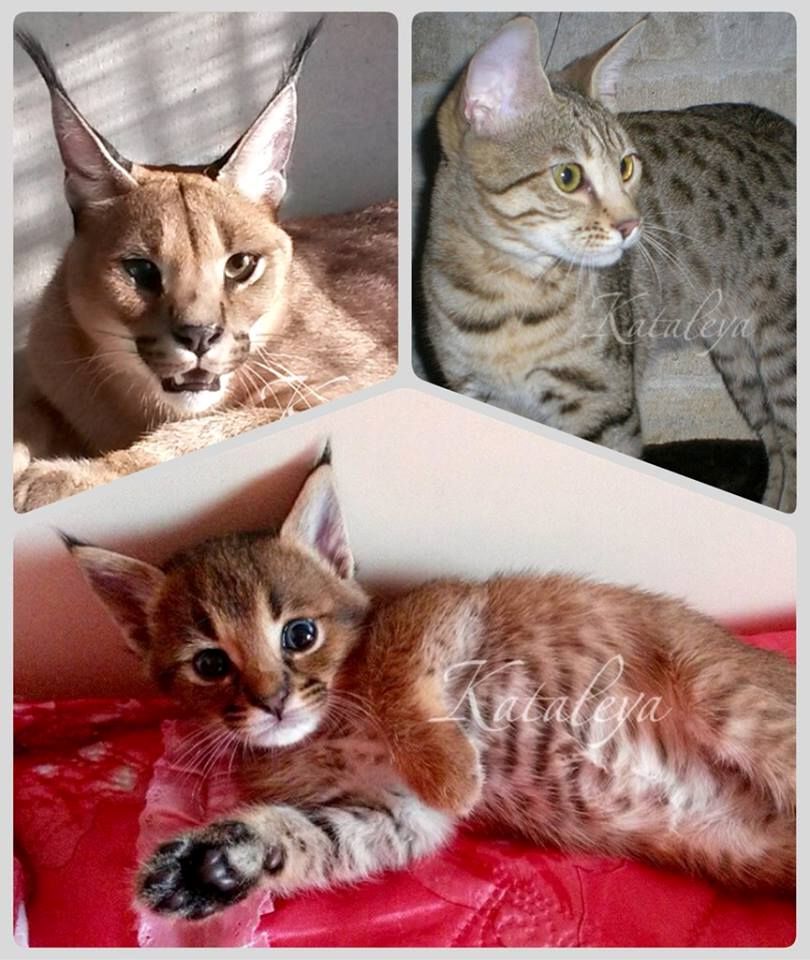
The first successful interbreeding of a domesticated caracal cat was with an Abyssinian cat in America. Second generation (F2) hybrids were obtained and were healthy, beautiful and the females were fertile. Unfortunately life dealt a blow to the breeding programme when the breeder died and her cats were rehomed. Work on the breed stopped. The rebirth of the Caracat began not in sunny Africa, but in snowy Russia. In the city of Ivanovo, a novice breeder Irina Nazarova was eager to begin breeding small wild cats and their hybrids. Irina was lucky from the start because her young caracal male was agreeable to mating with domestic cats. Young, healthy, short-haired brides of a large size were organised for him.
Irina picked suitable partners for mating with caracals from several breeds of domestic cats: Serengeti, Abyssinian, Egyptian Mau and Oriental. These laid down the desired traits - large ears, long muzzles and most importantly - known histories of breed health and fertility. Then things began to heat up! After a long wait, the first F1 litter (one male, one female) was born in July 2014 from caracal matings with Serengeti and the Abyssinian females. A further litter was born in 2015. The first goal is to create a diverse gene pool from different mothers in order to avoid excessive inbreeding later in the programme. The F1 hybrids grew to a large size, twice the size of house cats. They did not show any health problems. They were strong, sociable and wild-looking. What was surpring was that the 50% of wild caracal genes produced a very stable appearance greatly resembling the Caracal. By September 2015, 4 F1 litters had been born and an F2 litter was expected. All the kittens have been healthy and have good temperaments. Birth weights average 120 g and the weight at 6 months was 8 kg (the fully adult weight is likely to be 11 - 13 kg / 25 - 30 lbs).
Physically, Caracats are large (9-12 kg), tall and strong-looking. They have a long muzzle with a wide nose, expressive eyes and their ears are huge and coloured black on the outside, with tassels at the tips; typical of caracals and F1 Caracats. The body is brownish-red, without markings on the back and sides, but with spotted markings on on the chest, belly and inside of the legs (the American Caracats did not have these markings because the F1 cats came from an Abyssinian female, the Russian Caracats inherit these markings from their domestic mothers). Breeders want to preserve these features in later generations by breeding them to Abyssinian cats. The second (F2) generation will be crossed with Abyssinian cats to save the warmth and colour of ticking. Some F2 hybrids will also be selected for backcrossing to the Caracal and fixing the Caracal features such as ear tassels and facial markings.
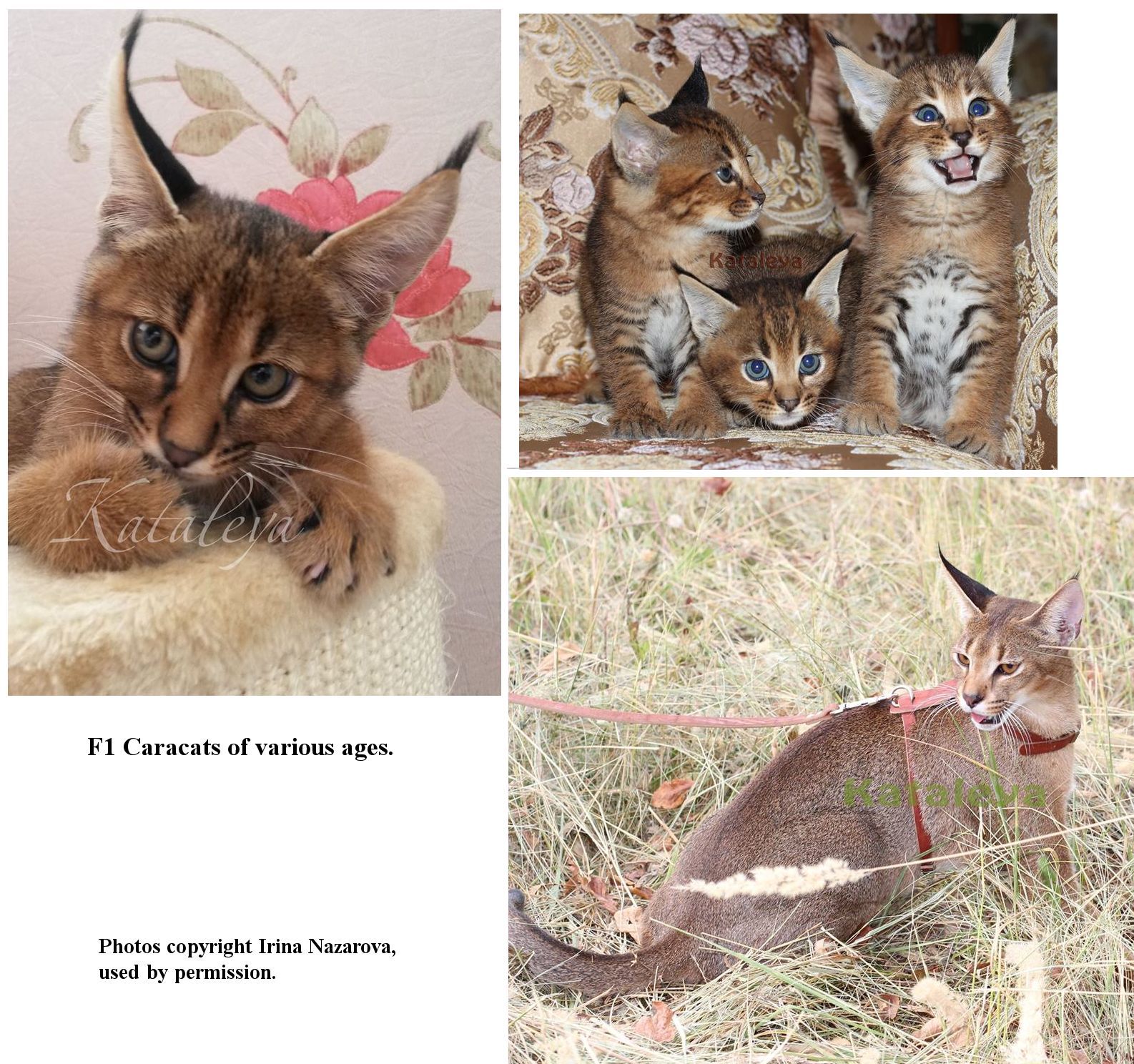
Caracat kittens reach the standard size of the average domestic cats in just 65-72 days. By one month old, their Caracal genes come into play and they quickly increase in size. This growth spurt is supported by feeding the kittens with quails and raw chicken complemented by dry cat food. They receive standard feline vaccinations. Breeders have no experience of a tendency to infections in Caracats. They probably inherit strong immune systems from their caracal parent. Nevertheless, they receive normal feline vaccinations and the inactivated rabies vaccine. They have shown no adverse effects to vaccination. Properly raised F1 kittens are very sociable and lack aggression. They grow up with their mothers and inherit the domestic cat's behaviour and social skills. Kittens are taught from an early age to be gentle with people so it is not necessary to declaw them. Just like domestic cats, these hybrids like to scratch things so they need toys and scratching posts so they don't spoil your furniture. Regardless of sex, the kittens are affectionate and friendly and are patient with children. Families that have young F1 Caracats are very satisfied and happy with their pets.
The breed is already registered with the USA-based where it is in the stage of preliminary recognition; this allows the official registration of foundation animals and their offspring. In September 2015, a new breed standard was written for the Russian ICU Association(International Cat Union). They were first presented to the world on the internet forum Breeders Cat Club (in Russian), and on the Facebook page of Irina Nazarova on Facebook and on Russian television. The first Russian breeding cattery, Kataleya, is working actively with the new breed and makes regular visits to exhibitions to promote this new breed. TThere is large demand for the kittens and a lot of interset from breeders who want to work on the Caracat breeding programme.
Like all new breeds, the Caracat has attracted attention and created a lot of discussion, both positive and negative. To date, most of the factual information has only been available in the Russian language. I am grateful to Irina for permitting to use her information and photos to make the information available in English.
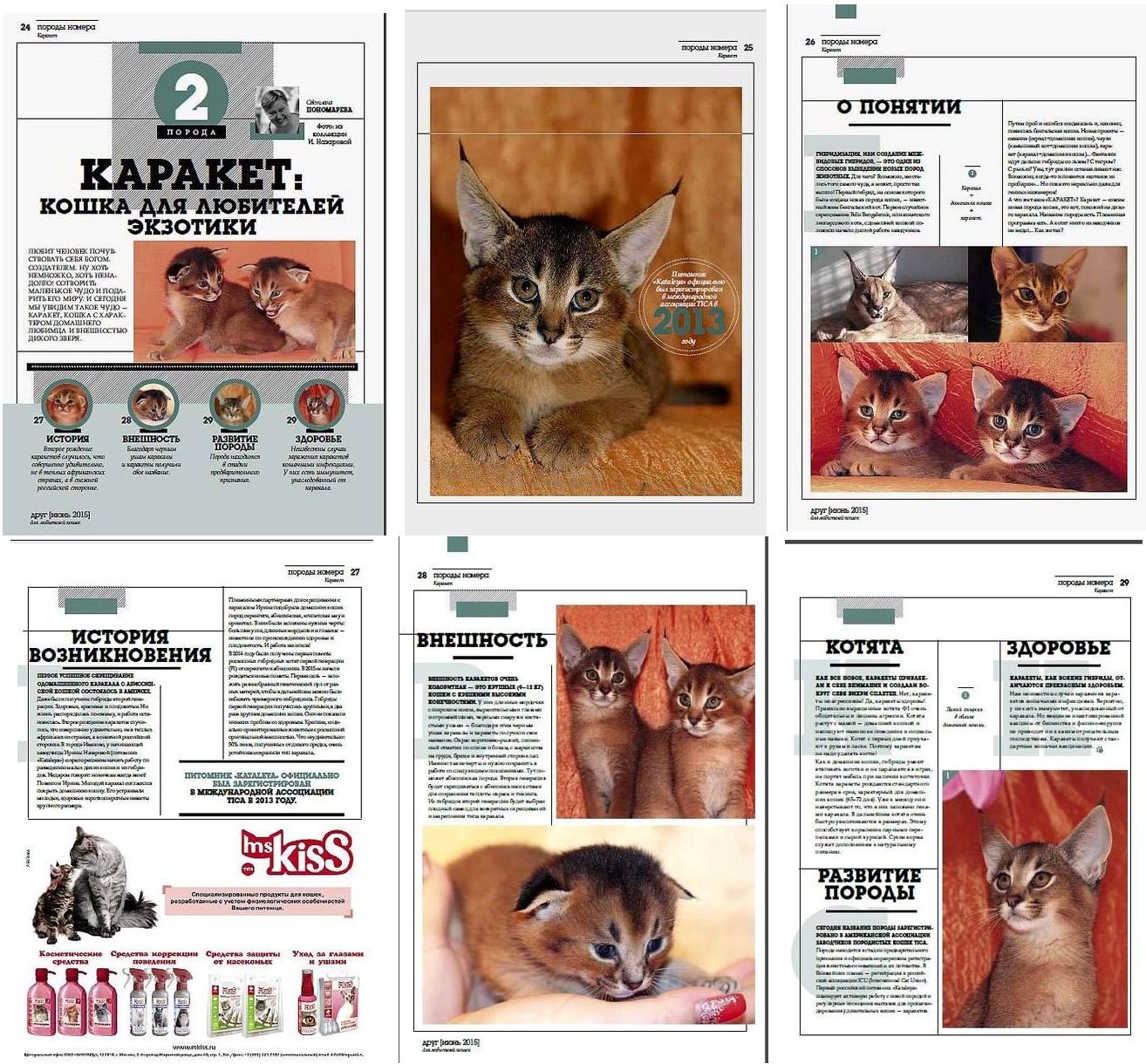
In June 2015, the Russian journal "Friend for Cat-Lovers" published an article about the breed.
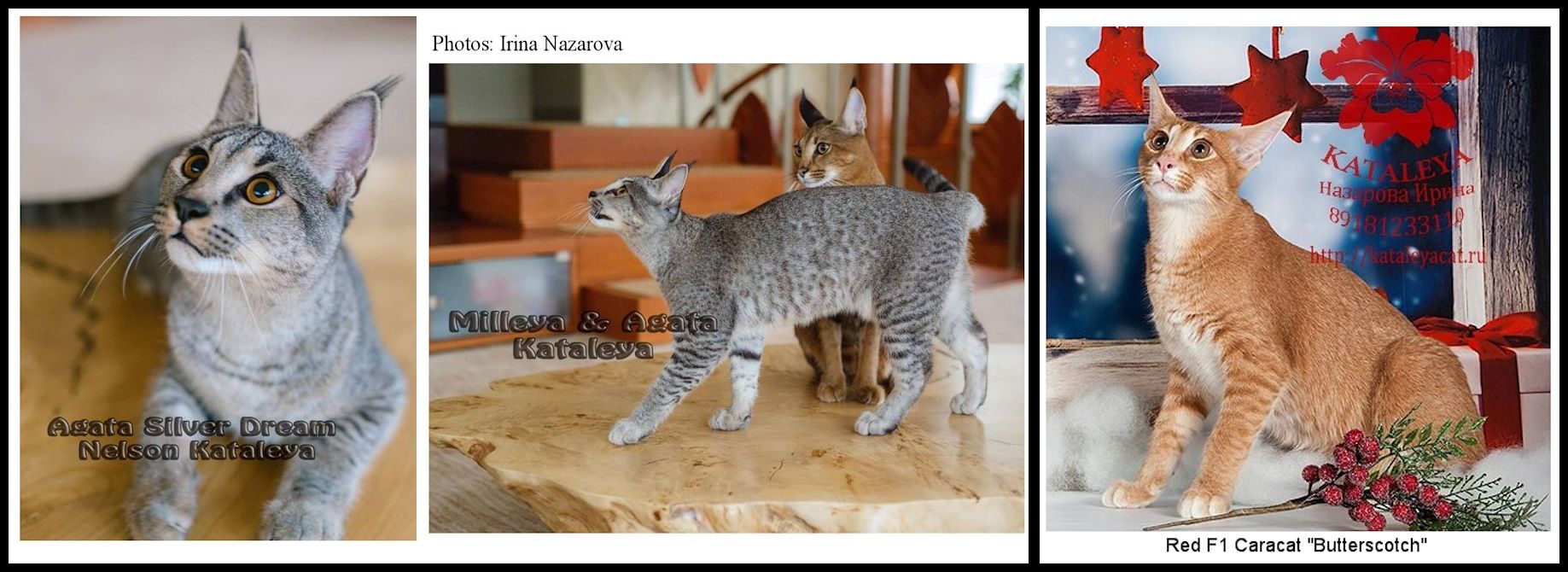
In 2016, silver Caracats were born, and in 2017 red Caracats were also born.
ALLEGED DOMESTIC X CHEETAH HYBRIDS
In October 2009, the PeoplePets website falsely reported that Chinese-born actress Bai Ling's cat Quiji was a cheetah hybrid with a cheetah father and domestic cat mother and purchased from a breeder for approximately $30,000. This is either a mistake or an attempt to mislead. Bai Ling's cat is definitely not a cat-cheetah hybrid, yet this story did the rounds of the gullible and people tried to find out where to get a similar cat.
The first hurdle is the comparative sizes: a cat is a snack for a cheetah, not a mate. Even if AI or IVF were used, a housecat's gestation period is around 63 days and cheetah gestation is 93 days. Both size and gestational mismatch are greater than the serval/domestic cat and caracal/domestic cat hybrids. Cheetah have very poor quality sperm and are unlikely to produce hybrids even with more closely related cat species. Even if cheetah sperm was used to fertilise a housecat egg, a domestic cat could not carry the foetus to term - between 63 and 70 days it would be born, ready or not, and being 20 days premature it would not be viable (20 days out of a 93 day gestation is a big chunk).
On her own blog Bai in September 2008, Bai Ling stated her cat is an A1 Supreme and part-serval. Although she says the A1 Supreme is not a Savannah cat, the term "A1 Supreme" just refers to the "supreme" quality of that particular Savannah cat and the corresponding high price. A1 Savannahs apparently used photos of Bai Ling and her A1 Savannah in their adverts. Claiming it is part cheetah appears to be a publicity stunt by the actress.
The other possible options for what Bai Ling's cat really was included Cheetoh (derived from Bengal and Ocicat mixes, cost around $1000 for breeder/show quality), Safari (Geoffroys/domestic mix - with only 70 registered, I couldn't find an "average price" but was advised "upwards of $6000") or Ashera (DNA tests on alleged Asheras found them to be Savannahs bred by Chris Shirk, somehow obtained by Lifestyle Pets and re-sold as Asheras for $40,000). Since the serval is nicknamed "poor man's cheetah" for its leggy appearance, I'm also guessing the claim it's a cheetah hybrid relates to that in the same way some folks still claim Bengal cats are hybrids between leopards and domestic cats. However Bai Ling herself wrote in September 2008 that she had a serval hybrid from A1 Savannahs even though she insisted it was an A1 Supreme and not a Savannah!
You are visitor number