OWNERSHIP AND IMPORTATION OF DOMESTIC X WILDCAT HYBRIDS
Importing Hybrids into the UK
The following information is from a British veterinarian who also breeds Bengal cats and who had problems with the interpretation of the Dangerous Wild Animals Act (1976) before it was clarified in 2007. He had hoped to import a Savannah cat from the US to breed in the UK. As a vet he thought this would be an relatively simple matter. However, there turned out to be a lot of red tapeand several agencies and Government departments involved - none of whom seemed willing to speak with each other to resolve apparent conflicts in the law relating to cats carrying wild blood! While the Act has been clarified, his experiences may be relevant to anyone else encountering the confusion when various government departments don't speek to each other and don't communicate effectively with Local Authorities.
After about a week of various phone calls, DEFRA (Dept of Environment, Food and Rural Affairs) eventually said it was acceptable to import a Savannah as long as it was F2 or more - i.e. the wild ancestor was grandparent, not parent. The PETS section of DEFRA said that as the cat was effectively a domestic cat it could be imported under the PETS scheme to allow the quarantine period to be spent in the breeders home in the US. This all sounded encouraging so the would-be importer contacted the breeders who told him that it was simply a matter of getting a CITES permit as all early generation hybrids with wild blood in them had to have one.
The British breeder went back to DEFRA who sent him to their CITES section who said it was no problem; the cat itself wasn't an endangered species and it just required a CITES import licence. He checked with PETS again with this new information and they thought it would be okay, although the CITES and PETS schemes are separate and seemed proud that they didn't communicate with each other.
At the last minute he received a call from the Dangerous Wild Animals Act section who appeared from nowhere to announce that any animal with wild blood of any F generation required a wildlife local permit meaning it must be kept in secure premises with double cages, etc. This act, they said, also applied to all Bengal cats. They did mention that it was under review, but that could mean anything! If a breeder wanted to keep foundation stock (a full blooded wild cat) then this must be kept in accordance with wild animal legislation - but Bengals and Savannahs are not full-blooded wild cats.In fact the information he was given was incorrect and was a problem with interpreting the act as it stood in 2006. F2 generation hybrids were not subject to licencing restrictions.
He phoned the Bengal club with the information he had been given and was told that something had been going on for the last year and it was true that "they" (the authorities) were trying to include all 15,000 British Bengals in the act. The club thought that nothing would come of it but didn't rate a British breeder's chances of importing a Savannah in the foreseeable future. This would also apply to Chausies, the various "Lynx" breeds (reputedly bobcat hybrids), Machbagral etc. There was a danger that it might be applied to the PixieBob, which was once reputed to have Bobcat blood, even though those claims had been disproven.
From experience this person (and myself also) knew that the Bengals have a gentle disposition and are carefully bred to maintain that temperament. The Savannah is bred to have a similar temperament and received favourable reports from breeders in the USA and also in Germany. However seemed to have no bearing. There are feral (domestic-gone-wild) cats in Britain that are far more wild, and there are ferals in Scotland that probably have a higher percentage of wild blood (compared to pet bengals) due to interbreeding with Scottish Wild Cats! (The Scottish Wildcat is not restricted under the Dangerous Wild Animals Act).
The only thing out of all this was that if anyone wanted to get information from the UK authorities, they'd have to check and double check with the same departments several times before getting to the correct information. In short, the bureacracy was a mess, the various authorities didn't fully understand that that the hybrids were a long way removed from a wild animal and were fully domestic cats and no-one seemed in any hurry to sort any of this out! My own personal experience suggested that the various bodies think that the issue will go away if they procrastinate for long enough!
With regard to Savannahs and other hybrid cats, the official response from DEFRA mid 2003 stated:
"This is not strictly an enquiry for the Pet Travel Scheme as the scheme only applies to domesticated breeds. The Savannah cat appears to be a hybrid cross of the Prionailurus Bengalensis (Bengal cat), this breed requires a CITES license for entry to the UK up to the fifth generation. Therefore a Savannah cat of F2 generation would need to be licensed into six months quarantine, as it would not be classed as a domestic cat."
DEFRA still didn't seem able to get their facts right - the Savannah is a hybrid with the Serval; the Bengal cat is a domestic breed more than 5 generations removed from the Asian Leopard Cat. DEFRA considered the Savannah to be wild, not domesticated, despite it being listed as a breed by North American registries and in recent cat encyclopaedias. Despite DEFRA's response, and to show what a mess the situation was, one F3 Savannah had apparently been imported into the UK - either the importer probably documented it as "domestic cat" without details of the hybrid ancestry or those involved in processing the importation weren't aware of th Savannah's ancestry. At the time, I was aware of breeders who asked the exporter in the USA to fill out the export paperwork as "domestic cat" and to send any pedigree papers separate by post.
As the situation stood in 2006, the responsibility lay with the importer's Local Authority to stipulate which generation was domestic and which required wild animal licences. This meant different Local Authorities could lay down different rules - an F4 Bengal might be a domestic cat in some Local Authorities, but a Dangerous Wild Animal in others. That would be a minefield when buying and selling Bengal cats! The situation was again tested with the Savannah breed in the UK. Most Local Authorities considered the F4 generation onwards to be domestic. Previously some breeders had imported F3 hybrids as domestics. On the other hand, owners of F2 hybrids were told they required a Dangerous Wild Animals Act licence. In fact only breeders working with F1 or wild species required appropriate licences and accommodation for their cats, but the Act was open to interpretation
In 2007, DEFRA (Dept for Environment, Food and Rural Affairs) clarified the position of the Bengal cat (and other hybrids) and the Dangerous Wild Animals Act 1976 as follows:The Bengal cat is not a true species but a hybrid of the domestic cat crossed with the Asian leopard cat. They are several generations removed from the wild ancestor, and currently kept in their thousands in the UK without serious problems arising. It was not specifically named on earlier versions of the Schedule but it technically fell within the catch-all listing of all species of Felidae (ie the cat family) except Felis catus, the domestic cat. Its effective inclusion in the list partly arose because the Schedule pre-dated the breeding of these animals in this country. Other cat hybrids also fell within the catch-all listing for Felidae.
We sought to clarify the position for domestic cat x wild cat hybrids generally within the revised Schedule (which came into force on 1 October 2007). Cat hybrids no longer require a licence if they are:
Local authorities responsible for licensing and enforcement previously exercised their discretion in respect of Bengal cats. Many, but not all, regarded them as normal domestic cats not subject to licensing. A few interpreted the act (as it was worded at the time) that F2, F3 and later generation Bengals required a Dangerous Wild Animals Act (1976) licence. The 2007 revised Schedule clarified the situation and meant more consistent interpretation throughout England, Scotland and Wales (Norther Ireland and the Irish Republic are not covered by this Act).
While ownership of some species and hybrids is restricted by the Dangerous Wild Animals Act, actually getting hold of foundation stock may involve other legislation. Any wildcat covered by CITES Appendix II cannot be traded internationally without a permit. CITES Appendix I prohibits all international trade in the animal itself (you would have to be a zoo involved in a conservation breeding programme) and in products made from them. An F1 hybrid of a CITES listed species could be judged a "product made from" a protected species and confiscated. Quite a few of these CITES listed species are bred in the USA for the pet trade (many American states have less restrictive laws on exotic animal ownership than Britain), but it would still be difficult or impossible to import one into Britain to start a new breeding line.
It should be stressed that the hybrid breeds are several generations removed from a wild ancestor, just as modern domestic cats are many generations removed from the ancestral wild ancestor. Despite alarmist articles, tabloid scare stories and urban myth, the later generation hybrid breeds are no wilder than any other domestic cat - in fact many of the hybrids are bred with good temperament in mind. Those tales of 100,000 Bengals which are 90% wild cat and must be kept caged do the breeds a disservice - they are not strictly Bengals, but are foundation cats used in breeding Bengals (and most Bengals do not cost tens of thousands of pounds; those who are happy to pay such prices show only that fools and their money are easily parted!).
Importing Hybrids into Continental Europe
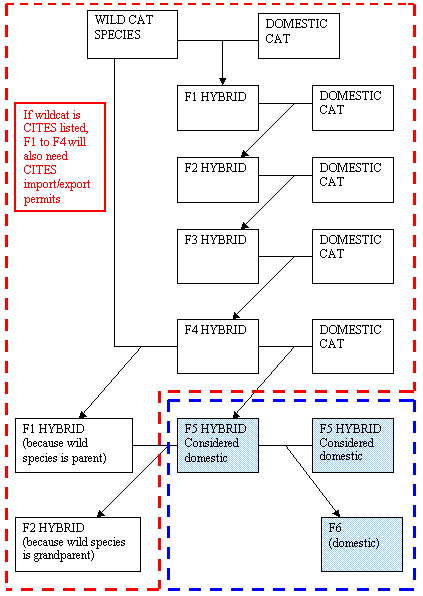
The definition of animal hybrids used by the CITES Conference of the Parties resolution 10.17 (as revised at the fourteenth meeting of the Conference of the Parties, The Hague (Netherlands), 3 15 June 2007) states that a hybrid animal that has in its previous four generations of lineage one or more specimens included in Appendix I or II of the Convention shall be subject to the provisions of the Convention just as if they were the full species. Under this interpretation, F1 to F4 hybrids between the serval and domestic cat should be treated the same way as servals.
For hybrids involving CITES-listed wild cat species, the exporter must first obtain a CITES export permit regardless of which country the animal is being shipped to. The CITES export permit is copied to the overseas purchaser who then applies for a CITES import permit. Not all countries require a CITES import permit. For example shipping hybrids from the USA to Canada requires a CITES export permit, but not an import permit, but some Canadian states prohibit private ownership of F1-F4 generation hybrids.
In general, European countries require a CITES import permit for F1-F4 hybrids, but not for F5 or later generations (F5 and later generations aren't considered hybrids). From F5 and later generations, the original (not copy!) TICA 5 generation pedigree is required as proof that the the cat is 5 generations removed from its wild ancestor. The cat must be microchipped so that the cat and the pedigree can be matched together.
As well as CITES permits, some European countries restrict the importation and ownership of F1 hybrids, but allow the importation of F2 and later generations. Other European countries require owners to have a permit to import F1 F4 hybrids from outside the EU and to own the hybrids (depending on the wildcat species involved). EU countries where permits are required for keeping the early generation hybrids (prospective importers must check which generations and which species are restricted) are Austria, Belgium, Czech Republic, Denmark, Germany, Finland, France, Hungary, Italy, Lithuania, Netherlands, Poland, Portugal, Spain, Switzerland and the UK.
In the UK, the CITES import permit will be required for F1-F4 generations, but F5 and later generations can be imported as domestic cats. A Dangerous Wild Animals permit is required for keeping F1 hybrids of certain species. Unlike domestic cats, the imported F1 hybrids have to be quarantined in a zoo facility in the UK, they cannot be home quarantined by the exporter and cannot be quarantined in a cattery.
In Germany, an importer requires a CITES import permit for F1-F4 generations, but before the CITES import permit can be obtained, an outside enclosure must be provided and pass inspection for housing F1-F4 generations and a permit is required for keeping and housing F1-F4 hybrids (they are not considered house pets!). Getting the CITES import permit depends on having the correct housing for a "wild" animal. In Switzerland, a CITES import permit is required for F1-F4 generations; the F1 and F2 generations of some species require ownership permits and large outdoor enclosures. Russia does not appear to require a CITES import permit or to place many restrictions on ownership. Norway and Sweden entirely ban F1-F4 hybrids, but allow import and ownership of F5 and later generations (which are considered domestic animals, not hybrids).
BRUSSELS (BELGIUM) LEGISLATION AGAINST HYBRID CATS (APRIL 2019)
Being the home of the EU, it is not surprising to see legislation in Brussels. The banning of certain cat breeds was reported by The Brussels Times on 15th April, 2019. This has recently been decided by the Brussels government by approving at first reading of a preliminary draft of this new law. According to La Derni re Heure newspaper, the Brussels government has banned certain hybrid cat breeds from the city due to risks associated with their behaviour and health. The Bengal and the Savannah may not be bred or sold in Brussels anymore, because they are not adapted to a life in captivity. The Brussels Council for Animal Welfare is using a sledgehammer to crack a nut and failing to distinguish between early generation hybrids and those that are many generations removed from a wild ancestor.
Secretary of State for Animal Welfare Bianca Debaets (CD & V) was supported in her choice by two opinions of the Brussels Council for Animal Welfare. "The first generations of hybrid breeds do not behave appropriately for life in captivity, which can cause serious problems. On the other hand, they present the problem of lack of fertility and their gestation period is not the same as that of domestic cats. During mating, the risk of aggression is very high. The ruling overlooks the fact that from the F4 generation onwards these cats are so far removed from the wild ancestor that their temperaments, behaviour and requirements are those of a domestic cat and show only the variability seen in non-hybrid domestic cats. It is only the early generation hybrids that display non-domestic traits, meaning there is no need to ban the later generations. So why can t Brussels selectively ban the early generations, as happens in some US cities? Undesirable genetic traits have been eliminated from the gene pool by selective breeding.
According to Yvan Beck, a Brussels veterinarian. "This is a minority problem compared to other issues to be addressed in terms of animal welfare. During my career I was dealing with very few cats of these breeds and those that I could cure did not have these characteristics, "he explains. "At the Savannah level, it is true that it is a very independent cat but I have never observed behavioural problems. As for the Scottish Fold, there are now almost no issues. Regarding the owners of hybrid cats, what will they do when the law comes into force? Euthanize their cats? It's absurd. I will never accept euthanizing a hybrid cat that is in good health."
Indeed, once the law is applicable, keeping hybrid cats will be totally forbidden. Owners who wish to keep their cat will have to report it to the Brussels government in order to get a permit. The latter will give an opinion and if the report is negative, they will euthanize their animal. However, the Secretary of State emphasised that such extreme measures will be very rare. "The opinion will almost never require owners to euthanize their cat, except in extreme cases."
"We want to know where those cats are," said Eric Laureys of the Debaets cabinet, "officially, there are currently 65 of those cats in Brussels, but there may be more."
Note: Brussels legislation is not solely about hybrid breeds. Importing, owning and breeding the Scottish Fold and Highland Fold will also become illegal following advice from the Animal Welfare Council, due to a serious genetic problem that can lead to cartilage malformations in the entire skeleton and severe pain.
BENGALS AND CITES
CITES still seem to have problems regarding Bengals moving across international borders. One correspondent had big problems when bringing her my pet cat from Australia to UK. She obtained a Bengal cross from a breeder whose F7 Bengal female (i.e. pure domestic) escaped and mated with a domestic moggy (believed to be a local tabby male) rather than with her intended mate. My correspondent’s cat was therefore F8, and purely domestic. The F8 was registered with TICA as a domestic shorthair because the unknown father meant he has no pedigree on the sire’s side. Although she can’t have a pedigree due to the unknown father, she has a letter from TICA confirming the origin of her cat.
When arranging to bring her F8 to the UK CITES gave three conflicting answers in the space of one day. At first they agreed the cat was a domestic cat far removed from an Asian Leopard Cat (ALC). Then the stated that as she could not prove who the father was, the cat would be classified as F1 – F4. This makes no logical sense as there are no F1 - F4 generation Bengals in Australia due to that country’s import ban on early generation Bengals. The lowest generation in Australia was an F6 Bengal. Next, CITES wanted the cat to have an expensive DNA test, but that might not give an accurate percentage of ALC genes vs domestic at genes! Only the Wisdom Panel Complete for Cats in the UK, and Basepaws in America provide ancestry information, but neither ship to Australia which made it impossible to get a DNA test that would satisfy CITES. Any test kit would have to be sent to her family in the UK who could then forward it to Australia.
CITES appeared to lack any degree of common sense in this case; they could have checked Australian legislation regarding Bengals in that country and confirmed the cat could not be an early generation Bengal.
My suggestions were:
- Firstly, get evidence from the Australian Government that there are no F1 - f4 Bengals in Australia due to import legislation. In addition, F1 - F3 males (if there were any) are sterile and could not have sired her cat. The first fertile generation is F4, therefore the cat would be F5 at worst. Getting copies of the legislation (usually available online) would support this argument.
- Again using legislation, explain that there are no ALCs held as pets or for breeding pets in Australia. This means there is no way the cat in question could be F1. Australia has legislation covering the possession of exotic cats and hybrids (it should be online, as is equivalent legislation in the UK). This can also be used as evidence that there is no way the cat could have been sired by an ALC or even an F4 Bengal.
- Provide information from the cat registries in Australia regarding the rules on F1 - F4 being prohibited, and that there is no way even an F4 could be the sire.
Finally common sense prevailed and CITES decided they were happy with the mother’s pedigree, and the breeder's letter detailing the Australian ban on F1 - F4 Bengals. A lot of hassle and headaches could have been avoided had CITES taken note of Australian legislation in the first place.
You are visitor number