DOMESTIC X SAND CAT AND PALLAS'S CAT HYBRIDS
Historically, it has been claimed that both Pallas's Cat (F. manul) and the Sand Cat (F. margarita) may have contributed to the domestic cat gene pool as ancestors of longhaired cats, though this is refuted by modern zoologists. The German naturalist Peter Pallas who discovered Pallas's Cat in the 18th century recorded that it would breed with domestic cats and it was once believed that the longhair trait had come from Pallas Cat matings. Similar suggestions have been made regarding the Sand Cat (F. margarita) as an ancestor of longhairs. The German naturalist Peter Pallas, who discovered Pallas's Cat (F manul), recorded that it would breed with domestic cats, but this has not been attempted in captivity. Neither species has contributed to the pre-historic development of the domestic cat.
SAND CAT X DOMESTIC HYBRIDS
Anecdotally, there have been two attempts to breed Sand cats with domestic cats in the USA, however the Sand cats apparently died without producing F1 offspring. Being adapted to arid climates, Sand cats are delicate in captivity and prone to respiratory infections. A natural hybrid is also believed to have occurred when a female domestic cat got into the enclosure of a sand cat - though if a female domestic could enter the enclosure, the similarly sized Sand Cat should have been able to escape from it!
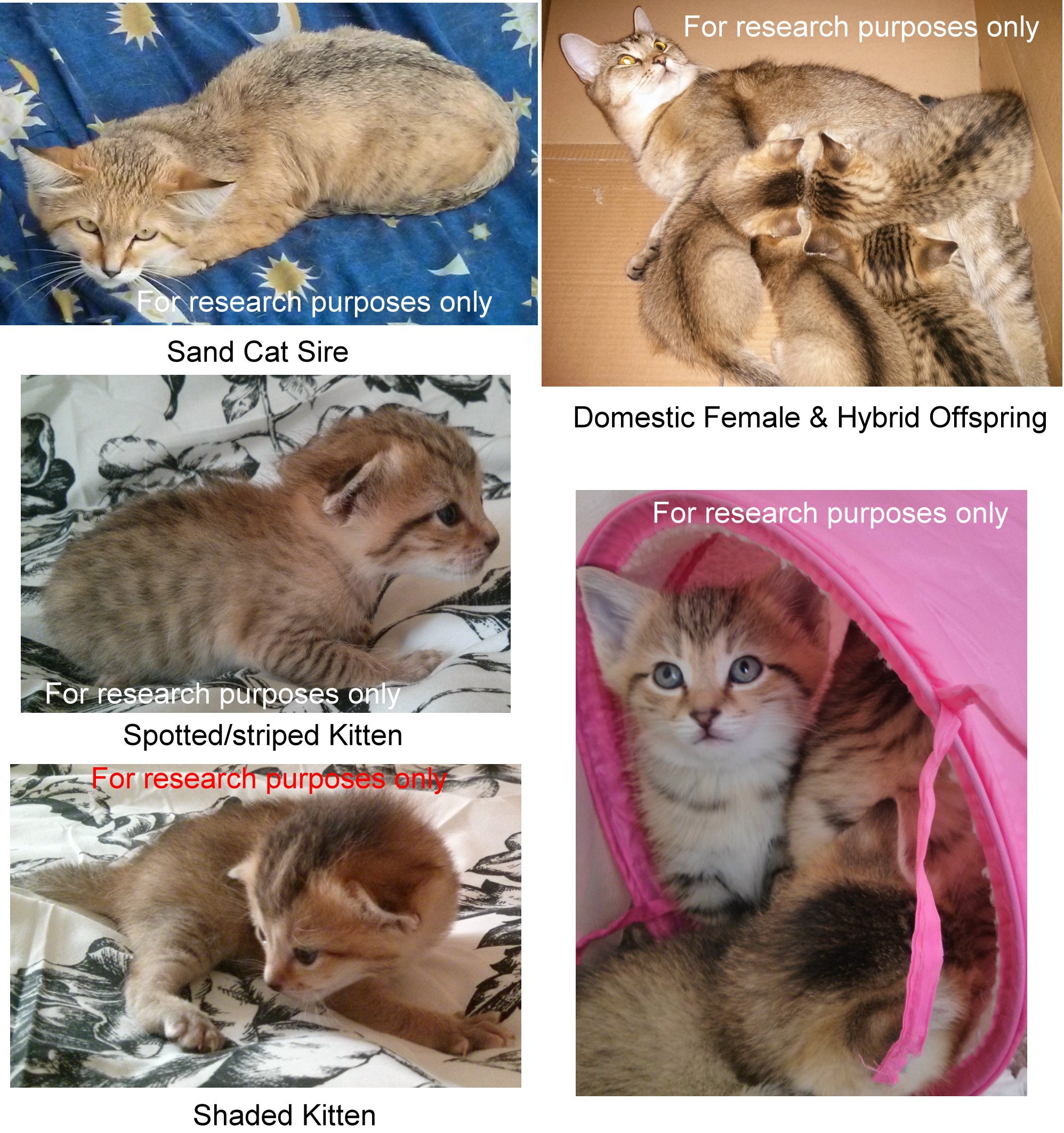
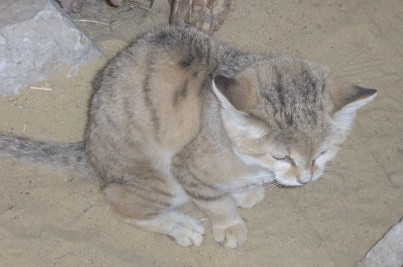
In 2013, there was a recorded breeding between a captive-bred male Sand Cat ("Trevor") and a ticked tabby shorthaired domestic female (Chinchilla cross). The captive-bred Sand Cat male was claimed to be surplus to conservation requirements and is a pet with access to domestic cats for company. In actuality, he had been bred for the pet trade and bought from an exotic pet trader. As Sand Cats require a more arid environment than domestic cats, he also has his own specially adapted living quarters. The photo (left) shows the typical colour and markings of a Sand Cat at Colchester Zoo; this cat was noticeably friendly towards its keeper.
Gestation was normal and the kittens were born at 66 days. The litter comprised four kittens (2 male, 2 female) that resembled heavily marked Sand Cat kittens with golden coats and large wide-set ears. Two of the kittens were golden/sandy coloured ticked tabbies with darker shading on the dorsal area and an even darker dorsal stripe. The other two had spotted tabby markings on a golden/sandy background. Sand Cat kittens are born with darker markings that fade as they mature and it is expected that these kittens’ markings will fade to more greyish tones. All had pale patches on the back of the ears. Their paw pads were black and some had another distinctive Sand Cat feature: the black “armbands” i.e. two dark horizontal stripes at the top of the foreleg.
Compared to domestic kittens, the hybrids were precocious in developing their senses of hearing and sight and in gaining their legs. Their faster growth and development appears to come from their Sand Cat ancestry. Once weaned, they were given a complete raw food diet as this was more suited to their wild ancestry than generic cat food (the sire eats a wild cat diet of mice, chicks etc)
Compared to the domestic parent, the kittens had wide heads in proportion to their bodies, and their faces appeared oval when viewed from the front. Like the Sand Cat, their muzzles were petite with relatively small whisker pads. They will probably lack the domestic cat’s jowls when full-grown. Most noticeably, and most Sand Cat-like, the top of the head was slightly flattened and the ears were large and low set with very wide bases. The body shape also resembled the Sand Cat, being sturdy with rather stocky legs and large feet.
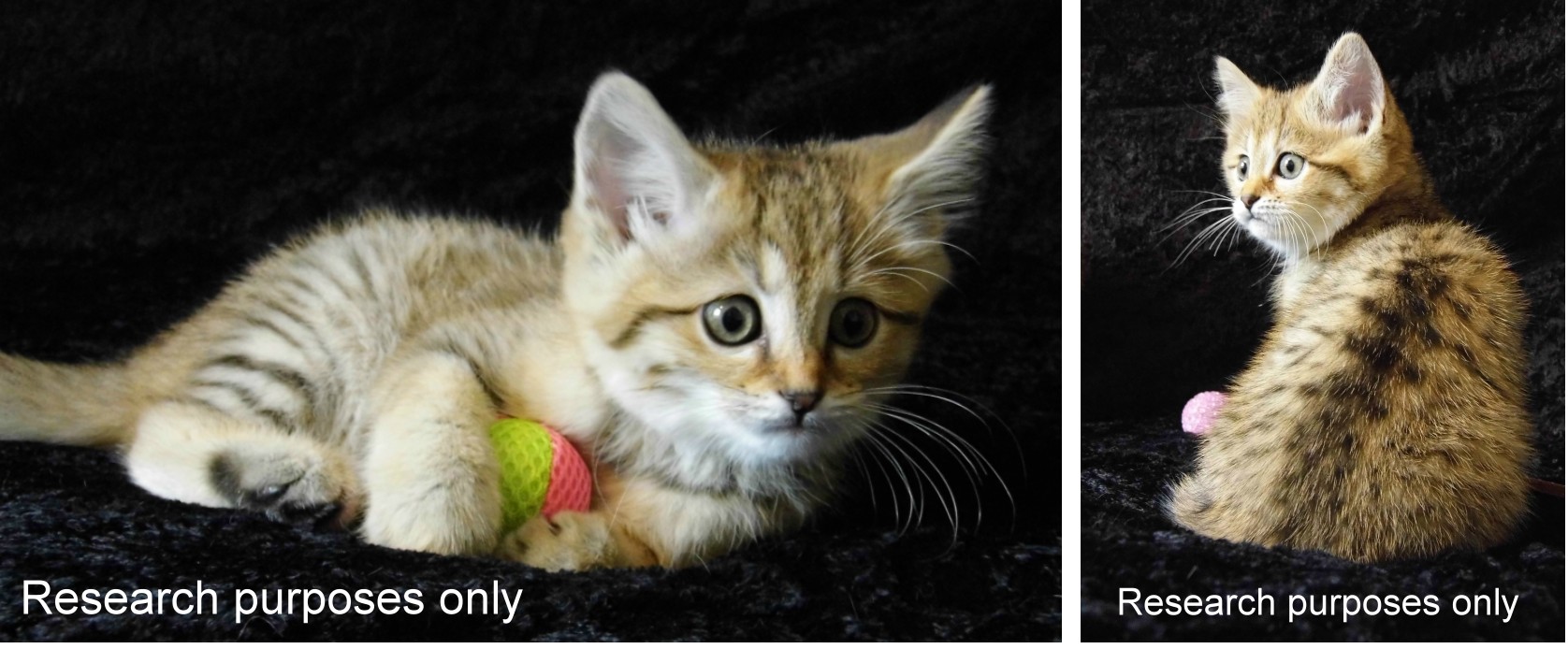
Below are photos of two of the young F1 hybrids. They are friendly, with the young males being especially affectionate, and very rowdy at playtime. Unlike domestic cats, they tend not to jump onto surfaces or laps, preferring to climb up. The sturdy legs and feet, and the large ears are very obvious. They bark (like a Sand Cat) as well as meow. The mew is very nasal and described as an "eeeing" sound. Unfortunately, one of the female F1 kittens was killed by the Sand Cat sire. The two males succumbed to FIP - a condition where the immune system over-reacts to Feline Coronavirus infection. This left only one F1 female, whose whereabouts are now unknown. The Sand Cat's consort also apparently died. Due to a change in circumstances (and prior to the death of the male kittens) the breeder "loaned" the Sand Cat sire to an experienced Bengal breeder, Jacky Bliss, where he was mated to a different female.
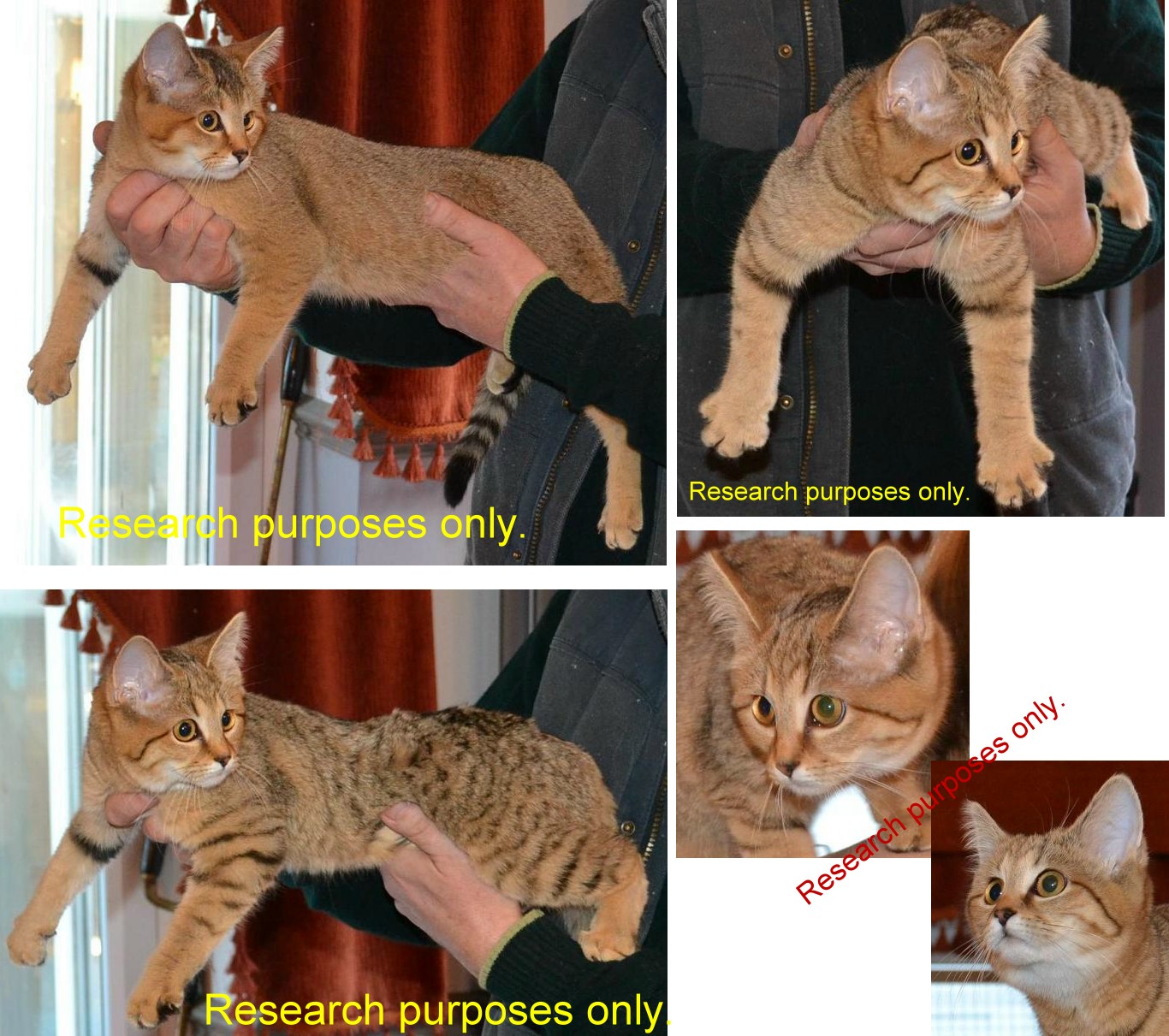
Later, the original domestic female died and Trevor's owner decided to sell her exotic pet for several thousand pounds. Rather than see the cat passed from owner to owner on the open market, money was raised and he remains with Jacky Bliss. In 2014, the second litter was born, this time to the different female. This proved to be a large litter, with only one female. Domestic studs will be found for the F1 females so that the Sand Cat look is preserved. The original F1 female cannot be traced, but the F1 female from the second litter produced F2 kittens in summer 2016. Trevor had not been used to sire any further F1 hybrids at that point and the contentious issues of hybridisation and the taking of wild Sand Cat kittens (often by killing the mother) for the illegal pet trade means this remains the case. However the stud and his offspring are now in experienced hands and progress is being made with a breed standard.
Unlike other hybrids, F2 males have proven fertile.
PALLAS CAT X DOMESTIC HYBRIDS
According to Charles Darwin in "The Variation Of Animals And Plants Under Domestication" (1860s), "Several naturalists, as Pallas, Temminck, Blyth, believe that domestic cats are the descendants of several species commingled: it is certain that cats cross readily with various wild species, and it would appear that the character of the domestic breeds has, at least in some cases, been thus affected. [...] Whether domestic cats have descended from several distinct species, or have only been modified by occasional crosses, their fertility, as far as is known, is unimpaired. The large Angora or Persian cat is the most distinct in structure and habits of all the domestic breeds; and is believed by Pallas, but on no distinct evidence, to be descended from the F. manul of middle Asia; and I am assured by Mr. Blyth that the Angora cat breeds freely with Indian cats, which, as we have already seen, have apparently been much crossed with F. chaus. In England half-bred Angora cats are perfectly fertile with one another." The Manul has been disproven as an ancestor of modern longhairs, but it is still not proven whether it can form hybrids with domestic cats.
Swanson, William & Stoops, Monica & M Magarey, G & Herrick, Jason. (2014). "Sperm cryopreservation in endangered felids Sperm cryopreservation in endangered felids: developing linkage of in situ-ex situ populations" contains an image of Pallas cat-domestic cat hybrid embryos at the 48 hour stage (5-8 cell stage) produced using IVF of domestic cat oocytes and frozen-thawed sperm from wild Mongolian Pallas’ cats. However this was just to investigate whether Pallas cat sperm remains viable after freezing and the embryos were not implanted.
You are visitor number