DOMESTIC X AFRICAN, INDIAN, EUROPEAN (INC. SCOTTISH) & CHINESE WILDCAT HYBRIDS
The probable ancestor of domestic cats is the African Wildcat (F lybica/F silvestris lybica) which, through mutation and selection, has given rise to modern F catus. Professor Eric Harley considers F catus to be a natural sub-species of F lybica. The intractable European Wildcat (F silvestris/ F silvestris silvestris) can interbreed with F. lybica and may have contributed to the gene pool. The modern domestic cat will interbreed naturally with F lybica and F silvestris subspecies, producing fertile hybrids. In the 1800s it was believed that domestic cats in each country evolved from indigenous wildcat populations, so crossing domestic tabbies to Scottish wildcats was seen as back-crossing rather than hybridisation. Hybrids occur naturally in rural areas where free roaming domestic cats or feral cats encounter these wildcats. According to Clark, Borodin and other authorities, population studies of domestics in such areas indicate the heavy influence of wild type genes.
According to Charles Darwin in "The Variation Of Animals And Plants Under Domestication" (1860s), "Sir W. Jardine has no doubt that, "in the north of Scotland, there has been occasional crossing with our native species (F. sylvestris), and that the result of these crosses has been kept in our houses. I have seen," he adds, "many cats very closely resembling the wild cat, and one or two that could scarcely be distinguished from it." Mr. Blyth (1/89. Asiatic Soc. of Calcutta; Curator's Report, August 1856. The passage from Sir W. Jardine is quoted from this Report. Mr. Blyth, who has especially attended to the wild and domestic cats of India, has given in this Report a very interesting discussion on their origin.) remarks on this passage, "but such cats are never seen in the southern parts of England; still, as compared with any Indian tame cat, the affinity of the ordinary British cat to F. sylvestris is manifest; and due I suspect to frequent intermixture at a time when the tame cat was first introduced into Britain and continued rare, while the wild species was far more abundant than at present." In Hungary, Jeitteles (1/90. 'Fauna Hungariae Sup.' 1862 s. 12.) was assured on trustworthy authority that a wild male cat crossed with a female domestic cat, and that the hybrids long lived in a domesticated state. In Algiers the domestic cat has crossed with the wild cat (F. lybica) of that country. (1/91. Isid. Geoffroy Saint-Hilaire 'Hist. Nat. Gen.' tome 3 page 177.) In South Africa as Mr. E. Layard informs me, the domestic cat intermingles freely with the wild F. caffra; he has seen a pair of hybrids which were quite tame and particularly attached to the lady who brought them up; and Mr. Fry has found that these hybrids are fertile. [...] Dr. D. Short has assured Mr. Blyth (1/92. 'Proc. Zoolog. Soc.' 1863 page 184.) that, at Hansi, hybrids between the common cat and F. ornata (or torquata) occur, "and that many of the domestic cats of that part of India were undistinguishable from the wild F. ornata."
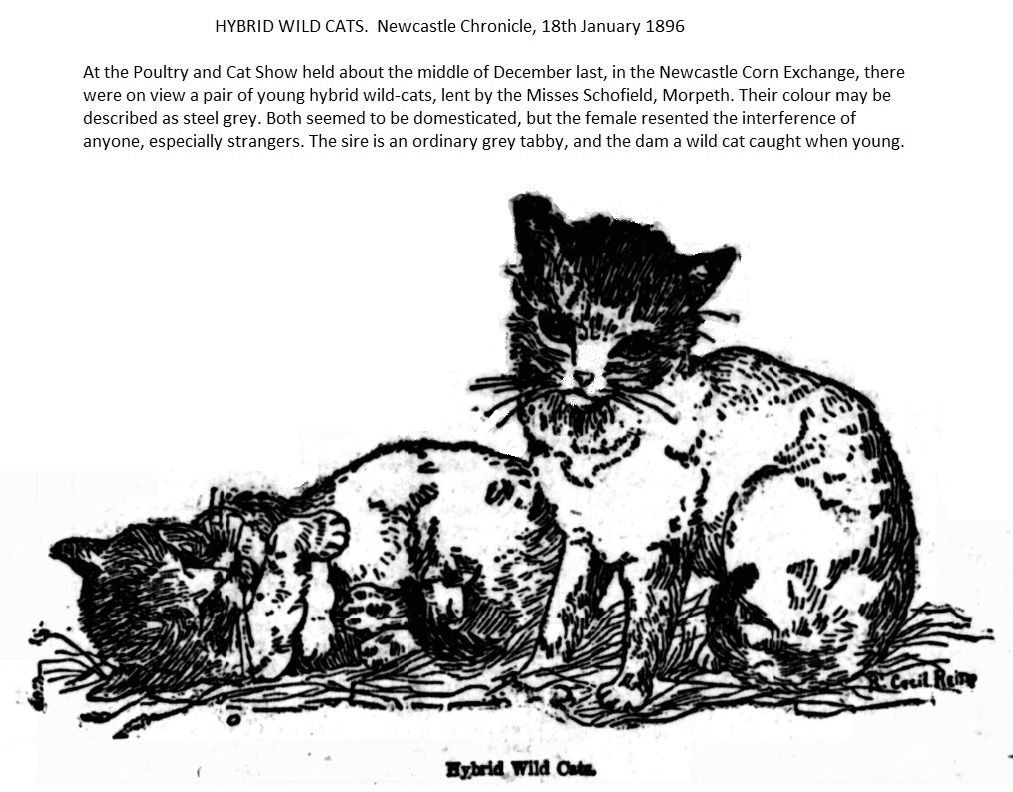
A number of hybrid wildcats (x F. libyca slvestris) were exhibited at early cat shows in Britain. Newcastle Chronicle, 18th January 1896 gves one such account: ”HYBRID WILD CATS. At the Poultry and Cat Show held about the middle of December last, in the Newcastle Corn Exchange, there were on view a pair of young hybrid wild-cats, lent by the Misses Schofield, Morpeth. Their colour may be described as steel grey. Both seemed to be domesticated, but the female resented the interference of anyone, especially strangers. The sire is an ordinary grey tabby, and the dam a wild cat caught when young. The hybrids exhibited some of the habits of their ancestry; they slept in curious positions, and seldom mewed even when hungry. Notwithstanding all the care of those in charge of the animals, one of them escaped on its return from Newcastle to Morpeth, and the late owners would be delighted if anybody could help them to find it. We are indebted to Mr. It. Cecil Reid for a drawing of the cats, which shows them in the curious attitudes they assumed when they were gazed at by critical Tynesiders. The question as to whether wild cats are still to be found in England has been settled by Dr St. George Mivart, who says that they are extinct in England and perhaps in Wales also, though they lived in this country till within fifty years ago, and in Wales till twenty years ago. But he asserts that wild cats are far from uncommon in Scotland, and are especially frequent in Inverness, Sutherland, and Ross-shire, and on the west coast of the Highlands. Some are to be found in Skye also, but not in the Western Isles. “
Presumed hybrids between the domestic cat and Libyan Cat (F libyca ocreata) were reported by K Ackerman (1898), RI Pocock (1907). K Ackerman (1898) also reported alleged hybrids between the domestic cat and Indian Desert Cat (F libyca ornata).
Domestic cat x F libyca silvestris (European Wild Cat) and F silvestris grampia (Scottish Wildcat) hybrids have been reported on numerous occasions, both in captivity and in the wild (K Ackerman (1898), O Antonius (1951), E Hamilton (1896), HB Peters (1932), TH Gillespie (1954), H Hemmer (1968), International Zoo Yearbook (1966, 1967), I Kotarba (1968), L Martin (1878), HB Peters (1932), RI Pocock (1907)).
According to H.C. Brooke in “Cat Gossip,” 8th August 1928, “Considering that the European Wild Cat (F. sylvestris) was at one time very common all over this country, and is still common in many parts of the Continent; and that it will inter-breed with tame cats, it is very singular that it has left practically no type-impression on the latter, though now and then in Scotland tame cats are found carrying the short thick tail characteristic of their savage cousin, probably the most absolutely untameable animal in existence. The tail of the wild cat is quite different from the brush of the Persian. The fact that about the tenth century Welsh laws placed a high value on cats and kittens, the wild cat being at that period common all over Britain, shows that the domestic cats of that day were not derived from sylvestris.”
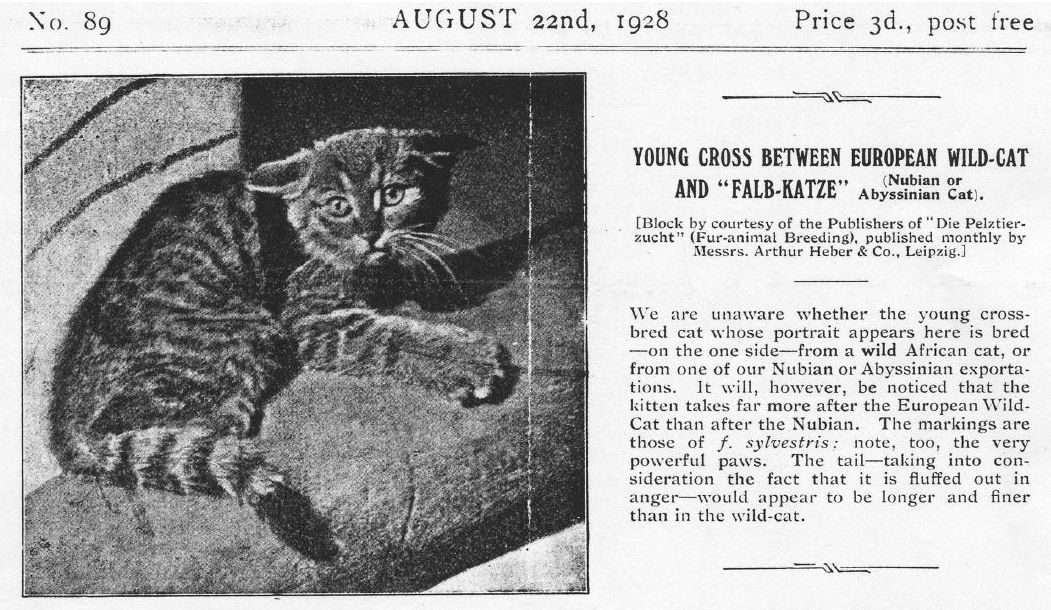
And two weeks later, in "Cat Gossip," 22nd August, 1928, the above photo was published: "Young Cross Between European Wild Cat and “Falb-Katze” (Nubian or Abyssinian Cat). [Block by courtesy of the Publishers of " Die Pelztier-zucht” (Fur-animal Breeding), published monthly by Messrs. Arthur Heber & Co., Leipzig.] We are unaware whether the young crossbred cat whose portrait appears here is bred — on the one side — from a wild African cat, or from one of our Nubian or Abyssinian exportations. It will, however, be noticed that the kitten takes far more after the European Wildcat than after the Nubian. The markings are those of F. sylvestris; note, too, the very powerful paws. The tail — taking into consideration the fact that it is fluffed out in anger — would appear to be longer and finer than in the wild-cat. [Nubian was the German name for Abyssinian cats.]
TH Gillespie (1954) reported 2 presumed hybrids, a male and a female, born to a domestic cat in spring 1924. They had rusty grey-striped coats resembling the Scottish Wild Cat. These were sent to Edinburgh Zoo where they mated and produced 4 kittens that were predominantly white in colour (indicating the white spotting gene was inherited from the mother). The kittens died young. Gillespie also reported 2 litters born to a female Manx cat that mated with a European Wild Cat (presumed Scottish Wildcat?). The litters were born in successive years, but none of the kittens survived for long.
H Petzch (1958, 1959) reported that a male Steppe cat (F libyca caudata) and "predominantly black" longhaired female domestic cat were caged together at Halle Zoo. After 69 days 3 female kittens were born. 2 resembled the domestic mother (white markings?), while the third resembled the Steppe cat (flecked coat). In temperament, the hybrids were timid and intractable, taking after the wild cat rather than the domestic cat. All were shorthaired due to the longhair gene being recessive and present only in the mother. Only one of the hybrid kittens survived to maturity. When mated to a Male Siamese cat she produced 5 offspring, none of whom inherited the Steppe Cat's flecked coat. 4 of these offspring (being 75% domestic, 25% Steppe cat) resembled their maternal grandmother i.e. black in colour. Seal-point Siamese cats are genetically black and the F1 hybrids carried the recessive gene for solid black.
Hybrids between male European Wildcats and Female domestic cats have been reliably reported on several occasions. In 1964 and 1965, hybrids were born at Warsaw Zoo. HB Peters (1932) wrote of young hybrids that were heavier in build than domestic cats of the same age. They resembled the European Wild Cat in appearance and temperament (they spat even before they could crawl properly). The hybrids died aged 3.5 months of an unidentified disease (distemper and cat flu were common in captive cats as well as in domestic pets).
The various subspecies of F libyca also interbreed freely. A male European wildcat (F libyca silvestris) mated to a Libyan cat (F libyca ocreata) produced 3 hybrid kittens that resembled a mackerel tabby domestic cat. 2 kittens were killed and eaten by the mother. The third was removed and reared by a domestic cat foster mother. It was 9 weeks old when reported. SS Flower (1929), RI Pocock (1907), S Zuckerman (1953). F libyca also breeds with other other wild species and with other hybrids. The F chaus/domestic cat hybrid Chausie has also been crossed with F silvestris to produce the Euro-Chausie. The similarly named Euro-Chaus, a European Wildcat x Jungle Cat hybrid, is considered an exotic, rather than a domestic, pet.
First generation hybrids from domestic cats and the generally untameable Scottish Wildcat inherit the Wildcat temperament. Later generations (F1 x F1) exhibit throwbacks to both Wildcat and domestic grandparents. Between 1873 and 1904, the Scottish Wildcat was experimentally crossed with various domestic breeds and hybrids were exhibited at early British cat shows. In 1939, Frances Pitt wrote in "Wild Animals in Britain" that Wildcat hybrids are "nervous and queer-tempered" and tended to revert to wild type. Pitt attempted to tame a male wildcat kitten she named Satan. Although ferocious with humans, Satan was all gentleness and devotion to a domestic female kitten that had been provided as company for him. In due course they mated and their offspring resembled typical wildcats. One of these, "Imp of Satan", became partly tame. The hybrids mated among themselves and some of their offspring resembled wildcats while others resembled domestic cats. According to Guggisberg, domestic cats were rare in England up until the tenth century and some interbreeding with native wildcats almost certainly occurred.
Excerpt from The Wild Cat - A Highland Gentleman
From “The Romance of Nature” (1937ish) by Frances Pitt
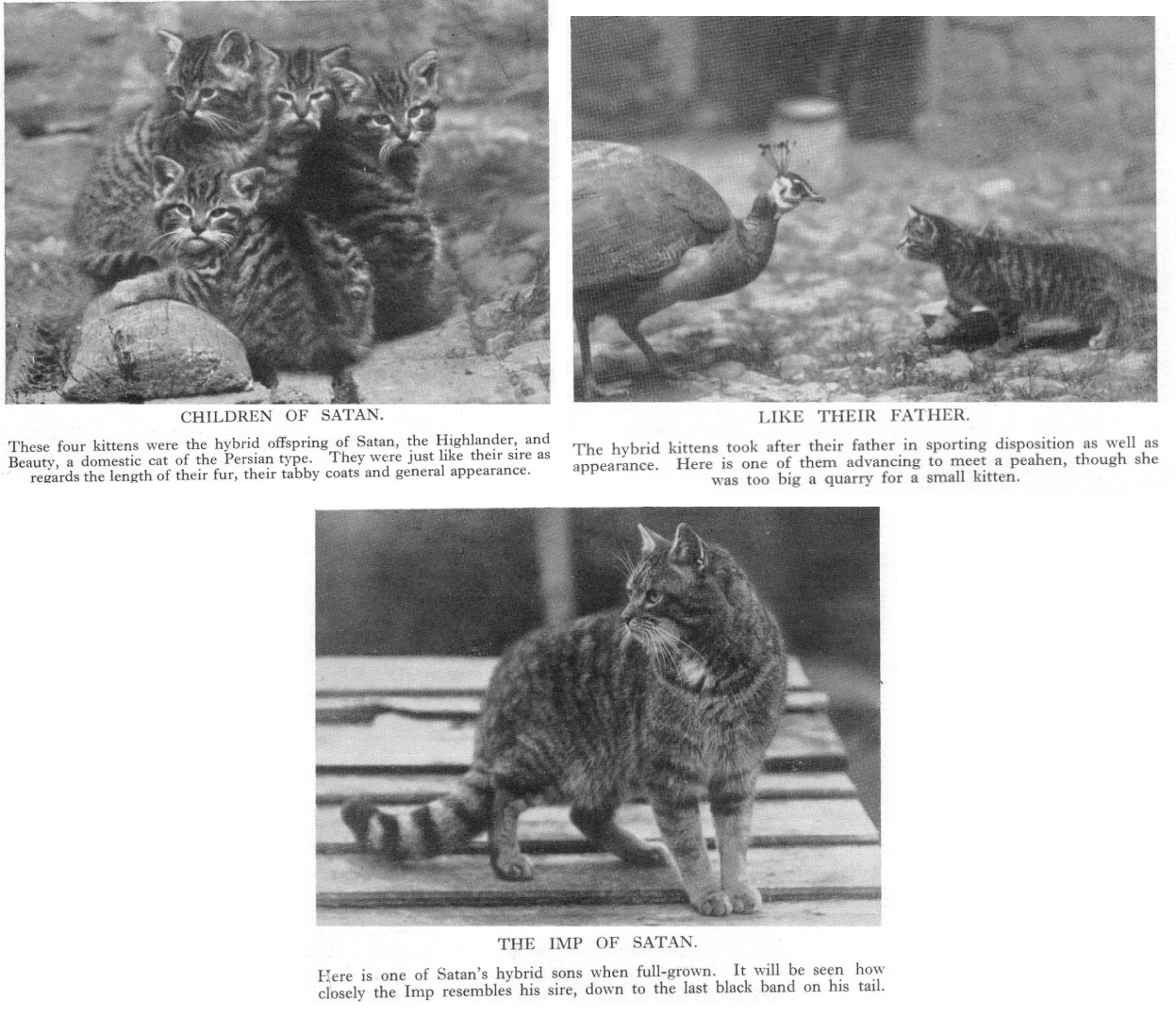
Then Satan arrived. He was but a wee scrap of yellow-grey-tabby fur, as small a kitten as I could desire; but his name was bestowed on sight and never changed. It remained appropriate until the day, six years and nine months later, that an epidemic of “ cat influenza” claimed him. Yet, though there was no reason to change his designation, I believe Satan became more nearly tame than any previous wild cat. With a view to reconciling him to his lot, I obtained a tiny domestic kitten, a longhaired female, whose coat was of the blotched tabby pattern, and put this baby with the wild kitten. Although he spat fiercely at all of us, the stranger accepted the tame kitten as a friend at once, and was ever afterwards deeply attached to her. It was only so long as he was weak and small that I could handle Satan. He grew fast, and with increasing strength fought like a fury, going into paroxysms of spitting and scratching when I tried to pick him up. He was soon untouchable, but with his increase of stature he gained in knowledge and confidence.
He learnt to know the members of the family and the staff, would come to the side of his cage to get food, take it from the hand and spit savagely at the same time. He became tamer than, I believe, any wild cat had been before, but not in the least less ferocious ; yet to Beauty, the kitten brought up with him, he was all gentleness and devotion. It is said that the wild cat, unlike the domestic cat, is monogamous, and mates for life. Satan’s behaviour supports this supposition. Not only was he most affectionate to Beauty, but when I introduced other female cats into his quarters he instantly attacked them. One day I brought a nice, meek little lady, and put her on the top of the old gentleman’s sleeping-quarters. In an instant Satan, glaring anger, sprang at her and knocked her off, sending her tumbling head-over-heels. Beauty was sometimes let out of the wild cat’s place, to take exercise and pay a visit to the house, but this distressed him sorely. He rent the air with harsh cries, for his voice, though loud, was not lovely. It was similar to, but worse than, that of a domestic tom-cat.
Satan became a huge cat. Beauty also flourished, and their alliance was blessed with many offspring, all of which resembled their sire in appearance, and in many traits of character. Hybrids between the wild and domestic cats have been bred on several occasions, notably by the late Mr. A. H. Cocks and Sir Claud Alexander; and in every case the wild type has been completely dominant. Satan and Beauty had six litters, all the kittens of which were exactly like “the old man.” They should have numbered eight litters, but Beauty, alas! had no notions of constancy to a spouse, and there were two families that would have provided Satan with ample grounds for a suit for divorce.
The domestic tom-cat is not always the best of fathers ; he will even, at times, attack small kittens ; so in the case of the early litters, Beauty had been permitted to rear them apart from Satan. When the kittens of unknown parentage arrived, I allowed one to survive, and let Beauty keep it in Satan’s quarters. Though no offspring of his, he treated it delightfully, and was ever gentle and considerate to it. From that time forward she reared her families in Satan’s place, and he was always good to the kittens. Satan might be savage towards human-beings, but he was a true Highland gentleman, and his conduct gave me a great respect for his species - he was a devoted and faithful spouse, also a gentle father.
The question whether hybrids between the wild and domestic cats occur naturally is a difficult one to answer; but I think it is doubtful, at the most a rare happening. The tendency of the wild cat to mate for life precludes stray alliances, and we have the character of the offspring to consider. I have no hesitation in saying that any cat sired by a bona fide wild tom would soon be off to the woods.
The first litter of kittens that Beauty produced were brought up as house pets, but soon proved of queer character. By the way, they were three females, and my mother, remembering that their sire was Satan and their dam Beauty, named them “the World, the Flesh, and the Devil ! The second kitten, burdened with such a name, came to an untimely end. The others flourished, and soon began to display strange traits. They were for ever climbing. They spent much of their time in the creepers upon the house, and upon the house-top. Although friendly with us, they were timid with strangers, and would spit on the slightest provocation.
They early began to take an interest in other livestock, particularly the tame wild ducks (my father’s pets) and the peafowl. Even as tiny kittens they studied the latter with care, but it was not until we found one of them with a duck - the duck being minus its head - that we realized how fully they had inherited the wild cat’s too sporting disposition. They had no idea where to stop, and were equally ready to hunt and kill everything that moved, from a mouse to a peacock ! Poultry they regarded a fair game.” The young cats had to be domiciled in wire pen, lately a pheasant aviary; as had subsequent kittens. Not one of them could be left free after it was half-grown.
Out of the next litter I kept a tom kitten. He was named the “Imp of Satan.” He grew into a very fine cat. Had one met him on a Highland mountain-side, one would never have doubted that he was a magnificent example of the true wild cat, and he was as sporting as the rest of the breed; but he had his mother’s charming manners. The Imp would follow me like a dog. We often went for walks together, and we rarely failed to bring a rabbit home with us; but one evening he ran off after a bunny and vanished into the wood. It was growing dark, and I could not find him. In vain did I call his name into the deepening twilight : no cat emerged from the shadows beneath the trees, and I had to leave him out for the night to enjoy himself wandering through the woods and getting into who knows what mischief. In the morning came a report of poultry killed at a neighbouring cottage. I went at once to the place, and found my cat, likewise three fowls without heads. After that I refrained from taking the Imp of Satan out for walks.
The hybrids in their turn produced kittens, some of which looked pure wild cats, and some throw-backs to the domestic side of their ancestry. Unfortunately it is not easy to keep a number of cats under experimental conditions and make investigations into their genetics, but the indications were that coat-colour, pattern, and length of fur, were inherited on simple Mendelian lines, and, possibly, also temperament. One kitten seemed as savage as any wild cat. With regard to differences between the wild and domestic cats, it appears that the former is much more susceptible to what we may term civilized diseases. Wild cats rarely survive long in Zoological Gardens, quickly succumbing to pneumonia, or some similar complaint ; and hybrids are nearly as liable to infection. I gave sundry crossbred kittens to the Edinburgh Gardens, hut not one survived for long ; yet under isolated conditions they are long-lived healthy cats.
Studies indicate that continued interbreeding of Scottish Wildcats with domestics causes Wildcat type to degenerate. In "Reproduction in the Scottish Wildcat", 1941 Harrison Matthews stated that hybrids tend to be smaller. As far back as 1896, naturalist Edward Hamilton had suggested that the true Wildcat was being supplanted by hybrid "mongrel" Wildcats. In areas where they regularly interbreed, descendants become closer in type to domestic cats. In "Wildcats", naturalist Mike Tomkies reported that modern Wildcats exhibit progressively more domestic cat traits including smaller size, tapered tail with fused black banding and white markings. Conversely, in areas where the Wildcat predominates, the domestic influence will be diluted. The "Kellas Cat" may be a complex domestic x F. silvestris hybrid with Wildcat blood predominating. Some researchers believe the Scottish Wildcat is now so mongrelised that it cannot be conserved as a pure-bred species.
The Scottish Wildcat once had a far wider distribution in the British Isles and some out-of-place Wildcats do occur. Photographs of the "Tonmawr Cub", a supposed ABC cub seen in Wales ("Cat Country", Di Francis) show it to be an adult Scottish Wildcat, while sightings of Wildcats in Surrey may result from an escaped hand-reared Wildcat and his progeny ("Claws and Purrs", Peter Neville), though wildcat genes from that single individual will eventually have been swamped by domestic cat genes.
In spite of modern hype, hybrid cat breeds are nothing new. At the first cat show in July 1871, the Duke of Sutherland exhibited a British (i.e. Scottish) Wild Cat which had lost its right front paw (no doubt in a trap). Hybrid wildcats were also exhibited at early shows; the Crystal Palace show of 1875 included a class for "Wild or Hybrid between Wild and Domestic Cats" (won by an ocelot). Between 1873 and 1904, the Scottish Wildcat was experimentally crossed with various domestic breeds, including the Siamese, and some of these hybrids were exhibited at early British cat shows. At the turn of the 20th century, Champion Southampton Red Rust, Claude Alexander's exceptional Abyssinian was apparently mated to an "Imported African Wild Cat" and the female offspring, Goldtick, registered as an Abyssinian. Goldtick was mated to a red self called Ras Brouke and produced Tim the Harvester.
Bred in Belgium, the Punjabi is a hybrid of Indian Desert Cat (F lybica supspecies) and resembles the desert cat with ticked ivory or ticked pale sandy colours with grey-black and chocolate spots respectively. It is included here because domestic cats, of which the Bengal is one in spite of hybrid origins, will readily interbreed with F lybica.
There is a misconception by some credulous cryptozoologists that the Norwegian Forest Cat (another naturally occurring longhaired breed) is a cross between domesticated longhairs and Scottish Wildcats. Firstly, the Norwegian Forest Cat comes from Norway and would have to swim a long way to meet up with Scottish Wildcats! Secondly, the long haired trait is recessive and crosses between domestic longhairs and European Wildcats (the mainland relative of the Scottish Wildcat) will produce shorthaired offspring (such as the Kellas Cat).
INTROGRESSIVE SCOTTISH WILDCAT HYBRIDS
Introgressive hybridization means the movement of genes between two species by frequent hybridization and backcrossing to preserve the introduced traits. It usually only occurs in small populations or in boundary areas where two species come into frequent contact and a stable, self-perpetuating intermediate form arises. It also occurs through natural selection, usually in order to introduce desirable wild-type genes into a domestic variety. It results in a visible shift in type.
There may have been one instance of visible shift from wild-type to breed type in Scotland. In 1988 a gamekeeper at Dufftown, North East Scotland, trapped a large black wild cat. It had a slim muscular body, long legs and a long whip like tail, triangular face with wide brow, large ears, Roman nose, overshot upper jaw and protruding canine teeth (fangs). Alien big Cat researcher Di Francis nicknamed it a "rabbit-headed" cat though pictures show a black cat of distinctly Siamese or Oriental type. In addition to the facial similarity, Oriental cats are slim and muscular with a long whip-like tail and many have visible canine teeth due to having a narrow lower jaw. The trapped cat was apparently so ferocious that the gamekeeper had to shoot it from a distance for his own safety. In 1993 a similar cat was seen swimming after wildfowl near East Kilbride. The gamekeeper set two dogs to "scare it away" and claimed that it attacked his dogs so ferociously that he had to shoot it to protect them. Another "rabbit-headed" cat had apparently been killed by a gamekeeper on the Revack Estate. Years earlier in 1938, a gamekeeper near Elgin attempted - and failed - to tame a feral kitten which photos apparently show to be a "rabbit-headed" cat. It was described as an excellent hunter; certainly I have known several Siamese purebreds to be excellent hunters, tackling prey as large as themselves.
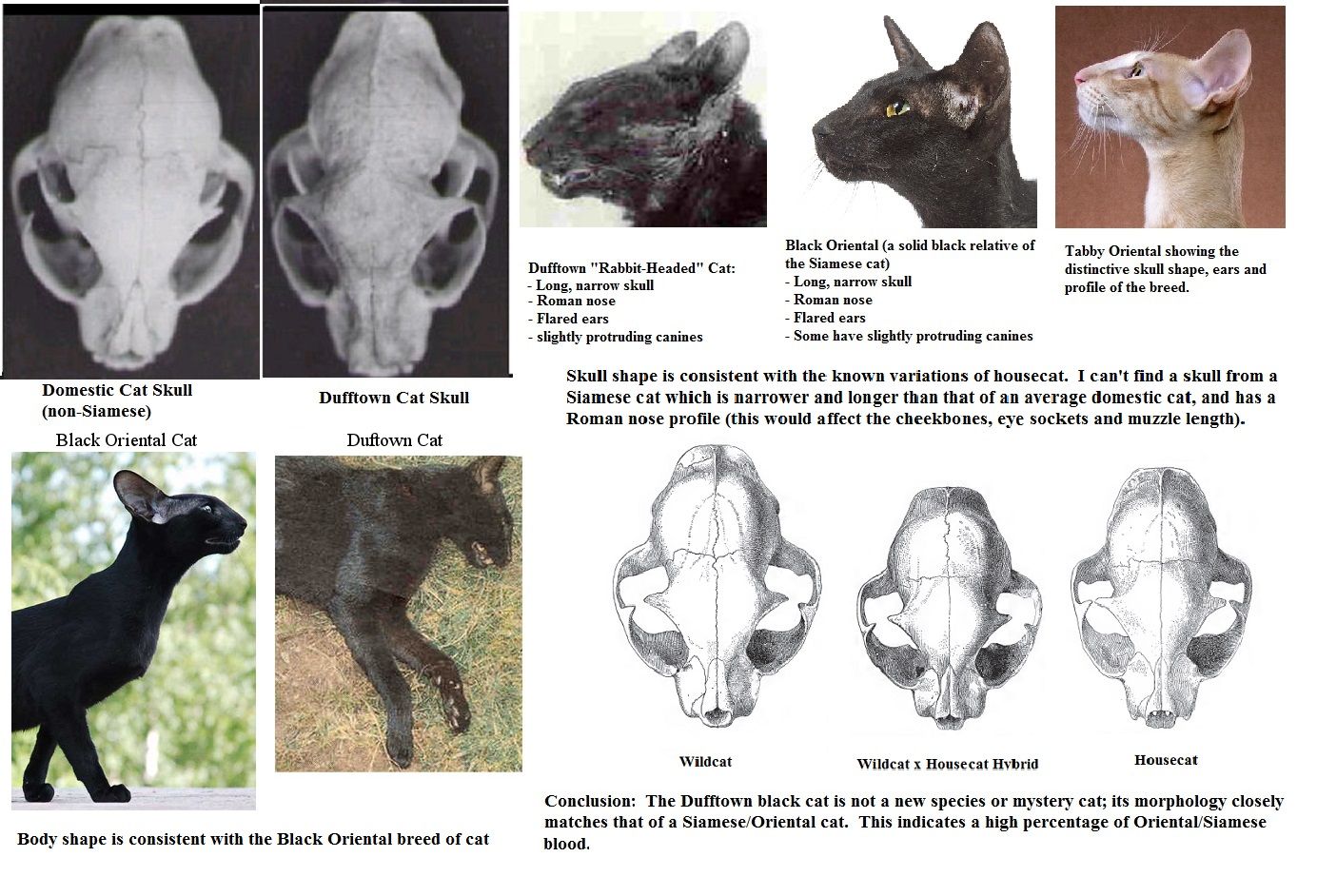
Although Francis suggested that these rabbit-headed black cats of Scotland are an undiscovered primitive species, it is more than likely that they are hybrids between Scottish Wildcats and Siamese-type domestics in an area where pure Wildcats were outnumbered by hybrids. Hybridisation either occurred at a time when Wildcats were routinely shot and surviving Wildcats mated with any domestic cat available. Or, as mentioned earlier, in the late 1800s and early 1900s the Scottish Wildcat was deliberately crossed with domestic breeds, it would almost certainly have been crossed with the popular Siamese cat; untameable ("queer-tempered") kittens were probably released as happened with the Elgin feral kitten. In an area with few native Scottish Wildcats and a greater number of hybrid cats of Oriental breed type (and Oriental cats are said to mature early and be highly sexed), the Oriental type could come to predominate. All feral cats and Wildcats are ferocious when trapped, but reports of them being shot purely because of their ferocity endangering man or dog are probably an excuse since gamekeepers generally shoot feral or domestic cats on sight.
Like the Kellas cats, the "rabbit-headed" cats would seem to be complex hybrids, but in this case conditions have allowed the introduced features to predominate, having become concentrated through inbreeding rather than diluted by outbreeding with other Scottish Wildcats (see
The Pros and Cons of Inbreeding for a discussion on how this features can become "fixed" through inbreeding).According to some researchers, traditional conservation efforts to protect the Scottish wildcat may be misguided. It has interbred with domestic cats for around 2000 years, so long that it no longer makes sense to preserve the wildcat as a separate pure-bred species. Discounting the Kellas cat, a variety derived from wild/domestic hybrids, there are essentially two groups of wildcats. One group more closely resembles the domestic cat. The other, with less contact with domestic cats, resembles the true wildcat, but no-one knows how pure it really is. Genetic markers suggest that the difference between wildcats and domestic cats is small. Instead, the slow displacement of wildcat by the more adaptable feral domestic or by hybrids is evolution in action. Attempts to conserve or reintroduce supposedly pure-bred wildcats are simply doomed to failure. Although wildlife groups will disagree, some researchers argue that the pure wildcat should only be protected if it plays an important role in the local ecosystem.
The European Wildcat, especially the Scottish subspecies, has become endanged through continued natural hybridization with free-ranging domestic cats. The hybrids also compete with the true wildcats; in particular because domestic cats breed more frequently.
Recent research suggests that hybridization has evolutionary value as it provides faster adaptation to a new or changing environment; even if only a few offspring are fertile these may be better adapted to the environment than either parent was. Where cats hybridize in the wild it demonstrates that the cats themselves have scant regard for the concept of species; as illustrated by the plight of the Scottish Wildcat. A tomcat will mate with whatever is available and on oestrus so long as it is a cat of roughly the right size. Humans are forcing wildcat species closer together (through habitat destruction) and inter-species matings may become more common as the cats make do with whatever mates they can find. Unfortunately many of those inter-species matings will not produce offspring and where offspring are produced, many will be infertile. The escape of hybrid pets will do no more and no less damage to the wild population than existing free-ranging domestic cats.
The greatest threat to the F silvestris and all of its subspecies (except for the domestic cat) is hybridization in the wild with stray or feral domestic cats. Hybridization has been taking place over a long period of time. Not surprisingly, hybrization has been happening for longer in areas where domestic cats have been present for thousands of years i.e. in those areas where the cat was domesticated. Domestic and feral tomcats appear to have a competitive advantage over male wildcats in access to oestrous females. This is due to domestic cats usually being larger and more populous. (Mendelssohn 1989). Hybridization in captivity demonstrates that distinctive characteristics of the African wildcat, such as its long legs and reddish-backed ears, are generally lost (Smithers 1983). Hybrids are often distinguishable by white markings caused by the gene for white spotting which is common in the domestic cat popuation.
In South Africa, it is impossible to find pure wildcats near to human settlements where there are domestic cats. Some "wildcats" have the common domestic cat trait of white legs and white patches on their bodies indicating hybrid ancestry. Hybrids have also been found far from human habitation e.g. in the Kalahari some 75 km from the nearest human settlement habitation while feral domestic cats have been found in Rub el Khali (uninhabited sand desert in the south-eastern Arabian peninusla), hundreds of kilometres from any human habitation. As well as hybridization, wildcats are threatened by feline panleukopenia which is carried by the more resistant feral domestic cat.
With domestic cats so widespread, it seems inevitable that hybridization will lead to the virtual extinction of the pure African and European wildcats and their replacement by hybrids. While humans want to conserve the pure-bred wildcats, nature is selecting for the far more successful genes of the domestic cat.
CHINESE DESERT CAT HYBRIDS
The Chinese Desert Cat (also called the Chinese Mountain Cat, Chinese Steppe Cat) of western China was classified as a wildcat subspecies, F. silvestris bieti, based on genetic analysis in 2007. It was previously considered a full species F. bieti. it resembles the European Wildcat in size and conformation, but has sandy fur with dark guard hairs and faint markings on the face, lower legs and tail. Anecdotally it is one of the ancestors of the naturally occurring Dragon Li (or Li Hua Mao, Fox Flower Cat) shorthaired domestic breed in China. The Dragon Li occurs only in Brown Mackerel Tabby with broken stripes on a golden background. The breed's strong full-bodied stature and wildcat-like face are said to be a result of its alleged wild ancestry. The breed was said to have been self-domesticating, presumably from a feral condition.
Although the Dragon Li breed turned out to be a marketing scam, the genetic relatedness of F.s. bieti with other F. silvestris subspecies makes it plausible that it can interbreed successfully with domestic cats.
OTHER F SILVESTRIS HYBRIDS
Maria Falkena bred both domestic cats and small wildcats. The foundation queen of her Oriental breed was a "Sudanesian Desert Cat" (Felis silvestris rubida - now a disputed classification, it is considered part of F lybica). The alert character of this cat was inherited by the descendants.
REFERENCES
Francis, Di. Cat Country.
Matthews, Harrison. 1941. Reproduction in the Scottish Wildcat
Neville, Peter. Claws and Purrs
Pitt, Frances. 1939. Wild Animals in Britain.
You are visitor number