DOMESTIC X ASIAN LEOPARD CAT AND MARGAY HYBRIDS
DOMESTIC X ASIAN LEOPARD CAT HYBRIDS
The very first Leopard Cat identified by Western science, Kerr 1792, was caught by net swimming in the Bay of Bengal. Mr. Kerr took that cat back to his camp and promptly made hybrids with a local domestic cat. Kerr’s leopard That cat's skull went to the Royal Society in London.
Philip M Rule The Cat: Its Natural History; Domestic Varieties; Management, and Treatment 1887: In the class of spotted tabby he-cats at the Crystal Palace there might have been seen a specimen named " Coppa," which was justly awarded first prize. the owner of this cat, Mr. J. Scott, bas kindly favoured me with the history of Coppa, which is of some interest whn regarded zoologically. the father of Coppa was a leopard-cat {Felis Bengalensis), picked up at an East Indian coffee plantation, and brought to England by a gentleman, who banded it over to Mr. Scott. He kept if for two years, and bred ten kittens by two mothers. Coppa is one of these kittens. As his mother was an English tabby, and as the pedigree of the sire is so unmistakably pure, and of the spotted kind, it is not surprising that he was the model of a spotted tabby. [...] Mr. Scott sold his leopard-cat to the Zoological Society, and also presented with it the mother of Coppa and one kitten. But they unfortunately took a form of distemper, and all died, and other cats by the side of them. Coppa, Mr. Scott remarks, is probably the only one left.
In 1889, Harrison Weir wrote in "Our Cats and All About Them": There is a rich-coloured brown tabby hybrid to be seen at the Zoological Society Gardens in Regent's Park, between the wild cat of Bengal and a tabby she-cat. It is handsome, but very wild. These hybrids, I am told, will breed again with tame variety, or with others. However, in 1927, Mr Boden-Kloss wrote to "Cat Gossip" regarding hybrids between wild and domestic cats in Malaya: "I have never heard of hybrids between bengalensis (the Leopard Cat) and domestic cats. One of the wild tribes of the Malay Peninsula has domesticated cats, and I have seen the woman suckling bengalensis kittens, but I do not know whether the latter survive and breed with the others!"
According to H.C. Brooke in “Cat Gossip,” 8th August 1928, “As regards Indian domestic cats, it has been stated, or assumed, by some naturalists that the Leopard Cat (of which we showed a specimen at Croydon two years ago — and have been sorry ever since) and the little Rusty-Spotted Cat have a share in the production of these, as well as the Chaus. The prevalence —formerly more so than to-day — of spotted, tame cats in India would seem to give colour to this theory, but personally we doubt if the Leopard Cat is fertile with domestica, and have never heard of a proved instance of their mating.”
Possibly the earliest documented Leopard Cat/domestic hybrid was in 1934 in a Belgian scientific journal. In 1941 a Japanese cat publication printed an article about a hybrid that was kept as a pet. In 1946, Jean Sugden, considered the founder of the Bengal breed, submitted a term paper on the subject of cross breeding cats in 1946 for her genetics class at UC Davis. Mill (then Jean Sugden) began theorizing about cross-breeding while studying genetics at UC Davis in the 1940s. Her first experiments to produce a hybrid began 40 years ago, when she was one of three people in the country to develop the Himalayan (Colourpoint Persian/Longhair) from Persian and Siamese cats. Of the 35 species of wild felines, Mill said that only a few could successfully breed with domestic cats. Most such hybrids were sterile, she said, but the Asian Leopard Cat produced fertile females and sterile males.
In the 1960s it was legal to buy wild animals as pets from stores. Despite deploring the capture of wild animals for sale, Jean Mill bought an Asian Leopard cat bred it to a domestic cats to create a small, tame leopard-lookalike, which she called a Leopardette. She hoped to preserve the look of the wild spotted wildcats that faced extinction through poaching and habitat loss. Jean Sugden bred her first Leopard Cat/domestic hybrid in Yuma, Arizona in 1963. She mated a female Asian Leopard Cat to a black domestic shorthair male, something she (erroneously) believed to be the first deliberate cross of wild and domestic species. . This resulted in Kin Kin, who was mated back to her father, resulting in a second (F2) generation.
The International Zoo Yearbook, 1965 reported 5 hybrid kittens born at Tallin, Estonia (formerly USSR) in 1963 to a male F bengalensis (Asian Leopard Cat) and female domestic Cat. The International Zoo Yearbook, 1970 reported two male hybrids were born at Kaunas, Lithuania (formerly USSR) in 1968 to an Amur leopard Cat (F bengalensis euptilura) and a Jungle Cat (F Chaus), another species that hybridises freely with domestic cats. The Long Island Ocelot Club (LIOC) newsletter of September/October 1968 reported a Bengal owned by Ed Sutherland. As well as a captive-born Lesser Leopard Cat (F bengalensis), Sutherland had a hybrid Albino Siamese/Lesser Leopard Cat and a hybrid Lesser Leopard Cat/Burmese.
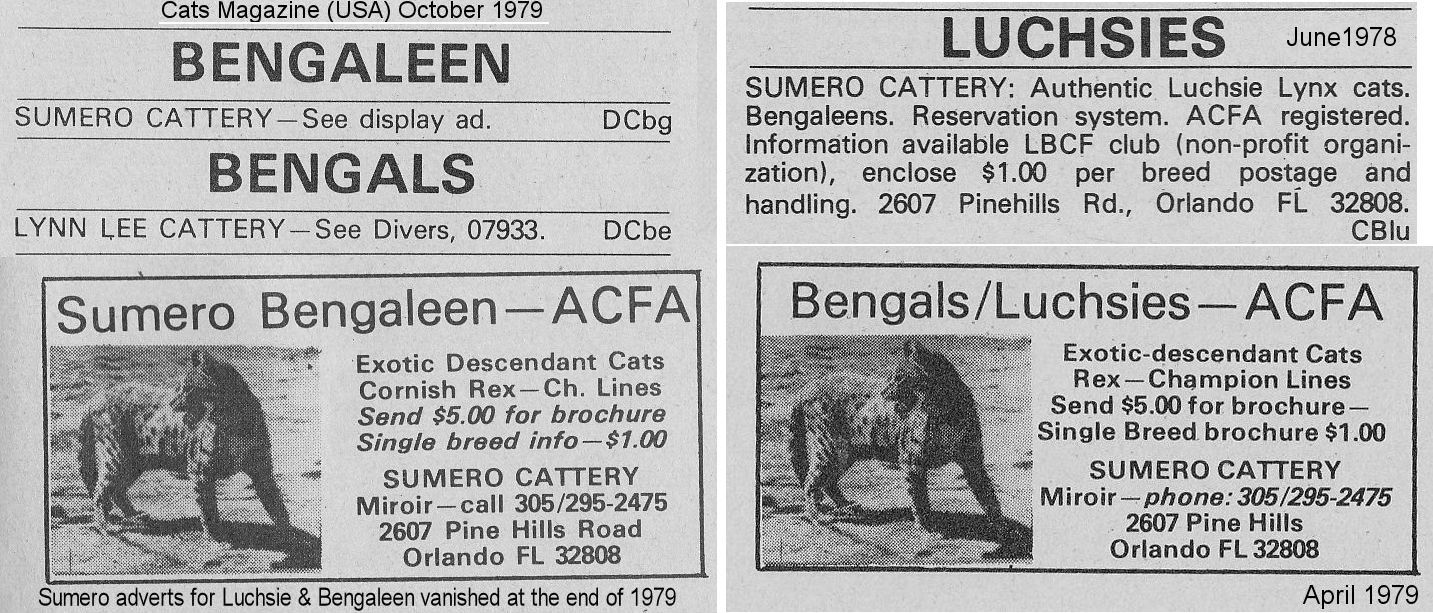
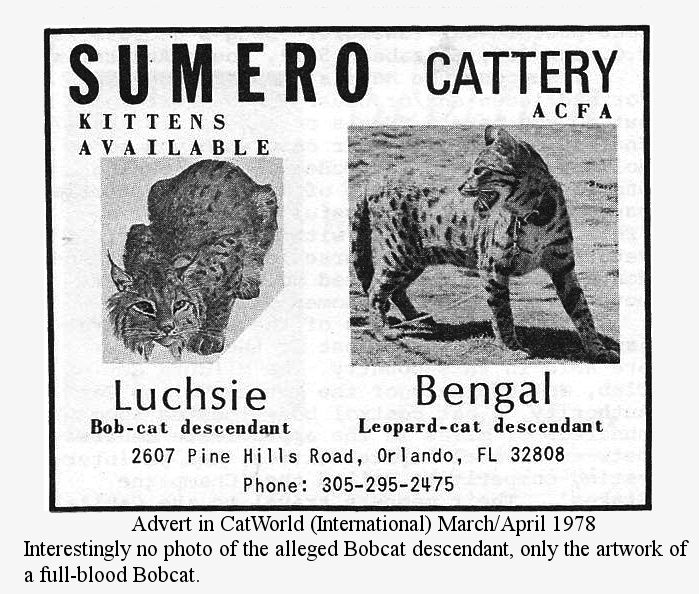
The Bengaleen, bred in Florida, came from the same cattery as the alleged Bobcat-hybrid Luchsie during the 1970s. This was when the cat we now know as the Bengal appeared on the scene and one of these clippings shows both breeds being advertised alongside each other. Several different breeders independently started Asian Leopard Cat hybrid breeding lines around the same time and this seems to be one of them. Sumero cattery soon dropped the Bengaleen name and continued breeding under the Bengal name.
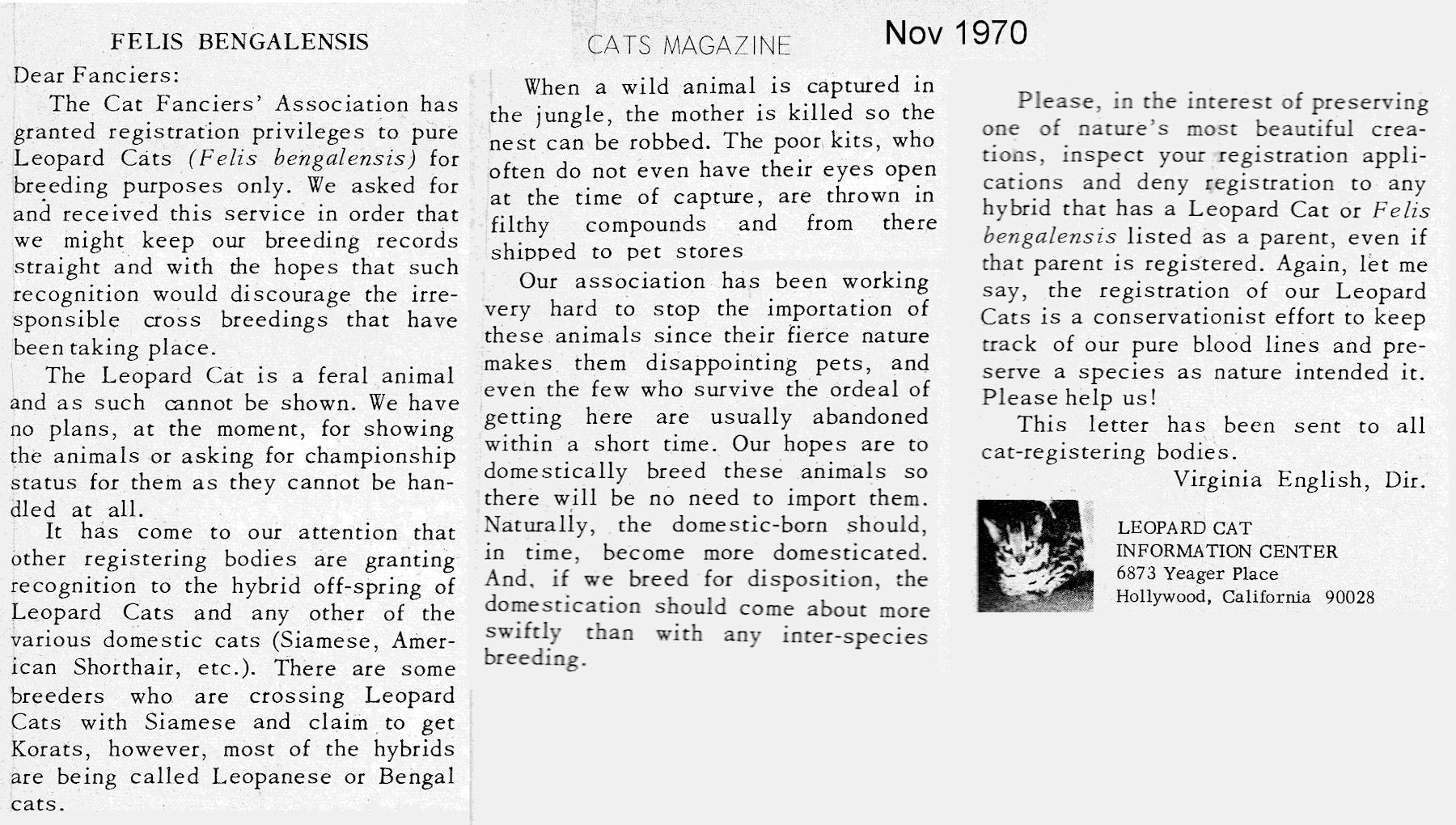
In 1970, several American registries allowed Asian Leopard Cats to be registered. The letter below is an appeal to prevent these wildcats being hybridised with domestic cats.
The main credit for the Bengal breed is given to Jean Sudgen who made that first documented cross in 1963 and found the female offspring to be fertile. However, Sugden's work was interrupted andduring her absence from the scene, members of LIOC were breeding F1 and F2 hybrids which they called Bengals. The LIOC newsletter of July/August, 1971 mentioned a hybrid owned by John M Jackson called Jenny-Any-Dots. She was Jackson's first leopard cat hybrid, bought from Gene Liberall when such hybrids were uncommon and mated to Leopard cat Rao, resulting in a single female kitten on 05/07/1970.
In 1972, Bengal hybrids were being bred by Bill Engler, but attracted criticism from some quarters "I see no reason to produce "breeds" of cats, such as the Bengal cat, as well as the Tiglons and Ligers produced elsewhere, and Leopon experiments of Japanese Zoos. Nor, do I believe that we should attempt to modify cats by interbreeding them with domestics to make a better "pet". Anyone that wants an exotic for a pet should accept it for what it is , and if they can't do that, should abandon the idea of getting one at all."(Arnette Barnett in LIOC Newsletter July/August 1972
LIOC's newsletter of May/June 1972 carried an anti-Bengal letter written by Virginia English, Hollywood, California. Luckily for modern Bengal owners, Ms English was in the minority and mistaken in her views (she seemed to have been after some self-publicity).
"I must express my disappointment at finding the so called Bengal Cat promoted in the LIOC Newsletter. These unfortunate freaks of nature are nothing to be encouraged. I'm sure Mr. Engler is well aware that many litters of Leopard Cat (Felis bengalensis) x domestic cat (Felis catus) have been born throughout the country in the past few years. Most of these breedings were accidental and the resultant offspring were given away with the stipulation that they be altered or put to sleep. Mr. Engler's cats are neither the first nor a new breed. To establish a hybrid breed it must be possible to breed like hybrid to like hybrid, resulting in viable like offspring. Since the two blood lines currently being worked with are neither totally unrelated nor alike in coloration, nor have any male hybrids proven fertile, it would seem a bit previous to claim the development of a new breed.
The dispositions of these hybrids may please the breeder and a select few owners, but unfortunately the average cat lover, even exotic cat lover usually finds them a bitter disappointment. We are already receiving calls from owners of this type of cat who want rid of the beasts. One that I tried to find a home for recently had already had three homes, been declawed and defanged and was relegated to life in a cage because of its untrustworthy nature. All this at six months of age. Unless a good deal more responsibility is taken in the placement of these animals there is no justification for causing them to be brought into the world. I would like to call the membership' s attention to an article on this subject that will appear in the July-August, 1972 issue of International CAT FANCY Magazine. I have recently been appointed their Exotic Cat Editor. This publication takes a great interest in the exotic cat and displays an editorial integrity unparalleled in other publications."
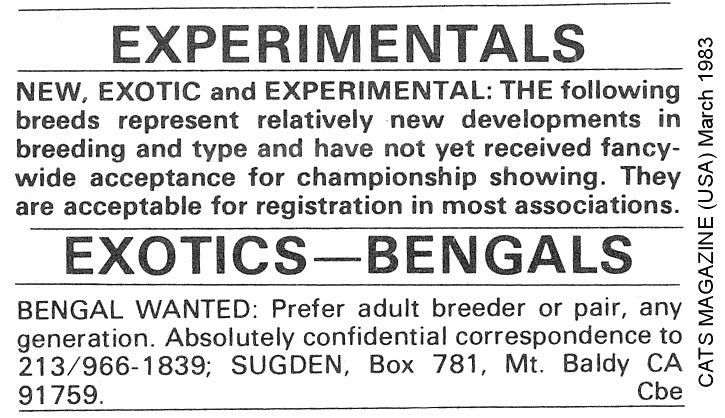
In the May/June 1975 LIOC newsletter, there was condemnation of a Mr T Harrison Van Ard of San Bernadine who was claiming to have discovered a new breed of cat. Van Ard was actually breeding leopard cat-domestic crosses and was selling state franchises for $7,500 to unwary investors hoping to raise these felines. The regional branch of LIOC wrote him a letter disassociating themselves with his activities and condemning his fraudulent methods. They also sent copies of the letter to the Better Business Bureau, District Attorney, Attorney General and others.
In the LIOC newsletter 23/2 April 1979, Pat Warren wrote one of the first articles about wild/domestic hybrid cats. In this excerpt she describes the early Bengal hybrids which came in different colours from the modern Bengal breed. The Warrens had heard of Bengal hybrids (Leopard Cat/Domestic crosses) and were eager to know more about them. "The first Bengals were probably those of Bill Engler's, bred mainly from his leopard cat, Shah. Bill was interested in creating "a breed" - that is a domestic type cat with wild type markings. He worked mainly with American Shorthairs because he like their ruggedness and calm dispositions. After his death in 1977, his cats were taken care of by the Douglases in Florida. ... The Bengals were strikingly beautiful, but in their own distinct way. In type, they strongly resemble leopard cats - right down to their large expressive eyes. I was facinated by the color range of the spotting that Engler and the Douglases had achieved. By working with different colors of domestics, they had gotten first generation Bengals with black, bronze, red, cream and tortoiseshell spots. While there, I lost my heart to a 4 month old daughter of Shah. Her mother was a blue tabby named Mama Blue. She had bold bronze spots on a golden background. I named her Tonga. While Tonga was a little timid, she had settled in quicker than many domestic cats."
The modern Bengal breed is derived from crossing Asian Leopard Cats with a variety of domestic breeds: Abyssinian, American Shorthair, Burmese, Egyptian Mau and some non-pedigree cats. Jean Sudgen who made the first fully documented cross in 1963 and found the female offspring to be fertile, but her work was interrupted, leaving members of LIOC to breed F1 and F2 hybrids which they called Bengals. Jean Sugden (later Jean Mill) briefly gave up breeding cats after she was widowed, but other people continued to produce the Asian Leopard Cat hybrids they called Bengals and Bengaleens; the Bengal name would ultimately stick, rather than Mill’s preferred “Leopardette.”. It wasn' until 1977, after marrying Robert Mill, that she returned to the Leopardettes and bred third and fourth generations. Jean Mill acquired 8 female hybrids from geneticist Dr Willard R Centerwall, UC Davis. Centerwall had been breeding hybrids of Asian Leopard Cats and domestic cats as part of a study of feline Leukaemia (the Asian Leopard Cat was thought to be immune) and was also studying the influence of environment and inheritance on temperament. Since 1972, he had been crossing the leopard cat with the domestic and observing the offspring. Six male leopard cats and more than 20 domestic females had produced over 100 F1 hybrids. The hybrids were raised by domestic mothers with wholly domestic foster siblings for comparison. Though averaging about midway between the wild and domestic parents, the hybrids exhibited a range of characteristics; none were as tameable as the domestic mother nor as untameable as a captive-bred leopard cat. He found the back-cross hybrids directly correlated behaviour with the ratio of domestic to wild genes
Around 1982, the Mills visited India where a zoo curator showed them a rosetted feral "Indian Mau". They went through the difficult process of importing it to Los Angeles and mated it with some female Asian leopard cat hybrids they had acquired. The results were Mill’s best Leopardettes, with amber eyes and spotted coats in several shades of copper, sorrel and silver. Mill expected that by the next generation of cats would have even more distinctive spots and consistent orange colour. Named "Millwood Tory of Delhi" this Indian cat was credited with introducing the glittered effect into the breed (although the best rosettes came from pirported margay hybrids when cats from the defunct Bristol breed were absorbed into the Bengal). Jean Mill’s Leopardettes made their debut in 1986 at the International Cat Show in Anaheim. They won an award for new breed and received special recognition at a later show in Madison Square Garden. Her best Leopardette, developed after years of selective breeding, was exhibited in September 1987 at the International Cat Show in the Los Angeles Convention Center.
Meanwhile in Los Angeles, Paul Casey, was developing his own spotted cat – California Spangles - by combining eight different breeds of domestic felines. It is now known that Casey had acquired two whole litters of Asian Leopard Cat/Siamese crosses for his breeding stock. However, said Mill in 1987, those were entirely different to her wilder-looking breed.
In Britain in the early days of Bengal breeding, some Bengals were bred to Siamese cats to improve the blue eye colour of the "snow" varieties. Siamese outcrosses didn't go down on the Bengal pedigree as Siamese; some may have been registered with TICA as "unknown" or "experimental shorthair." Four breeders in the UK were known to have used Siamese outcrosses, homing the early generations as pets or as a now lost British breed called the Savannah (not the same as the breed developed using the serval) documented in Cat World in March 1997. Official Bengal history does not mention the Siamese outcrosses. (Personal correspondence.)
In the 1990s, cryptozoologist Karl Shuker suggested that escaped Leopard Cats (F. bengalensis) may have led to natural Leopard Cat hybrids in Britain, citing the development of the Bengal breed to support this ("The Lovecats", Fortean Times 68, pages 50-51). While the Bengal originates from such hybrids, those hybrids rarely breed successfully without human intervention. In the definitive book of the breed, "Getting to Know the Bengal Cat" by Gene Johnson, it is documented that F1 males are sterile while the fertile F1 females are poor mothers and may commit infanticide. F2 (hybrid x domestic) kittens may have to be raised by a foster-mother and are fully fertile. Without human intervention, hybridization with Leopard cats would very likely stop with the sterile F1 males and the poor maternal skills of the F1 females.
A more likely, and very dilute, source of Leopard cat genes is the Bengal breed. However, Bengal x moggy offspring will not be ferocious giants since, contrary to wildly inaccurate press reports, Bengals are affectionate, unaggressive and normal pet cats. In 2003, the BBC and other news agencies reported "90%" wild-blood "Bengals". Cats with such high percentages of wild blood are not pets, they are produced by back-crossing successive generations of Bengals to pure-bred Asian leopard cats and are used in breeding programmes. The percentage of wild blood in pet Bengals is closer to 12.5%
Some Bengals also contain a few Margay genes; an early experimental "Bristol" hybrid resulted from domestic x Margay (F wiedi) crosses. The "Bristol" numbered only a few individuals, some of which were incorporated into early Bengals (see next section). The Bengal has been crossed with a number of domestic breeds and with other wild species.
The Russian Ussuri breed is believed to be the result of natural hybridization between domestic cats of Siberian and European Shorthair type and the local subspecies of Asian Leopard Cats. This is conjecture based on the cats' physical appearance. The Ussuri is a naturally occurring breed, but its numbers are dwindling through interbreeding with other local cats. This demonstrates the shift towards the prevalent local type. Unless a breeding programme is set up to preserve the type, hybrid or not, it will be lost.
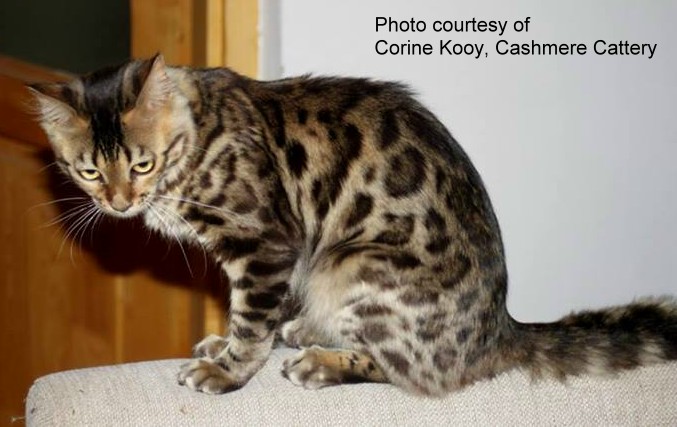
|
|
|
DOMESTIC X MARGAY HYBRIDS
According to Charles Darwin in "The Variation Of Animals And Plants Under Domestication" (1860s), "Azara states, but only on the authority of the inhabitants, that in Paraguay the cat has crossed with two native species."
In the Long Island Ocelot Club Newsletter (LIOC) of Sept 1962, Mr and Mrs Tom MacBean wrote "Incidentally, I know of a cross-breeding of a margay with a domestic cat which I think is rather interesting, This was accomplished accidentally by the arrival of a male margay on a farm belonging to my friend here in Puerto Vallarta who had several cats keeping down the rat population. The margay mated with one of the females: two of the kittens had all the margay markings and one looked, as my friend said, most peculiar. "
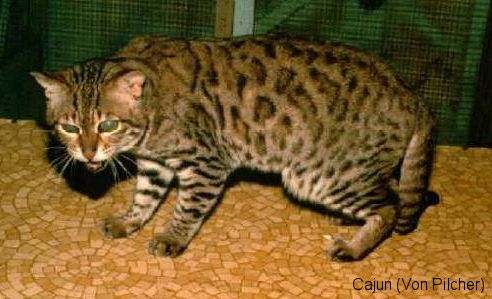
The "Bristol" breed, derived from margay x domestic crosses, predated the Bengal breed, but died out due to infertility problems. Around 1991, the last fertile Bristols were absorbed into the early Bengal breed to augment the Bengal's limited gene pool (due to inbreeding). In 1991,Solveig Pflueger, TICA's geneticist, heard of some cats housed at a private residence in Texas. These were registered with TICA as "Bristol Cats" - a breed believed to be extinct through infertility. The colony numbered about 10 cats and its sire was Cajun (then quite old); it was not very fertile, averaging 2 litters per year. Cajun's rosettes resembled those of an ocelot or margay and he was believed to be an ocelot, margay or oncilla (tiger cat) hybrid. Breed books and articles of the 1980s reported the Bristol as a margay hybrid. Cajun had a very white ground colour on his chest and belly, very small and rounded ears, and a voice like that of an ocelot. Though less striking, the other cats were also clearly hybrids. Some had the black smoky charcoal colour that sometimes appears in F1 and F2 Bengals. Investigation unearthed photos of an ocelot-type cat mating with a domestic shorthair. The ocelot-looking cat is sometimes wrongly described as a "feral" cat - "feral" means a domestic animal that has reverted to being wild, the South American rosetted cats are wild species, not ferals!
The two Bristol females young enough to be used in breeding were placed in Bengal breeding programmes (one with Gogees, one [Sugarfoot] with Belltown). Belltown Sugarfoot produced several Bengal/Bristol litters and one of the kittens was incorporated into the Gogees line. The cats bearing Bristol blood inherited a more robust type, small ears and good rosetting. The problem of infertility was bred out and the Bengal gene pool was enhanced. Several Bengal breeders have lines that go back to Bristol/Bengal crosses, though others dispute the ability of South American wild cats to hybridise with domestic cats. This latter view is mistaken - the modern "Safari" breed is a Geoffroy's cat hybrid. Oncilla/domestic hybrids have been bred in the 1950s or 1960s by Mme Falken-Rohrle. DNA tests may determine the identity of the Bristol's wild species ancestor, but the genes are so dilute that genetic markers may have been bred out.
DOMESTIC X OCELOT HYBRIDS
To my knowledge, no-one has yet bred ocelot x domestic cat hybrids as pets; although I understand that a Bengal breeder hoped to breed his male ocelot to one of his female Bengals, but had not accomplished this mating due to the ocelot's temperament. Because the Margay and Ocelot can be crossed, the ocelot could, in theory, produce hybrids with domestic cats. I have one account of a possible hybrid, but DNA evidence is still awaited. Crystal Pillard owns a rescued female ocelot that that was not pregnant when obtained and had not been outdoors. The ocelot was later found to be pregnant and the only male cat in the home was a large Bengal. The kittens were born healthy and ate well and had gold showing through their dark silver and black coats. Samples from the the ocelot mother, the presumptive Bengal father and the kittens have been sent for "parent verification testing". A second litter was bred from the same parents to prove the paternity of the first kittens.
There is no breed name for ocelot hybrids, though the term "Ocelittle" has sometimes been used.
Ocicats, sometimes misspelled as "Ocecats", are not hybrids between ocelots and domestic cats. They are a cross between Abyssinians, Siamese and domestic shorthair cats and do not contain wildcat blood. Its name comes from its resemblance to the ocelot and does not indicate ocelot ancestry.
BENGAL x CHAUSIE HYBRIDS
|
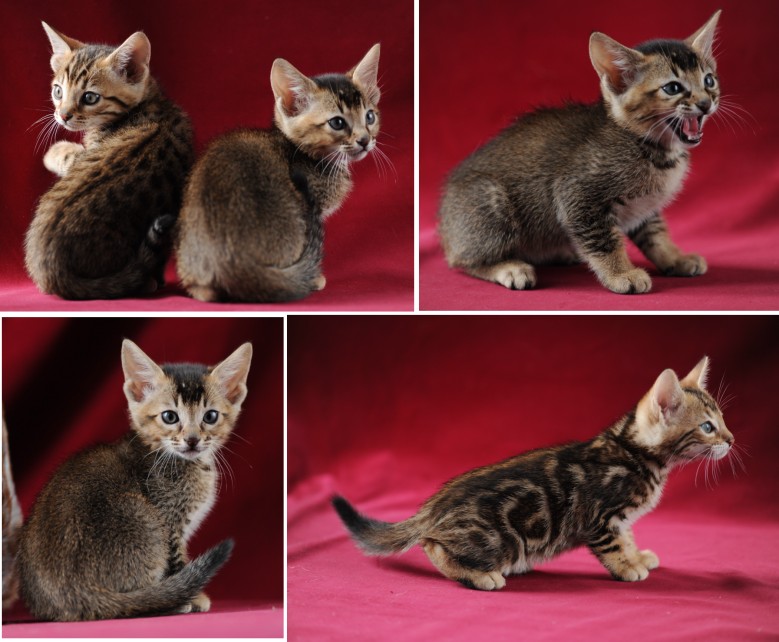
Bengal x Chausie cross kittens. Photos courtesy Andrzej Grabowski (photographed for Ewa Zgrabczynska) |
Some hybrids have been crossed with other hybrids to create new breeds combining multiple traits. These Bengal x Chausie hybrids were bred accidentally by Ewa Zgrabczynska, a breeder of Bengals and Chausies (black brown ticked). A young male marbled Bengal taught himself to open a door when Ewa was absent and mated a Chausie female (a hybrid from Abyssinians). Both cats had excellent, friendly temperaments. The litter had a mix of marbled and ticked kittens.
Derived from Chausie x Bengal cross, originally called "Jungle" and renamed Poljun in 2014. Medium to large cats, with males larger than females. Athletic, but not heavily built. Powerful looking, active and intelligent, but never aggressive. Long forehead, slightly triangular (especially in females) with high, well-developed cheekbones, full muzzle and chin; rounded whisker pads. Ears medium/large, tall and erect, wide based, rounded tips with ear tufts preferred, placed close together on the top of head. Eves oval-to-round, medium to large but must not protrude; gold/yellow (preferred) to light green and intelligent-looking. Long, elegant, muscular body with deep chest. Hind legs longer than forelegs, medium boning and muscular. Long medium-thick tail. Coat short/medium and dense with a softer undercoat. All patterns have tabby markings on face, legs and tail, necklaces on chest. Brown ticked tabby spotted - sandy-gray to reddish gold ticked base coat, small spots on the body and a distinctly lighter colour around eyes and on muzzle. Brown black marbled - beige background with brown/black marbling. Black brown spotted - grey to brown background with darker spots or rosettes on the body and striped or spotted legs. White lockets are not allowed, but there may be some white specks in the coat like the Chausie's grizzle markings.
CUBBARI (FROM BENGAL x BRITISH SHORTHAIR HYBRIDS)
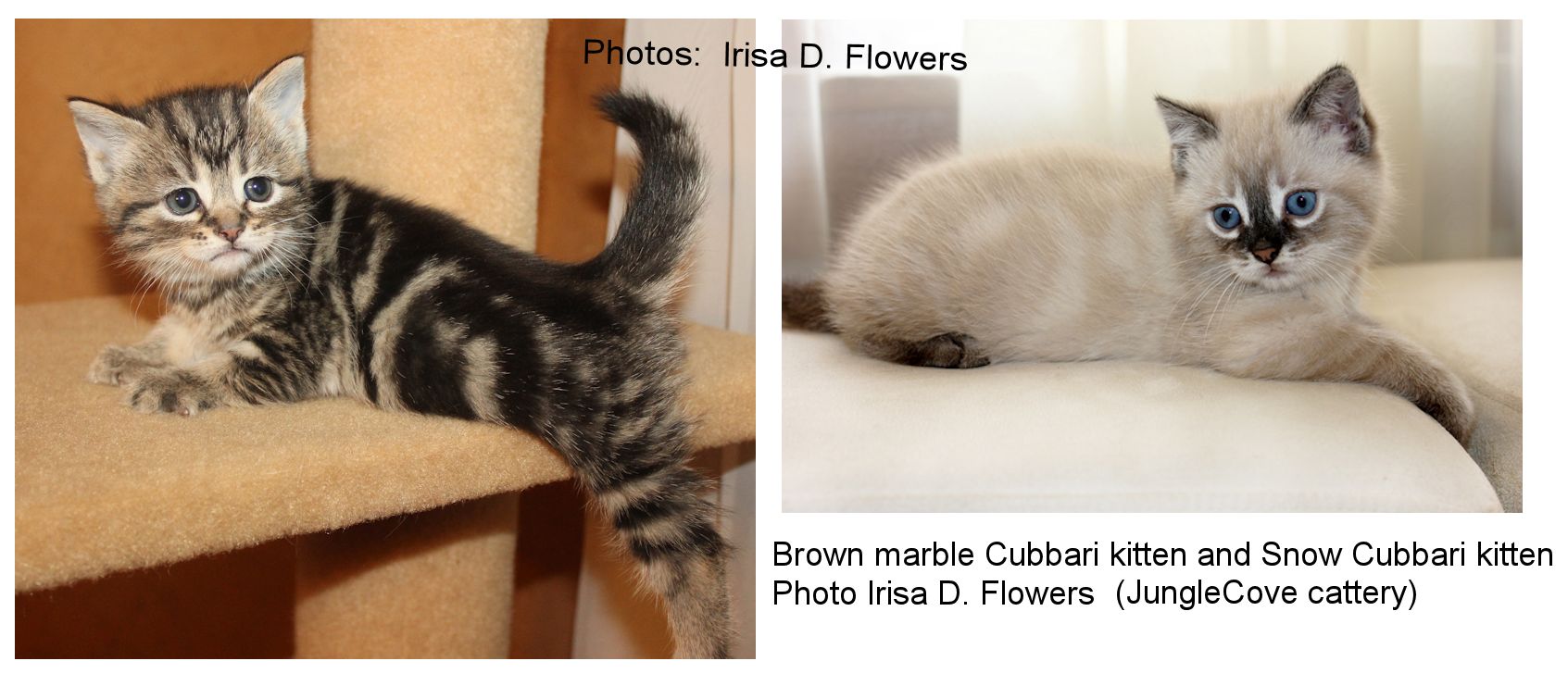
The Cubbari (nicknamed Cub-cat) is being developed by Irisa D. Flowers and aims to create a domestic cat that, when adult, has the physical appearance of a big cat cub. They are small in stature with thick, sturdy boned bodies and weigh 5- 8lbs as adults. Their sturdy conformation, thick legs, rather large paws, facial features and rounded ears should bring to mind a young lion of leopard. They have a loving, cuddly personality with a social, active edge. The breed was founded using non-standard (i.e. long-legged) Munchkin and Bengal cats, but the emphasis is on coat color and pattern, facial structure and developing breed-specific traits. Tabby British Shorthairs, especially goldens, are also being used and contribute the necessary cobbiness. The Cubbari's temperament should be highly friendly, cuddly and active.
Colours and patterns include snow, golden, brown, and black with or without Agouti and ticked variants as well as tabby in marbled (classic), spotted or rosetted and shaded are most notable within the breed. The charcoal pattern inherited from the Bengal is also seen. Although a Munchkin was used in the foundation stock, the Cubbari does not have short legs.
|
Cubbari kittens. Photos courtesy Irisa D. Flowers of cubbaricat.com |
"PUMA" (FROM BENGAL x BURMESE HYBRIDS)
|
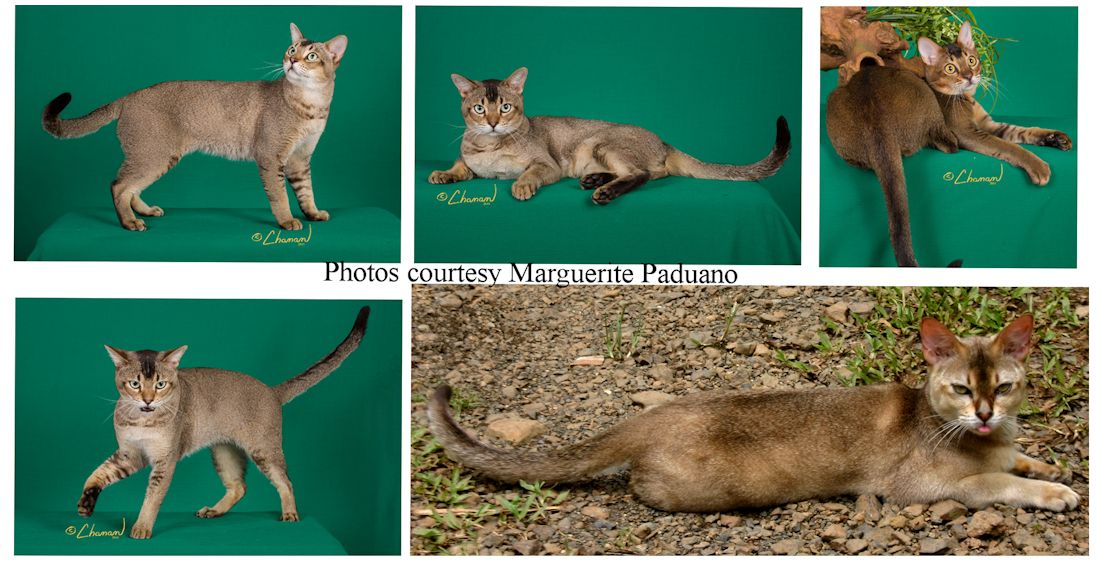
PUMA breed. Photos courtesy Marguerite Paduano of Naturesacrescattery.com |
The PUMA has been developed by Marguerite Paduano of Naturesacrescattery.com and have been exhibited at TICA shows in Tampa, Florida where judges were encouraging about this naturally bred (not a novel mutation) variety. They combine the elegance and affection of the American Burmese and the intelligence of the Bengal as well as being athletic, playful and mischievous. The current generation of kittens exhibit many of the characteristics of the wild Puma. The kittens are born spotted, but have ticked coats as adults; these are golden or rusty in colour with minimal barring. They lack the tear-lines many people associate with the wild puma.
Kittens born almost white turn golden or tawny. Kittens born brown may turn a warm rusty brown. Those born with spots lose these spots at around 8 months. “Phantom PUMAs” have an elegant pewter grey coat with fawn undertones and glitter. Many of the PUMA kittens have glitter inherited from the Bengal.
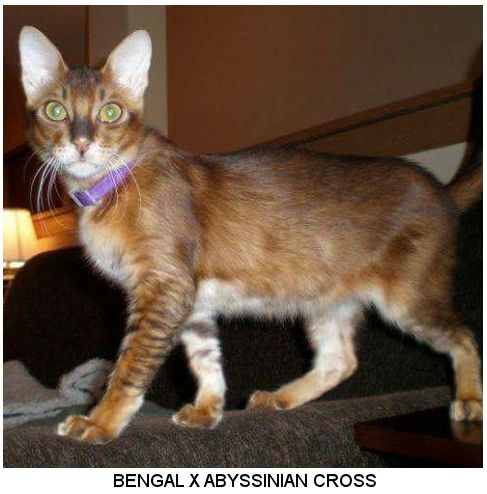
BENGAL x ABYSSINIAN HYBRIDS
You are visitor number