A HISTORY OF CAT SHOWS IN BRITAIN
This page is not intended to be a definitive history of cat shows or cat fancies. Cat fancies will be able to provide far more detailed information on their own history, right down to "which cat won which prize in which year, and who were his parents?". For definitive information or for information on the cat fancy outside of the UK, you are advised to visit the official sites of the registries whose history interests you.
In "Animals, Their Nature and Their Uses" (1850s), Charles Baker wrote, "The Cat must be considered as a faithless friend, brought to oppose a still more insidious enemy. The domestic cat is the only animal of the tribe to which it belongs, whose services can more than recompense the trouble of its education." To Baker, cats were useful for controlling vermin, rather than being valued for their appearance.
Not all cat lovers would have agreed with this view. Some were already trying to perpetuate certain looks though there seemed to be no co-ordinated efforts and the habit of letting cats wander freely undermined their attempts. In "Origin of Species" (1859), though Charles Darwin acknowledged the attempts and the difficulties, he was dismissive of the selective breeding of cats, "...cats from their nocturnal habits, cannot be so easily matched [bred] and although so much valued by women and children, we rarely see a distinct breed long kept up."
Nevertheless, owners were breeding cats for their appearance and trueness to type. It was natural that they should want to compare their efforts against those of other breeders.
The earliest recorded cat show took place in England at the St Giles Fair, Winchester, in 1598 though we have no details of the exhibits or how they were judged. A cat show was held at a London house in 1861 and another was held at the Crystal Palace in 1868. During the 1860s, the first cat shows in North America took place in New England, being county fairs featuring farmers' cats: the local Maine Coon breed. Official Cat Shows (Championship Cat Shows) with rules and breed standards began in 1870s Britain as part of a general public enthusiasm for seeing exhibitions of objects and of animals.
According to this item in the Freeman's Journal , 27th March 1876, the first show in the United Kingdom was in 1859 in Dublin: "London Cat Show. The Irish lady at whose suggestion the first cat show ever held in the United Kingdom took place in 1859 in Dublin would be not a little pleased at the success of her idea if she witnessed the wonderful collection of specimens of the feline race which was exhibited at the Alexandra Palace on Saturday. Although there is not in the pens such a striking novelty as the extraordinary variegated cat lately shown at a kindred competition near London, which on examination was found to have several artistic layers of paint on its cost, it is claimed that the only genuine pure red tabby she cat ever seen in public, as well as two others whose completeness of line is only spoiled by a little speck of white under the throat, is here open to the inspection of connoisseurs.
THE VERY FIRST BRITISH CAT SHOWS
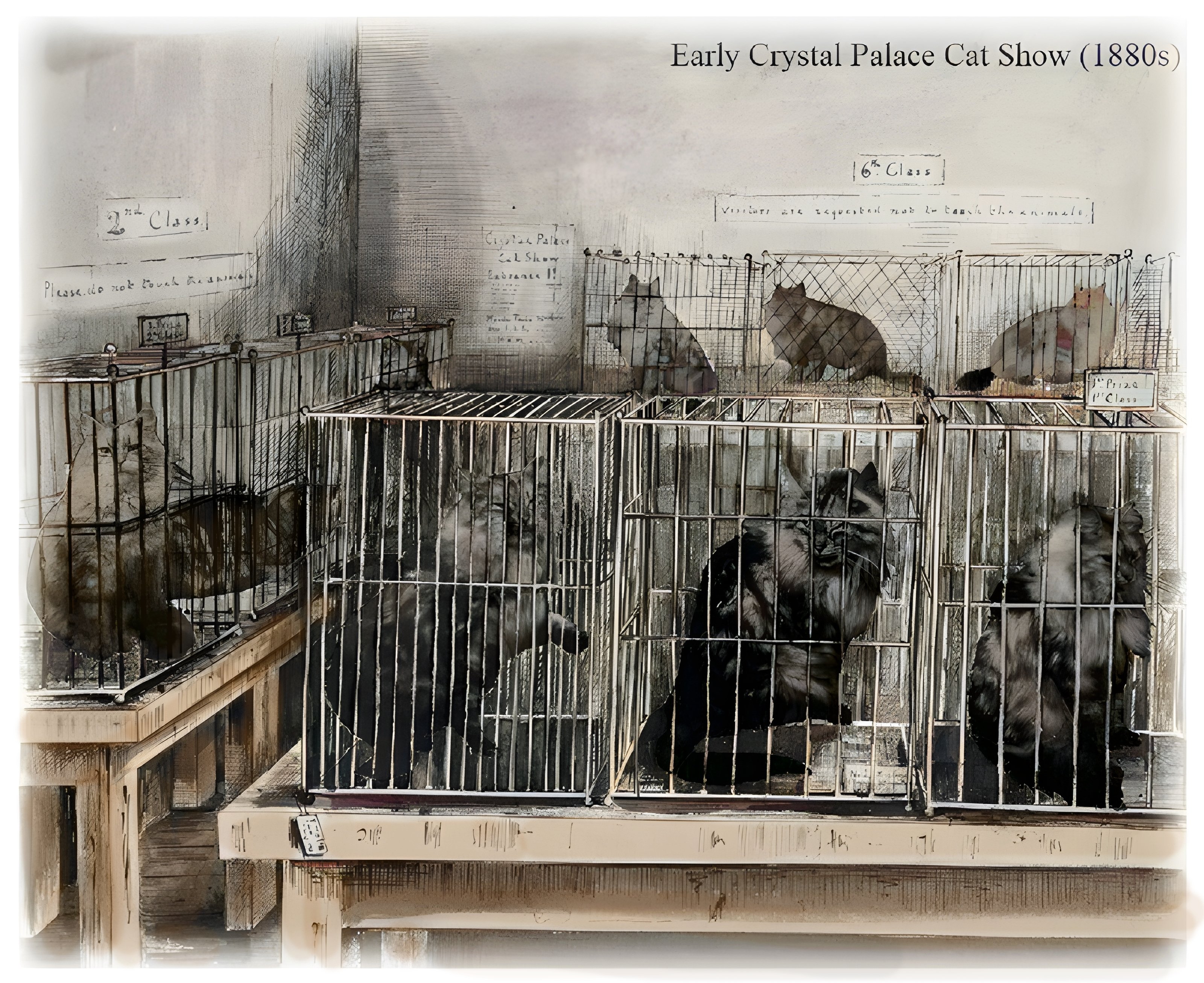
Although Harrison Weir is considered the father of the modern cat fancy, he did not organize the first ever cat show at the Crystal Palace on his own. That distinction also goes to naturalist, Mr Fred Wilson, superintendent of the natural history department at the Crystal Palace. It would have been natural for him to want to arrange displays of animals there. Wilson s Crystal Palace Cat Show is reported on page 6 of the London Standard for Wednesday 18 October 1893 celebrating 25 years of cat shows at the Crystal Palace:
CAT SHOW AT THE CRYSTAL PALACE. Twenty-five years ago, Mr Fred Wilson had the happy idea of organising a Cat Show at the Crystal Palace. In this early exhibition only sixty-five animals were shown; but such was the novelty that immediate popularity was attained, and from that day to this the Show, under the auspices of the Crystal Palace Company and the National Cat Club, has gone on increasing, until yesterday about six hundred of these domestic pats were ranged before judges for inspection. It has, indeed, been found necessary to amalgamate several classes, and to put certain checks upon the entries, in order that the works of judging might be brought within reasonable limits.
You'll see that 1893 minus 25 gives 1868, but the first show was actually 1871. Why the confusion over how many years the cat show had existed? In the first two years, there were 2 shows each year: 2 in 1871 (July and December), 2 in 1872 (May and October), but only one in 1873 ( and October). Although the article celebrated 25 cat shows, the shows had run for 23 years, not 25 years.
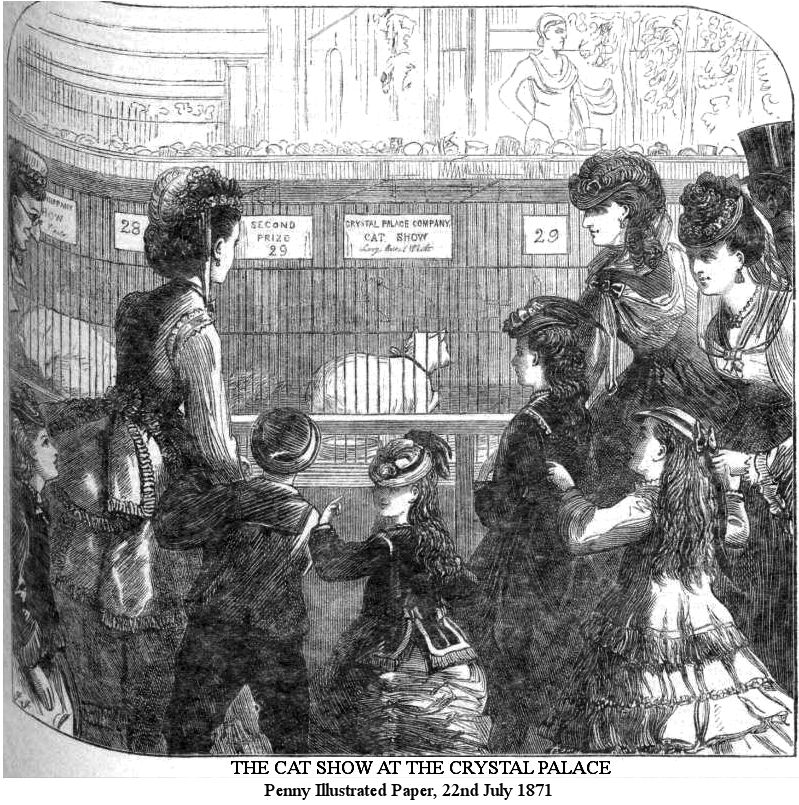
Page 5 of the Bath Chronicle and Weekly Gazette of Thursday 20 July 1871 also mentions Wilson s role in the development of the first cat shows: THE CAT SHOW AT THE CRYSTAL PALACE Over 150 specimens have been sent in, although the entrance fee is 3s. 6d., but then it must be recollected the directors of the Crystal Palace Company have held out the inducement of nigh 70 in prizes. Mr F. W. Wilson, the superintendent of the natural history department, has to a great extent been instrumental in collecting so large a congregation of cats, and heaps of difficulty he had in many instances to overcome the objections of fair ladies to part even temporarily with Pussy. This article was published in 1871; the year that Harrison Weir is credited with running the first cat show at the Crystal Palace.
Here's what the animal fancy said about some of the exhibits: In cage 50, was a Black Persian, a huge black animal, originally belonging to the late Lord Palmerston, and now shown by Mr. Tanner of Hanwell, was an object of much remark. In cage 63, was The Hon. Mrs. Grey's Persian of ancient pedigree. It was stated that it was brought to this country on the shoulders of an Arab. Mrs. Louisa Macguire's French-African specimen, aged 10 years and valued at 500 pounds! But most probably Mrs. Macguire's magnificent creature is never permitted to condescend to such ignoble pursuits as the destruction of vermin. Among the rarer specimens were two Siamese cats, which are said to be the first of the kind, ever brought to this country. The pair, shown by Mr. Maxwell, are singular and elegant, in their smooth skins and ears tipped in ebony, and blue eyes with red pupils. Caught recently of the Duke of Sutherland's estates, a savage varmint it is even still, and frets against its bars, or moves uneasily about like the lion Androcles physicked, holding up its wounded paw, a joint of which has been snapped off in the trap. Mr. S Carleigh, well known in the Music Hall world, exhibited a cat with 26 claws, and this "lusus naturae" excited not a little curiosity. And this statement was made in respect to rare tortoiseshell tom: "Rather too largely admixed with white."
There were actually two cat shows run by the Crystal Palace Company in 1871 and 1872. The second show was the result of the huge public response to the first. The rather hastily arranged first show exhibited the cats of aristocratic ownership and natural history connections. The second show, scheduled for December 1871, encouraged exhibits from the working classes. This was partly to promote responsible ownership of domestic cats. In between July and December 1871, there were four cat shows. Two were held in London by entrepreneurs capitalising on the sudden cat show craze. On August 2nd and 3rd, Mr Holland ran his show at the North Woolwich Gardens. It attracted between 100 and 200 exhibits. On August 29th and 30th, Albert Trotman's show in Bedford High Street, Camden Town, was billed as a "Grand Cosmopolitan Prize Cat Show." The other two shows were held in Glasgow and Edinburgh for those who had read about the Crystal Palace show but were too far away to attend. After the North Woolwich Gardens Show, Mr Holland claimed that he was the person who had first conceived the idea of having a cat show and that the Crystal Palace Company had "indirectly got his notion." Harrison Weir publicly responded in a letter published in London Standard of 19th September, 1871. He asserted that the Crystal Palace Show was the first cat show, and was solely his idea. In the thorough manner of the Victorians, Weir drew comparisons between the prize lists and entry fees of his Crystal Palace Show and Holland's Woolwich Garden Show. Then there was the vexatious (for Holland) fact that the Crystal Palace cat show had been promoted in the advertising bills of the Crystal Palace Company for months, including advertising bills at railway stations! Here is what Harrison Weir wrote:
CAT SHOWS. TO THE EDITOR OF THE STANDARD. London Evening Standard, 19th September 1871: Sirs, - In the Standard of Wednesday, September 17th, there is an article entitled, "Concerning Barmaids," nearly at the end of which occur these words:- "It is not the first time Mr. Holland has laid society under a debt. History will record that he introduced baby shows and cat competitions to the British public." Mr. Holland did neither. The first baby show was held at the Surrey Gardens, very many years ago, when, under the direction of Mr. Tylor, and Sullier was there, and in his great orchestra, by the side of the Jake, the prizes were given away, and many shows at other places have been held subsequently. .
With regard to the cat show it is more than twelve months ago that, thinking the cat was a most useful, beautiful, though much neglected animal as to its rearing, tending, culture of its instincts, colour, markings, and form, I thought it would raise its status if I could induce some person or persons to hold a cat show, and many months ago the Crystal Palace Company kindly consented on my representations, to hold one in the Palace, at which my brother, Mr. John Jenner Weir, F.Z.S., the Rev. Cumming Macdonne, and myself, acted as judges. Upon the show becoming a fact and a great success, Mr. Holland put forth a statement that he had conceived the idea of having a cat show, and that the Crystal Palace Company had indirectly got his notion. I wrote and told Mr. Holland that this was not the case, and that it came entirely from me, and that I had neither directly nor indirectly heard of his having thought of such a thing, nor did I know him, nor do I even know where the North Woolwich Gardens are. Yet I did think it strange, although the Crystal Palace Company had advertised theirs for months in their book, by circular, and also by bills at railway stations and other places, that not until it was a success did I or the company learn his intention of holding one. The Crystal Palace was the first cat show, and it was my idea and that of no one else. Another curious thing (to me) was the remarkable likeness of Mr. Holland's prize list to mine, which I drew up for the Crystal Palace Company - almost word for word, with the exception of leaving out two or three classes, even to the price of entry, 3s. 6d. for each cat, and odd sum, but I had my reasons for it. This and other matters that have been made known to me lead me to form an opinion of Mr. Holland in the matter which I shall keep to myself, but I leave others to draw their own conclusions.
I apologise for troubling you, Sir, on so light a matter, and were it not for my friends I should not do so, though of course know the unsoundness of Mr. Holland's statement. And yet after all I am indeed glad to hear there are ether cat shows, and I shall be still more pleased to find them becoming general. I am very fond of the cat, both myself and family. At this time I have ten cats of varied colours, and all to me are beautiful, and although I keep many birds, pigeons, and poultry, the cats in no way inconvenience them. There are poultry shows now almost everywhere, and why not cat shows? Take, for instance the quantity of cats kept in London alone. Cat shows will hold out inducements for their improvement in size, form, and colour, and the domestic cat will soon become a domestic pleasure. As I said before, I hope to hear of more, and trust they will prove as interesting as the first show held at the Crystal Palace. - HARRISON WEIR, Weirleigh, Kent.
On Page 5 of the Morning Post for Saturday 26 October 1872 Fred Wilson and Harrison Weir are both credited as originators of the Crystal Palace shows, but the underlying concept of a competitive cat show is credited to Baroness Burdett Coutts, the Duchess of Sutherland, and her catty friends.
CAT SHOW AT THE CRYSTAL PALACE. The fourth National Cat Show at the Palace was opened yesterday afternoon for private view, and also for the awarding of prizes by the judges. This show, which will be thrown open to the public to-day, and again on Monday and Tuesday is the largest that has yet been held here, or indeed anywhere else in the country, there being 300 entries, which include, with kittens, no less that about 370 specimens of the domesticated feline race. Although exhibitions of cats on so extensive a scale may be said to have chiefly originated with Mr. Harrison Weir, the artist, and Mr. F. W. Wilson, of the Natural History Department at the Crystal Palace, yet the credit of the idea should be given to the Baroness Burdett Coutts, the Duchess of Sutherland, and a few other ladies, who, with a view to encourage the humbler classes to take an interest in and treat with kindness poor Puss, had previously given rewards for the best specimens of cats bred by working men.
Page 2 of the London Standard of Monday September 22nd, 1873, states The judges of the merits of the animals were Mr. Harrison Weir, Mr. J. Jenner Weir, and Mr. P. H. Jones ; and the general arrangements of the show were under the direction of Mr. F. W. Wilson, of the Natural History Department of the Palace. i.e. Harrison Weir had judged at the show, but the show s organiser was Fred Wilson. Wilson s contribution to the cat fancy has probably been overlooked as he was not part of the catty circle who went on to found or join cat clubs, while Weir's contribution is recognised as he set down the first judging standards for championship shows and wrote prolifically about cats.
While it appears Weir did not organise, as is often stated, the first cat show, he did set down standards for methodical judging of cats and he was a founder member of the first cat club and organiser of their first Championship Cat Show as reported on Page 3 of the Morning Post for October 14 1896: CAT SHOW AT THE CRYSTAL PALACE. The first Championship Show held under the auspices of the National Cat Club was opened yesterday at the Crystal Palace. The club, which contains many distinguished members, some time ago appointed a special Show Committee, consisting of Lady Marcus Beresford, Mrs Balding, Mr. S. Woodiwiss, Mr. Hawkins, and Mr. Gresham, and every effort was made to render the exhibition a great success. The services of Mr. Harrison Weir, Mr. Louise Wain, Mrs Vallance, Mrs Bridewater, and Messrs. Welburn, Billett, and Jennings were secured as judges.
The early cat shows were novel enough to be mentioned in stories. In "Mrs Brown at the Crystal Palace," (1875) Arthur Sketchley wrote [...] were a-playin' fancy tunes as I don't care to 'ear ; tho' in course the Old 'Underth would be out of place at a Cat Show, as was the next time as I went. And certingly I never did see finer speciments of what the party as was a showin' 'em called " the feelin' specious." And well he might ; for I've knowed cats myself with a deal more feelin' than Christshuns, partikler with their kittens, as they don't never let starve while they're a-goin' about gaddin' like young Mrs. Dewlap, as said she couldn't be troubled with nussin', and brought the infant up with the bottle as broke down under it, and were a-'overin' between life and death for nearly two days, and then took a turn, as was all neglect. But, law, there was lovely cats to be sure in cages, not as I'm one to make a fool of no animals myself, tho' in course a brass collar is all werry well in a tortus-shell Tom, as 'ave been known to fetch five pounds, but not a pattern as I cares for in a cat, as think a dark tabby worth twenty on 'im ; though I'm sure ourn, as were as black as your 'at, with a eye like a gooseberry for greenness, and 'is 'abit-shirt like the driven snow for whiteness, as took a pride in 'isself, and wouldn't never go near the coal-cellar, and never cared about 'avin of 'is meals in the washus, I could 'ave showed 'im and took a prize, I do believe, but for that old beast, Old Sinful, as cut 'im off in 'is prime with 'is pisoned liver on the top of the wall, as come 'ome to 'im in the janders that wery next week. But certingly that Cristshul Pallis is the place for to improve the mind, and even cats must be improved by them shows; for I do believe as they reg'lar enjoyed a-seein' the company, the same as the dogs did, for there was dogs at the dog show, as was jest afore, as barked incessant, and some on 'em 'owled all thro' the music, as shows as they must 'ave ears. Arthur Sketchley was the pen-name of George Rose (1817 1882), an author and humorous entertainer. Mrs Brown, an illiterate old woman of the lower middle class, based on Dickens's Mrs. Gamp, gave monologues on a series of current topics ranging from Disraeli to a visit to the seaside.
Mrs Henry Paull also mentioned the Crystal Palace Cat Show in her book "Only a Cat; or The Autobiography of Tom Blackman" (1877) : Only a cat! Quite true, and yet I am about to try and interest you with the history of my long life. I have more confidence in the attempt because I have heard great talk lately of the improved estimation in which our race is held by society in general. Instead of being treated with contempt, dislike, or even cruelty, as in days now happily gone by, there is a talk of our being exhibited in shows at the Crystal Palace, and those of us who are well fed and kindly treated, are standing proofs that we are not the spiteful, treacherous creatures our enemies so falsely represent.
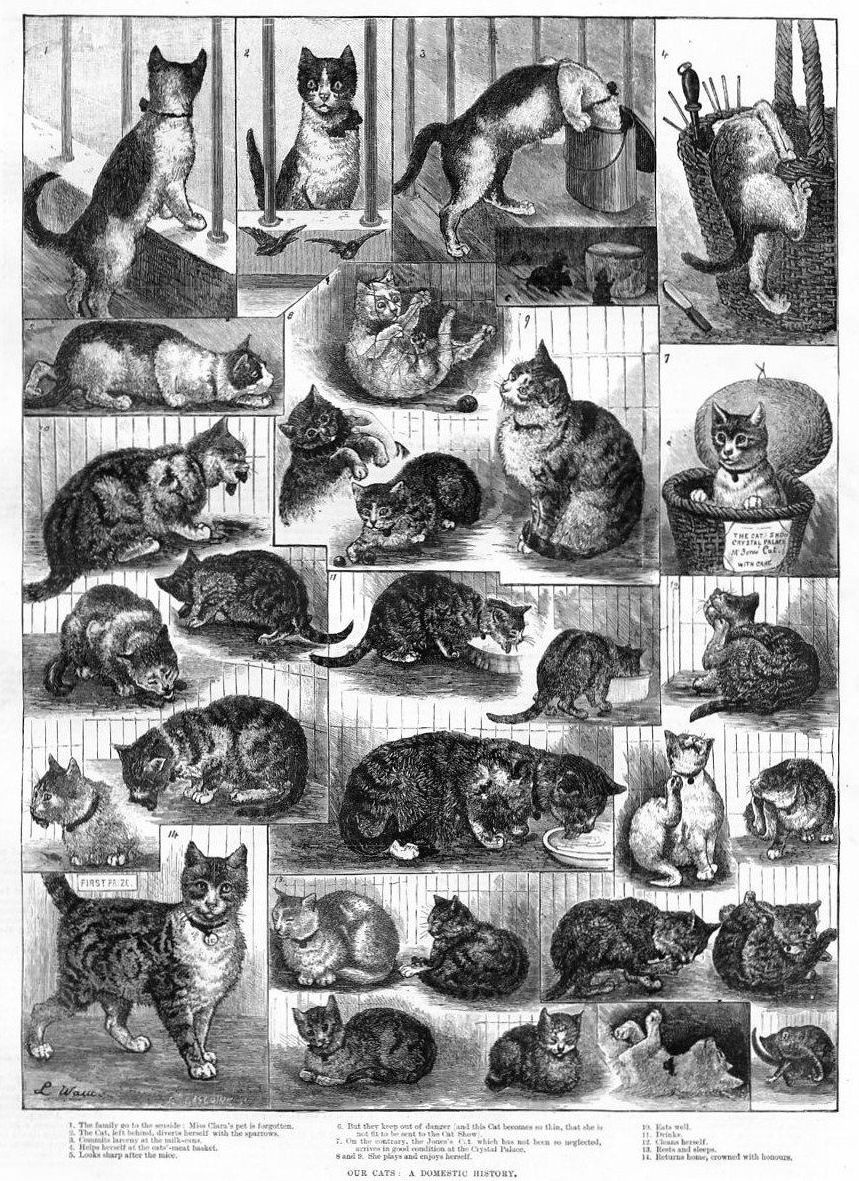
BRITAIN'S FIRST CHAMPIONSHIP CAT SHOWS
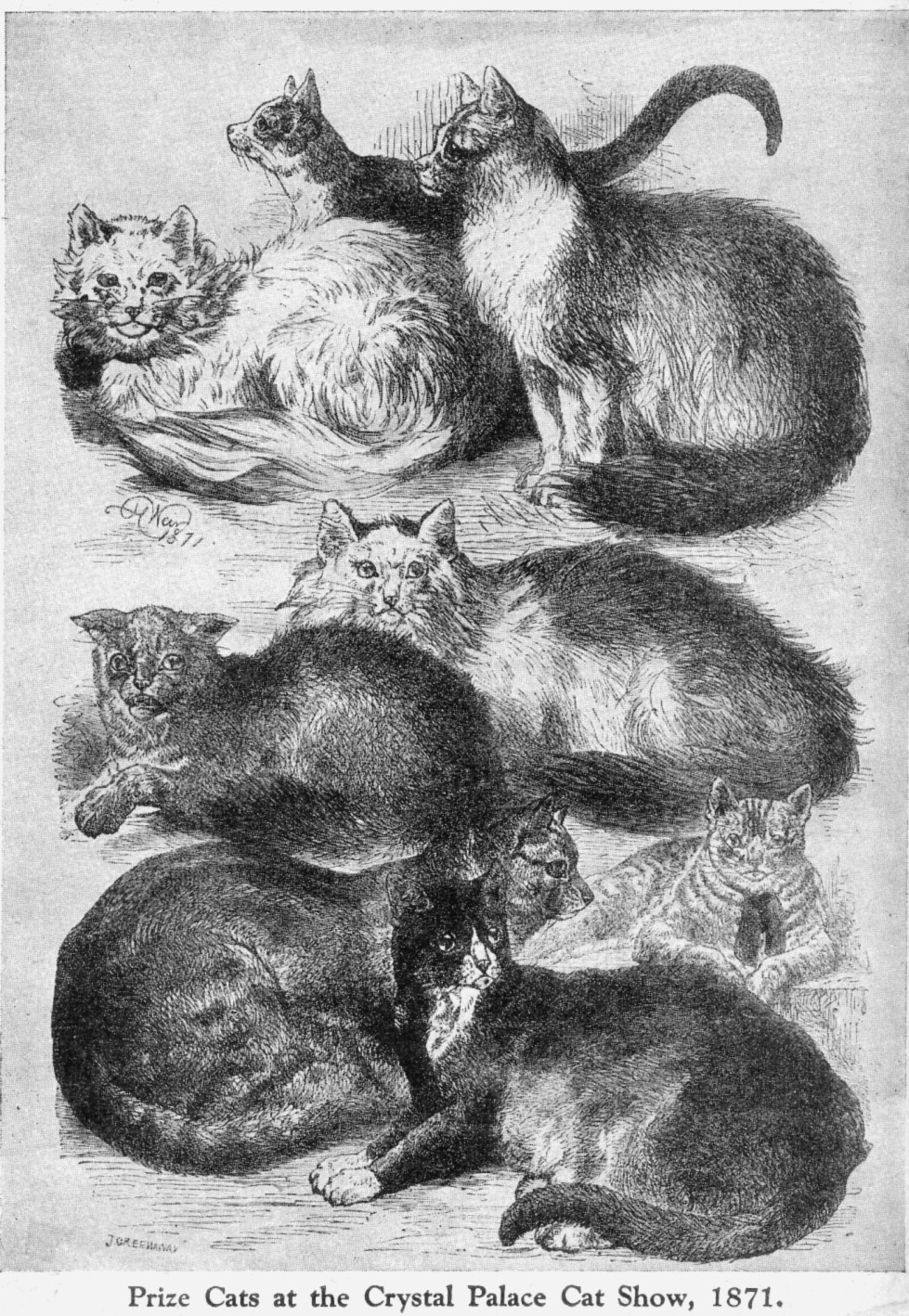
Barely twenty years after Darwin had been so dismissive of selective cat breeding, the world's first "Championship Cat Show" was staged at London s Crystal Palace on Thursday 13th July 1871 (some sources quote 12th or even 16th July, press reports support the date of 13th July). Although the first Crystal Palace Cat Show had been held several years previously, a Championship Cat Show was the brainchild of writer, artist, and noted cat lover, Harrison Weir who wrote breed standards against which the entries would be judged and he was one of the three judges. Weir suggested the idea of a cat show to Mr Wilkinson, the Manager of the Crystal Palace which was one of London's leading venues at the time, so this really was a high profile event! Before the day was over, the Crystal Palace Company presented Harrison Weir with a pint-size silver tankard "in recognition of his suggestions and services."
Weir grouped the cats in different classes according to length of fur, colour, shape and build. He drew up guides for judging and called these "Standards of Excellence" or "Standards of Points". For the first time the number of marks awarded for the colour of coat or the shape of the body were laid down. Weir's work was later incorporated into a standard manual for cat show organisers, "Our Cats" and he is recognised as the father of the cat fancy.
|
|
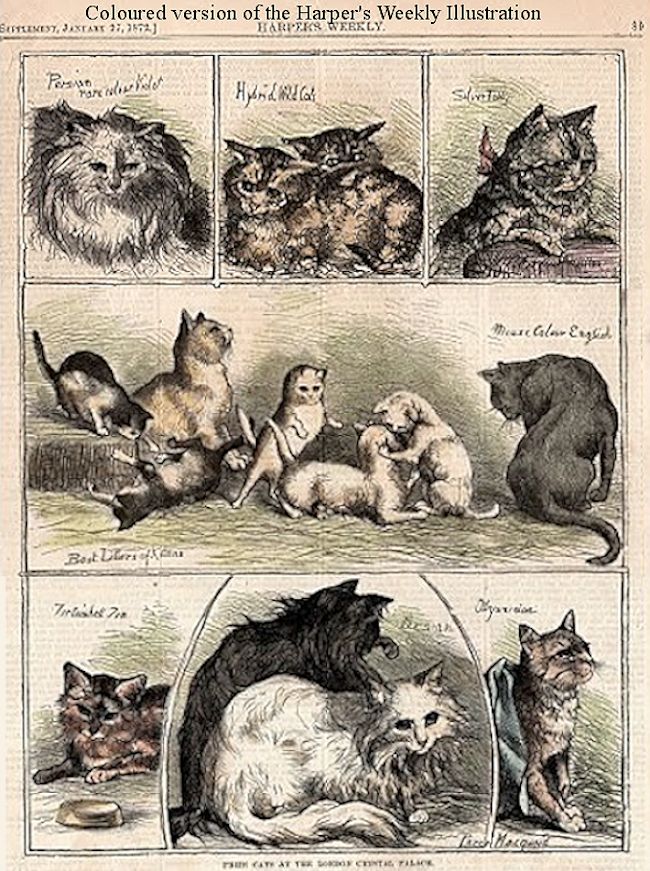
The legend on the 1871 illustration of prize-winning exhibits reads:- Top left-to-right: Persian rare colour Violet; Hybrid Wildcats; Silver Tabby. Middle left-to-right: Best Litters of Kittens; Mouse Colour English. Bottom left-to-right: Tortoiseshell Tom; Persian; Abyssinian. |
He later wrote that he had "conceived the idea that it would be well to hold Cat Shows so that the different breeds, colours, markings etc. might be more carefully attended to and the domestic cat sitting in front of the fire would then possess a beauty and an attractiveness to its owner unobserved and unknown because uncultivated before". He had been distressed by the long ages of neglect, ill-treatment and absolute cruelty towards domestic cats had suffered, and his main objective in organising the first show was promoting their welfare rather than providing an arena for competitive cat owners.
"The first cat show led up to the observation and kindly feeling for the domestic cat. Since then, throughout the length and breadth of the land, there have been Cat Shows, and much interest in them is taken by all classes of the community. Having before my mind many instances to show that Shows generate a love for cats I have never regretted planning the first Cat Show at the Crystal Palace." But in 1892, Weir prefaced the second edition of Our Cats and All About Them with his remorse at being part of the National Cat Club, a club whose ideals he no longer believed in. I now feel the deepest regret that I was ever induced to be in any way associated with it, he wrote. The problem was that narcissistic pet owners were not so much fancy cats, but cultivating their personal images. I found the principal idea of many of its members consisted not so much in promoting the welfare of the Cat as of winning prizes, and more particularly their own Cat Club medals and only the members of that Cat Club were eligible to win those medals. The Cat Fancy had become an exclusive club from which the general public was excluded from joining. Some judging categories were divided by the cat owner s social class. Some cats entered into the working-men s classes are also entered in the ordinary classes [. . .] These, to my mind are only bogus working-men's cats," according to one reporter at the 1899 Cat Club show.
|
|
|
The Victorian public at that time had a great appetite for exhibitions. The Crystal Palace had housed industry exhibitions showcasing inventions from around the Empire. Other fancy animals were bred and exhibited and cat lovers were not to be outdone. Many exhibits were Longhairs, though these were shorter-coated and longer-nosed than modern Persian Longhairs. Weir himself he preferred the shorthairs and it would be some years before the Angoras and Persians came to dominate the shows. It attracted thousands of cat lovers, many of whom went on to organise local cat shows on similar lines.
The show manager was one Mr Wilson and the judges were Harrison Weir, his brother John Jenner Weir and the Rev J MacDona (or McDonald - reports vary!). It was well advertised in London and posters showing a large head of a black cat were widely distributed. The cat show was advertised in The Times of 10th July 1871, "The Cat Show is to be held on Thursday next", but no-one was certain of what to expect. Weir, the show's organiser, had some concerns en route to the show - he had no idea how many exhibits he would find there, nor how they would behave. It was feared they would sulk or be distressed. The official show advertisements stated 25 classes comprising nearly all the known species of Eastern (i.e. Angora and Persian) and other foreign (Russian, Siamese) cats, as well as the British varieties (Shorthairs, Manx). The show attracted 170 exhibits and awarded 54 prizes; the large number of prizes being an incentive for future shows. The prizes were awarded to 32 gentlemen, 15 married ladies and only 4 spinsters - apparently dispelling the myth that cats were pets for spinsters. The Daily Telegraph urged its readers to "Hurry down as soon as they had finished reading these lines" and there were such vast numbers that it was sometimes impossible to see the cats. The cats themselves were penned in cages borrowed from the Pigeon Society and most were quiet and well behaved.
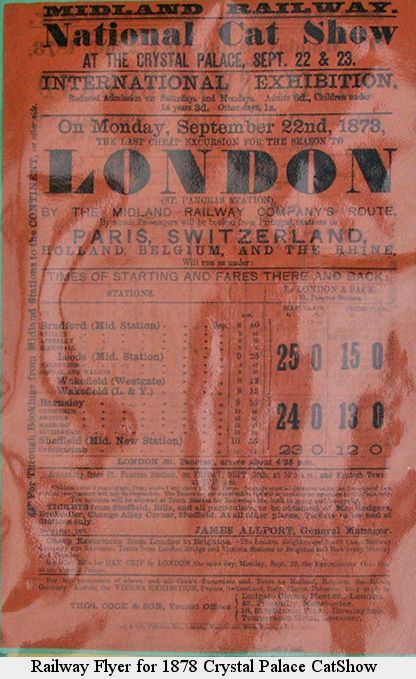
There were novelty classes which would not be permitted today including a prize for the fattest cat (won by a huge 20 lb cat belonging to a Mr Nash) and also for the biggest cat. Some of the more unusual exhibits included an Algerian Cat, listed as a French African cat. The Duke of Sutherland exhibited a British (i.e. Scottish) Wild Cat which had lost its right front paw and behaved like a mad devil, no doubt through terror. The two Siamese cats brought varying opinions. One writer described them as an unnatural kind of cat , whilst another thought that they were singular and elegant in their smooth skins . The Daily Telegraph, which had earlier urged its readers to go to the show, described the Siamese cats as curious, unprepossessing and their colours completed "the resemblance of the little brutes to a pair of pug puppies". One of the winners was Harrison Weir's blue tabby, "The Old Lady" who was fourteen at the time. For many years after this win her owner wore on his watch chain the silver bell that The Old Lady had worn round her neck at the Palace.
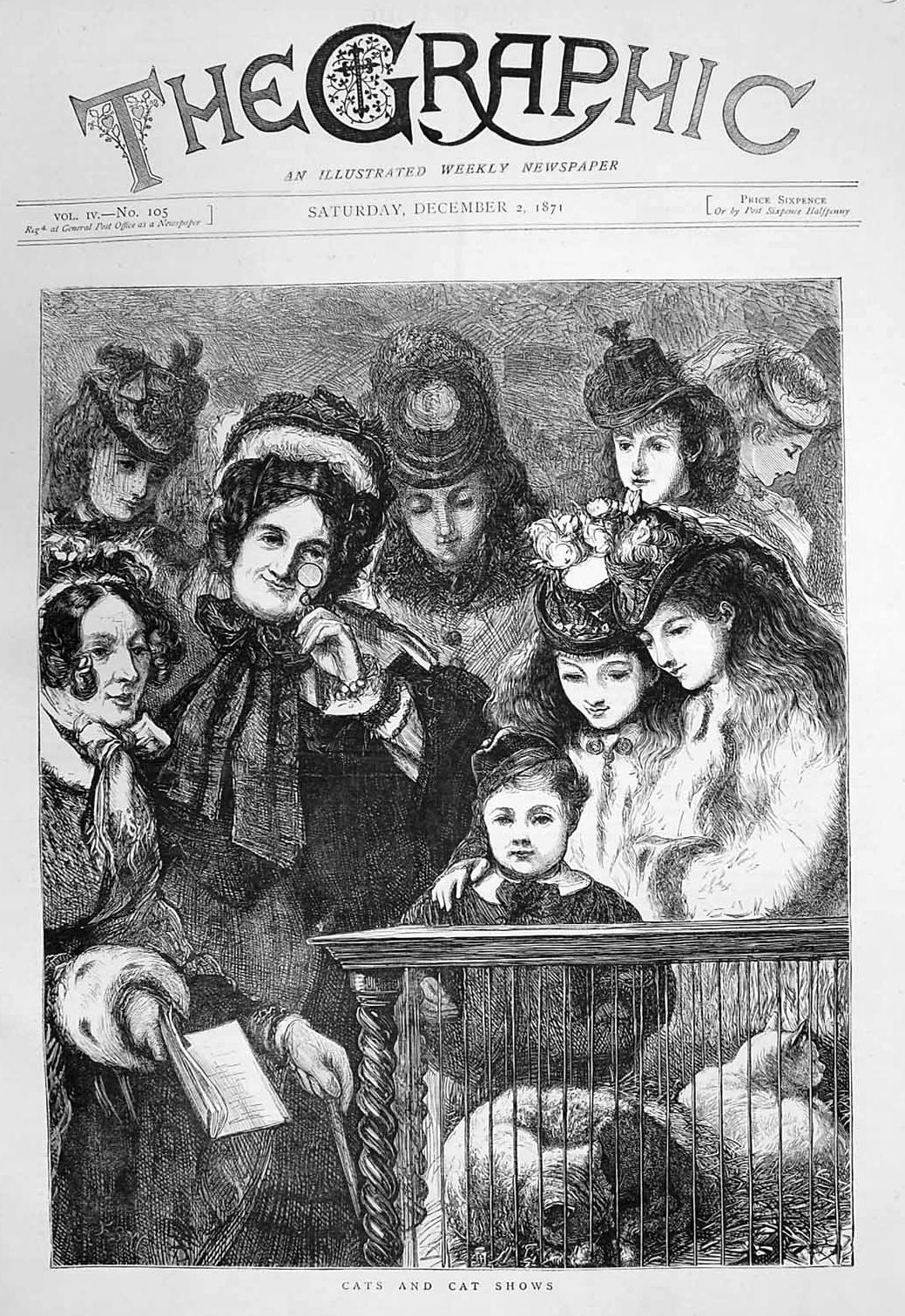
According to the following day's Morning Post: " The greatest novelty of the day in the way of shows is the show of cats at Crystal Palace. We have had cattle shows, horse shows, dog shows and shows of various other animals more or less domesticated. hut this is the first cat show of an extensive and thoroughly organised character the world has ever seen." After the event, several journals reported Weir's cat show. Prior to the show there had been concern over how the cats would behave and Harpers Weekly of 19th August 1871 described the problems of caging one cat on the day of the show. It also seemed that one day was not enough for some people as The Illustrated London News of 22nd July 1871 reported "The show was only open one day." So successful was the show that later in 1871, a second show was held at the Crystal Palace, this time a three day show running from Saturday 2nd to Monday 4th December according to a report in The Times on the 4th December.
Cat breeding and showing had mainly interested middle and upper class women, with several aristocrats participating, so how did the "working men's" classes begin? One version (which corresponds to Weir's original aims) is that those upper classes (who were always keen on educating the masses) wanted to promote better cat care among the lower classes. Hence the earliest shows had classes for "Cats Belonging to Working Men". Another version of the story goes that when that first show was held at Crystal Palace, not enough cats could be found as exhibits. The cellars at the Crystal Palace were full of stray cats, so workmen were told to round them up. The generous prizes on offer prompted the workmen to enter their own pet cats for the show as well, leading to working men's classes. In recounting the history of the show in Pearson s Magazine ("Show Cats," in Vol V, Jan - 1898) GB Burgin wrote that the shortfall of entries was remedied thus: "Then someone discovered that the Palace cellars were full of cats and kittens and mice, so a few workmen were set to work cat-hunting there. The workmen also brought their own cats to the show."
The catalogue of the Fourth National Cat Show held at Sydenham, England, October 26th, 28th and 29th, 1872, lists on page 15 under the heading " Class 21 -Short-haired Unusual Colour She-Cats " the entry " 127 Lady Dorothy Nevill, Pure Siamese ' Mrs. Poodles'." Page 12 of the 1875 catalogue carries under the same heading the entry: " 112 Mr.J. Walter, Siamese, 'Mymie,' aged five years. Winner of First Prizes Crystal Palace 1873 and 1874." At this time there were Chinese and Japanese cats as well as Siamese and Abyssinian, so the early "Siamese" cats may have been different to those sent to England in 1884. Some of those "Unusual colour" cats might have been brown Burmese cats or the intermediates now called Tonkinese.
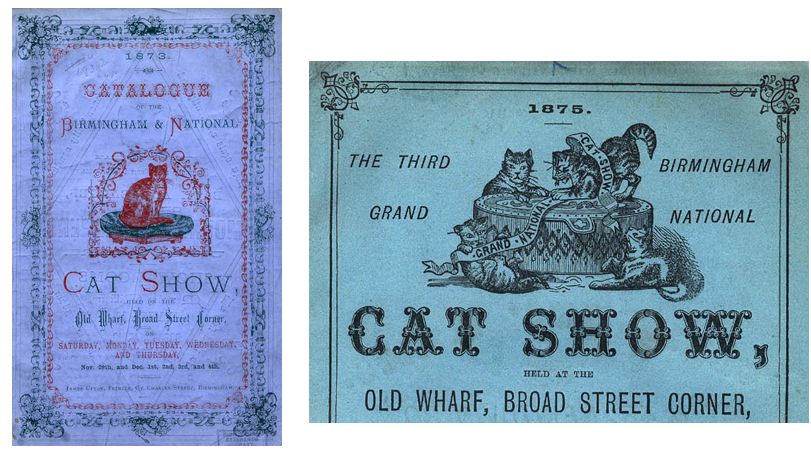
In 1873, a cat show was held at the Alexandra Palace, north London and another was held in Birmingham. The 1873 Birmingham Cat show had 51 classes. Class 11 was for cats of an Unusual Colour Colour to be any remarkable hue not otherwise specified, the Any Other Colour class of its time. There was also a class for Cats of no Sex referring to male neuters. The 1875 show had 48 classes and Cats of No Sex had become Gelded Cats . The shows were held at the Old Wharf off of Broad Street. The cost of entering a cat was 3s, 6d, which paid for the exhibit s food and for Suitable pens and Cushions . The majority of the exhibitors were from Birmingham and its environs, but the 1875 catalogue lists exhibits from much further afield. Miss Boville s exhibit came from Portsmouth. Captain Nicholson s exhibit came from Denbigh. Mrs Nicholls cat was from London and Mr Horner s cat came from Leeds. Many would have been sent unaccompanied by train under Regulation 4: All Cats from the country must be forwarded on Friday [ ] Each Cat must be in a separate basket except, of course, the mother and kittens classes. There were several classes for cats owned by working men with a reduced fee of 1s to enter a cat. Rule 14 stated this was To encourage the kind treatment of domestic Cats, the Committee offer a series of prizes to be competed for by Working Men. The cats on show were offered for sale, Exhibitors must state on the Certificates the price at which they are prepared to sell their Cats [ ] A prohibitory price may however, be stated . In 1873, Master G. Tansley s entry in the heaviest long-haired cat class had the prohibitory price of 1000. In 1875, Mr and Mrs Helden put Not for Sale against their evidently beloved long-haired tabby cat. An explanatory note stated: At the Siege of Paris [1871] the owner of this Cat repeatedly refused 30 francs for it to be killed for food.
The 1875 show in Edinburgh attracted 570 exhibits while the Crystal Palace show of the same year had 325 exhibition pens and included a special class for "Wild or Hybrid between Wild and Domestic Cats". The wildcats class was won by an ocelot. Bengals, Chausies and Savannahs may seem like modern fads, but hybrids have been shown right from the early days and the 1871 illustration depicts Hybrid Wildcats (top row centre).
The prizes on offer would certainly have encouraged the working class to enter. First prize might be as much as 30 shillings. Entry fees and prizes in the Working Men's classes were lower than in the other classes. This also made show cats, particularly winning cats, very valuable and hopefully better cared for. At this time, an exhibition quality longhaired cat might cost the equivalent of a housemaid's annual wages, with some Champion cats being worth twice or more that amount. Exhibitors were soon less interested in cat welfare than in promoting their own breeds and, most importantly, in winning prizes. They were, to use a term from the world of horse events, pot-hunters.
The Cat Fancy's early beginnings in Britain were also described by a ship's doctor, who was also a veterinary surgeon, writing circa 1872. Doctor Gordon Stables listed the classes at what he refers to as 'pussy shows' taking place at the Crystal Palace and at Birmingham. In his list of the classes at the Crystal Palace and Birmingham shows, Dr Stables discussed the points to be looked for in the exhibits. Regarding shorthairs he wrote "Class 1. And first on the list comes Tortoiseshell Tom" Stables found Tortoiseshell Tom an ugly cat and expressed surprise that he only seen one tortie tomcat, and that one died at three months old. In many of the classes listed, the exhibits were to be judged by 'size', and Stables observed that the Black and White "...is a large, handsome, gentlemanlike fellow". Stables gave unusual advice to exhibitors in the matter of preparing an exhibit's coat for the show: little dabs of fresh cream here and there over the cat's fur so that the prospective contender will wash his coat so thoroughly and so extensively as to produce a beautiful, shining pelage. Stables, writing in the 1870s and before the era of genetics, would not have understand the scarcity of tortie tomcats. Stables' book suggested there was no class for the Blue cat, however he does mention the "Blue or Silver Tabby" while "Unusual Colour" there is a "Maltese" which was describes as all of one colour, "a strange sort of slate colour or blue: even the whiskers were of the same hue."
From the Western Daily Press, 22nd November 1876, we have the fall-out from a cat show. Bear in mind, that at this time cats were sent unaccompanied by rail and it was not unknown for cats to be sent back to the wrong owners afterwards. During the unpacking and re-packing of the feline exhibits, some escaped the stewards never to be seen again. A CAT SHOW COURT. At Lambeth police court, Robert Couldry, living at Lower Norwood, appeared to a summons for detaining a prize cat, alleged to be the property of Alfred Mackness. According to the evidence it appeared that in November, 1875, a cat show was held at Birmingham, which both complainant and defendant exhibited white she cats. For that exhibited by the defendant he was highly commended, but the complainant, for his, obtained a prize of 25s. The prize cat, after being brought to Norwood, disappeared, and from inquiries made it was believed the defendant had it in his possession. The animal was valued at 15. The complainant afterwards went to the cat shows at Alexandra Palace and Crystal Palace and there saw what he believed to be his white cat, At latter show it was entered as the property of a Miss Johns, and, although white, was described "Charcoal" by name. The defendant, when afterwards spoken to, said he had had the cat for two years at Crystal Palace, where he was employed. He had since refused to give it up and hence the present proceedings. The complainant denied that his cat was lost in transit from Birmingham to London, and said he could swear to his animal out of dozens. It was remarkable from the blue colour of its eyes. For the defence it was urged by Mr Bilton that the cat exhibited the Crystal Palace was the property of the defendant, and the one that was highly commended at Birmingham. To bear out his line of defence he added that he would have a number of cats brought before the Court, and ask the complainant to see if he could identify the one he claimed. Accordingly a box containing three white she cats, and two baskets, each containing another cat of a somewhat similar colour, were brought in. The cats, by one, were taken out, and examined by the complainant, who declared neither was the prize- cat, he claimed. Some witnesses believed that one of cats in the box was the property of the complainant. The defendant was sworn, and declared that the cat he exhibited at Birmingham and which was "highly commended," was his own, and the same that was in the show at the Crystal Palace. The magistrates dismissed the summons.
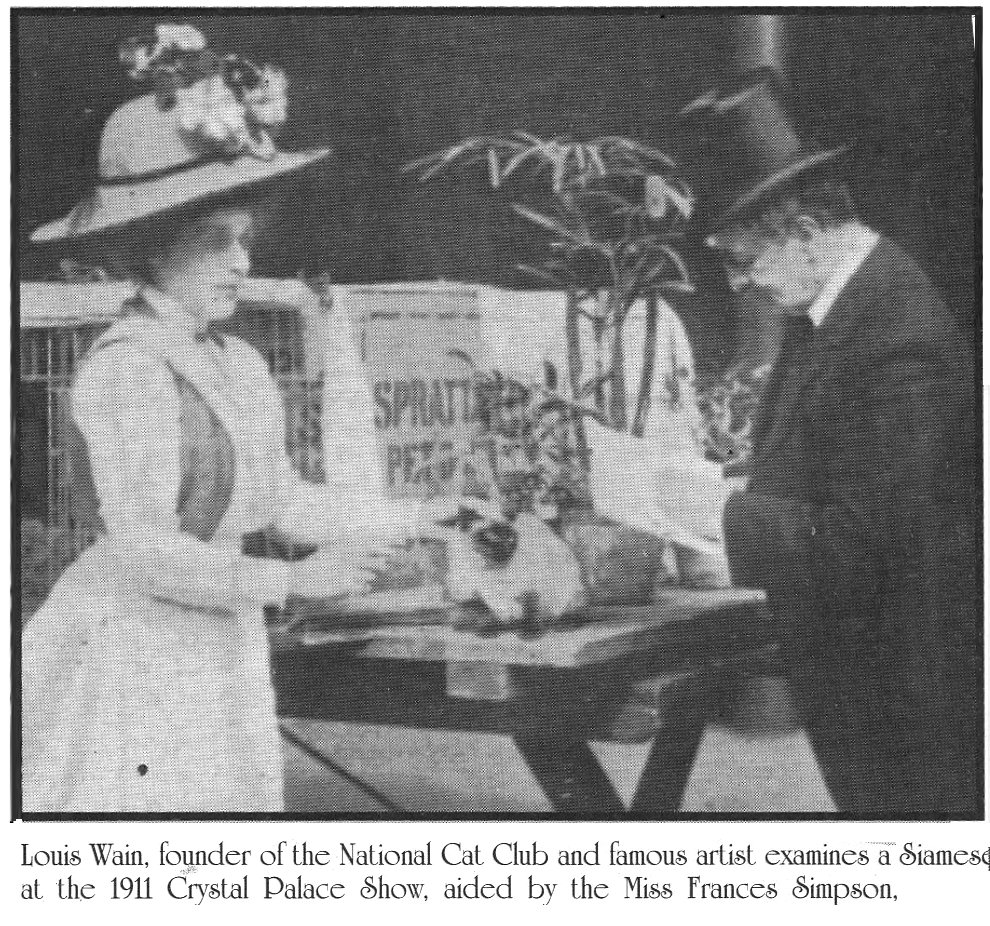
By 1887, cat shows were regular events and the National Cat Club was founded in London. The idea of a National Cat Club was first mooted at an impromptu assemblage of ladies and gentlemen on June 15th, 1887; the second day of the four day Alexandra Palace Cat Show. The National Cat Club aimed to promote the breeding of pedigree cats (and the proper keeping of pedigrees) and organise shows. The first National Cat Club Show was held at the Crystal Palace, London, in July 1887. The Show Manager was Mr F Wilson and 323 cats were entered. It was judged by Mr and Mrs Harrison Weir and Dr Gorden. The Entrance fee was 3 shillings and sixpence with an additional 2 shillings for Miscellaneous Club classes. The National Cat Club's first President was Harrison Weir, but he resigned because he felt that members were becoming elitist and more interested in winning prizes than in promoting the welfare of cats (the reason he has organised the 1871 show). He was succeeded by the artist Louis Wain.
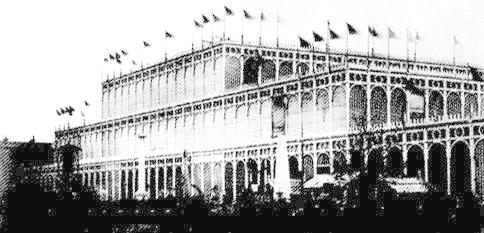
In 1890, the gentleman s sporting journal The Field published an article about the Crystal Palace Cat Show by naturalist W.B. Tegetmeier.
THE NATURALIST. VARIATIONS IN THE CAT. Field, 25th October 1890
The Annual Cat Show at the Crystal Palace, which took place this week, affords an opportunity of investigating the progress that has been made in producing or intensifying variations in the domestic cat during the score of years the show has been established. In one direction there has certainly been a decided progress. On the occasion of the first show, fancy cats were so little thought of, that Mr Wilson, at that time naturalist to the Palace, told me he had to make up the number of entries by exhibiting some of the numerous cats kept in the building as rat catchers, and showing them in the names of the employes; whilst at the present time the "cat fancy" is in the ascendant. We have not only a National Cat Club, but a cats' house - for boarding the animals during their owners' absence - which we are told is supported by "sympathising subscribers; but the proposal for a cat and cage-bird necropolis, which was gravely started by a deceased bone-setter, and supported by various titled personages, proved too great an absurdity for the public, and reached no farther than the issue of the prospectus. There is, therefore, little chance of the remains of our favourites being ground into manure for the benefit of the inhabitants of some yet uncivilised island a few thousands of years hence, as recently happened to the cats entombed by the ancient Egyptians at Beni Hassan. Nevertheless, the cat fancy progresses. Six hundred animals of the different varieties of Fells domesticus were on view at Sydenham on Tuesday and Wednesday last, where they were arranged in some fifty classes, and competed for 150 prizes. This large number of classes exceeds that of the known varieties, and was formed by separating the sexes and ages of the animals, and giving a duplicate set of prizes to the cats of the proletarians.
The animals were arranged primarily into short-haired and longhaired; those in each group being shown in classes according to sex, age, and colour. The chief self-colours - to borrow a term from the florists' vocabulary - are black, white, and smoky tint, by courtesy called blue. The striped cats - termed tabbies - are divided into those with brown ground colour, those with a light or "silver" ground, and the sandy, or "red" tabbies. There are also classes for such as have the stripes broken up into spots. The tortoiseshell offers some singular phenomena to the naturalist - in the tortoiseshell without white the colours are mingled black and reddish sandy. She tortoiseshell cats are not uncommon, but males are of extreme rarity, and consequently of considerable pecuniary value. In the tortoiseshell and white the colours are in much stronger and larger patches, and more distinctly defined. This marking prevails in both sexes. As a show cat, a tortoiseshell tom would be a great acquisition, only one having been on view during the whole of the Palace shows. Various attempts have been made to produce the variety by careful selection of parents. The result of one of these experiments, which was by courtesy called tortoiseshell, was shown at the Palace - a dark, badly coloured grizzle, showing that much more careful experimenting must be had recourse to if the desired result is to be obtained. That this can be accomplished there can be no doubt; for, a few years since, sandy or "red" tabby females were exceedingly rare, but, by careful selection they have been bred, and at the show no less than six specimens were exhibited.
The Siamese breed, dun in colour, with all the extremities, nose, ears, feet, and tail black, has become much less definitely marked than when first imported. The long-haired cats of various colours - which are usually termed Persian or Angora, after the place from whence they are generally obtained - are remarkable, not only for the length of the hair, but also from the fact that in many there is incomplete development of the sense organs. The eyes are blue, like those of a kitten before being opened; and in many, but not all, the internal ear is correspondingly undeveloped, and the animal consequently deaf. These longhaired varieties are more delicate than the common breed, and are subject to epileptic attacks, during which they dash about in an alarming manner, but usually recover if they are allowed to remain perfectly undisturbed in the place in which they endeavour to conceal themselves.
The origin of the domestic cat is doubtless of a composite character. The ancient Egyptians mummified their domestic variety, derived from Fells maniculata, a North African species; and in every country in which the cat has been domesticated, it has crossed with the smaller wild Felidae of the district, and acquired new characters; so that the cat of the more secluded districts of the western world are unlike those of Europe, which again differ from the cat of Persia, as they do from the animals of the still further East. The exact history of the long-haired Persian is not recorded. It probably was derived from an animal in which a natural variation occurred, which was valued and carefully bred from. Long hair is not uncommon in the Felidae. Not long since a long-haired variety of the cheetah (Felils jubatus) was received at the Zoological Gardens, Regent's Park, where it was immediately raised to the dignity of a distinct species, and called Fells lanea. It is doubtless owing to the multiple origin of the cat, and the difficulty under ordinary conditions of regulating the parentage, that the numerous varieties are due, and that so little dependence can be placed on the colours of the kittens in any particular litter. W. B. TEGETMEIER.
This was Harrison Weir s letter in The Field (8th November 1890), in response to Mr Tegetmeier. (Weir claimed to be originator of that first cat show, not giving due credit to Mr Fred Wilson.) Sir, - Having read Mr Tegetmeier's notice of the last cat show at the Crystal Palace, I should like to make a few observations with regard to it. He states that at the first Cat Show at the Crystal Palace Mr Wilson had great difficulty in getting a show together, and was obliged to have recourse to some of the departmental cats to make up. This was so, and as I was the originator of the show, and also worked to get entries, I can give the cause of the difficulty. It was not so much that there were not good cats then, but neither I nor he could induce the owners to send them, they saying, in most cases that the cats would knock themselves to pieces against the wires of the cages in their efforts to escape, &c. When I sent my own silver tabby (not for competition) l was much afraid that she would so injure herself, and both Mr Wilson and myself were much surprised at the quiet way in which the cats resigned themselves to their fate. I may add that there were quite as good longhaired cats kept then as now, and they were generally called French or Paris cats. Perhaps this last was a corruption of the word Persian.
As regards the Siamese cats, to which Mr Tegetmeier refers as losing their markings from being bred here, I think, possibly, he was led into error by seeing a clouded chocolate-coloured Siamese she cat. This is the cat which I have noticed, and about which I had much correspondence in reference to my book "Our Cats," and in the course of which I learned, and which I set forth, that there was this colour in Siam as an independent breed from the drab colour with black points, and It was very rare, and of equal, if not of more value than the preceding. The specimen shown at the Palace, I believe, was imported direct from Siam. I also learned there was a third and larger breed.
As regards the drab or fawn breed, I have not myself seen any deterioration in the markings to those bred here. There is much variation in the imported specimens, some being deeper in the black markings than others, but I am apt to think, if we can acclimatise them, which is a doubtful matter, so many dying, that with our careful matching we shall improve the colouring rather than not. However this may be, one thing is certain, they have been of much use to the cat fancier in the way of crossing for variety of colour with our own English and some foreign breeds. The young of these cats differ from ours, inasmuch that when some of them are born they can see, and the rest of the litter have their eyes open in two to three days. Again, like the Himalayan rabbit (so called), which is nearly white when kindled, and the black parts only appearing after the shedding of the first coat, so with the Siamese cats, they not attaining to their full colour until the end of the second year, nor do the eyes assume that beautiful opalesque colour.
Just another word or two respecting the deafness of white cats. Mr Tegetmeier states that blue-eyed cats are often deaf, though not all; this is true, and a white cat may also have bright, orange-yellow eyes, or green, and yet be "stone deaf. One of mine, a Persian, was so. Black cats are sometimes partially deaf, but tabbies seldom. I have also noticed that in deaf white cats the sense of smell is sometimes deficient. There were several new shades of colour shown at the last Crystal Palace Show, both in the long and the short haired varieties, which were exceedingly interesting to both the naturalist and cat fancier. The show also was so large that no doubt exists that the breeding of beautiful cats is now becoming the fashion. HARRISON WEIR. Sevenoaks, Kent, Nov. 1.
In 1893, the cat fancy was well enough developed that Wain began the stud book for these exhibition cats as sceptically reported in "A Stud Book for Blooded Cats" (The New York Times, January 16, 1893; reprinted from the London Daily News): "A publication which claims to be "the first stud book concerning the cat that has yet been attempted," demands a note, both as a literary curiosity and as a document for the future historian of our domestic pets. Such is the "Stud Book and Register" just issued to members of "The National Cat Club," and published by Messrs, Clarke Son of Bromley, Kent. The substantial feature of the pamphlet is the register of some 200 pedigree cats, the property of about fifty persons, with notes of their points. No attempt, of course, is made to trace any cat to Dick Whittington's famous animal, materials for genealogical research being wanting, though "sires" and "dams" are in most cases gravely recorded. Mr Louis Wain, the popular cat artist, has very appropriately been chosen President of the club, which claims to have the welfare of "Poor Puss" at heart without any idea of personal advantage, and sensibly declares its object to be "not only to breed handsome cats, but healthier cats."
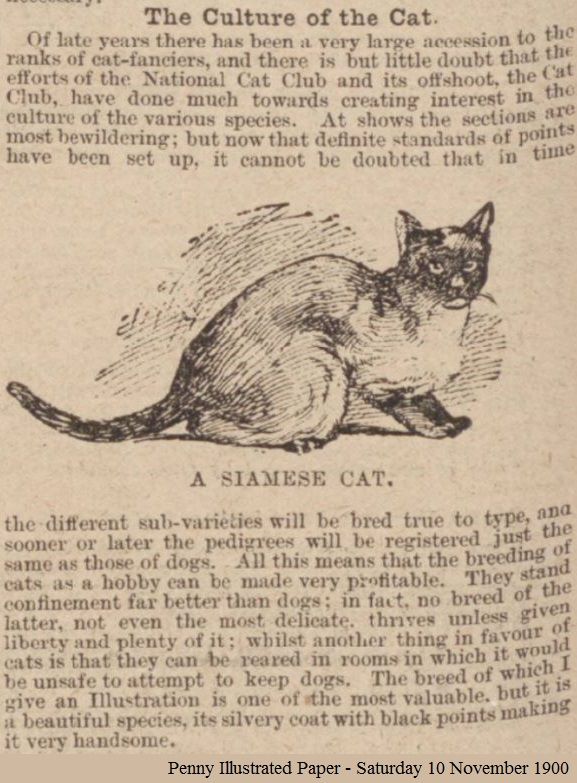
The Lady s Realm of 1900 (Vol VIII) said Weir had done wonders for the amelioration of pussy. [. . . ] "how great has been the change in the conditions of life of the harmless, necessary cat! Never mind their owner s class or lack of it, the humble cat had become a household pet, enjoying the comfort of the fireside. Prior to Weir's cat shows, puss was a street animal or, at best, the cook's rodent controller. Before Harrison Weir raised their image and profile, cats were considered street animals and pest-controller. Very few valued them purely as pets or attractive living ornaments. In his 1889 book Our Cats and All About Them, even Weir the father of the cat fancy had admitted an initial bias against the feline race.
(In 1902) Just over twenty-five years ago was held the N.C.C. Charity Cat Show, which was a great success. The prizes were given away by the Princess Alexis Dolgorouki. Lady Decies had conceived the idea of a ring-class for the charity, with a five-shilling fee and the honour as prize. This nearly caused a fiasco, as a savage fight took place between Mrs. McLaren Morrison's Black Cherry and Mrs. Stead s Champion Smoker Ranji. Ladies screamed, cats swore, Ranji escaped and hid under a piano, and Dr. Roper received a nasty bite. Those ring-classes! How well we remember our Red Indian S.H. clearing the ring on one occasion. H.C. Brooke, Cat Gossip, March 16 1927
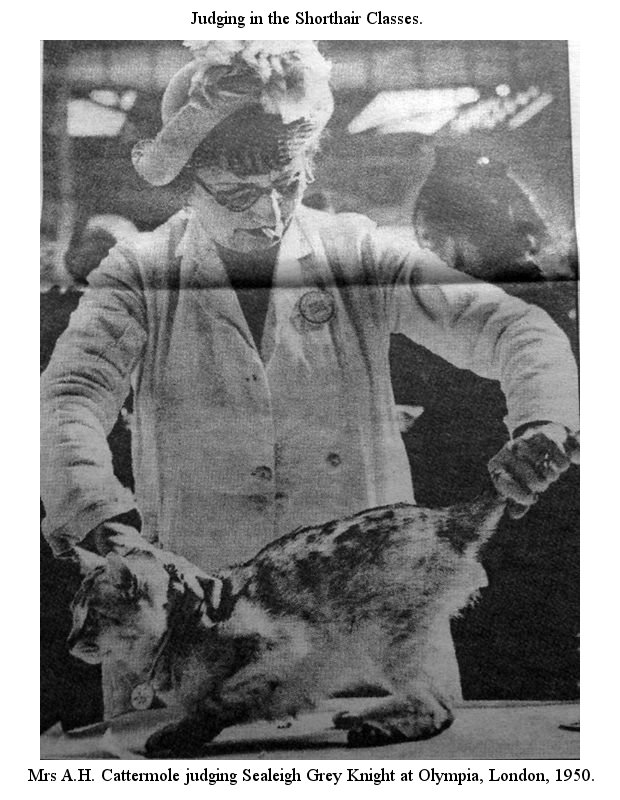
Until 1910 the National Cat Club was also, the Governing Body of the Cat Fancy. In 1910 the Governing Council of the Cat Fancy (GCCF) was formed. The National Cat Club Show was held at Crystal Palace until December 1936 when the venue was destroyed by fire on the eve of the National Show. Fortunately for the NCC, they had not taken their trophies there on the day before the show as was the usual practice! In the following years, the show was held at a number of different venues: Paddington Bakers Hall, Kentish Town Baths, Paddington Baths, Seymour Hall, the Royal Horticultural Hall, Olympia and Earls Court. The current venue is Olympia, although it is often uncomfortably crowded for visitors (especially in comparison with the Supreme which is held in the more spacious surroundings of Birmingham National Exhibition Centre).
The following words were written by Harrison Weir in 1903 for the preface of Simpson's "Book of the Cat". Thirty years had elapsed since his Crystal Palace cat show and his words make it evident that he was disenchanted with the course the cat fancy had taken:
"Thirty years ago it was apparent to me that cats were not valued at their true worth, and then I suggested a show of cats! Let anyone try to start anything new, though novelty is said to charm! Many were the gibes, jokes, and jeers that were thrown at me then. But nothing succeeds like success. Now, if I may without offence say a few word as to present day shows, it is that they have not answered my expectations. Why? Because particular breeds are catered for an run after. Why such breathless talk about long-haired cats, be they blues or silvers? This is not cat breeding. I want, I wish, and, if I live, I hope to see far more of the 'harmless necessary cat' at our shows; for a high-class short-haired cat is one of the most perfect animals ever created. [ ] Far more I might, and perhaps am expected to add; but my life's work is well-nigh done. He who fights honourable the good fight sinks at last."
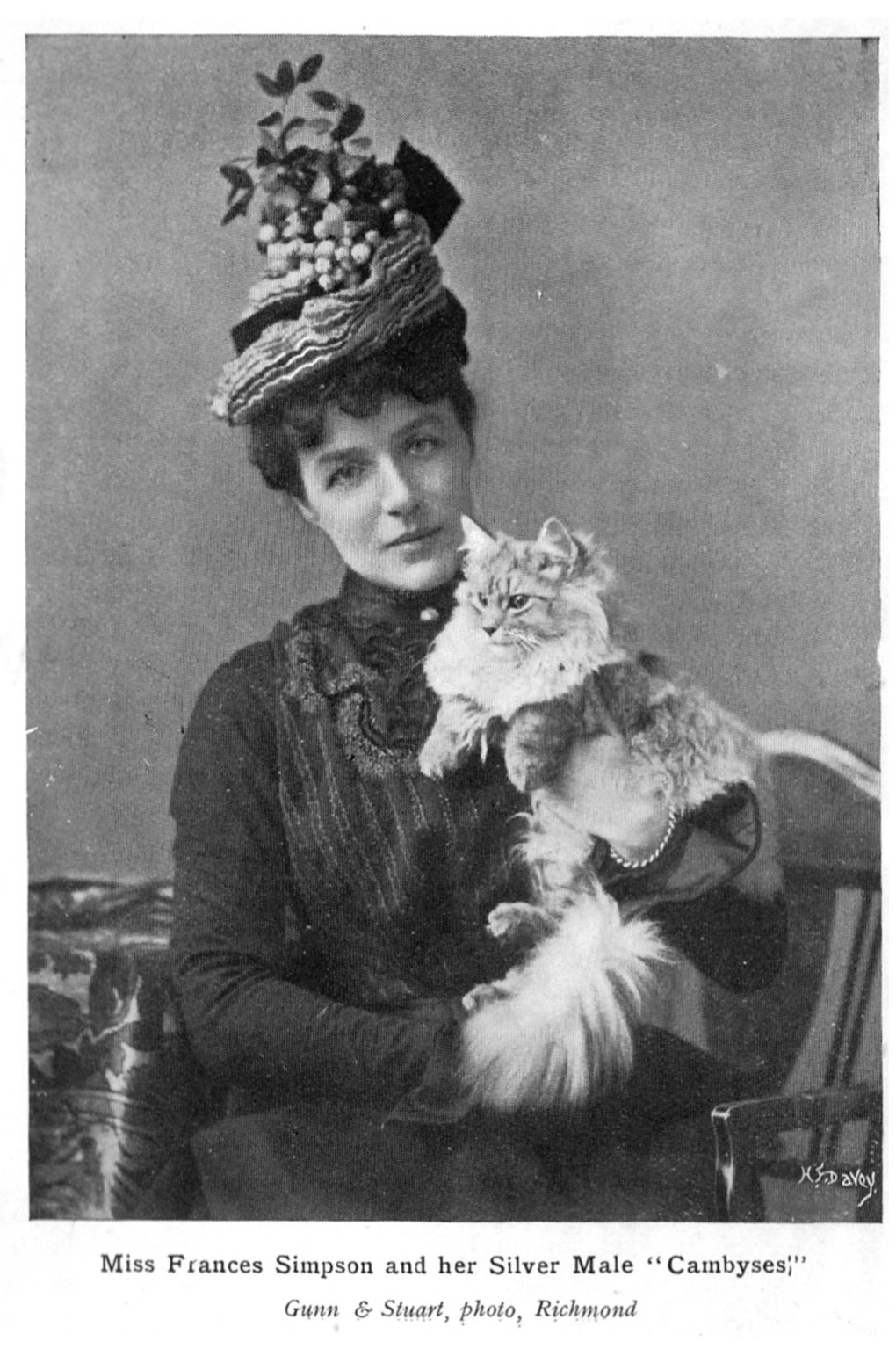
While Weir preferred shorthairs, Frances Simpson and others championed the Persian. The weekly "Fur and Feather" magazine first appeared in 1890 and Persian cats were offered for sale in its columns. It also contained letters and one cat exhibitor wrote to Fur and Feather complaining that "The last time I showed my Russian was in a class supposedly for Russians only. She was, however, beaten by a round-headed British Blue."
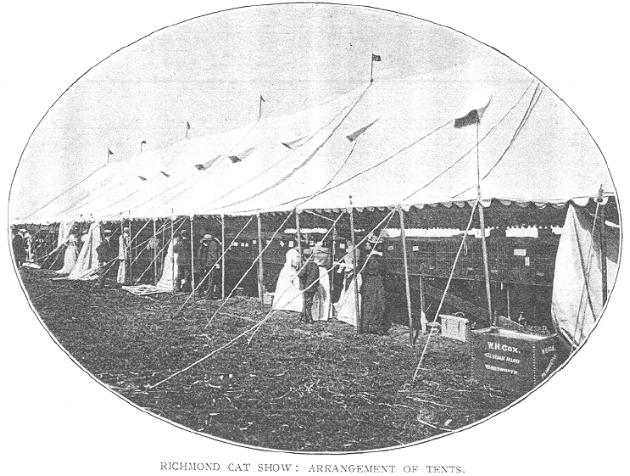
In 1898, an aristocratic breeder and cat collector, Lady Marcus Beresford, founded a rival organisation called The Cat Club. Its members included some of the most important people in the land. However, The Cat Club foundered in 1903. It was replaced by yet another group, the Cat Fanciers Association.
Queen Victoria herself helped popularise cats. The Queen has done much to make cats popular pets of society. At the big bazaar last season she bought two pairs of Siamese cats, and when visiting Wales some years ago she took with her a pair of Persian kittens, which she hardly allowed out of her sight. The only Royalty, however, whose name has ever figured in catalogues of cat shows is the Princess Victoria of Schleswig- Holstein, who shows Persian cats. A notable cat-lover is Lady Decies, whose Fulmer Zaida recently won the 1,000 championship at the Crystal Palace. The Duchess of Bedford is also a cat enthusiast, and for several years she owned a cat named Gobblin, which was as famous in its day as Lady Marcus Beresford's "blues." Lady Colin Campbell is another society woman who is the possessor of several magnificent cats. (Western Mail, Perth, Western Australia, 14 January 1905 From other sources we learn that Gertrude Willoughby (later Lady Decies) presented her Majesty with a Persian kitten.
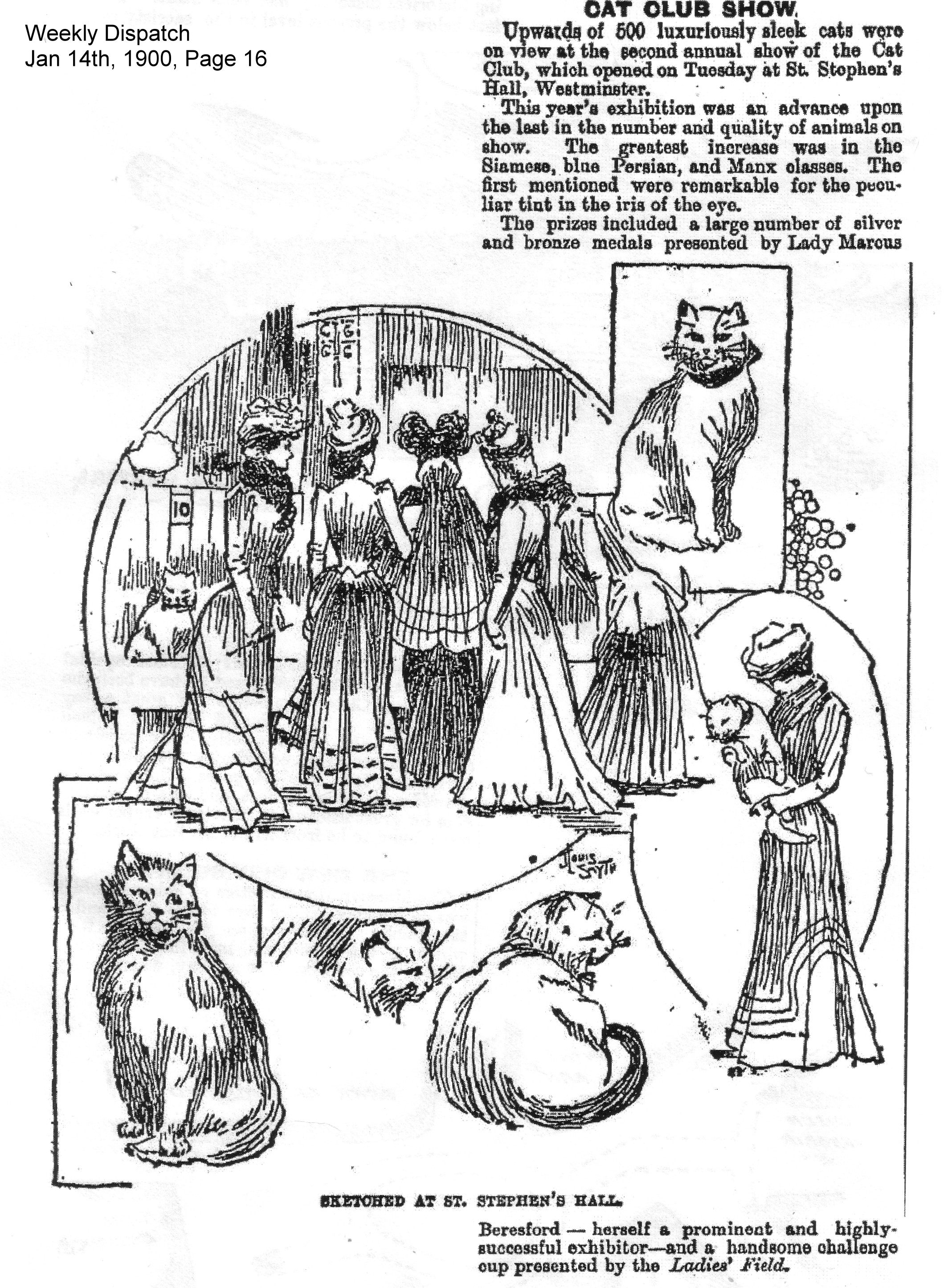
The Victorian cat shows were undoubtedly popular. Most judges were all-rounders who judged not only all breeds of cat but also birds, dogs, flowers and so on. At the beginning of 20th century at a London cat show, there were five different breeds of cat competing. There were two longhaired varieties, the Angora and the Persian, and three shorthairs, the Siamese, the Manx and the "shorthair" (domestic shorthair) though the shorthair came in nine colour varieties.
Breeder, judge and persian enthusiast Frances Simpson wrote "The commonest of all cats are Shorthaired Tabbies and Whites or Black and Whites. The markings are sometimes quite grotesque in their distribution. It seems almost a pity to so far encourage these cats as to give classes for them at our Shows." The longhairs were not the snubby-nosed Persians we are used to seeing today. Miss Simpson also stated "Apart from the length and texture of fur, the points of the animals are practically the same, whether long- or short-haired. They should be cobby in build and short on the legs, the head should be round and broad, eyes large and full, nose short, ears small and wide apart."
In 1906, there was no general consensus on when a kitten became a cat. The American Democrat and Chronicle newpaper of 25th November, 1906, reported Cat fanciers in Great Britain, who are growing numerous, are riven by the profound question: Can a kitten become a cat before it is a year old? The Southern Counties Cat Club has declared that the period of adolescence ceases at nine months, and its members are going to call cats, cats and kittens, kittens on these lines, wherever happens. Other clubs differ at the frequent cat shows.
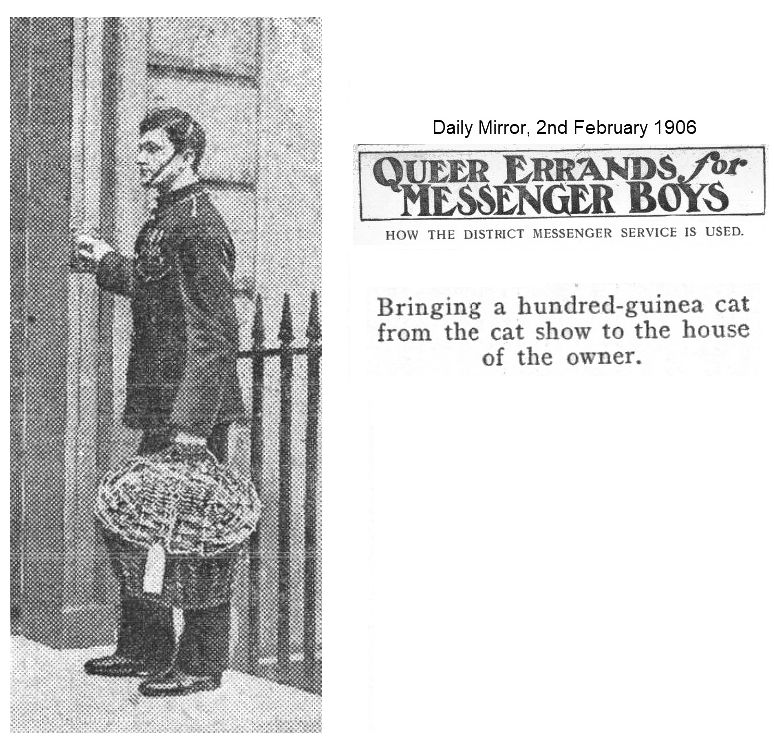
When the Governing Council of the Cat Fancy was founded in 1910 there were 16 cat clubs represented. Most were regional clubs or for certain varieties, excepting the short-lived "Wilson's Ltd Cat Club" which appears to have been a business venture. The first cat registers had already been set up by the Cat Club and the National Cat Club. Rivalry meant that cats registered with one club could not be registered with the other. When the GCCF became the sole registry, it inherited those early registers to set up a combined registry. In 1910, the register had four sections: Longhairs, Shorthairs, Abyssinians and Siamese. A pedigree cat was defined as one with registered parents, grandparents and great-grandparents (i.e. three generations) and this definition is the one still recognised by modern Trading Standards Officers. In order to have a place on the Full Register, cats must not only have the three generations of registered ancestors, those ancestors must be of cats within their own section of the register. Apart from information surviving in the Stud Books, which go back to 1910, those early registry records have been lost. Some enthusiasts have put together partial records based on fragmented information in books such as Frances Simpson's 3 books published between 1901 and 1924 and from the Stud Books listing those cats that were "placed" (won their class) at Championship cat shows, along with those cats' parents.
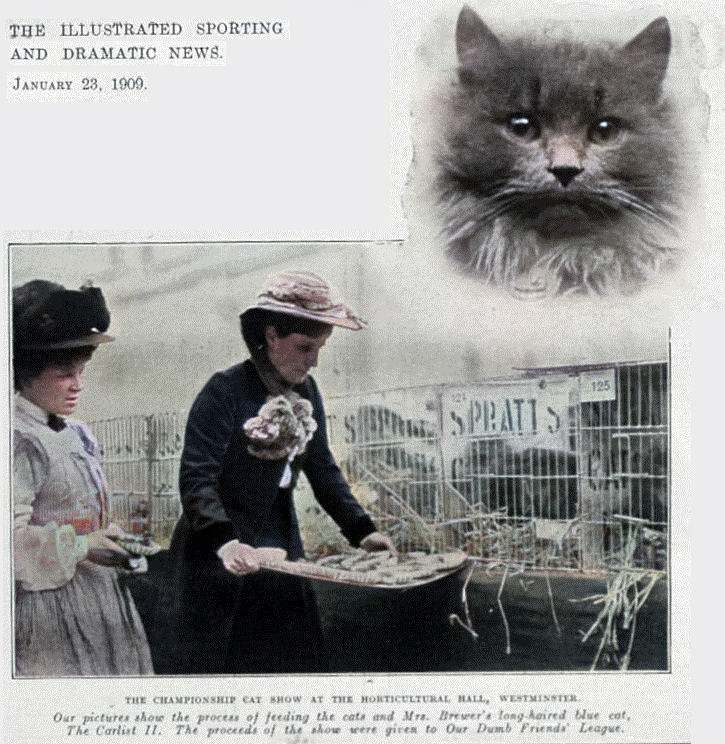
The following letter from Louis Wain was published in the issue of "Our Cats" (the first magazine that bore that name) which was published weekly at ld. It appeared in the issue for 18th November 1911.
To the Editor of " Our Cats " Dear Madam, The Crystal Palace Show.
This is Coronation Year and, although the Coronation itself is a thing of the past, people are still striving to make this a memorable year in every way in all branches of private and public work I to make it, in fact, a banner year in the history of our times. It is not too late to make the coming show of the N.C.C. at the Crystal Palace a Coronation Show. May I also ask exhibitors to support Lady Decies' Ring Classes on the second day of the show. Lady Decies has been so consistent a supporter of the N.C.C. that I feel sure she will have a good entry. The Ring Classes being judged mainly for good deportment in the ring, and after all the judging of the other classes for show points is over, Lady Decies is not precluded from exhibiting in other classes than her own, of course. Yours obediently, (Signed) Louis Wain
The name of Lady Decies comes up time and again in the early days of the cat fancy. Gertrude Willoughby, who owned Fulmer Cattery, began breeding cats prior to becoming the Lady Decies. Maria Gertrude Willoughby (24 Feb 1862 - 4 April 1939) was the daughter of Sir John Pollard Willoughby, 4th Baronet Willoughby. Miss Willoughby married William Marcus de la Poer Horsley-Beresford, 4th Baron Decies, son of William Robert John Horsley-Beresford, 3rd Baron Decies (Fulmer Grove, Buckinghamshire) on 12 March 1901 and became Baroness Decies. Her married surname was Horsley-Beresford.
Not all shows seem to have been serious affairs. The Hats Free Press (and American newspaper), 13th August, 1904 reported Prizes for all kinds of cats - prizes were offered at an English cat show for the happiest cat, the best performing cat, and the funniest cat, although it doesn t state which show or where it was held. It may have been a charity fundraising cat show. Charity shows, as well as championship shows, were organised by cat fanciers.
Even into the 1930s cat breeding was considered to be a cheap hobby that could be turned into a money-making career. However, after the Second World War, shortages meant reduced cash prizes at shows and kitten prices dropped, although pedigree kittens could still cost the equivalent of several week s wages for a working man.

PEDIGREE CATS OF THE 1880s and 1890s
The earliest cats shows had paid particular attention to shorthaired cats such as the Archangel (Maltese or Russian Blue) and Manx. In 1889, Harrison Weir wrote and illustrated "Our Cats". Weir had arranged the first formal cat show in England in 1871 and produced the first breed standards. Excerpts from "Our Cats" illustrate cat types during the 1870s and 1880s. Weir preferred the shorthairs over the longhairs.
|
|
|
|
In contrast, Frances Simpson was a champion of the longhairs. This is reflected in her 1903 work "The Book of the Cat" (she was editor rather than author). The extracts from "The Book of the Cat" describes the British longhair (the Persian) and its American equivalent, the Maine Cat. The excerpts follow the progress of Simpson's beloved White Persians (one of the most popular varieties) and the much newer Cream Persian which looked set to become fashionable after having been overlooked previously.
As well as describing the then common breeds, these two authors, and the contemporaries whose letters and comments also appear in their works, give some insight into how cats were cared for, how they were bred, how they were prepared for a show and some now quaint ideas about inheritance! It also provides some comparison between Britain and America.
Classes were generally "longhairs" and "shorthairs" with no distinction between different breeds within those groupings. For example, Persians competed against Angoras with the result that the less extreme Angora type was lost. Two interesting sections from Frances Simpson's work are on the White Persian (which was shifting from yellow-eyed to blue-eyed) and Cream Persians (a new development). In 1926, Cat Gossip editor H C Brooke noted that at a cat show in Lille there were classes for "Short-hair Persians" (chats persans a poil ras) as well as the normal Long-hair classes! Brooke wondered how "Short-hair Persians" were distinguished from ordinary Short-hairs. In those days, the Persian had not yet become the flat-faced creature we see today and might have been termed a "British Longhair".
In 1903, Frances Simpson wrote in "The Book of the Cat" "In classing all long-haired cats as Persians I may be wrong, but the distinctions, apparently with hardly any difference, between Angoras and Persians are of so fine a nature that I must be pardoned if I ignore the class of cat commonly called Angora, which seems gradually to have disappeared from our midst. Certainly there is no special classification given for Angoras, and in response to many inquiries from animal fanciers I have never been able to obtain any definite information as to the difference between a Persian and an Angora cat. Mr Harrison Weir, in his book on cats, states that the Angora differs somewhat from the Persian in that the head is rather smaller and ears larger, fur more silky with a tendency to woolliness."
Simpson championed the cause of the long-hairs which were, by then, outnumbering short-hairs at cat shows by about four long-hairs to every short-hair shown (this probably did not include Foreign short-hairs such as Siamese or blue Russian) . "The Book of The Cat" has relatively few photos of short-hairs and Simpson wrote that she had included so few pictures of short-haired cats in her book because the long-hairs were so much more attractive that more photographs existed of them than of short-hairs. Because short-hairs were both cheaper and less pretty, fewer people bothered to take good photos of them.
From that point onwards, her comments were applicable to the cat we now know as the Persian. She considered the Persian to be less amiable and less reliable in temperament than the short-haired (British) cat, but considered them more intelligent and as keen when hunting prey as were short-hairs. However, they were less healthy than short-hairs and the longest haired kittens were the most difficult to rear. She attributed this to in-breeding.
Because cat shows were traditionally held in the summer months, Persians were rarely shown in their full glory and often presented an unkempt and moth-eaten appearance because they were moulting. On the other hand, the summer coat made it harder to disguise poor conformation or "a multitude of sins". Illness and skin problems also caused loss of coat, in those days before vaccinations and when enteritis and cat flu and various parasites were more common, Persians were considered at a disadvantage - so much so, that some breeders turned their attention to short-hairs instead.
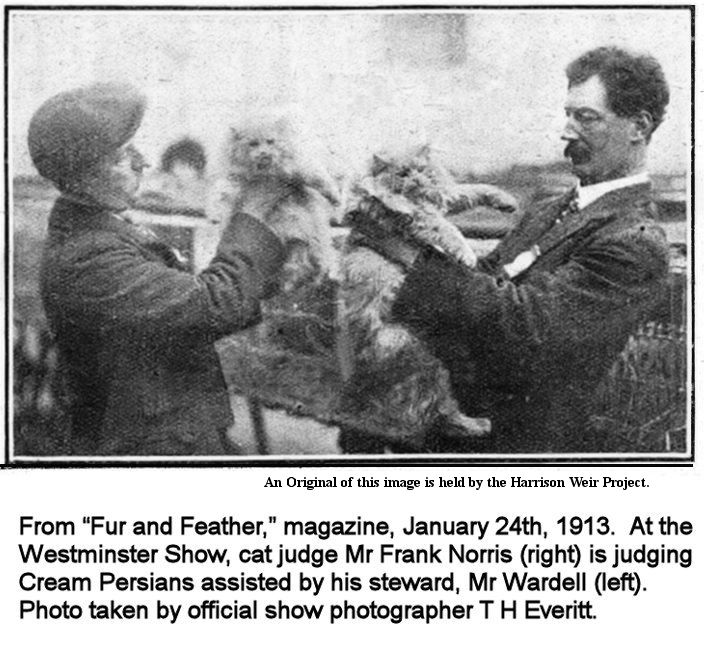
According to John Jennings book "Domestic or Fancy Cats", "Of the many varieties or breeds of the cat with which we are now familiar, it must be remembered that, however crossed, selected, re-crossed, domesticated, or what not, we have but two breeds on which the super-structure of what is known today as the 'classification of varieties' has been reared - viz, the long-hair or Eastern cat, and the short-hair or European. The term 'breed' is even here used advisedly, for whatever the outer covering or coat, colour, or length of fur, the contour of each and all is practically the same. Nor is this confined to mere outline. Take the skull, for example, which measured in the usual manner with shot, making due allowance for difference in size, is not only similar in the different varieties of either long- or short-hair, but even in the wild cat the anatomy is similar, the slight variation being in a great measure explained by its different conditions of life and diet, and is in unison with the fact of how even the ordinary domestic cat will undergo a change in taking up a semi-wild, outdoor existence."
For details of the different breeds, see Retrospective Index 1880s to early 1900s section
A BRIEF HISTORY OF THE GCCF
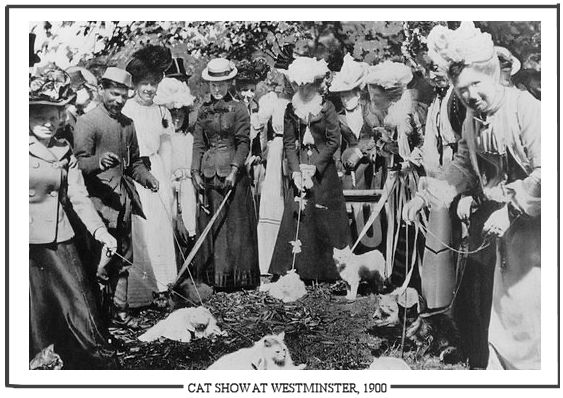
As well as the Crystal Palace cat shows which began in 1871, shows were held at Brighton, Richmond, Hounslow, Harrogate, Sandy (Bedsfordshire), Newbury, Reading and at several London venues including the Crystal Palace, Westminster and the Botanical Gardens (Kew). These early shows became so popular that, at a show held at the Alexandra Palace in summer of 1887, a number of fanciers formed The National Cat Club. Membership was by invitation, there was a committee with elected officers and the National Cat Club formulated rules for cat shows. The foundation of the National Cat Club in 1887 is considered by many to be the birth of the Cat Fancy. From 1887 until 1910, the National Cat Club ran many shows including its Championship Shows at the Crystal Palace. It remains the premier cat club of Great Britain, and from it in 1910 The Governing Council of the Cat Fancy was born. From 1887 to 1910, the National Cat Club carried out the functions which are now performed by the GCCF including keeping breed registers. It also became a court of inquiry/appeal in cat-related matters. In 1893 it issued the first ever cat stud book.
The Scottish Cat Club was formed in 1894, and this early club ran many shows which were staged in Glasgow. Later, numerous other clubs were founded, and when the GCCF was instituted, these came under its jurisdiction. Among the specialist breed clubs formed in 1900 were The Black and White Cat Club; The Silver and Smoke Club (later incorporated with The Chinchilla, Silver Tabby and Smoke Society); The Orange, Cream and Tortoiseshell (which later became The Red, Cream, Tortoiseshell, Tortoiseshell-and-White, Brown Tabby and Blue-Cream Society). The Siamese Cat Club started in October 1900. These were followed in 1901 by The Blue Persian Cat Society; The Manx Club and The Short-hair Cat Society. There was also the Neuter Cat Society, the British Cat Club (Sir Claude Alexander was Hon. Secretary), Richmond Club (long defunct), Wilson's Ltd. Cat Club (long defunct) Newbury Club. Several regional clubs were also instituted: The Cat Club (1900); The Northern Counties Club (1900); The Midland Counties Cat Club (1901) and The Southern Counties Cat Club (1904).
The earliest first record of the Siamese Cat Club is a show catalogue of "Billetts Great Open Cat Show" held at Reading on the 27th and 28th February, 1901. At that there were three special prizes " Open to members of the Siamese Club only". Entries of Siamese at the Crustal Palace Cat Shows remained small until 1903. Between 1871 and 1887, only 19 Siamese were exhibited (15 females, 4 males). In 1903 there were 25 exhibited at that show, after which the Siamese continued to increase in numbers.
By 1898, the rival "The Cat Club" was founded by Lady Marcus Beresford and drew up its own rule and held its own successful shows at the old Westminster Aquarium. The Cat Club published a 2-volume stud book in 1899. Some clubs sided with The Cat Club while others remained attached to The National Cat Club. In 1904, these 2 rival clubs decided to try to settle their differences, but for the next 6 years there was general unrest in the Cat Fancy, and a Cat Fanciers Association was formed. The National Cat Club (and several others) did not take part in the often fierce arguments and controversy and made the first move towards peace. In April 1909, The Cat Fanciers Association was invited to send 3 delegates to confer with 3 members of The National Cat Club to consider "the condition of the Cat Fancy generally". Neither party was satisfied and negotiations continued until March 1910 when a historic conference of the Cat Fancy took place at 11, Victoria Street, Westminster. This conference resulted in the formation of The Governing Council of the Cat Fancy.
The National Cat Club agreed to hand over its governing powers to the newly formed GCCF and in return was granted 4 delegates in perpetuity; other clubs affiliated to the council were granted 1 or 2 delegates. In later years attempts were made to change this numerical representation. Mr FW Western said "in Council" that he recognized that The National Cat Club had certain rights, and that he would resist attempts to reduce their representation The handing over of registrations and fees to the GCCF meant a huge loss of revenue to The National Cat Club, but the club agreed that it was for the overall good of the Cat Fancy.
The Midland Counties Cat Club, The Southern Counties, The Northern Counties and The Blue-Persian Cat Society were each permitted 2 delegates. The Blue-Persian Cat Society was the only breed club to be granted 2 representatives at that time and other breed clubs (The Black and White and The Brown Tabby (later The Red, Cream, Tortoiseshell, Tortoiseshell-and-White and Blue-Cream Society); The Chinchilla, Silver and Smoke Society; The Short-hair Cat Society; The Siamese Cat Club and The Neuter Cat Club (later combined with the Kensington Kitten Club) were granted only 1 delegate, though this could be increased to 2 if their memberships increased. One regional club was also allowed 2 delegates: The Newbury Cat Club.
|
|
|
The Siamese Cat Club grew rapidly and in 1930 had 4 delegates, the maximum number permitted. All clubs which had a certain number of delegates allowed to them by 31st December 1930 were allowed to retain that number in perpetuity even if their memberships decreased. This was accepted by the GCCF when its Constitution was revised in 1932. The Croydon Cat Club had one delegate in 1920 and a second in 1923. The Kensington Kitten Club was allowed 1 delegate a little later. The Siamese Cat Society of the British Empire and the Abyssinian Cat Club were each permitted one delegate from 1930. Later, many clubs were formed and became affiliated to the GCCF and were also granted representation. Some of the early clubs ceased to exist and were thus no longer represented.
Before the Second World War, The Southsea Cat Club and The South-Western Counties Cat Club became affiliated. In 1946 The Notts and Derbyshire Cat Club was formed. In 1947, the Blue-Pointed Cat Club, which had ceased to exist during the war, was re-affiliated. In 1948, The Herts and Middlesex Cat Club appeared. The Scottish Cat Club, had been hard hit during the period of distress on the Clyde and had dropped out as a member of the GCCF. It nevertheless carried on with shows and eventually rejoined the Council. In 1950, The Edinburgh and East of Scotland Club was affiliated. In 1951 The Lancashire and North-Western Counties and The Yorkshire County Cat Club also became affiliated. Soon after, the Russian Blue Club was affiliated, but did not have sufficient members for it to be granted a delegate.
The GCCF's preliminary meeting was held on the 17th May 1910, at the Inns of Court Hotel and a chairman(Russell Biggs), officers and a committee were appointed. The Constitution and Rules were drafted in outline. The first official meeting was 11th October 1910. In 1911, the GCCF's Constitution and Rules were drawn up by Mrs Slingsby, Mr Little and Mr Russell Biggs. The first General Meeting of the GCCF was a historic event for the Cat Fancy. Those present were Mr Russell Biggs (Chairman and representative for The National Cat Club), Mr de Vere Brooke, Miss Burton, Miss Cope, Mrs Fosbery, Miss Jay, Miss Kerwell, Miss H Lea, Mrs TB. Mason, Mrs Robinson, Miss Frances Simpson, Mrs Slingsby, Mrs Spoforth, Miss Wood, Mr Cox, Mr R Little, Mr T Watson, Mr J Wilson and Mr S Desborough (Secretary).
Following the First World War (the "Great War"), Mrs Slingsby was responsible, with several others, for rallying the Cat Fancy. She later helped redraft the Constitution and Rules, which were not amended again until 1932. The Constitution was further revised in 1953.
Sir Claude Alexander was for some years Chairman, succeeded in 1926 by Cyril Yeates (a delegate from The Black and White Club since 1921). Yeates' popularity made it impossible for him to retire; when he did finally retire in 1949 he was elected the first President of the GCCF. Physically unimposing, he was considered a giant in the role of legislator, breeder, judge, show manager and "keeper of the peace." He was known as "King of the Cats" and later the "Grand Old Man of the Cat Fancy". He was show manager at most of the Crystal Palace Cat Shows until the venue was destroyed by fire. Yeates died in 1950 aged 75 and was remembered as a far-sighted chairman who also assisted cat clubs outside of Britain. Along with his wife Gretta, Yeates assisted the formation of The Cat Club de Paris and other French clubs along the same lines as the GCCF. GCCF secretaries not only attended all GCCF meetings, they also controlled the registrations and transfers of kittens and cats and are responsible for show catalogues and records of Challenge Certificates and Premier Certificates. Secretary for some years was Miss H Lea, followed by Mr Edmonds, Mr Barratt and Mr Herbert Thompson.
After Yeates, Miss Kit Wilson was the next Chairman, but she resigned after only one year due to personal commitments and was succeeded by Miss Kathleen Yorke, an all-breeds judge.
The first show run by the GCCF's was held in celebration of the Coronation of Her Majesty Queen Elizabeth II in 1953; the Coronation Show was held at the Royal Horticultural Society s New Hall. It was attended by cat fanciers from many parts of Europe and also from the USA and South Africa; some as judges and others as observers. By the 1950s, several overseas clubs and foreign governing bodies were also affiliated to the British GCCF: The Cat Club de Paris; The Cat Club Vaudois (Switzerland); La Société Royale Feline de Flandres (Belgium); Felikat (Netherlands); Norsk Racekatten (Norway); Svenska Kattklubben (Sweden); Racekatten (Denmark); JYRAK (Denmark). The clubs of many nations were also represented by La Fédération Internationale Feline d Europe (FIFE).