SHORTHAIRED CATS OF THE 19TH CENTURY - MISCELLANEOUS FOREIGN BREEDS - SWISS MOUNTAIN CAT

Miscellaneous Foreign Breeds (Frances Simpson)

In addition to the Siamese and Abyssinian, a number of other "Foreign" breeds were described or depicted in "The Book of the Cat". The "Burmese" cat, which appeared in a photograph, appears to be an Oriental ticked tabby, rather than the breed known today as the Burmese.

The section on Foreign cats was contributed by Mr H C Brooke. Among the Foreign breeds he described were the Chinese lop-eared cat, the South American dwarf cat and an early Rex or wirehair cat called the Mombassa cat.

"There is said to be a variety of Chinese cat which is remarkable for its pendent ears. We have never been able to ascertain anything definite with regard to this variety. Some years back a class was provided for them at a certain Continental cat show, and we went across in the hope of seeing, and if possible acquiring, some specimens; but alas the class was empty! We have seen a stuffed specimen in a Continental museum, which was a half long-haired cat, the ears being pendent down the sides of the head instead of erect; but do not attach much value to this."

"We have seen specimens of a very tiny domestic cat, full-grown individuals of which weigh only about three pounds. Those we saw came from South America."

"A cat called the Mombassa cat, from the East of Africa, is said to have a short coat of wiry texture."

"There are, of course, no cats indigenous to Australia. An American writer gives it as his opinion that a certain strain of Australian cats is derived from imported Siamese cats. A specimen we possessed last year, which was born on a ship during the passage from Australia, and which exactly resembled its dam, certainly had every appearance of being of Eastern origin. It had the marten-shaped head, and a triple kink in the tail; its voice also resembled that of the Siamese. In colour it was grey with dark spots."

The Mexican Hairless is also described, in the form of a letter written by E J Shinick to Mr H C Brooke regarding a pair of hairless cats which had come into Mr Shinick's possession. Being brother and sister, Shinick had not allowed the pair to breed. The male was killed by dogs and the writer was, at the time of the letter, seeking another specimen to mate with the surviving female and also hoping to sell the female to Mr Brooke.

"In answer would say my hairless cats are brother and sister. I got them from the Indians a few miles from this place. The old Jesuit Fathers tell me they are the last of the Aztec breed known only in New Mexico. I have found them the most intelligent and affectionate family pets I have ever met in the cat line; they are the quickest in action and smartest cats I have ever seen. They are fond of a warm bath, and love to sleep under the clothes at night with our little girl. They seem to understand nearly everything that is said to them; but I have never had time to train them. They are marked exactly alike - with mouse coloured backs; with neck, stomach and legs a delicate flesh tint. Their bodies are always warm and soft as a child's. They love to be fondled and caressed, and are very playful; will run up and down your body and around your waist like a flash.

"Nellie" weighs about eight pounds, and "Dick" weighed ten pounds; but I am sorry to say we have lost "Dick". We have never allowed them to go out of the house, as the dogs would be after them. They were very fond of our water spaniel, and would sleep with her. "Dick" was a sly rascal, and would steal out. One night last year he stole out, and the dogs finished him. His loss was very great, as I may never replace him. The Chicago Cat Club valued them at 1,000 dollars each. They were very anxious for me to come on with them for their cat shows, but I could not go. They were never on exhibition; as this is a small city, I feared they would be stolen. I have made every endeavour to get another mate for "Nellie", but have not been successful. I never allowed them to mate, as they were brother and sister, and I thought it might alter "Nellie's" beautiful form, which is round and handsome, with body rather long. In winter they have a light fur on back and ridge of tail, which falls off in warm weather. They stand the cold weather the same as other cats. They are not like the hairless dogs, whose hide is solid and tough; they are soft and delicate, with very loose skin.

"Nellie" has a very small head, large amber eyes, extra long moustache and eyebrows; her voice now is a good baritone, when young it sounded exactly like a child's. They have great appetites, and are quite dainty eaters - fried chicken and good steak is their choice. Have never been sick an hour. The enclosed faded picture is the only one I have at present - it is very lifelike, as it shows the wrinkles in its fine, soft skin. "Dick" was a very powerful cat; could whip any dog alone; his courage, no doubt, was the cause of his death. He always was the boss over our dogs. I have priced "Nellie" at 300 dollars. She is too valuable for me to keep in a small town. Many wealthy ladies would value her at her weight in gold if they knew what a very rare pet she is. I think in your position she would be a very good investment to exhibit at cat shows and other select events, as she doubtless is the only hairless cat now known. I have written to Old Mexico and all over this country without finding another. I would like to have her in some large museum where she would interest and be appreciated by thousands of people." E J Shinick, Albuquerque, New Mexico, February 3rd, 1902

In “Animal Life and the World of Nature” (Vol 1, 1902-1903), Shinick was quoted "Dick was a very powerful cat, and could whip any dog alone; his courage no doubt was the cause of his death. He was a sly rascal and would steal out, and one night he got out and several dogs killed him. His loss was very great and I may never replace him. The Chicago Cat Club valued him at 1,000 dollars. I have sent all over the country and endeavoured to get a mate for 'Nellie,' but I fear the breed is extinct."

The [Russian] Blue Cat (Harrison Weir)

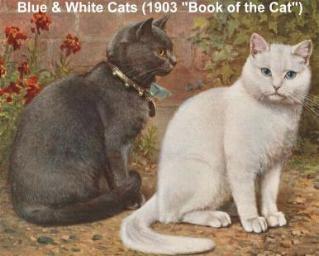
This is shown often under a number of names. It was at first shown as the Archangel cat, then Russian blue, Spanish blue, Chartreuse blue, and, lastly, and I know not why, the American blue. It is not, in my belief, a distinct breed, but merely a light-coloured form of the black cat. In fact, I have ascertained that one shown at the Crystal Palace, and which won many prizes on account of its beautiful blue colour slightly tinged with purple, was the offspring of a tabby and white she-cat and a black-and-white he-cat, and I have seen the same colour occur when bred from the cats usually kept about a farmhouse as a protection from rats and mice, though none of the parents had any blue colour.

Being so beautiful, and as it is possible in some places abroad it may be bred in numbers, I deemed it advisable, when making out the prize schedule, to give special prizes for this colour; the fur being used for various purposes on account of its hue. A fine specimen should be even in colour, of a bluish-lilac tint, with no sootiness or black, and though light be firm and rich in tone, the nose and pads dark, and the eyes orange-yellow. If of a very light blue-gray, the nose and pads may be of a deep chocolate colour and the eyes deep yellow, not green.

If it is a foreign variety, I can only say that I see no distinction in form, temper, or habit; and, as I have before mentioned, it is sometimes bred here in England from cats bearing no resemblance to the bluish-lilac colour, nor of foreign extraction or pedigree. I feel bound, however, to admit that those that came from Archangel were of a deeper, purer tint than the English cross-breeds; and on reference to my notes, I find they had larger ears and eyes, and were larger and longer in the head and legs, also the coat or fur was excessively short, rather inclined to woolliness, but bright and glossy, the hair inside the ears being shorter than is usual in the English cat.

Russian Blue Cats (Frances Simpson)

Frances Simpson wrote in "Cats and All About Them" "The best authorities seem to agree in believing that they [Russian Blues] are not a distinct breed, and therefore they are now classed at our Shows amongst the short-haired English varieties." In her more famous "The Book of the Cat", Simpson wrote "That there are two distinct types of these blue cats is apparent to anyone who observes the specimens exhibited at our shows. The foreign or imported variety have wedge-shaped faces, and are longer and larger in the head, with prominent ears; otherwise in colour and coat, they are similar to those bred in England, and which partake of the same formation as an ordinary British cat." Faults included yellow, green or greenish-yellow eyes instead of the required deep orange and too thick tails which indicated a long-haired ancestor.

Mrs Carew-Cox was cited as a foremost breeder of blue short-hairs (the Russian variety) and contributed information to "The Book of the Cat":

"Blue short-haired cats - many of them imported from Northern Russia - make very desirable pets […] Kittens, however, require both care and patience to rear successfully, and strange to say, attain sounder constitutions when brought up by a healthy English foster-mother. […] A Russian cat should be of an even shade of blue throughout, even the skin itself being often - in fact, generally - of a bluish tinge. There should be no stripes or bars and - for exhibition purposes - there should be no white patches. Kittens frequently have body markings when very young, also rings on their tails; but in purebred specimens these defects generally become effaced before they are many weeks old. In one case a kitten (now a large neuter) had until five months of age two broad black stripes down his back on either side of his spine; they were so decided in appearance that it seemed very doubtful that they would ever disappear. However, at six months old, he was a perfectly self-coloured cat! This is, of course, most remarkable and unusual, and amongst all the many kittens of this breed that I have reared for the past thirteen years there has never been another presenting a similar appearance.

The eyes of a Russian should be golden in colour, or deep orange. To procure deep-coloured eyes, experiments have been made in crossing Russians with Persians, but the results - so far as I have seen - have not proved satisfactory, and to an experienced eye the cross is perceptible. I believe there is no really recognised standard of points for this breed, which until quite recently was comparatively little known. I note that there is a very fair demand for Russians at the present time - chiefly, strange to say, from the North of England. The shape of the head in many of those imported is more pointed than round; indeed some have long, lean pointed heads and faces with big ears. The backs of the ears should be as free from hair as possible; some, I remark, are entirely devoid of hair on the upper parts of their ears - at least, if there is any, it is not perceptible to the naked eye. Others, again, have ears covered with peculiarly fine, close silky hair. Some imported blues are very round in face and head, with tiny ears and eyes set rather wide apart. These are surely the prettiest, and are generally given the preference at shows; but of course it cannot be denied that the long-faced variety present the most foreign appearance , more especially when this type also possesses a lithe and rather lean body."

Carew-Cox described the coat as short, close, glossy and silvery but sometimes rather woolly due to the severity of their native climates. Some were paler in colour than others, including some lavender-blues which, though beautiful, were more delicate than the darker blues. There was also a tendency for the blue coat of older cats to discolour to a rusty brown in summer. Cats imported from Archangel were generally of a deep, firm blue with larger eyes and ears and longer head and legs than the English cats.

She noted that short-haired blues also existed in the north of Norway, in Iceland and in some parts of the US. "Many years ago, so blues (with faint tabby markings) were imported from the north of Norway; these were called 'Canon Girdlestone's breed'. I owned two very pretty soft-looking creatures. Blue-and-white cats have been imported from the north of Russia, and are particularly attractive when evenly marked.[…] There are some people who appear to wish to assert that there is an English breed of blues, and I have been told strange tales of unexpected meetings in country villages with cats of this colour, whose owners declared that both parents were English bred. As , however, it is not always possible to identify the sires of household cats, I venture to doubt these assertions. It is sometimes posible to breed blues from a black English female mated to a Russian male. This experiment does not always succeed as some blacks never breed blues, although mated several times consecutively with Russians."

Note: Carew-Cox would not have known that the black cats were carrying blue as a recessive gene in order to produce blues from matings with her Russian cats. Those same household cats would have produced blues when mated to another black carrying the same recessive gene!

"In 1889, however, I purchased a smooth blue, whose owners declared her to be a Siamese - she certainly resembled a puma-shaped Siamese in her body outline and movements - and I believe I entered her in the stud books as such. […] In 1890 I owned a very pretty soft-looking blue female - she was, in fact, a blue tabby (one of Canon Girdlestone's breed); also a male of the same variety."

Other blues Carew-Cox owned included "Kola", a pretty blue-and-white round-faced female from Kola and Lingpopo, a beautiful foreign-looking blue from Archangel. These cats - blues, lavender-blues, blue-and-whites, solid blue "Siamese" and blue tabbies - were some of the founders of the Russian Blue breed.

"In America, the classification given for these cats at the Beresford Cat Club show is 'Blue or Maltese,' but I have not heard of any ardent fanciers of this breed over the water. "

Frances Simpson also included the self blue in the section on short-haired cats as well as noting the popularity of the "Maltese" in America. "For a long time we have called the self blues Russians. No doubt they, in the first instance, came from the East; but since they were imported into this country they have been mixed in a great measure with self blacks, and in some cases with long-haired blues, to get strong, short, round heads, so that at the present time we have very few pure-bred Russians in this country."

She wrote "An explanation may be deemed due to my readers for having included blues amongst the English types, but as the clubs have recognised this breed, and sanctioned their being catalogued amongst the English exhibits, I felt justified in adopting this course; more particularly as the country of origin still remains a matter of speculation.[…]"There seems to be a great difference of opinion as to the shape and make of head of these cats. Some judges look for a round, full head of the English-bred cat; others the long head of the Eastern variety. I think that difference arises to a great extent according to where these cats originally came from. I have heard the opinions of some who give Archangel as the port of origin; others Malta. If the cat originated from Archangel, one would naturally expect a long head of Eastern type. The specimens, however, from Malta have certainly the round head and more of the English-bred type."

A letter from Mrs H V James in Fur and Feather summed up the confusion and frustration:

"I am very interested in the discussion on blue Russians, as years ago I had a perfect type of a blue Russian, which had been imported. When Russians were judged as Russians it won well at shows, so you may like to have a description of the cat - which is, I believe, a correct one, according to several authorities on Russian cats. A real Russian should be longer in the leg than the English blue. The head is pointed and narrow; the ears large, but round; tail long, full near the body, but very tapering. According to the English taste, it is not a pretty cat, and only excels over the British blue in the colour and quality of its coat, which is much shorter and softer than the latter. The true colour is a real lavender-blue, of such softness and brilliancy that it shines like silver in a strong light. The eyes are amber. I think it a great mistake to give 'Russian' in our show classification now, as these are really almost extinct in England, I believe, and our principal clubs have been wise enough to drop the title for 'Short-haired Blues,' in the same way that 'Persian' has been dropped for 'Long-haired Cats.'

The last time I showed my Russian was at the first Westminster show, in a class for Russians. She was, however, beaten by the round-headed British blue, although she was, I believe, the only Russian in the class. In 1901 the class was altered to 'Short-haired Blues' which was more correct, as few of the blues shown then had anything of the Russian about them, either in shape or coat. As these classes are not arranged, it would be unfair to judge them except by the standard of our own shorthaired cats, and I think that if a club wants to encourage Russians it should give the extra class, 'Blue Russian', and let it be judged as such. I must own it is disappointing for a Russian owner who, seeing 'Russian Blue' only given in the schedule, enters his cat accordingly, and gets beaten by a short-haired blue in just the points that the Russian is correct in. I know my feelings after Westminster 1899, when my Russian was described as 'grand colour, texture of coat, failing to winner in width of head and smallness of ears.'. the blue short-hairs now show are, I know, far more beautiful with their round heads and shorter legs; but, unfortunately, the beautiful is not always the correct type."

At the start of the cat fancy, Russian Whites and Russian Bicolours were also imported. Grace Pond wrote in "The Cat" (1974) "The earliest registrations in the years 1898 to 1899 show that a Mr Brooks imported a white Russian female, no name given; another white Russian was registered as "Granny". There was also "Olga", a Russian Blue with a white spot." However, it was the blues from Arkangel that found most favour and some modern breeders refuse to acknowledge the wider palette of colours found in early imports and consider them cross-breds, forgetting that early Russian Blue imports were interbred with British Black Shorthairs in the hope of getting a good blue colour!

While judges were aware that the longer legs and longer head was the correct type for the Russian cats, the standard of points for the short-haired blue classes favoured the British cats and thus the Russians lost out.

Siamese (Harrison Weir)

Among the beautiful varieties of the domestic cat brought into notice by the cat shows, none deserve more attention than "The Royal Cat of Siam." In form, colour, texture, and length, or rather shortness of its coat, it is widely different from other short-haired varieties; yet there is but little difference in its mode of life or habit. I have not had the pleasure of owning one of this breed, though when on a visit to Lady Dorothy Nevill, at Dangstien, near Petersfield, I had several opportunities for observation. I noticed in particular the intense liking of these cats for "the woods" not passing along the hedgerows like the ordinary cat, but quickly and quietly creeping from bush to bush, then away in the shaws; not that they displayed a wildness of nature, in being shy or distrustful, nor did they seem to care about getting wet like many cats do, though apparently they suffer much when it is cold and damp weather, as would be likely on account of the extreme shortness of their fur, which is of both a hairy and a woolly texture, and not so glossy as our ordinary common domestic cat, nor is the tail, which is thin. Lady Dorothy Nevill informed me that those which belonged to her were imported from Siam and presented by Sir R Herbert of the Colonial Office; the late Duke of Wellington imported the breed, also Mr Scott of Rotherfield. Lady Dorothy Nevill thought them exceedingly docile and domestic, but delicate in their constitution although her ladyship kept one for two years, another over a year, hut eventually all died of the same complaint, that of worms, which permeated every part of their body.

Mr Young, of Harrogate, possesses a chocolate variety of this Royal Siamese cat; it was sent from Singapore to Mr Brennand, from whom he purchased it, and is described as "most loving and affectionate," which I believe is usually the case. Although this peculiar colour is very beautiful and scarce, I am of opinion that the light gray or fawn colour with black and well-marked muzzle, ears, and legs is the typical variety, the markings being the same as the Himalayan rabbits. There are cavies so marked; and many years ago I saw a mouse similarly coloured. Mr. Young informs me that the kittens he has bred from his dark variety have invariably come the usual gray or light dun colour with dark points. I therefore take that to be the correct form and colour, and the darker colour to be an accidental deviation. In pug-dogs such a depth of colour would be considered a blemish, however beautiful it might be; even black pugs do not obtain prizes in competition with a true-marked light dun; but whatever colour the body is it should be clear and firm, rich and not clouded in any way. But I give Mr Young’s own views:

"The dun Siamese we have has won whenever shown; the body is of a dun colour, nose, part of the face, ears, feet, and tail of a very dark chocolate brown, nearly black, eyes of a beautiful blue by day, and a red colour at night! My other prize cat is of a very rich chocolate or seal, with darker face, ears and tail; the legs are a shade darker which intensifies towards the feet. The eyes small, of a rich amber colour, the ears are bare of hair, and not so much hair between the eyes and the ears as the English cats have. The dun, unless under special judges, invariably beats the chocolate at the shows. The tail is shorter and finer than our English cats. I may add that we lately have had four kittens from the chocolate cat by a pure dun Siamese he-cat. All the young are dun coloured, and when born were very light, nearly white, but are gradually getting the dark points of the parents; in fact I expect that one will turn chocolate. The cats are very affectionate, and make charming ladies’ pets, hut are rather more delicate than our cats, but after they have once wintered in England they seem to get acclimatised. Mr Brennand, who brought the chocolate one and another, a male, from Singapore last year informs me that there are two varieties, a large and small. Ours are the small; he also tells me the chocolate is the most rare.

I have heard a little more regarding the Siamese cats from Miss Walker, the daughter of General Walker, who brought over one male and three females. It seems the only pure breed is kept at the King of Siam’s palace, and the cats are very difficult to procure, for in Siam it took three different gentlemen of great influence three months before they could get any. Their food is fish and rice boiled together until quite soft, and Miss Walker finds the kittens bred have thriven on it. It is my intention to try and breed from a white English female with blue eyes, and a Siamese male.The Siamese cats are very prolific breeders, having generally five at each. litter, and three litters a year. We have never succeeded in breeding any like our chocolate cat; they all come fawn, with black or dark brown points; the last family are a little darker on their backs, which gives them a richer appearance than the pale fawn. Hitherto we have never had any half-bred Siamese; but there used to be a male Siamese at Hurworth-on-Tees, and there were many young bred from English cats. They invariably showed the Siamese cross in the ground colour."

From the foregoing it will be seen how very difficult it is to obtain the pure breed, even in Siam, and on reference to the Crystal Palace catalogues from the year 1871 until 1887, I find that there were fifteen females and only four males, and some of these were not entire; and I have always understood that the latter were not allowed to be exported, and were only got by those so fortunate as a most extraordinary favour, as the King of Siam is most jealous of keeping the breed entirely in Siam as royal cats. The one exhibited by Lady Dorothy Nevill (Mrs Poodle) had three kittens by an English cat; but none showed any trace of the Siamese, being all tabby.

Although Mr. Herbert Young was informed by Mr Brennand that there is another and a larger breed in Siam, it does not appear that any of these have been imported; nor have we any description of them, either as to colour, size, form, or quality of coat, or whether they resemble the lesser variety in this or any respect, yet it is to be hoped that, ere long, some specimens may be secured for this country. Besides Mr. Herbert Young, I am also indebted to the courtesy of Mrs. Vyvyan, of Dover, who is a lover of this beautiful breed, and who kindly sends the following information:

"The original pair were sent from Bangkok, and it is believed that they came from the King's Palace, where alone the breed are said to be kept pure. At any rate they were procured as a great favour, after much delay and great difficulty, and since that time no others have been attainable by the same person. We were in China when they reached us, and the following year 1886, we brought the father, mother, and a pair of kittens to England. Their habits are in general the same as the common cat, though it has been observed by strangers, 'there is a pleasant wild animal odour,' which is not apparent to us. Most of the kittens have a kink in the tail; it varies in position, sometimes in the middle, close to the body, or at the extreme end like a hook."

This tallies with the description given by Mr Darwin of the Malayan and also the Siamese cats. See my notes on the Manx cat Mr. Young had also noted this peculiarity in "the Royal cat of Siam." Mrs. Vyvyan further remarks "They are very affectionate and personally attached to their human friends, not liking to be left alone, and following us from room to room more after the manner of dogs than cats. They are devoted parents, the old father taking the greatest interest in the young ones. They are friendly with the dogs of the house, occupying the same baskets; but the males are very strong, and fight with great persistency with strange dogs, and conquer all other tom-cats in their neighbourhood. We lost one, however, a very fine cat, in China in this way, as he returned to the house almost torn to pieces and in a dying condition, from an encounter with some animal which we think was one of the wild cats of the hills.

We feed them on fresh fish boiled with rice, until the two are nearly amalgamated; they also take bread and milk warm, the milk having been boiled, and this diet seems to suit them better than any other. They also like chicken and game. We have proved the fish diet is not essential, as two of our cats (in Cornwall) never get it. Rather a free life seems necessary to their perfect acclimatisation, where they can go out and provide themselves with raw animal food, ‘feather and fur.’ We find these cats require a great deal of care, unless they live in the country, and become hardy through being constantly out of doors. The kittens are difficult to rear unless they are born late in the spring, thus having the warm weather before them. Most deaths occur before they are six months old.

We have lost several kittens from worms, which they endeavour to vomit; as relief we give them raw chicken heads, with the feathers on, with success. We also give cod-liver oil, if the appetite fails and weight diminishes. When first born the colour is nearly pure white, the only trace of 'points' being a fine line of dark gray at the edge of the ears; a gradual alteration takes place, the body becoming creamy, the ears, face, tail, and feet darkening, until, about a year old, they attain perfection, when the points should be the deepest brown, nearly black, and the body ash or fawn colour, eyes opal or blue, looking red in the dark. After maturity they are apt to darken considerably, though not in all specimens. They are most interesting and delightful pets. But owing to their delicacy and the great care they require, no one, unless a real cat lover, should attempt to keep them; they cannot with safety to their health be treated as common cats.

"During ‘Susan’s’ (one of the cats) illness, the old he-cat came daily to condole with her, bringing delicate ‘attentions’ in the form of freshly-caught mice. ‘Loquat’ also provided this for a young family for whom she had no milk. Another, ‘Saiwan,’ is very clever at undoing the latch of the window in order to let himself out; tying it up with string is of no use, and he has even managed to untwist wire that has been used to prevent his going out in the snow. We have at present two males, four adult females, and five kittens." One of our kittens sent to Scotland last August, has done well."

Mrs Lee, of Penshurst, also has some fine specimens of the breed, and of the same colours as described, I take it, therefore, that the true breed, by consensus of opinion, is that of the dun, fawn, or ash-coloured ground, with black points. Other colours should be shown in the variety classes. The head should be long from the ears to the eyes, and not over broad, and then rather sharply taper off towards the muzzle, the forehead flat, and receding, the eyes somewhat aslant downwards towards the nose, and the eyes of a pearly, yet bright blue colour, the ears usual size and black, with little or no hair on the inside, with black muzzle, and round the eyes black. The form should be slight, graceful, and delicately made, body long, tail rather short and thin, and the legs somewhat short, slender, and the feet oval, not so round as the ordinary English cat. The body should be one bright, uniform, even colour, not clouded, either rich fawn, dun, or ash. The legs, feet, and tail black. The back slightly darker is allowable, if of a rich colour, and the colour softened, not clouded.

Siamese (Daily Telegraph, 1879)

A yet more curious, if less prepossessing, couple of juveniles of Siamese extraction with black muzzles, ears, feet and tail setting off a close, yellowish drab coat and completing the resemblance of the little brutes to a pair of pug puppies.

Siamese ("Domestic and Fancy Cats", John Jennings)

The strain shown by Mrs. Vyvyan and Miss Forestier Walker was stated to be in direct descent from the first cats exhibited in England. These were Tiam o' Shan and Susan (first prizes Crystal Palace and Alexandra Palace), imported by these ladies many years ago. Their influence has practically preserved the breed and established it, the pedigree of nearly all the well-known cats that have appeared in the show world in the meantime being traceable to the original strain, either in direct outcome or by crossing imported females with Mrs. Vyvyan's stud cats.

Siamese ("Notre Ami Le Chat" [Our Friend the Cat] (1899), Paul Meguin)
(Being almost a copy of Weir's description)

A little smaller than our European cat, an elegant profile, low and long. Legs thin and rather short. Feet longer and less round than those of the ordinary cat. Back long and thin. Head small, broad between the eyes, narrowing between the ears. Forehead flat. Nose long and big. Cheeks getting thinner towards the mouth. Lips full and round. Ears big and large at the base, with no fur inside. Eye almond-shaped, oblique towards the nose, iris is a beautiful opal blue, with a luminous pupil which is reddish both in semi-darkness and in the light. Tail is shorter than that of the ordinary cat, thick at the root and getting thinner towards the tip. Fur short, rather woolly, soft and silky to the touch, brilliant and lustrous on the face, the legs and the tail

Colour is uniform, a little darker on the back […] Points black ears, this colour must not go behind these organs. Black mask tail and legs, The black must not go on the body nor mark it. In full health the Siamese cat should not be too fat; the coat should be soft, clear, brilliant and shining, lying flat on the body, which should also show firm and hard muscles.

Royal Siamese (Anon)

Of the Royal Siamese, it can be said that he is a most curious creature, quite unlike our familiar English house-cat. He is more refined in his type, and his close-lying fur makes him seem delicate in his make. In his colour and manner both, he is less like a cat than like a dog. His colour is dun with a darker brown at the head, tail and on the legs, although his feet may sometimes be white, and this is regarded as somewhat of a fault by those breeders perfecting his kind. His back is, in general, darker than his underneath, so that he seems to wear a saddle. His tail may be kinked or knotted, and is frequently foreshortened; breeders regard the latter as a great fault, more so than the former two traits.

If in his colour he is like the pug, with his darker points, in his head and face he is more like a little fox, for his face is curiously elongated, or "foreign" or "wedge-shaped" as the breeders like to call it, and less round than the English types of cat, and his eyes should be blue. In his limbs he is more gracile and less sturdy than the house-cat, and, I am made to understand, in his health he is also more delicate. In his manner, the Royal Siamese is more of a wild creature than a domestic one; his cry sounding like to a human infant. The male of this race is easily moved to fight our native English tom-cats.

A lesser relative to him is the Temple Cat, who is dark brown in body, with limbs yet a little darker, and whose eyes are the proper orange. When bred to the Royal Cat, the progeny are neither brown, nor dun, but a dull and undistinguished colour, and with poor contrast between points and body.

Siamese (Frances Simpson)

As an owner/breeder, Simpson is associated with Persians, especially blue Persians. Her first Persian, acquired in 1899, appears to have been Miss Mercer's Melrose Lassie. However, she also owned a pair of chocolate point Siamese, Netherland Tilu and his sister, Netherlands Ma, born in 1897 - in a time when only the seal-points were considered true Siamese.

"The Book of the Cat" contains contributions and quotes from various breeders representing a variety of views and experiences, sometimes quite contradictory, about the Siamese cat. It was evident that there were two different colours of Siamese and also two different body types. Simpson wrote, "While admitting that blues, blacks, whites, tabbies and other cats may also be cats of Siam, these being common to all parts of the world, this [Siamese Cat] Club recognises only as Siamese cats those cats […] known to British cat fanciers as the 'royal' Siamese."

The Seal (royal) and the Chocolate Siamese were both recognised and some breeders recommended that they be mated to each other, while others vehemently disagreed with this practice. More than one breeder/exhibitor was apparently breeding prize-winning Siamese through crossing a blue-eyed white cat with a Siamese female; probably because the English type was preferred over the foreign type (the same was true of Russian Blues). In a letter to "Fur and Feather", Mrs Carew-Cox and others recommended against breeding Siamese to white short-hair as the kittens always favoured the English parent in type. In addition, all Siamese kittens were born white and it was impossible to say which kittens would develop the Siamese colouration and which would stay white (note: this was because poor quality kittens would be destroyed at birth). The kittens from such a mating might also turn out to be, or pass on, other colours. Carew-Cox and her fellow breeders were speaking from observation; the genetics of dominant white masking other colours was not understood.

Miss Forestier-Walker and her sister, Mrs Vyvyan, had received a pair of Siamese cats from the Siamese Palace in 1884-5; Miss Forestier-Walker wrote "Siamese cats were first introduced into England about twenty-five years ago, but were not often seen until a few years later. […] Since then they have become fairly common. There are two distinct varieties in the present day. (1) The royal cat of Siam" by which she meant the seal point Siamese, "(2) The chocolate cats are deep brown in colour showing hardly any markings, and have blue eyes. […] The tails are sometimes straight, which is not a fault; but a knot or kink in the tail is a peculiarity of the breed, and therefore desirable. In England it has been asserted that this is a defect, but in Siam it is highly prized […] In the East a cat with a kinked tail fetches a higher price.

There is a legend that the light-coloured cats with blue eyes represent silver; the dark cats with yellow eyes, gold; and that the possessor of both will have plenty. This rather gives the idea that originally the eyes of the pure chocolate cat were yellow, and that the present variety has been crossed with the royal cat. […] It is a great mistake to mix the varieties, as the result after they become adult is a blurring of the markings and a patchy coat."

What Miss Forestier-Walker was describing was the range of colours from the brown Burmese (though the "Burmese cat" of 1903 was a very different cat), through the "blurred" or less distinct markings of the mink range (Tonkinese) to the sharply defined colourpoint of the Siamese. The brown or sable version is sometimes erroneously identified by modern readers as the Havana Brown

Forestier-Walker continued, "The males are extremely powerful, and will kill strange cats and fight dogs. They are devoted to their wives and children, and to their owners. They are exceedingly intelligent. With the dogs of the house they will be on excellent terms. […] The kittens are difficult to rear, as they suffer from worms and teething […] I find it satisfactory to bring them up on lighter food, such as Ridge's food, milk, gravy, and fish, until they begin to cut their teeth, when meat is required." It was common to foster Siamese kittens on English house cats as this supposedly made them more robust and healthier. While most considered the imported cats to be delicate and disadvantaged in the English climate, Lady Marcus Beresford considered imported kittens to be much the stronger. Another breeder, Mrs A Hawkins was more perceptive on this matter: "When newly imported they are naturally delicate, and must be hardened off, so to speak […] that is to say, you cannot treat them at first as you would our ordinary fireside cats."

Of temperament, Mrs A Hawkins found "Siamese are particularly gentle and affectionate." and Miss Forestier Walker stated "They are very intelligent, almost doggy in their ways, and very affectionate, but not universally friendly. The males are great fighters, and freely use their terrible voices; but they are well suited for house pets, as they seem happiest with their human friends."

One of the great Champion cats of the time, "Wankee" was bred in Hong Kong in 1895, the offspring of a female kitten stolen from the Palace in Siam. Wankee was imported to England aged 6 months and his owner, Mrs Robinson, contributed further words on the breed. "One of the most beautiful of the short-haired cats is undoubtedly the royal cat of Siam, and the breed is increasing in popularity; but is never likely to be common, as the cats are delicate in this country. […] The [standard of] points of the chocolate Siamese are the same as the royal, with the exception of body colour, which is a dark rich brown all over, thus making the markings less noticeable. All Siamese darken with age, and when they get dark there is a tendency to call them chocolates. I know of only one real chocolate - Mr C Cooke's 'Zetland Wanzies' - so consider them more likely to be a freak than a distinct variety."

Mrs Robinson wrote, "Of the royals there seem to be two types in England: the one - rather a small, long-headed cat, with glossy, close lying coat and deep blue eyes, and with a decided tendency to darken with age - is generally the imported cat or having imported parents; the other is a larger cat, with a rounder head, a much thicker, longer and less close-lying coat, and the eyes a paler blue (these cats do not darken as much or as soon as the other type, and have generally been bred for several generations in England)."

Miss Forestier Walker continued "This breed is said to be kept very carefully in the palace in Bangkok - hence the title 'royal' - and is by no means the common cat of Siam. One gentleman (a missionary), who had lived there fifteen years, had during that time seen only three. A few years ago there was a pair of these cats in the Zoological Gardens at Bangkok, but they were very poor specimens. […] The first specimens were brought to England about twenty-five or thirty years ago, and Mr Harrison Weir says that among those who possessed them were Lady Dorothy Nevill, whose cats were 'imported and presented by Sir R Herbert of the Colonial Office. The late Duke of Wellington imported the breed, also Mr Scott of Rotherfield.' "

According to yet another authority on Siamese cats, Mrs Parker Brough, "There are distinct varieties of Siamese known to fanciers - the palace or royal cat, the temple cat (chocolate), and there is likewise the common cat of the country, which is also found within the palace. The points of the chocolate cat are identical for shows with those of the royal except body colour, but the imported chocolate is often dark chocolate, with blue eyes, stumpy tail with a marked kink, short legs, and heavy, thick body. There are not many chocolates exhibited, owing to the preference given to the royal variety. It must be understood that there is no definite royal breed as such, but the palace breed seems to have originated by selection." Lady Marcus Beresford wrote of her Siamese imported from a Bangkok temple "They differed from the royal Siamese, being darker and having a more pointed head and face, and their eyes were larger and fuller."

Mrs Parker Brough wrote "Until recently the Siamese was but little known in Europe, but occasionally was to be found in the various zoological gardens. At present there is a fine female specimen to be seen at the Zoo at Frankfort-on-the-Main, having been purchased from the King of Roumania. One or two are to be seen at the Hague. London has the first one it has had for six years, but it is not shown owing to its want of condition. […] A point on which the Siamese fancy is divided is where the ideal cat should have a kink in the tail or not.[…] There is a peculiarity in breeding the Siamese - i.e. the rarity of female kittens in a litter, the average seeming to be five males to two females. […] They have naturally rather delicate lungs."

The Siamese cats described included 'Attache' (a neuter) who was "a very large and powerful creature, with massive limbs, and an unconquerable antipathy to all other cats of any description" except for a blue Russian neuter. It was also noted that "The males are, however, antagonistic to others of their sex, and fight with a terrible persistency. I have heard of a stalwart fellow who, being allowed his liberty, cleared the neighbourhood of all other wandering toms. When made neuter, Siamese become most charming home pets."

A pair of Siamese cats had been sent by Lady Marcus Beresford to Mrs Clinton Locke in America, but the breed had not yet become established there. Simpson summed up by saying "I do not believe that Siamese will ever become common in England, for many reasons. These cats are expensive to purchase, difficult to rear, and fancier are afraid to risk them in the show pen [i.e. due to delicate nature of the cats and risk of show fever]; but in spite of these drawbacks, I think as time goes on and the Siamese Club extends its labours, we shall see and hear more of these really curious creatures, for what we call the royal Siamese bears no resemblance to any other cat, and the distinguishing difference, being so great, tend to make the breed one of our best show cats and a clear class to itself, for the Siamese of the purest blood should not be crossed with other cats. We have heard of 'any other colour' Siamese, but these cats of varied hue claiming to be Siamese are but the offspring of a cross. We have been told of black and blue and tabby Siamese; but the fanciers of Siamese look askance at these freaks, and feel that it is worse than useless to attempt to produce any other variety than that which we have learned by custom to designate the Royal cat of Siam."

Siamese ("The Cat Its Points and Management in Health and Disease" (1908), Frank Townend Barton MRCVS)

When the kittens are born they are white, but subsequently change into a deep fawn or dun, with black points. The coat should be smooth, lustrous and fine in texture. The eyes large, and of an intense blue with markings round. The ears small, and carried erect with a slightly forward incline at the tips. The head lacks the massiveness of the English cat, being more wedge shaped.

Some Siamese cats have a little white about their feet, but they are better without this yet it is not a disqualification. There is another colour for the Siamese - the chocolate body with pure black points.

Diverse Breeds - Siamese (Frances Simpson)

Siamese are a special breed and should be kept as such - the same may be said of the Manx and Blues. All attempts to cross those cats with other breeds should be discouraged.

Swiss Mountain Cat ("The Book of the Cat", 1903, Frances Simpson)

Reference was made in Simpson's book to the "Swiss Mountain Cat" - not in the section of shorthairs, but in the section on any other colour Persians:

The best and most definitely coloured AOC I ever saw was Mrs Davies' "Sin Li", a deep self-coloured chocolate-brown cat. He was supposed to be one of three Swiss mountain cats imported to this country, and he was a most handsome and interesting animal. Unfortunately, he died young, leaving no progeny.."

These brown cats were probably from South East Asia as a branch of the Royal Cats of Siam. The Encyclopaedia Britannica (11th Edition) refers to a "wholly chocolate-coloured strain of Siamese. Master Timkey Brown and his dam, Granny Grumps, were cats shown in London in 1894". They were described as "Siamese with coats of burnished chestnut with greeny-blue eyes." These self-brown Siamese, known as Swiss Mountain Cat, lost favour and the breed was abandoned after the 1920s following a statement from the Siamese Cat Club of Britain that "The club much regrets it is unable to encourage the breeding of any but blue-eyed Siamese."

Simpson's book also described yellow-eyed brown Siamese cats, probably forerunners of the modern Burmese. With so many years elapsed, it is impossible to say with certainty whether the chocolate-brown cats were equivalent to modern Havanas, Burmese or Tonkinese - the modern breeds are western refinements of the multiple varieties being imported from Thailand in the late 1800s and early 1900s.

MESSYBEAST.COM HISTORY INDEX