SHORTHAIRED CATS OF THE 19TH CENTURY - BRITISH SHORTHAIRS (FRANCES SIMPSON)
Short-haired Cats (Frances Simpson, Book of the Cat, 1903) Simpson was a champion of Persian cats and therefore some bias against the short-hairs, by which she means British Shorthairs, may be evident in this section of her book.
If a census could be taken of the cats in England, or even in London, I suppose the proportion of short-haired cats to long-haired cats be about ten to one. In the cat fancy, however, the breeders of Persians in comparison with those of the short-haired varieties are far more numerous. In former days, when cat shows were first held at the Crystal Palace, the premier position was given to the short-haired breeds. On reference to the catalogues up to 1895 I find the following heading at the commencement: "Class I. Short-haired Cats: He Cats, Tortoiseshell or Tortoiseshell-and-White." Then followed the rest of the short-haired varieties, including Siamese, Manx, and blue (self-colour). The long-haired breeds, therefore, in those days had to play second fiddle, so to speak. It was in 1896, when the National Cat Club took over the Crystal Palace shows, that the place of honour was given to the long-haired or Persian cats; and now, as all the world knows - or, at any rate, all the cat world - at every show the short-haired cats are in a very small minority.
At one time - not so very long ago - there was a danger of these breed becoming an unknown quantity at our shows. This would have been a grievous pity; so some champions of the household or homely puss arose, and Sir Claud and Lady Alexander founded in 1901 the British Cat Club, to encourage the breeding, exhibiting, and kind treatment of these cats. The subscription first started at 5s [5 shillings], but was reduced to 2s 6d [2 shillings and sixpence], so as to try to get members of the poorer classes to join and take an interest in the welfare of pussy. A goodly number of members' names are now on the list, and much has been done in supporting shows by offering specials - chiefly in money - and in the generous guaranteeing of classes. The hon. Secretary and treasurer is Sir Claud Alexander, Faygate Wood, Sussex. Ther is a Scottish branch of the club, of which the secretary is Miss Leith, Ross Priory, Alexandria, N.B.
It was also in 1901 that the Short-haired Cat Society was founded by Mr Gambier Bolton, whose name is so well known in the animal world. At most of the principal shows this society is represented, and some handsome challenge cups and prizes are placed for competition. The hon. Secretary is Mrs Middleton of 67, Cheyne Court, Chelsea, and the annual subscription is 5s and 2s 6d to working classes.
In considering the short-haired breeds, I will divide them into three section - viz selfs or whole colours, broken colours, and any other distinct variety. The Siamese and Manx cats I have dealt with in previous chapters, and foreign cats will have a corner to themselves later on; so I propose to deal first with those interesting short-haired self-coloured cats formerly called Russian or Archangel, and which in America are termed Maltese.
There has been a good deal of discussion lately as to the points desirable in these cats, which of recent years have clearly become a species of British cats, and therefore are rightly classed as such at our shows, instead of as Russians. Yet this latter name sticks to the variety, and no doubt there are still some real foreign short-haired blues to be found, differing, however, in type from those we have become accustomed to breed and exhibit in England. Harrison Weir and John Jennings, in their book on cats in the early days of the fancy, deal with cats called Russians amongst the long-haired breed, and these are described by them as larger in body and shorter in leg than Persians, with a coat of woolly texture interspersed with wiry, coarse hairs [the modern Siberian cat]. In colour we are told they were generally dark tabby, the markings being rather indistinct.
I do not think such cats are to be found now in our midst, and so I presume this species of long-haired cat has died out. Anyhow, the term "Russian" when now used, is meant to designate the self-coloured, smooth-haired cat with which we are all familiar. Certainly, the best blues I have always remarked are those that have been bred in England, or that, at least, can boast an English sire or dam; and, after writing right and left to breeders of British cats, I have had difficulty in obtaining any really good photographs. I cannot, however, complain of the pictures of blue short-hairs which illustrate these pages, and which have been really showered upon me. I have failed, however, to be able to illustrate the difference between the foreigners and Britishers. [Simpson's description of Russian and American Blues are to be found earlier in these excerpts]
Short-haired Cats (Part II) (Frances Simpson)
And now I will take a general glance over the other short-haired breeds commonly called English or British cats. As regards points, these are the same as in the long-haired varieties. I give the list as drawn up by the sub-committee of the Cat Club [Simpson herself and Gambier Bolton] for the use of fanciers and judges:-
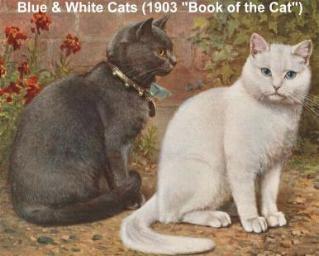
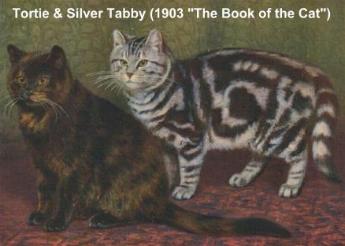
White - colour, pure white. Eyes, blue. Black - colour, pure and rich black; no white. Eyes orange. Tortoiseshell - Colour, patched yellow, orange and black; no stripes. Eyes orange. Tortoiseshell and White - Colour, white patched with yellow, orange and black; no stripes. Eyes orange. Silver Tabby - Colour silver grey, marked with rich black stripes or bars; no pure white. Eyes, green or orange. Spotted Tabby - Colour, any shade of light colour, evenly marked with spots of a darker shade or black; no stripes; no pure white. Eyes, orange, yellow or green. Brown Tabby - Colour, golden brown, marked with rich black stripes or bars; no white. Eyes, orange or green. Orange or Red Tabby - Colour, light orange or red, with darker stripes or bars; no white. Eyes hazel, or golden brown. Tabby and White - Colour, any shade of tabby with white. Eyes, orange or green.
N.B. - Where more than one colour is given for the eyes, the first one is to be preferred to the second or third.
It will therefore be seen that texture and length of coat are really the distinguishing points between the two varieties. It is just as grave a mistake for a Persian cat to have a short, close coat as it is for one of British type to possess any of that woolliness or length of fur which denotes a mésalliance. The commonest species of all short-haired cats may be said to be represented by broken-coloured specimens - that is orange-and-white, tabby-and-white, and black-and-white. These sorts of cats we most frequently see about our public streets and in the homes of country cottagers. At our shows this type of cat - which would be classed as "any other colour" - is fast disappearing from our midst. In America I observe that a class is still specially reserved for orange-and-white cats, and it would seem that this is rather a favourite breed with our cousins over the water.
A good black, with rich glossy coat and deep amber eyes, is, to my mind, one of the choicest of our short-haired breeds. These cats are often marred by the white spot at the throat, and, of course, green eyes predominate to a very great extent. As in the long-haired cats, blue-eyed whites are coming much more to the fore, and on the show bench, at least, we do not see many other specimens with yellow or green eyes.
Our British tabbies - orange, brown, and silver - are always well represented at the principal shows, and or late years competition has been much keener in these classes. It is when we come to markings that the long-haired breeds must take a back seat, so to speak, and the British puss has an easy walk-over. In the short, close coat, the broad or narrow bands of the darker colour show up in grand relief on the ground-work of a rich, though paler, shade. The rings round the neck and tail, and the bars on the legs are seen to great perfection. It will be easily understood, therefore, that markings in short-haired tabbies claim the first and greatest consideration, and that these should be sharp and distinct, great care is needed in mating and breeding.
A serious and rather common defect amongst silver tabbies is a tinge of brown about the face - generally on the nose. Orange-tabby females are rarer than males. The peculiar species known as spotted tabbies is becoming very rare, and whereas formerly some of this breed were generally exhibited at large shows, we now seldom see them. Spotted tabbies are usually brown or silver. I do not recollect having heard of an orange-spotted tabby. The spots should be spread uniformly over the body, feet, and tail, and if on the face so much the better. A perfect specimen should not have a suspicion of a stripe or bar anywhere. Harrison Weir considers that the spotted tabby is a much nearer approach to the wild English cat and some other wild cats in the way of colour than the ordinary broad-banded tabby [he was wrong, the mackerel tabby is the "wild" pattern].
Amongst writers on cats - such as Harrison Weir and Mr Jennings - priority of place is given to the tortoiseshell cat, and this breed heads their list of short-haired breeds. So also formerly in the Crystal Palace catalogue, to which I have before alluded, tortoiseshells lead the way. Here again, the patchy nature of the three colours is - or at least, ought to be - the distinguishing feature, and the long-haired cat of the same variety loses some of its individuality by reason of the length of fur, causing a mingling or blurring of the colours.
It is a strange fact in natural history, which no-one has attempted to explain, that the tortoiseshell tom is a most rare and uncommon animal. A number of clever fanciers and breeders have used their best endeavours and patiently persevered in the fruitless attempt to breed tortoiseshell male cats. In my long experience I have never known anyone who has succeeded, and those specimens that have been exhibited from time to time have been picked up quite by chance. I recollect, many years ago, at the Crystal Palace show, seeing the pen of a short-haired cat smothered with prize cards, and the owner of the puss standing proudly by, informing inquirers that it was a tortoiseshell tom that lay hidden behind his awards. This man had been paid a shilling by a London cook to take away the troublesome beast out of her area! He had taken it away to some purpose, and his surprise at finding himself and his cat famous was amusing to behold.
A very beautiful cat is the English tortoiseshell-and-white when the colours are well distributed, the red and black showing up so splendidly on the snowy ground-work. I must say I far prefer those cats to the tortoiseshells, which are often so dingy in appearance. In this breed the male sex is conspicuous by its absence. The two breeds that have made great strides of late years amongst the long-haired cats - namely, creams and smokes - are very rarely met with in the short-haired varieties. I know, however, of a silver tabby that, when mated to a black, throws smoke kittens. These are quaint and pretty, with bright green eyes. The undercoat is snowy white, and gleams through the dark outer fur, giving a very distinguished appearance. It is a pity some fanciers do not seriously take up the breeding of cream short-haired cats, as I think they would repay any trouble pent over them. They should, of course, be as pale and even in colour as possible, without any markings, and with deep amber eyes. I can only recall one or two, and these not at all perfect specimens.
Amongst our present-day fanciers of short-haired cats I may mention Sir Claude and Lady Alexander, who have splendid specimens of many of the breeds. Mrs Collingwood has recently almost discarded Persians for the British beauties, being specially partial to silver and orange tabbies. Lady Decies for many years owned the invincible "Champion Xenophon" - a brown tabby of extreme beauty - who died in 1902. There are several fine short-hairs at the spacious catteries at Birchington.
Mrs Herring's name has always been associated with "Champion Jimmy," the noted silver tabby, and she is also the owner of "King Saul," one of the few tortoiseshell toms that appear at our shows. Many other specimens have been bred by this well-known fancier. Mr Harold Blackett has a trio of famous prize-winning silver tabbies, and Mrs Bonny is a noted breeder of browns and silvers. This enthusiastic fancier writes:- "For many years past I have devoted myself to the cult of the British tabby cat; it has been my one hobby. Really good specimens of browns and silvers are scarce. Certainly silvers have increased in numbers during the last few years, and the quality has improved. They are difficult to rear, more especially the males." Mrs Bonny's celebrated brown female tabby, "Heather Belle," died in 1903. A silver tabby "Dame Fortune" - her daughter by Mrs Collingwood's "Champion James II" - created quite a sensation at the Westminster and other shows. Mrs Derby Hyde has always been faithful to short-haired blue-eyed whites. Mr Kuhnel is noted for his gorgeous-coloured and finely marked orange tabbies. Many breeders of Persians keep one or two short-haired specimens, and I cannot help believing that, as time goes on, we shall have a larger number of fanciers taking up British cats.
Harrison Weir, in comparing the two varieties, writes:- "I am disappointed at the neglect of the short-haired English cat, buy the ascendancy of the foreign long-hair. Both are truly beautiful, but the first, in my opinion, is far in advance of the latter in intelligence. In point of face, in animal life, in that way it has no peer; and, again, the rich colourings are, I think, more than equal to the softened beauty of the longer-coated. I do not think that the breeding of short-hairs is yet properly understood."
A correspondent writing to Our Cats, complaining of the classification for short-hairs at shows, says:- "All fanciers of that beautiful animal the British cat feel how they are handicapped when they receive schedules of the various shows and compare the classification of short- and long-haired cats. For better it would be honestly to announce a 'foreign cat show,' with a rider that a few English may compete if they choose. 'Tis a pity, in many ways; for, given a little encouragement, the standard of the poor, everyday, homely pussy would be raised, and we would not see so much wanton cruelty and neglect attached hereto." [Note: "homely" in British English means home-loving/welcoming, it does not mean unattractive.]
In America short-hairs have not "taken on," and at the various shows the specials offered are as small in number as the entries made. I never hear of any exportations of British cats to American fanciers; but perhaps some enthusiast of the breed will start a short-haired cattery. There is certainly room for such an enterprise, and the sturdier Britisher would more easily resist the trials of an Atlantic trip and the terrors of a three days' show.
I have been fortunate in obtaining the kind assistance of two of our best authorities on short-haired cats - namely Mr H E Jung and Mr T B Mason. Some notes by these competent judges will be read with interest.
Mr H E Jung says "It is a matter of regret that this variety at shows is not so fully represented as it should be, taking into consideration the large number of cat exhibitors. There is no doubt that the prettier long-haired variety secures greater support from the lady exhibitors. In addition to the characteristic of being a native production of the British Isles, they have certainly a great advantage in their racy, workmanlike appearance, which is lacking in the long-haired variety. What is handsomer than a sleek-coated black, with its grand, golden-amber eyes; the workmanlike spotless white, with its clear blue eyes; the aristocratic silver, with its rich tabby markings, its soft emerald or orange eye; or the pale, lavender-hued blue, with its coat of velvet-like texture?
Thanks to such enthusiastic breeders as Lady Alexander, Mrs Herring, Lady Decies, Mr Sam Woodiwiss, Mr R P Hughes, Mr Kuhnel, Mr Louis Wain, and several others, we are not likely to allow the English short-haired variety to deteriorate. I myself think there has been a great improvement in the specimens penned the last few years. The fault we must guard against is the loss of size and stamina, which can only be averted by judicious mating. The increasing number of shows in America, the Colonies, and even on the Continent, should stimulate breeders of the short-haired variety to extend their catteries, for no doubt in a few years there will be a strong demand for the English-bred short-haired cat. Up to the present only in England has anything like a systematic rule been followed out, which is most essential: in fact, the only course possible to obtain good specimens is to follow out a system of breeding as near perfect as possible - for, as in everything else where breeding is concerned, the old maxim of 'blood will tell' holds good.
The stud books should be kept up to date, and stud registrations should be followed out, just as in the dog world. I can imagine many of my readers who do not take up cats as a hobby saying 'The ordinary common garden cat suits my purpose; he is affectionate, he catches mice, and that is all I require.' But how much more satisfactory it is to be able to say, 'My cat is blue-blooded, has an aristocratic pedigree, is handsome; he goes to shows, perhaps wins, and he is still affectionate; he also catches the mice as well as his brother of lower birth and less striking appearance.' You must also bear in mind he does not require any daintier feeding. I consider it is always pleasanter in cat, dog, or horse to own a distinguished-looking animal than an ill-bred ungainly one that neither pleases not satisfies the eye.
I would here remark upon the absence of men who take up breeding cats as a hobby, and yet the short-haired variety is essentially a man's breed. They require very little grooming and attention compared to the long-haired varieties. Several of the most prominent judges of cats are also recognised in the dog world. I may mention the late Mr Enoch Welburn; Mr F Gresham, the keen 'all-round' judge; Mr L P C Astley, also at home both in one or the other; Mr Sam Woodiwiss, the well-known fancier and expert; Mr Lane, who also adjudicates on both breeds; and Mr Louis Wain, to whom we are indebted for those delightful pictures depicting cat life.
Tortoiseshells are most difficult cats to breed. Either they come too dark or too light, or the colours are not sufficiently well blended. One of the singularities of the breed is the nearly entire absence of males in every litter; in fact, I remember the say was that a tortoiseshell tom was as scarce as the dodo. At the present time however, we hve two good toms - viz. 'Champion Ballochmyle Samson,' winner of no fewer than twelve first prizes and championships, the property of Lady Alexander, and 'Champion King Saul,' winner of numerous championships and first prizes, owned by Mrs herring. Both these males are very good, and whenever they have been penned together it has always been a difficult matter for me to decide the winner. In females, 'Ballochmyle Bountiful Bertie' (sire, 'Ballochmyle Samson' [Note: a fertile tortie tom!], also the property of Lady Alexander, winner of several firsts and championships; 'Fulmer May,' the property of Lady Decies, winner of many firsts - they are both grand females, of the right colour and type; the tortoiseshell-and-white 'Champion Ballochmyle Otter,' the best tortoiseshell-and-white I have ever seen penned, winner of nine first prizes and championships, the property of Lady Alexander. This cat has held her own in her class for the last seven years - a most remarkable feat.
Silver tabbies I must certainly class among the most aristocratic of the breeds. Fanciers will tell you how difficult it is to obtain a good one. Either the tabby markings are not clear, nor sufficiently defined, the black is not dense enough, the butterfly markings are not distinct, or the eyes are not of the correct colour. To get anything like a perfect type in silvers is a great feat, and only the outcome of judicious mating. One of the great faults of many silvers on the bench today is that they are deficient in size, and unless we attend to this I am afraid that shortly we are likely to produce a diminutive type which, of course, is greatly to be avoided. I hardly think this breed is sufficiently supported, taking into consideration the richness in colour and markings of the silver tabby. Among the many winning males. 'Champion Jimmy' stands out very prominently, having won numerous championships and first prizes; he was the property of Mrs Herring [other silver tabby males and females and owners are listed].
Very few good brown tabbies are benched, and breeders, I am afraid, get very disheartened at the result of their efforts. I despair to think of the litters I have seen, and not a good one amongst them. The rich brown sable colour is very seldom met with, and now that the world-renowned champion of champions, 'Xenophon,' is no more, we have only 'Flying Fox' and 'King of Lee' anything like the type you expect in this handsome breed. Of 'Champion Xenophon' I am afraid we can truly say, 'We shall ne'er look on his like again.' His wonderful colour, markings, and size approached the ideal short-haired cat. I believe he was either bred by Mr Heslop, or came under his keen eye, and like a good many others, was brought down south by that fancier to make a name. He was claimed by Mr Sam Woodiwiss, who showed him for some years, and he secured for his owner numerous championships, first prizes, and specials, afterwards changing hands and become the property of Lady Decies, still following up his winning career after and unbroken record of 'second to none.' I think I am correct in saying this cat has won more money and specials than any short-haired cat ever exhibited.
Red tabbies, again, are one of the difficult varieties to obtain. The dense, dark red tabby markings against the light red ground is only the result of judicious mating and breeding [there follows a list of notable cats, mostly from the Ballochmyle line].
Blues (self-coloured). There seems to be a great difference of opinion as to the shape and make of head of these cats. Some judges look for a round, full head of the English-bred cat; others, the long head of the Eastern variety. I think that difference arises to a great extent according to where these cats originally came from. I have heard the opinions of some who give Archangel as the port of origin; others, Malta. If the cat originated from Archangel, one would naturally expect a long head of Eastern type. The specimens, however, from Malta have certainly the round head and more of the English-bred type. The chief points, in my opinion, apart from the shape of head, is body colour, shape, colour of eye, and closeness of coat. They are no doubt a very handsome breed. In colour they are a light blue, with a delicate lavender bloom pervading the whole coat [there followed a list of notable blue cats, including Mrs Carew-Cox's Russian-bred 'Moscow']. An explanation may be deemed due to my readers for having included blues amongst the English types, but as the clubs have recognised the breed, and sanctioned their being catalogues amongst the English exhibits, I felt justified in adopting this course; more particularly as the country of origin still remains a matter of speculation."
White English cats appear to have lost less in size than many others, as two of the largest winners of today - viz 'Ballochmyle Snow King' and 'Ballochmyle Billie Blue Eyes' - will testify. The white retains the racy, workmanlike character of the true English-bred cat. One fault is very prevalent: they lean very much towards a broken coat (a good many of the white cats penned today have this failing); it is, no doubt, a very difficult fault to breed out. It is noticeable that the females in this breed are so very small, and in marked contrast to the toms. The chief points one desires in this breed are closeness of coat, size, and a distinct light blue eyes (not washy). Among the numerous winners are 'Ballochmyle Snow King,' formerly owned by Mr Sam Woodiwiss, and now the property of Lady Alexander; 'Ballochmyle Billie Blue Eyes' and 'Biddy Blue Eyes,' the property of Mrs herring.
Blacks, I am sorry to say, are somewhat neglected, considering how striking they are. The dense black coat, the contrasting grand amber eye, should always find a weak spot in the heart of every exhibitor of the short-haired varieties. The points we look for are chiefly closeness of coat, the black of great density, pure amber eyes set in a good round head topped with small ears. I can well imagine my readers will say, 'A pure amber eye - how is it to be got? It is such a rarity.' I know, however, that by careful mating it is not only possible, but most distinctly certain, as Mr R J Hughes, the late owner of that lovely female 'Amber Queen,' one of the best-eyed cats I have seen, can testify. He, in fact, has bred many of the best-eyed winners of late years.
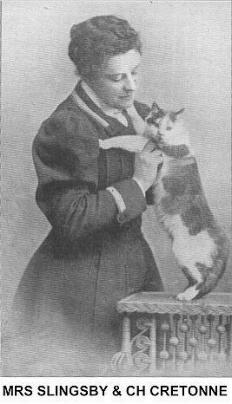
Mr T B Mason's name is a household one in the cat fancy, and this most popular judge has been kind enough to set down some of his many experiences, and a little of his universal knowledge, for the benefit of my readers.
"For more than twenty-five years I have taken a very great interest in all our minor pets, so the breeding and exhibiting of cats has had a large share of my attention. I look at the past, and compare it with the present, and I am more than satisfied with the progress made and the high-water mark of excellence attained. In the 'eighties [1880s], when that noted North Country breeder the late Mr young, of Harrogate, was hard at work laying the foundations of markings and colour in the silver tabby, orange tabby, and the tortoiseshells, which has resulted in making the strains of the North Country short-hairs so far ahead of all others, he had little or no idea that in so brief a time the cat fancy would develop into such an important one as it is at the present time. In recent years we have seen the National Cat Club, the Cat Club, and a great many specialist clubs formed for the special object of breeding cats to perfection in colour and markings. Standards have been made and issued by noted breeders, who have met together and have exchanged ideas, so that at the present time we have standards that are ideals of perfection. Shape, colour, markings, coat, and colour of eyes for each separate variety are all plainly stated. All this interest, together with the holding of many big shows in different parts of the kingdom, have brought into prominence a great host of fanciers, including many ladies holding high positions in the best class of society. No wonder, then that there should be a call for a standard work dealing with all varieties of cats.
In the few remarks I have to make on short-haired cats I shall take the self colours first. They are, I believe, our oldest variety; the black or the white cat is to be found in many a household. In some parts of the North when I was a boy it was said to be a sign of good luck to have a sound-coloured black cat, with a coat like a raven's wing, with not a white hair to be found in it. If you have one like this in your home, with a good round head, neat ears, and rich orange eyes, let me ask you to take great care of it. If you reside in a district where shows are held - either in connection with the local agricultural society or in the winter time in the town hall in connection with the local fanciers' society - by all means enter it, and you will find you have an exhibit of real value. We possess grand examples of first-class blacks in Lady Alexander's 'Black Bump,' Lady Decies' 'Charcoal' and 'Shamrock,' Mrs Nott's 'King of Blacks,' and many other present-day winners. In self whites lady Alexander's 'Snow King,' 'Billie Blue Eyes,' and 'Snow Bump'; Mrs Western's 'Prickly Pearl'; and the Hon A Wodehouse's 'White Devil' are about the best living, and in condition and coat are hard to find fault with.
The eyes of the self white must be a rich-coloured blue. The shorter and fuller you can get both the self black and the self white the better will be the chances of their winning prizes; a long, coarse coat, big or badly set-on ears, and long, thin, snipy faces are little or no good in the show pen. In your breeding arrangements you do not need at this time of the day to make many experiments. In breeding self whites the great aim is to obtain shape and colour of eyes. So many good sires are to be obtained that if you are deficient in bone, shape, or colour of eyes, you can with careful mating obtain these - in some cases with the first cross. My opinion is that in breeding whites no other colour should be mixed with them. In the breeding of blacks you are altogether on another matter. It is a well-known fact that the cross with the sewlf blue is a most distinct advantage. It not only gives tone and soundness to both the blue and the black, but it also adds lustre.
For a long time we have called the self blues Russians. No doubt they, in the first instance, came from the East; but since they were imported into this country they have been mixed in a great measure with self blacks, and in some cases with long-haired blues, to get strong, short, round heads, so that at the present time we have very few pure-bred Russians in this country.
My advice to those who are breeding self blues or self blacks is, by all means put one cross of blacks in the blues, especially if the black has orange eyes. It is in eyes that most of our self blues fail. Let me, however, give here a word of warning. O not mix the colours too often or you will get the blues too dark or nearly like black [note: this is an old genetic theory]. If you get one cross of the black and blue, use it as it should be used, by mixing the offspring will together. I know a great many breeders are not in favour of this in-breeding. This is, without doubt, their loss. In all branches in-breeding is the sure road to success.
To go outside at every cross, or too often, brings with it a lot of trouble and disappointment. To all my advice is, having got the strains of noted sires in your youngsters, so mix them that all the good and little of the bad points will come out as the result of your breeding. That you will not get all winners is a sure conclusion, but my experience is - and it is formed after thirty years' breeding of fancy pet stock - that in this way you are more likely than in any other to breed winners [there followed a list of leading self blues]. All that is needed to make this one of our most popular varieties is uniformity in shape. In my opinion these cats should be judged on the same lines as our self blacks and self whites.
I now come to the tabbies - silver, orange and brown. What a lovely variety they are, and what a fine picture any of the three colours makes if they are seen in full coat and clear markings! In silvers the old-time champion 'The Silver king' was without a doubt the foundation of most of our present-day winners. Mrs Herring's 'Jimmy,' the noted female 'Shelly,' and a host of others that at the moment I cannot remember are worthy of the great deeds of the past [a list of noted silver tabbies followed]. In the orange we have a strong lot [there follows a list] all of them getting close on the standard both in colour and markings. In browns the old champion 'Xenophon' is, to my mind, the best tabby of any colour ever seen in the show pen; his picture is before me as I pen these lines. I will remember giving him the first and special for best cat in the show; since that time how many times he has won the championship I cannot say. His loss will be great, both to the fancy and also to Lady Decies. [Again a list of current brown tabbies] are all good ones; but in this colour of tabbies the competition is not half so keen as it is for silver and orange.
One standard governs all the three colours. The ground or body colour must be pure and clear from any other colour. In a great many well-marked ones I meet in the show pen the rusty brown tinge on nose, ears and brindled in the body markings puts them out of the prize list. It is a great mistake to cross the silver tabby with the brown tabby or with one that has in its pedigree the brown tabby blood. If the black markings need a darker shade, my advice is use for once the self black. If you do not get the desired effect the first cross, the youngsters mated together have been known to breed some really good ones. By all means, if possible, get into your silvers green eyes. I am aware that the standard says green or orange eyes; but in all cases where the competition is very keen the orange eyes are a distinct disadvantage.
In the breeding of the orange tabby you need to be very careful. The use of the tortoiseshell has been found to be very advantageous; in fact some of our best orange tabbies have been bred from the tortoiseshells [note: the relationship of sex-linked red to tortoiseshell was not understood]. The mixing of these two varieties, if done carefully, will bring success on both sides; but care should be taken not to bring too much of the tortoiseshell into the orange, or, on the other hand, carry too much orange into the tortoiseshell. The pale yellow eye in an orange is a great point against it winning in the keen competition which we have at the present time. The eyes must be a very rich orange, to match the body colour, which should be two or three shades lighter than the markings.
In the browns we have two distinct colours - the sable colour and the old brown colour. The old cat that I have referred to of Lady Decies' was a sable tabby. No doubt this colour is the more taking of the two, but both are useful, and the old brown colour must not by any means be overlooked in our liking for the sable colour. In all the colours of tabbies we find that the chief bad points are the white lips in the sables mostly, the white spots in the chest in our orange, and the rusty mousy colour in our silvers. The colour of eyes, too, in our browns and sables is far from what it ought to be. Some eyes are a pale green, some a pale yellow. All this proves that the breeders at times go too far in the outcrossing, and bring in with it faults that crop up when those crossings are nearly forgotten [note: recessive genes and polygenes hinted at!].
In the breeding of browns nothing more is needed than what we have - namely, the sable colour ones and the old coloured browns. The blending together of these two colours will put any breeder on the highway to success. I am more than surprised that this variety is not stronger than it is at the present time. I am sure, of all the race and colours of tabbies they are the easiest to breed, and yet we find they are the fewest in number at out big shows. In looking for a real good tabby, do not miss the chest, feet and tail. We have a great lot of good cats if body markings and colour were all that was needed, but when it comes to the ringed tail, the rings around the chest, and the markings right around the toe ends, then they 'come a cropper,' as we say in the North.
One more important point before I finish. What a painful task it is to the judge to find very good all-round exhibits that have plain head markings. The face and cheeks are right in ground colour; and the pencil markings on the fore-face, running into the markings behind the ears, and those on the cheeks are of the faintest colour, and in many cases broken. Such head markings and colour spoil many otherwise really good cats.
I now come to the tortoiseshells - a mixture of orange and black. I have dealt with mixing of colours in my remarks on the orange tabbies. All I need say here is, mind that in your tortoiseshells you do not get the orange markings. The most successful breeder in the North of this variety - the late Mr Young, or Harrogate - made tabby markings in a tortoiseshell a disqualification in the show pen the presence of any white is also a very great drawback, and this is often found in small patches on the belly. You can have both too light and too much orange colour, or you can have them too dark or too much black. Equal colours and well mixed is about the right thing, with good orange eyes. At the present time we have Lady Alexander's and Mrs herring's males - 'Champion Samson' and 'Champion King Saul.' Females are very strong, and well represented in Mrs Pratt's 'Tib of Rochdale' and Messrs Graham and Ainsley's 'Sunine'.
The tortoiseshell-and-white is a most lovely and taking variety, commonly called the 'chintz-and-white' in our homesteads. Very few and far between are good specimens to be found, and yet in the show pens these tri-colour cats have a great advantage over their fellow felines. Lady Alexander has exhibited some splendid tortoiseshell-and-whites, 'Ballochmyle Otter' being one of the best. A very common drawback in this variety is the mixture of tabby with the orange and white, instead of patches of black [note: i.e. tabby torties were appearing]. I feel sure if this variety were only taken up more we should see a remarkable advancement both in markings and in colour. The patches - white, orange, and black - in an ideal specimen should be, if possible, about equal in number, and well placed on the body, head and feet; they look very charming when you see a really good one. I hope a few more fanciers and breeders of short-haired cats will be coming forward, so that the number exhibited at our shows may steadily increase."
In this hope I do most heartily join, for although my name is mostly connected with the long-haired breeds, I am such a lover of all cats that I feel as anxious for one variety as another to obtain friends and favour. It is specially in the South of England that the interest in our short-haired breeds is on the wane, and it behoves all fanciers to strive to assist in keeping alive the love of the British cat in our midst.
In 1902 Sir Claud and Lady Alexander most generously guaranteed the whole of these classes, and although they themselves made a very numerous entry, yet there was a deficit to pay of several pounds, a thing which ought not to be.
I find that the Manx, Siamese, and blues are generally able to take care of themselves at shows, or they have clubs and secretaries who look after their interests; but the "common or garden" puss needs a kindly hand to assist in drawing him to the front, for, as that well-known lover of "the domestic cat," Harrison Weir, writes, "Why should not the cat that sits purring in front of us before the fire be an object of interest, and be selected for in its colour, markings, and form?"
Note: Interestingly, in 1912, a male Tortoiseshell and White was registered with the GCCF, being "Ballochmyle Bachelor", owned by Lady Alexander, bred by C Adkin, born 11th March, 1905, sire "Jabez", dam "Kit". He won 1st Prizes at the National CC Show in 1909, 1910 and 1911 and at Westminster in 1911 and 1912. There seem to have been several tortie males from the Ballochmyle line suggesting either some very interesting genetics in the Ballochmyle line!
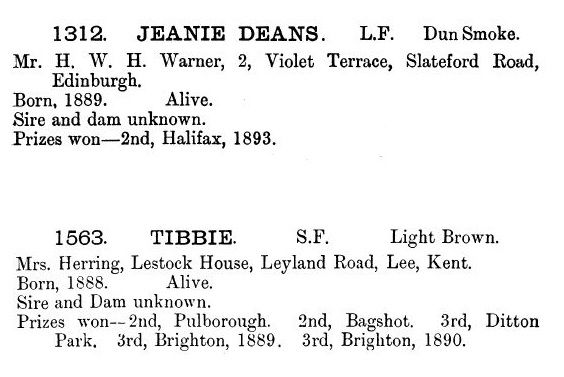
Note: The registry entry below lists a "light brown" shorthair as well as a "dun smoke" longhair.
 If a census could be taken of the cats in England, or even in London, I suppose the proportion of short-haired cats to long-haired cats be about ten to one. In the cat fancy, however, the breeders of Persians in comparison with those of the short-haired varieties are far more numerous. In former days, when cat shows were first held at the Crystal Palace, the premier position was given to the short-haired breeds. On reference to the catalogues up to 1895 I find the following heading at the commencement: "Class I. Short-haired Cats: He Cats, Tortoiseshell or Tortoiseshell-and-White." Then followed the rest of the short-haired varieties, including Siamese, Manx, and blue (self-colour). The long-haired breeds, therefore, in those days had to play second fiddle, so to speak. It was in 1896, when the National Cat Club took over the Crystal Palace shows, that the place of honour was given to the long-haired or Persian cats; and now, as all the world knows - or, at any rate, all the cat world - at every show the short-haired cats are in a very small minority.
 And now I will take a general glance over the other short-haired breeds commonly called English or British cats. As regards points, these are the same as in the long-haired varieties. I give the list as drawn up by the sub-committee of the Cat Club [Simpson herself and Gambier Bolton] for the use of fanciers and judges:-
 Very few good brown tabbies are benched, and breeders, I am afraid, get very disheartened at the result of their efforts. I despair to think of the litters I have seen, and not a good one amongst them. The rich brown sable colour is very seldom met with, and now that the world-renowned champion of champions, 'Xenophon,' is no more, we have only 'Flying Fox' and 'King of Lee' anything like the type you expect in this handsome breed. Of 'Champion Xenophon' I am afraid we can truly say, 'We shall ne'er look on his like again.' His wonderful colour, markings, and size approached the ideal short-haired cat. I believe he was either bred by Mr Heslop, or came under his keen eye, and like a good many others, was brought down south by that fancier to make a name. He was claimed by Mr Sam Woodiwiss, who showed him for some years, and he secured for his owner numerous championships, first prizes, and specials, afterwards changing hands and become the property of Lady Decies, still following up his winning career after and unbroken record of 'second to none.' I think I am correct in saying this cat has won more money and specials than any short-haired cat ever exhibited.
 Mr T B Mason's name is a household one in the cat fancy, and this most popular judge has been kind enough to set down some of his many experiences, and a little of his universal knowledge, for the benefit of my readers.