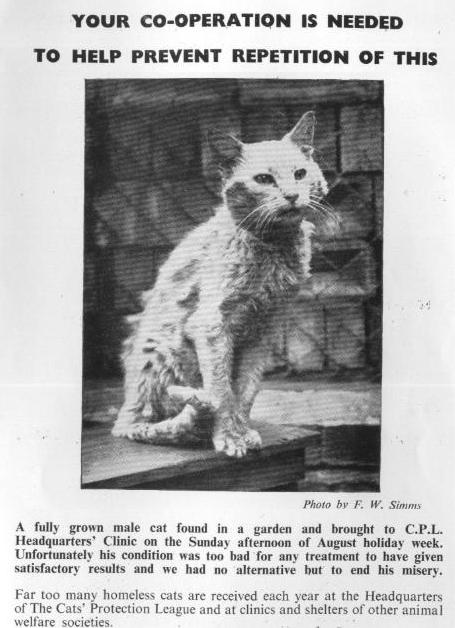
A BRIEF HISTORY OF CAT RESCUE
This article looks at the early history of British cat rescue, starting with the early animal rescue societies. For an up-to-date history of a particular welfare organisation, you are advised to visit its own website (a search engine will find it for you).
EARLY VIEWS ON ANIMAL RESCUE
Cat-related excerpts from Evolutional Ethics And Animal Psychology By E. P. Evans (1897)
A few quotes pertaining to cat sanctuaries.
In India hospitals for diseased and decrepit beasts have existed from time immemorial, and still constitute a universally recognised object of public charity and private munificence. [...] To the Greeks and other nations of antiquity it seemed as absurd to prolong the life of a decrepit man as it does to Prof. Williams to prolong the life of a decrepit beast. But a sense of the sacredness of human life prevents Englishmen of to-day from showing kindness to the aged and infirm by killing them, and a still stronger feeling of the same kind prevents Jainas from treating old and sickly animals in the same way.
***
Perhaps, when we have fully outgrown our anthropocentric ideas and traditions, we may also discover in a hospital for old and worn-out animals something really commendable and not utterly and irredeemably comical.
***
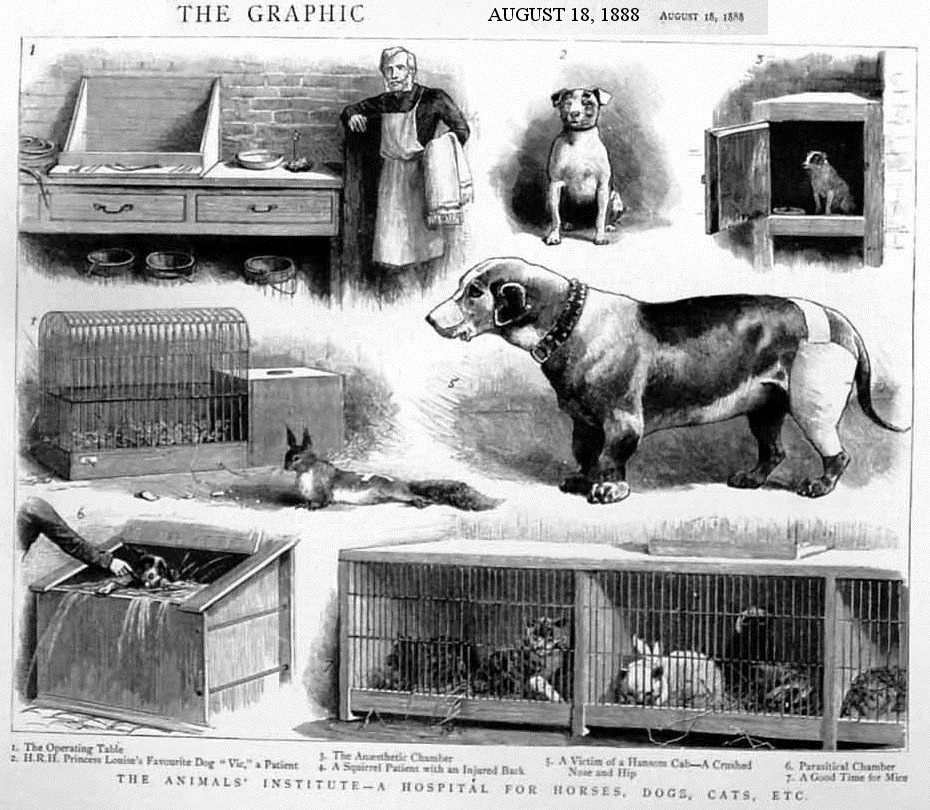
Notwithstanding the ridicule [...] it has been deemed necessary to found a similar Animals' Institute in. London, for the purpose of relieving the sufferings of sick or wounded animals by proper medical or surgical treatment. How urgent was the need of such an institution is evident from the fact that soon after it was opened for the reception of patients, the hospital was found insufficient to accommodate all the horses, dogs, cats, and other animals for which admission was sought. It was also thought advisable to establish, as supplementary to the hospital, a sanitarium in the suburbs of the city for convalescents and for cases requiring prolonged treatment, careful dietary, and rest. Although the animals of the poorer classes, as well as waifs and estrays, are treated gratuitously, the number of paying patients promises to make the institution self-supporting after the preliminary expenses have been covered.
Very different from this retreat for unfortunate animals is the veterinary hospital recently established in New York under the charge of four surgeons, the chief of whom also drives out to visit his patients in their homes like an ordinary medical practitioner. The principal patrons of this institution are wealthy ladies, whose pampered pugs, high-bred cats, and other pets suffer from indigestion caused by too rich and abundant food. ... From a general philozoic point of view this establishment has no practical value whatever, since it affords no relief to the thousands of maimed and sick creatures who stand in most pressing need of it.
In some of the other larger European cities we also find occasional asylums for stray and famished dogs and homes for houseless cats, such as the refuge founded by Ellen M. Gifford at Brighton, in England, for the succour and sustenance of needy animals, Miss Lindo's hospital for consumptive and home for weary horses near London, and the Countess De la Torres's [sic] asylum for cats at Hammersmith [note: in fact she was a cat hoarder]. The pound, which exists in most towns, or the parish pinfold, is an establishment of a wholly different nature, inasmuch as its purpose is not to provide a refuge for beast, but to give protection to man, corresponding, in this respect, not so much to a hospital or almshouse as to what the bedlam or the madhouse used to be before the discovery of more rational and scientific methods of treating the insane.
"In Egypt," says Lecky, "there are hospitals for superannuated cats, and the most loathsome insects are regarded with tenderness; but human life is treated as if it were of no account, and human suffering scarcely elicits a care. The same contrast appears more or less in all Eastern nations." Also some of the men most conspicuous for their activity during the Reign of Terror in France were very fond of pet animals. Couthon was strongly attached to a spaniel; Fournier lavished his love on a squirrel; Panis kept two gold pheasants; Chaumette had an aviary; and the sanguinary Marat was devoted to doves. The psychological problem pre- sented in all these cases is to reconcile so much kindness to the lower animals with so great indifference or such excessive cruelty to human beings. [...] This principle is exemplified on a smaller scale by the German lady who advertised in a Berlin paper for " well-mannered and well-dressed children to be employed for several hours each day to amuse a sickly cat " ; and by the American lady who ordered a rosewood coffin lined with satin and inlaid with silver for the obsequies of a deceased lapdog. Peoples, as well as persons, may have their sympathies warped and drawn awry and thus develop into " cranks."
***
That the lower animals are capable of feeling compassion and exercising charity toward creatures of their own or of other species is proved by numerous and well-authenticated examples of cats and dogs carrying food to other cats and dogs that were utter strangers to them, but were evidently suffering from hunger.
SOME HISTORY OF ANIMAL RESCUE
This letter appeared in The Exeter Flying Post, 25th October 1889 following the publication of a report on the 21st Crystal Palace Car Show: "Inspired by the Crystal Palace Cat Show, a lady pleads for the establishment of 'a place for rescuing neglected and starving cats, crying out for help from those who pass by as though pity did not dwell in a their hearts, and others suffering was no concern of theirs.' We plead guilty to a lot of pity for the ordinary cry of distress; but we have always been informed that the stray pussy cat's cry was generally a cry merely of triumphant or baffled affection. And the British public generally responds to it with a lump of coal."
In the 1890s, there were an estimated three quarters of a million homeless cats in London. This numbers were swollen in the summer months when pet cats were put out to fend for themselves while their owners went on holiday. Simpson wrote, "It is during the summer months when householders leave town for their holidays, that poor pussy is forsaken and forgotten and, no provision being made for her, she is forced to take to the streets, where she seeks in vain to stalk the wily London sparrow or pick up any scraps from the gutter." Holiday boarding was available for those who cared enough - and Simpson noted that the poorer classes were more likely to make arrangements for boarding than were their social superiors! At the Battersea Home for Lost Dogs there were also special arrangements for stray cats and at a very small charge per week cats could be taken in to board. Frances Simpson suggested that some of the many "distressed ladies", particularly those living in the country, could run boarding catteries as a means of having an income and providing a service to cat fanciers needing long-term boarding for their cats: "To dwellers in any of our large cities the sojourn in some country place would come as a boon and a blessing"
THE 1895 LONDON CATS DEBATE
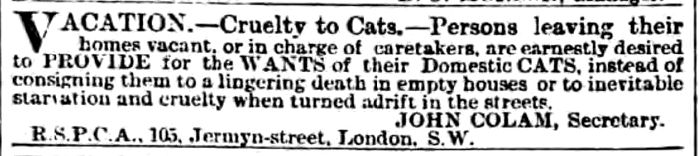
At the start of the summer out of town season, the R.S.P.C.A. placed a regular advertisement stating that it was cruelty to abandon a cat, or to leave it shut up in an empty house, while the family went to the countryside or seaside. Cat owners were told that they should make provision for the cat to be cared for in their absence. This prompted the following exchange in the letters column of the Morning Post, a London newspaper, during 1895.
Morning Post, 27th July 1895
Sir, You have inserted letters from Mr. Colam on the subject of domestic cats, and I notice daily an advertisement on your first page urging people to make provision for them in the Metropolis, and I believe the R.S.P.C.A. has been spending money out of its ample funds to set up a home for cats. No one can have a more intense dislike to animals being treated with cruelty than I have, but it strikes me and many others that this constantly recurring caterwaul is silly in the extreme. Cats are excessively cunning, and well able to take care of themselves; it is impossible to restrict their movements, and even if they are not provided with regular meals at home they will find food elsewhere. Mr. Colam seems to ignore the fact that cats are kept to kill mice, which are to be found everywhere, and it is only when cats are completely spoilt by over-petting that they lose their power of seizing mice and birds. My opposite neighbour had a fine cat that caught sparrows almost daily on the roof. At the same hour every day he could be seen from an attic window lying in wait, often shamming sleep, and when he got his bird he would come downstairs and show it to everyone with the greatest pride before he proceeded to kill it by slow stages and with the cruelty peculiar to all the cat tribe.
I disapprove entirely of this waste of money and sympathy. There are too many cats in London, and about here they are a serious nuisance. As compared to other countries, England is almost free from the reproach of cruelty to animals; it is in countries like Italy, Spain, and Ireland that brutal cruelty exists. The number of cases of cattle-maiming in Ireland is appalling, many of them too horrible to describe, and I have scarcely ever heard of a priest interfering or a conviction being obtained. In England if cases of cruelty occur they are severely punished; public opinion would not tolerate them as it does in Ireland, I wish Mr. Colam and his Society would devote a part of their large income to stop these cruelties in Ireland, and leave our cats alone. Yours, etc, Earl s-court, July 20. Walter Severn.
Morning Post, 29th July 1895
Sir - Mr. Walter Severn's letter will not commend itself to those who are acquainted with its subject. His anxiety to defend the neglect of the owners of cats has led him into several errors. 1. That cats can find food for themselves if not provided with it at home, a very little observation of the condition of stray cats in our West-end streets, squares, and parks is sufficient to disprove. 2. That they are kept merely for the purpose of killing mice it needs but a visit to a cat show also to disprove. 3. That cats kill birds by slow stages and with cruelty is equally unfounded in fact, the first claw or bite being immediately fatal to the bird. Yours, etc, D. July 27th
Morning Post, 30th July 1895
Sir. - In the cause of humanity I sincerely hope that you will find space in your paper for the insertion of these few lines. Mr. Colam, of the Royal Society for Prevention of Cruelty to Animals, has worked hard, and, I am glad to say with some success, in the endeavour to ameliorate the condition of the London cats during the absence from home of their owners ; and I feel sure many persons will be pained on reading Mr. Walter Severn's letter in your issue of to-day, in which letter he tries to upset all the good that has been done. He disapproves of what he calls waste of money and sympathies when expended in aid of starving cats. He ignores the fact that they are God's creatures, and that we are as responsible in His eyes for their well-being as for that of any other domestic animal. Mr. Severn's contention that Mr. Colam should transfer his attentions to Ireland and desert at least one class of animal in England is absurd. The Society does its best, and is bound to do so in both countries, so far as its limited means permit. Unfortunately, I know for a fact that the flourishing state of funds to which Mr. Severn alludes exists only in his imagination. The Society is in reality in very urgent need of increased subscriptions. I have sufficient faith in the residents of London to believe that not many of those who now realise to what deep depths of suffering cats can be reduced by being left for a few weeks to the sole care of servant will neglect to make some dependable provision for their pets in their absence, but should an isolated case occur where it may be otherwise, and this brought about by the influence of Mr. Severn's letter, he need not be proud of having entailed suffering upon a domestic animal needlessly. - Yours, etc July 27. A Twelve Years' Reader.
Sir, - l am sorry to see that a correspondent finds fault with Mr. Colam s appeal for commonly humane consideration for cats ; he probably dislikes them and knows little or nothing about them or he would be aware of the fact that a properly fed and cared-for cat is a far better mouser than a starving animal who has no energy for anything. The well-fed pet cat who used to catch birds is a proof of this, though I should say that it was an exceptional case. If cats are so well able to take care of themselves, how does your correspondent account for the scores of wretched, starving, mangy animals that are to be seen? Most certainly every effort should be made to punish the fiendish acts of cattle-maiming, but it is a queer sort of humanity which will leave a cat to starvation and ill-usage while making such efforts. Yours, etc, Cat Lover.
Morning Post, 31st July 1895
Sir, Notwithstanding the dogmatic assertion of "D. in to-day's Morning Post, I think Mr. Walter Severn knows more of the habits of the ordinary domestic cat than " D." ; indeed, I find it difficult to believe that "D." has ever seen a cat's treatment of a live bird. Last winter I took from a cat a live robin, but although quite alive it was unable to fly, and I was obliged to kill it to prevent further torture by the cat. Only this morning a cat who is well fed brought a live moorhen into my house. My cook took the bird away; it was so scared that it fell into an area, when it was caught by my sister, who carried it to its home, a pond some 100 yards away from the house. By this time it had sufficiently recovered to dive into the water and come up again in the middle of the pond apparently all right. I have never known a bird killed immediately by "the first claw or bite" of a cat. No doubt London cats are ill-used when their owners pamper them through a season, and leave them at the end of it to be kicked about the streets homeless and hungry; but at the same time no cat, unless perfectly ravenous, will eat a mouse or bird it has caught till it has shown what the cat no doubt considers sport. Yours, et. James Crouch.
Sir, Amongst Mr. Severn's unfair and question-begging statements none, perhaps, is more beside the mark than his concluding wish that tbe S.P.C.A. "would devote a part of their large income to stop these cruelties in Ireland and leave our cats alone." Is one form of cruelty to be ignored because another is more shocking to Mr.Severn? As well might we make distinctions in other crimes, and say to the police, Catch all murderers, but leave our forgers alone." Conversely, need we withhold our sympathy and efforts on behalf of suffering animals in Ireland and elsewhere because we do what we can to lessen the miseries of neglected cats in London? The argument (?) that there are too many cats is neither here nor there. If it is true - and probably it is - let us get rid of the surplus by all means, but let it be done humanely, not by slow torture. Exposure to starvation and to the cruelties of human brutes is no fit way to reduce the numbers of these too much despised animals. Yours, etc. B. C. P., Dulwich, July 30.
Morning Post, Saturday 3rd August 1895
Sir. In one of the letters which have appeared in the Morning Post, A Cat Lover asks how I can account for the scores of wretched, starving, mangy animals which are to be seen here. My contention is that there are far too many cats, and that instead of the S.P.C.A. making provision for their protection, and consequent increase, steps should be taken to destroy some of these pests. Our cook has just told me that a stray cat has kittened in our pantry and given her the annoyance of drowning the kittens. Mr Colam is making his society indirectly responsible for cruelty, to say nothing of waste of money. These wretched cats prowl about, the toms fighting desperately, and the females giving birth to large families in filthy cellars and out-of-the-way places. I believe, from what I am told by my son, who is a bacteriologist, that many of these cats are diseased and help to spread disease. Another correspondent, B.C.P. seems to see little difference between the neglect of London cats and the maiming of cattle in Ireland [list of livestock cruelty]. Yours etc, Walter Severn, Earl s-court.
Sir. I do not think that Mr. Severn realises that poor pussy is frequently shut up in a room in a deserted house, to be found a famished corpse by the returning family, laid out probably in the drawing-room or some other apartment. Some years ago a Frenchwoman tried to induce me to take her husband as groom, and gave as proof of his good heart that he scolded her if he saw her brutalising even a cat. May I recommend the Battersea Home for the starving pussies? I left a cat there last winter during my absence abroad, and on my return found her in the very best of health and spirits. Those who believe that cats have no personal attachments should have seen our meeting, and how the creature sprang on my shoulder, and overwhelmed me with caresses, to the great detriment of my bonnet. The most faithful dog could not have greeted more effusively.- Yours, etc. E. Dillon, Pudlicote House, Charlbury.
Sir. With the above the Metropolis is obviously very over-stocked. The old saying about not keeping cats that catch no mice is clearly wise. Those who appreciate their feline friends would hardly object to supplying them with an inexpensive chain collar with a metal disc on which could be stamped the number of their house and street. Cats caught after a certain date minus the necklet could be humanely asphyxiated as were, and probably are, surplus dogs at Battersea. Yours, etc. Claude Champion de Crespigny. Champion Lodge, Maldon, Essex, August 1.
Sir, - Without presuming to state that Mr. Walter Severn has conclusively shown a dreadful lack of sympathy with the acute suffering of our feline domestics, may I suggest that the simplest solution is to take away the whole family, including the cats. I always do when going to the country or seaside, believing and perceiving that my three cats are greatly benefited by the change of air. As they are attached to my family they are no trouble. Yours, etc, A Fellow Creature.
(The Morning Post either received no more letters, or decided not to prolong the discussion in its letters column.)
****
For many years the anti-cruelty societies and animal shelters (in both the UK and USA) were in conflict with the old maids who rescued or fed the strays. The societies were trying to control the population through killing unwanted cats, and indeed, many of the cats were injured or diseased. At the same time groups of (primarily) women, dismissed by the cat-cullers as deluded sentimentalists, wanted to rescue and rehome the animals wherever possible. Unfortunately some of those rescuers became cat hoarders due to the overwhelming number of needy cats. Chloroforming a cat and then placing the dead or deeply unconscious cat under water for a period of time "to be certain it did not revive" was the most humane method then available. It was an big improvement on drowning conscious cats although some towns allowed animals - mostly puppies and kittens - to be drowned in pits provided for that purpose and the RSPCA stated that sacks must be tied and weighted with a heavy stone. Later, electrocution came to be the preferred and cheaper method. In London, the RSPCA killed 1500 cats each week, but in the early 20th century the public was losing its taste for this mass slaughter and were increasingly supporting the rescuers and animal shelters. The rise of cat shows added to this softening of stance.
During the First World War, animal welfare pioneer Maria Dickin worked to improve the dreadful state of animal health in the Whitechapel area of London. Dickin wanted to open a clinic where East Enders living in poverty could receive free treatment for their sick and injured animals. She opened her free dispensary in 1917 and within 6 years she had her first horse-drawn clinic.
Many of the news cuttings included here relate to the late 19th and early 20th Century when rescue meant destruction of all cats and dogs taken to a shelter . The effectiveness of these organisations appeared to be judged by the number of unwanted animals destroyed each year it seemed unthinkable that anyone might want to adopt a second-hand cat. These were Societies for the Destruction of Animals and cats at the time were so abundant that the kill rates were often 100% with perhaps a few of the prettiest cats being sold or rehomed. At the same time, Frances Simpson s book, Cats for Pleasure and Profit, promoted the breeding of fancy cats for sale.
This is excerpted from Cat And Dog Life by C. Rowland Johns; Chapter XXXVI of Wonderful London (c 1923). Most of the article describes dogs and their welfare; but the author included a few notes on cats.
In the East-end of London there is a large foreign and semi-foreign population who will not deliberately commission the destruction of their dogs or cats, although they are quite willing to hand their superfluous animals over to a shelter, murmuring, You will not kill it! washing their hands in the air and inwardly calling on their consciences to witness that they have done the right thing. And so they have, although it would have been better still if they had put a couple more coppers in the box, for chloroform is expensive, especially when a dog or a cat, and not a conscience, has to be put to sleep. But the great thing, we are told by the solemn caretaker, is to get the animals. Look at em ! Better dead than alive, I think.
Many of these little places deal with cats as well as dogs, and there are many more cats than dogs in the poorer districts. The London cats would be as numerous as rabbits in Australia if these shelters did not carry on their work of rescue. You will not see cats congregated in joyful and vociferous crowds in London - though you may hear their melancholy voices at night; but you will scarcely traverse any thoroughfare without seeing at least one pussy sunning herself on some fence or window-ledge, secure from ill-mannered dogs. Suburban streets swarm with cats; and even in the busy thoroughfares of the City and West-end they go about their own concerns, aloof and dignified.
The London cat has the distinction of supporting a special industry. In almost every street market there is a stall bearing the sign, Pussy s Butcher, and the itinerant vendor of cat s meat is still seen - and heard - in suburban by-ways. The stray cat problem is even more difficult than the problem of the stray dog. There is not even the prospect of a 7s. 6d. tax at some future date to restrain their owners from allowing innumerable kittens to live until they grow up and are not wanted. When they are lost, accidentally or otherwise, it is no one s business to collect them - indeed, it would be hard to distinguish them, pussy being by nature a wanderer - and a stray cat continues to be a stray unless she can find herself a new home: until she is so far gone in wretchedness that some kindly soul picks her up and takes her to a cats home. True, a cat will not starve as quickly as a dog, for she has access to the domestic dustbins, the edible contents of which so much astonished Max O Rell when he lived in London.
WHILE January 1st is the dog s evil day, August Bank Holiday, and the weeks before and after, hold tragedy for many cats. Presuming on their faculty for picking up a living somehow, many cat owners set out for their holidays without making any provision for their pets, expecting to find pussy on their return, plump and debonair, purring a welcome on the doorstep! Some cats are old campaigners, and know how to insinuate themselves as temporary boarders in a new home; but the majority fall victims to the vagaries of climate, bad and dirty food, and distress at the loss of their homes and friends. To these poor waifs the cat and dog shelters are havens of refuge.
There are many people who hold that the life of a domestic animal should never be taken, but a shelter run on this principle would soon out-rival the Zoological Gardens in size and expense, without any money takings at the gate. It is no pleasure to those who conduct these rescue places to destroy life, they are true lovers of animals, and yet, from a sense of duty, spend their lives in doing work which is abhorrent to them.
MUCH of the work is voluntary; there is no money in it for the commercially minded, and no one will do it unless he wishes to prevent animal suffering. The fumes of the chloroform and gas produce headaches, but the heartaches are harder to bear. Yet they do the uncongenial work year after year, spending their lives in a thankless and difficult drudgery, because they believe that death is the best gift they can bestow on the superabundant feline and canine residents in poverty-ridden homes. Here is one of the workers coming into the room. She looks at the cats in the cages around the walls and speaks to the caretaker.
I have a home for that kitten. We will keep her, the rest must go.
The work begins. The lid of the lethal box is lifted, the chloroform is placed in a shallow dish, a cloth is soaked in it, waved around the box so that. the air mixes with the fumes, and the cat is placed inside, the lid shut down, and an opening left through which the cat may be stroked and soothed. A working woman brings in a dog and watches the last act in the life-drama of the cat.
What a lovely death ! she exclaims. I opes I goes as easy when my time comes. Why, it s just sleep coming over you like a silver cloud I
The lady who supervises the shelter answers: Yes, it s very easy She does not explain that she sold her piano to keep the shelter going in its early days. nor that she could run a car with the money she spends in the work, although it is true. But some people wonder what she is making out of it! They think that no one ever does anything except for selfish reasons.
In addition to the cat and dog shelters and the larger dogs homes, there are other places supported by animal lovers for the alleviation of suffering. There is no need for any dog or cat in London to suffer from lack of veterinary attention because of the poverty of the owner. There are hospitals, dispensaries, clinics and out-patients wards connected with most of the animals protection associations. If an animal suffers from lack of skilled treatment it is the fault of the owner s neglect or the owner s ignorance.
Tricycles and motor ambulances are often to be seen taking sick, injured or stray animals to the hospitals. There are caravans, or travelling dispensaries, which take up a pitch in side streets, to which crowd children with their sick and afflicted domestic pets. The Canine Defence League has a scheme by which veterinary surgeons visit sick dogs in their own homes free of cost to poor owners. It would be a mistake to imagine that London s dogs and cats are all in need of such help as these organizations give, for Londoners in general are good and considerate owners, and the public authorities are more thoughtful of animal welfare than provincial governing bodies.
CATS IN LONDON. (Huddersfield Chronicle, 25th August 1900)
Year by year the Royal Society for the Prevention of Cruelty to Animals, and the more recently founded London Institution for Lost and Starving Cats, appeal to the humanity of house- holders not to forget their feline pets when they leave town for the holidays. This season, for some reason, the plea would appear to have been more than usually ignored, and on all hands is heard a piteous tale of an exceptionally large number of hungry and homeless creatures prowling about the squares and streets. It is a heartless and wanton neglect of the poor animals, who, if they have not been the favourites of the drawing-room, have at least enjoyed a warm corner near the kitchen fire and a liberal share of scraps and bones from kind-hearted cooks. At the institution just named, which is situate at 38, Ferdinand street, Camden Town, any cat can be mercifully and painlessly despatched in a lethal chamber for the small cost of eighteen pence, and this is surely an outlay not to be grudged by any who have noticed the gaunt and woebegone skeletons hanging about the areas in which they were once well treated. In the case of the poor and the actual labouring classes the "happy despatch" is performed gratuitously for their pets, and these humble folk very frequently manifest vastly greater solicitude for the Tom or Tabby of their hearths than do their social superiors.
At the present time cats are brought to the institution at the rate of between 50 and 60 a day. A sad and sorry lot of grimalkins many of them are, for not infrequently the police bring in some wretched starveling, or some tender-hearted woman takes pity upon two or three deserted creatures in her street, and conveys' or sends them to be killed. It is a veritable casual ward of cats, and the weeks spent in the streets, with the constant terror of ill-usage by loafers, attack by dogs, and want of food, render the poor beasts timid, cringing, and ill-tempered. The experience of those who attend to them is entirely against the generally accepted theory that cats become attached to places rather than people, for there is no doubt as to the joy of the pussies when their owners come to see or to fetch them.
It is somewhat surprising to learn that careful estimates place the number of cats in London at three-quarters of a million, of which from 80,000 to 100.000 are homeless. These latter congregate much at night in disused burial grounds and open spaces as well as in back-yards, where they are such disturbers of nocturnal peace. Where they find enough to prolong their miserable existence is a mystery, for the alertness of the London sparrow is patent to anyone who has ever watched a cat trying to stalk it, and little enough that the animal could eat under the greatest pressure of hunger is to be gleaned from a London gutter.
|
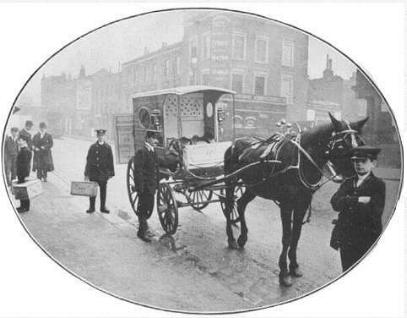
Above: London Institution's horse drawn van (1903) |
|
CATS. (The Times, 24th July, 1902)
TO THE EDITOR OF THE TIMES.
Sir, - The time of year is rapidly approaching when a large number of people leave London. As a result of this exodus an immense number of unfortunate cats are left behind to starve, and, being animals of very strong vitality, they starve slowly and very painfully. In many cases masters and mistresses of houses do not know of the existence of cats which are kept in their own houses, and still oftener in their stables. Is it asking too much of masters and mistresses to beg them before leaving London to find out whether any cats are kept on their premises, and to make sure either that such cats are moved into the country with the rest of the establishment or that they are painlessly killed before the family moves? And may I ask people to do that which already very many kind people do, which is to have any stray starving cats which they see about sent to an institution where the poor animal will be painlessly killed? I know of the existence of two such institutions. There may be more, but I can only speak of these two. First, the Royal London Institution and Home for Lost and Starving Cats, which is under the patronage of her Majesty the Queen and of many other kind and charitable ladies. The address of this institution is 36 and 38, Ferdinand-street, Camden-town, N.W. If any one intends to leave an unfortunate cat behind him in London, he has only to send a postcard to this institution and either a servant will call and take the cat back to the institution with him or else a cat-box will be sent by L.P.D. Co., who by contract will bring the cat carriage paid by the institution. It is not my business to beg for this institution, but it is only right to say that it is supported by voluntary contributions, and, although any cat will be taken in and painlessly killed free of charge, it will be helping a deserving charity if people who send cats there will send a sum of money, however small, towards the funds. The other society of which I am aware is the Society for the Protection of Cats, Gordon-cottage. Argyll-place, King-street, Hammersmith, under the patronage of the Duke and Duchess of Bedford and Earl Percy, M.P. If any one will put a stray cat into a basket, say a margarine basket, and give it to Carter, Paterson or to Pickford, they will deliver the cat at this institution for the charge of 6d. Unless a good home is found, the cat will be placed in a lethal chamber, and will be saved from the agony of slow starvation which would otherwise be its fate.
I am, Sir, your obedient servant, BARRINGTON SIMEON, House of Commons, July 21.
FELINE BOARDERS. (London Daily News, 29th July 1902)
May I, through your paper, ask the public to see that their cats are left in good hands during their absence? There are now several good homes in London and elsewhere where boarders are taken, should their owners not be able to leave them with friends. Two of these I myself know quite well "The Royal Institution for Lost and Starving Cats," 38, Ferdinand-street, Camden Town. London. N.W., and "The Society for the Protection of Cats," Gordon Cottage, King-street, Hammersmith, London. W. Yours, etc. F. HOWELL. 38. Circus-road. South Hampstead, July 26.
THE HOLIDAY CAT. (Frances Simpson, in The Queen, 19th August 1905)
A good deal has been written in the papers lately about the forlorn and forsaken cats that are left to starve during the temporary absence of their owners at this season of the year in our London streets. It is well that the attention of the public should be drawn to the deplorable way in which, year after year, people who in other respects are kind and pitiful seek rest and change for themselves, and yet make not provision for their pets. This suffering brought upon poor dumb animals is as often caused by want of thought as be want of heart. In the bustle and excitement of the general exodus, and in the eager desire to escape from the heat and turmoil of London, the fireside cat and the kitchen mouser are entirely passed over, or, if remembered, these hurrying holiday makers say, Oh, the cat will be all right, she can catch mice ; or The neighbours will look after her ; or The caretaker will be sure to give her a drop of milk ; and off they go without a pang of conscience. I have heard of many sad and terrible experiences of the holiday cat. A lady shut up her house for six weeks, making no arrangement for the holiday pet. On returning home and going to her bedroom, she heard a faint scratching in the wardrobe, and on opening the door a fearfully emaciated creature fell out. It was the poor cat, that had been shut up all that time without food or water. She had had kittens, which were dead, and she in her famished frenzy had torn to pieces and tried to eat a sealskin jacket.
The cat is by nature timid, and she shrinks from the noise and hustle of the streets; she hates strangers, and would not willingly go forth from her home, especially in the daytime, unless forced to do so from dire necessity. It is only too true that a cat is considered fair game for the street arab to hunt and hound down. How often, also, we see a terrified cat chased by a dog, and though puss sometimes shows a brave front and baffles the enemy, yet what agony of mind the poor creature must endure ere perhaps some kindly person will give her assistance, or she herself finds a haven of rest behind some area rails; or, if within reach of a square garden, she will scramble up the nearest tree.
It is said that for every evil under the sun there is a remedy or there is none, and it needs some influential means of lessening the terrible suffering of these much tried and cruelly used animals. Some time ago there was a stir made in high places about the taxation of cats, and if only the same amount of energy and public correspondence could be brought to bear on the subject of providing a cats shelter in London under police supervision, it would indeed be a boon and a blessing to man and beast alike. There are some cats homes in London where the humane work of rescuing these poor waifs is carried on, but it is impossible for any one individual, with even a staff of willing helpers, to cope with the amazing number of stray cats. Then, again, the space in these institutions is very limited as regards the accommodation set apart for boarders and reliable temporary quarters for pet cats would be gladly welcomed by many who are really anxious to provide for their animals when the summer flitting of the household takes place. It has been roughly estimated that during the holiday months 5000 cats are left in a state of semi-starvation as against 500 during the winter months.
There is now a scheme under consideration of Our Dumb Friends League for a large hospital for animals in London, and premises have been taken near Victoria station. It has been suggested that a cats shelter should be started in connection with this institution, and in time to open branches in each borough of the metropolis. For the carrying out of this scheme a considerable capital would necessarily be required, and it behoves all cat lovers to endeavour individually and collectively to gather together sufficient funds to at least make a beginning, so that ere long London, Londoners, and London cats may reap the benefits that such a much-needed institution would assuredly be the means of providing. In the annual report of the Dublin Cats Home, which was started sixteen years ago by Miss Swifte, it is stated that this energetic and enthusiastic secretary has recently agitated for, and succeeded in obtaining, the sanction of the chief of the police to issue a special order to his men on the force to use their best endeavours to pick up and take to the institution all ill-treated, forsake, and homeless cats, and in the lethal chamber these poor waifs and strays are drifted painlessly to their last home.
If proof were needed to show how necessary it is that a boarding-house for cats should be started in London, I would refer to a letter I wrote to a contemporary in July last, headed The Holiday cat. In this I offered to supply the names and addresses of ladies personally known to myself where pet cats could be accommodated during the temporary absence of owners. I was quite unprepared for the enormous number of letters that I received from cat lovers in difficulties who anxiously sought information and wished for a reply by return. Some of my correspondents inclosed stamped envelopes, but others did not; however, I answered one and all during my holiday trip, and should feel more than repaid if a few poor pussies were safely and comfortably housed during the month of August, when London has been said to be given over to cats, caretakers, and curates!
I know several cat fanciers and cat lovers who make a point of taking their pussies with them on their summer outing, and although as a rule cats are not good travellers and resent a change of surroundings, yet I know from my own experience with what delight a London cat will take to the country, with what joy she leaps like a young tiger through the long grass, or dashes up a tree in the exuberance of her spirits, and then wonders how she is to get down again! We are too accustomed to consider that a cat s place is the home and on the hearth, forgetting that to a cat of character life has other aspects; and though she may live contentedly within four walls, yet, if given the chance, she will revel in a country holiday. It is only the few, however, that can or will take their pussies away with them, and therefore some provision should and must be made whereby our town cat and house pets may be safely housed and kindly treated during our absence. Amongst the numerous letters re The Holiday cat that reached me, one from a correspondent residing in a remote part of the country was in a different strain to all the rest. This simple-minded country gentleman utterly repudiated the idea that such forgetful holiday makers existed as mentioned by me, but that, if supposing anyone went away leaving a cat to starve, then those inhuman wretches should be poleaxed ! This gentleman seemed to imagine I had rushed into print without just cause of complaint, but I think my reply must have enlightened him.
Truly the problem of providing for our thousands of stray cats is a difficult one, for not only during the holidays, but all the year round, they, like the poor, are ever with us.
HOMELESS CATS THOUSANDS OF ANIMALS LEFT TO WANDER ABOUT LONDON. (London Daily News, 5th August 1907)
During the past fortnight hundreds of thousands of holiday-makers have left London for the country; and the thoughtless among them have left their cats behind to spend a hunted holiday" in the streets. As a result the summer contingent of strays," as they are termed, has begun flow into the cat shelters of the Metropolis. As many 30 cats in a day have been brought to the new Fulham shelter provided by Our Dumb Friends League, according to information supplied to a representative of "The Daily News." If the animals are in bad condition they are at once placed in the lethal box. Many are kept for some weeks, waiting to be claimed. "Our Dumb Friends* League" receives cats at any hour of the night or day at 931, Fulham-road, S.W., and 41, Fulbourne-street, Whitechapel. The London Institution for Lost and Starving Cats at Ferdinand-street, Camden Town, is also exceedingly busy just now. The average number of cats per day received by this institution is 40, but during the summer months that number is largely exceeded. The institution estimates that at the present time there must be nearly 100,000 homeless cats in London alone.
CATS DAY. (Sussex Agricultural Express, 30th September 1910)
TO THE EDITOR. Sir, October 1st is known as Cats' Day to true lovers of cats, and many, though not as many might, send a small sum to those institutions which seek for and take in starving cats found in the streets of large towns. It is well, while fondling our own pets, not to forget those homeless creatures left destitute through no fault of their own. The causes which lead to this state of things are many. Sometimes pussy is forgotten in the hurry and bustle of moving house, or terrified by the general disturbance she hides until all is quiet again, and alas all those who she had learned to associate with home are gone she knows not where. Many cats are left to shift for themselves while the family goes away for the summer holidays, proof of this is seen in the increase of cats taken to the homes at this time of the year. It is not however only those who leave home to which this state of things is attributed. Poor people keep a kitten for the children to play with, when they tire of it or pussy loses her playful wavy she is left to shift for herself, and even driven away from the only shelter she has ever known. Tradesboys are too often the cause of kittens getting lost; always ready for a game the little creature is enticed along the street by a piece of string until the boy too gets tired of his playmate, and kitty is then too far to find her way back. A sharp look out should kept on those who offend in this respect.
A great deal could be said on this subject, it is not however my intention to occupy more space than is necessary to point out what a great increase of work might carried out if everybody who has any liking for cats would send a trifle to a cats' home on October 1st. Below are the names and addresses of three of the London homes and shelters for stray cats, which are under excellent management:- The London Institution for Lost and Starving Cats, 36, 38, 40 and 42 Ferdinand-street, Camden Town, N.W.; Whitechapel Shelter for Stray Cats (under the Dumb Friends' League), hon. secretarv, the Rev. L. S. Lewis, 31, Buxton-street, E.; Ealing Shelter for Stray Cats (under the Dumb Friends' League), hon. secretary, Mrs. M. Tringham, 19, Hollingbourne-gardens, West Ealing. This home is in danger of falling through, owing to lack of funds from local districts. I shall be pleased to give information to anyone interested in this subject through the columns of the Sussex Express." K. E.ARDINGLY.
PROTECTION FOR CATS.(Leicester Daily Post, 28th February, 1912.)
Sir, - Can any of your readers explain why it is so difficult to keep a cat in Leicester? My own experiences, and that of many of my friends who are cat lovers, is that directly they have had one long enough to become fond of it, it invariably mysteriously disappears. There can be little doubt that the animal has been shot, or, perhaps, forcibly detained somewhere. A cat, well-trained and well-cared-for, will always return to its home while it is able to do so. I have read somewhere of a class of men – too lazy to earn their bread by honest work – who obtain a "living" by killing other people's pets, and selling their skins to be made into gloves, &c. The mere fact that the cat may be the only playmate of some little child never crosses the minds of those who commit such atrocities. But to the child the loss of its dearly-loved pet may be a calamity. It seems to be the general feeling nowadays that anyone may shoot or trap an ordinary domestic cat without compunction. If anyone were to take it into his head to shoot a cow or a porker, or even to slay a neighbour's dog, the owners and the law in conjunction would quickly bring Nemesis upon him. As a lover of cats, I have often wished that the Chancellor of the Exchequer would impose a tax upon them. If that were done the State, in return for the revenue obtained, would be compelled to ensure the same protection for cats as for other domestic animals. – Yours faithfully, "CAT LOVER."
ANIMALS AND THE HOLIDAYS. (Sheffield Daily Telegraph, 29th July 1913).
105, Jermyn Street, London. S.W., July 28, 1913. - Sir, Now that the holiday season is again upon us, may I beg for the hospitality of your columns in appealing to owners of dogs, etc , to make adequate provision for the comfort and welfare of their animals before leaving home for the seaside or elsewhere? A moment s reflection will enable anyone to realise the sad plight of dogs and cats turned out to look after themselves, or shut up in houses without their usual associations and attention, and I trust very much that everyone will use their utmost endeavours to prevent the infliction of suffering in this way. There are various establishments in London and the provinces where dogs, cats, and other pets may be boarded at moderate rates and I appeal to all to see that this is done when it is not possible to arrange for animals to be taken care of during absence on holiday byv friends or neighbours. Yours faithfully, Edward G. Fairholme, Chief Secretary, R.S.P.C.A.
SPCAs
Depending on the individual society, "SPCA" stands for either "Society for the Prevention of Cruelty to Animals" or "Society for the Protection and Care of Animals". They are also known as humane societies. For laws which protect animals, see the
Cat Care Retrospective Index.The first SPCA or humane society was set up by Dublin-born landowner Richard "Humanity" Martin who campaigned for a preventive act to protect animals from cruelty and unjust treatment. The act was passed by the British Parliament in 1822. It has since been followed by animal protection acts which extend or modify the degree of protection offered to animals.
In 1824, the world s first SPCA was formed in London and in 1837 this became the RSPCA under the royal patronage of Queen Victoria. It became the model for many others around the world. In 1845, the French Societé Protectrice des Animaux was formed. America followed somewhat later with the American SPCA in 1866 and the American Humane Association in 1877.
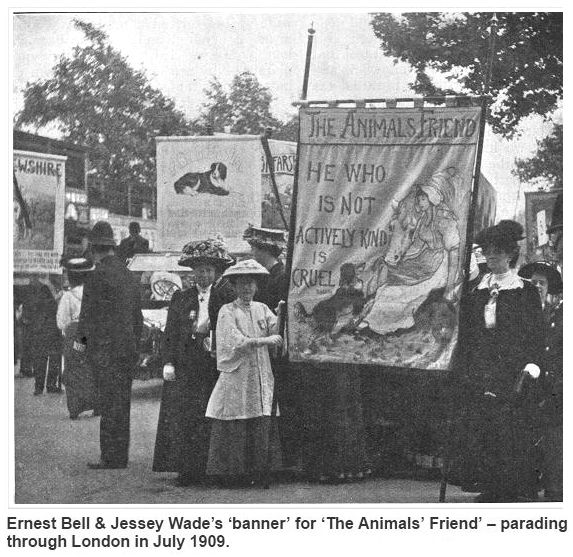
Caroline Earle White founded the Women s Humane Society in Bensalem, Pennsylvania in April 1869. Under Earle White s leadership, the organization became the first humane education program in Pennsylvania. In the beginning, it was a Woman s Branch spin-off of the Pennsylvania SPCA (1868) that Earle White set in motion. Earle White was an active and outspoken campaigner and was married to lawyer Richard White. In 1869 the Women s Humane Society took over the Philadelphia city pound and re-open it under more humane guidelines as the City Refuge for Lost and Suffering Animals. Her objective was to care for homeless animals by finding homes for them in families and, if this was not possible, by finding boarding homes, hospital or refuges for their accommodation, and it this was not possible, they were given a quick and painless death. In 1901r, the Annie L. Lowry Home for Smaller Animals opened under the Society s aegis; unlike most animal pounds, it had indoor and outdoor kennels and concrete floors instead of dirt floors. Concrete was easier to sanitise and reduced the spread of disease. Caroline Earle White also oversaw the formation of the Pennsylvania branch of the Band of Mercy movement. She helped start the American Anti-Vivisection Society in 1883 and she founded and edited the Journal of Zoophily (motto: He who is not actively kind is cruel).
The first Band of Mercy was established at Wood Green in England in 1875 by Mrs Smithies; after her death it was continued by Mr Smithies and Miss Smithies. It was aimed mostly at educating children to be kind to animals. The Bands of Mercy conference held at the RSPCA in London on January 31, 1883, a resolution was passed that the RSPCA would become the governing body of the Bands of Mercy in matters of a general character. The individual Bands of Mercy retained freedom of direction and responsibility in all matters relating to local proceedings, including finances.
BANDS OF MERCY (HUMANE EDUCATION)
The Band of Mercy movement traces back to the formation of a Society for Prevention of Cruelty to Animals (SPCA) in England. The SPCA arose from an 1822 Act of Parliament to prevent cruelty to farm animals and appears to have been the world s first animal charity. It was formed in 1824 by a group of 22 reformers led by Richard Martin MP, William Wilberforce MP, and the Reverend Arthur Broome. Its influential members lobbied Parliament throughout the nineteenth century, resulting in animal protection laws such as the Cruelty to Animals Act 1835. It was granted a Royal Warrant by Queen Victoria in 1840, becoming the RSPCA.
A small group of SPCA members, led by Catherine Smithies, established the Bands of Mercy movement in 1875. It aimed to be a children s club, modelled on the Temperance Society s Band of Hope and encouraged children to love, respect and be kind to animals. The individual Bands of Mercy were locally-led organisations and the movement had its own periodical, the Band of Mercy Advocate (1879-1934), edited by Catherine s son, Thomas. Catherine Smithies died in 1877 and there is an obelisk and public drinking fountain (for animals and for people) in Wood Green, London honouring her Temperance and Band of Mercy activities. In 1882, the year before Thomas Smithies died, the RSPCA agreed to take over the Bands of Mercy and the Band of Mercy Advocate.
The Band of Mercy used a variety of media to promote its cause such as periodicals, songs, images, tracts (fliers/handbills), calendars, competitions, awards and medals, etc. It sponsored prizes at village shows e,g, a medal for the best kept tom cat and essay competitions for school children with themes such as man s duty towards animals under his care, which could not be completed by rote, but required the entrant to think and read around the theme. The themes were often worded in the religious manner prevalent at the time, referring to pets and livestock as animals entrusted by God to man s care.
Although intended to be a children s club, the Band of Mercy cause was taken up by more adults and with more enthusiasm and activism than originally intended; including direct action against hunters (and in some US cities, the abduction and destruction of stray cats). The aim of the original Band of Mercy was the regular and systematic study of animals and to do the best to protect them, erring on the side of mercy, the idea being that we cannot mistreat those we love and understand. Children were encouraged to learn about animals and their habits. Enthusiasm waned in the early 20th Century, with intervention overtaking prevention of cruelty. The name Band of Mercy was revived, or rather usurped, in 1963 by John Prestige and was the forerunner of the Animal Liberation Front.
Catherine Smithies was not the only nineteenth century woman campaigning for animal welfare. In 1875 Frances Power Cobbe formed the Victoria Street Society campaigning against vivisection; this eventually became the National Anti-Vivisection Society.
The Band of Mercy movement was taken up overseas as well. In 1882, George T. Angell, founder of the Massachusetts Society for the Prevention of Cruelty to Animals (MSPCA) teamed up with Rev. Thomas Timmins to start Bands of Mercy in the USA. In England, membership of the Band of Mercy movement was between 40,000 and 50,000 in the mid-1880s, and in America about 90,000. By the early 20th century there were more than 27,000 Bands of Mercy in the USA. Its members pledged I will try to be kind to all living creatures, and try to protect them from cruel usage. By the 1930s the groups were more often known as Junior Humane Leagues.
Before the world wars, humane education for children was considered a way to create a kinder and more peaceful world. Unfortunately, two world wars, the communist threat and the space race focused American education on maths and science, to the detriment of humane education and the Band of Mercy movement. Bands of Mercy were mostly driven by animal welfare organizations whose focus now moved to intervention in abuse, rather than education to prevent it. As a result, the Band of Mercy initiative largely petered out in North America and, arguably, animal neglect and cruelty cases increased.
In mid-1880s Australia, the Band of Mercy movement was under the gentle rule of the ladies, and was more overtly Christian than in Britain, while the Animal Protection Society (of Australia) was governed by the stern hand of man. The aim of the former was to educate children to be kind to animals, while the duty of the other to punish that child when grown up for any acts of cruelty towards animals.
DOGS' HOMES AND DUMB FRIENDS
The majority of early institutions and "homes" were not for rehoming stray or surrendered cats and dogs. "Rescue" in the nineteenth century and early twentieth century meant "given a merciful death" and they handled thousands of unwanted, maimed and diseased animals for whom the only salvation probably was the choloroform lethal chamber. It is easy to judge them by modern standards which aim for low euthanasia rates, and many of the "rescuers," who were generally women, came in for abuse (and admittedly a few were in it for self-aggrandisement), but life for unwanted cats and dogs was pretty horrific and chloroform fumes were definitely more merciful than battering, drowning, abandoned to starve, stolen for vivisection or skinning alive by furriers.
Battersea Dogs Home was set up in 1860 as the "Temporary Home for Lost and Starving Dogs" by Mary Tealby in Holloway, London, moving to Battersea in 1871. In the 1880s and 1890s, it sometimes took in 35,000 to 42,000 stray and unwanted dogs in a single year, housing them in communal pens. While Battersea Dogs' Home is best associated with dogs, in 1883 it also became involved with rescuing and rehoming cats.
In 1897, "Our Dumb Friends' League" was founded. Within a year it had 22 branches and by 1900 had a horse ambulance. In 1906 an animal hospital was opened to provide veterinary care for pets belonging to the poor. In 1912, The League launched the "Blue Cross Fund" to assist animals during the Balkan War. In 1950, Our Dumb Friends' League officially changed its name to The Blue Cross, being the animals' equivalent of the Red Cross. As well as animal hospitals, it now has adoption centres.
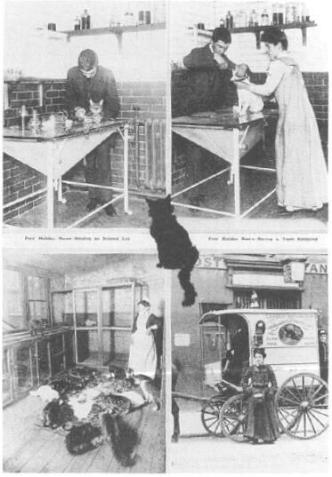
At the end of the 1800s and start of the 1900s, the London Institution for Lost and Starving Cats collected strays in its horse drawn van. The huge number of unwanted cats meant that most had to be destroyed within 24 hours. Many were already beyond saving due to starvation, disease or injury and these were destroyed at once. The London Institution for Cats also provided free medical care to cats whose owners could not afford the attention of a vet and a full page spread from a 1910 issue of The Sphere depicted a cat receiving dental attention. The service was free to the poor and apparently no gratuities were allowed. A horse-drawn van patrolled the streets advertising A Home For Lost And Starving Cats at 36-42 Ferdinand Street, Camden Town. The service, promised the sign, was free to the poor , with no gratuities allowed . Staff were depicted in formal nurses' uniforms. Other photos depicted one such attendant supervising feeding time and the the treatment of an injured leg and a bad tooth.
In America, the plight of stray cats was equally desperate. In New York City an estimated 60,000 stray cats subsisted on garbage and vermin. Henry Bergh founded an SPCA in 1866 that would later become the ASPCA, but for many years there were complaints that it did not take sufficient interest in the sufferings of stray cats; this came to a head in the 1890s with a court case against the "Midnight Band of Mercy", which was operating a trap-kill scheme. In 1868, George T. Angell founded the Massachusetts SPCA and creates the first SPCA magazine, "Our Dumb Animals." In 1882, he sets up the American version of Bands of Mercy, also aimed at schoolchildren. Since 1973, the "Band of Mercy" has become associated with militant animal rights organisations.
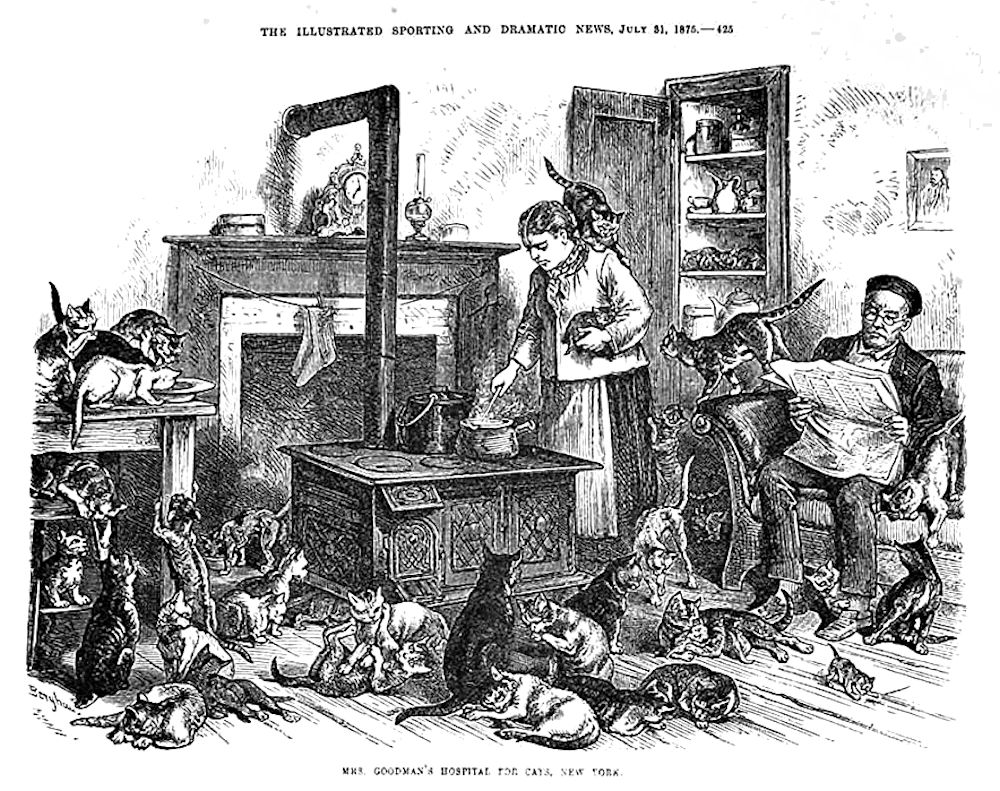
In 1874, an animal shelter (not restricted to cats) was founded in Philadelphia to bring relief to dogs, cats and other unfortunate creatures and to offer a painless death. In 1889 this became the Morris Refuge for Homeless and Suffering Animals. This engraving from The Illustrated Sporting and Dramatic News in 1875 shows "Mrs Goodman's Hospital For Cats, New York." It accompanied a description of the pioneering work of this American cat lover.
In Boston, in 1884, the Ellen M Gifford Sheltering Home For Animals was founded following a bequest from Miss Gifford. "If only the waifs, the strays, the sick, the abused would be sure to get entrance to the home, and anybody could feel at liberty to bring in a starved or ill-treated animal and have it cared for without pay, my object would be attained.". According to a Miss Winslow (Helen Winslow was author of "Concerning Cats" in 1900), writing to Frances Simpson, there were several cat asylums and refuges in the American Far West and a Sheltering Home in Brighton, Massachusetts. In 1901 Mrs Leland Norton founded a Cat Refuge in Chicago.
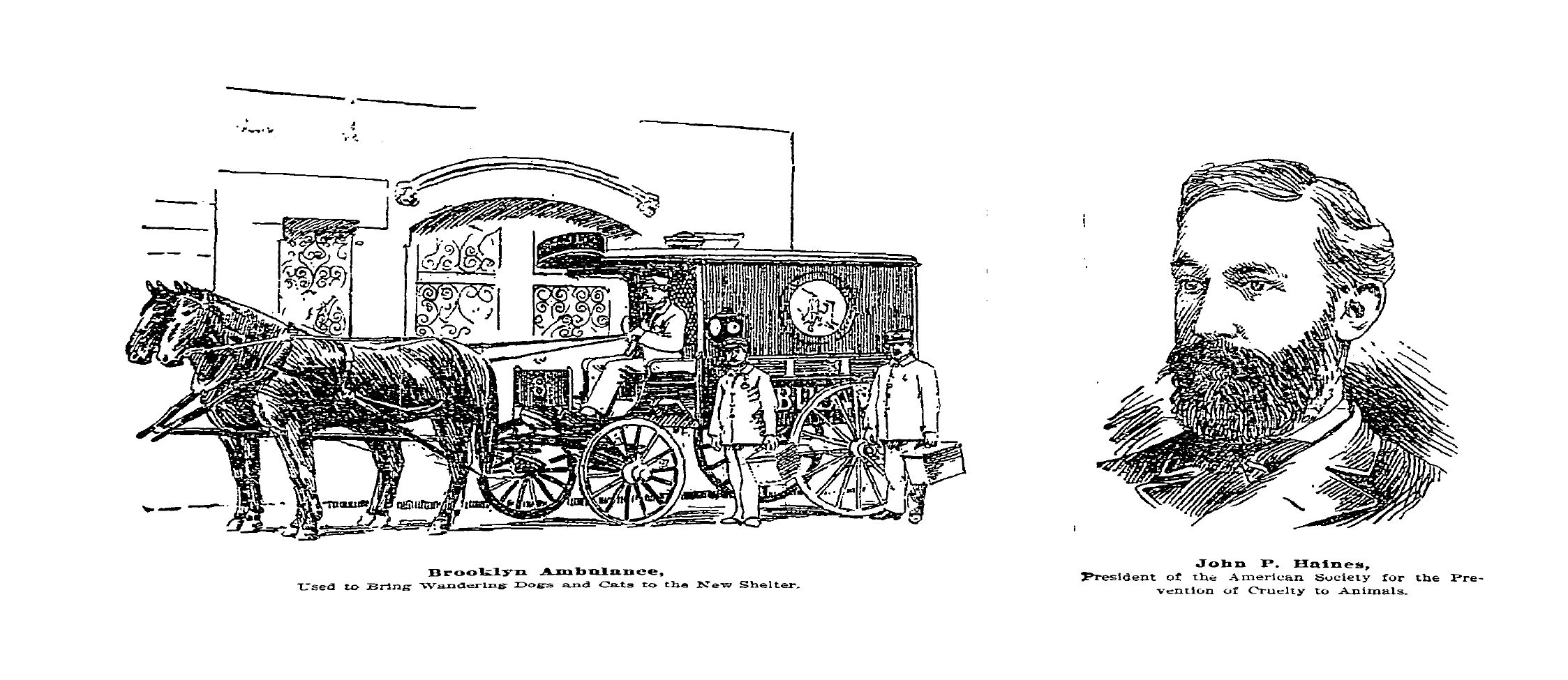
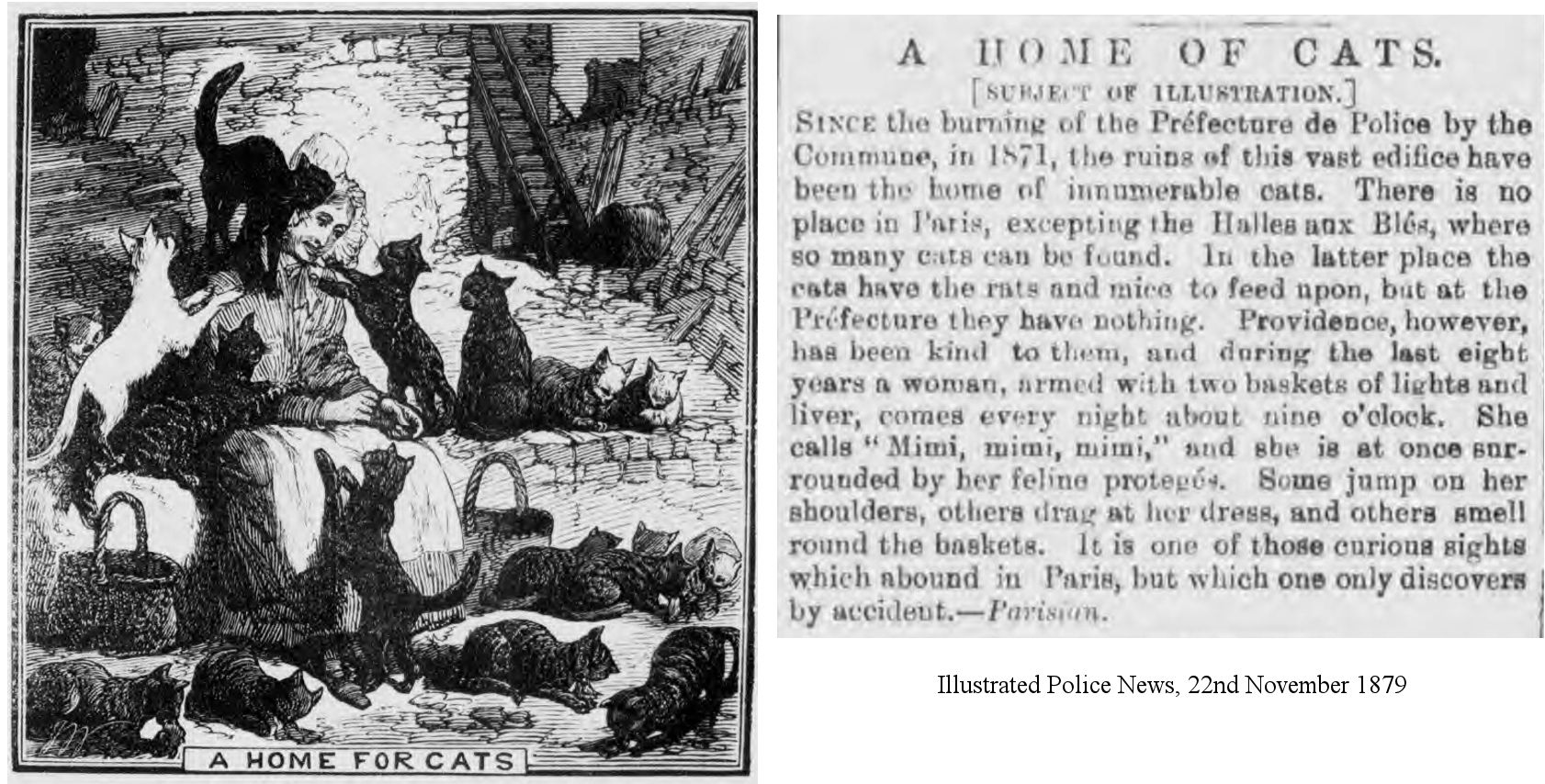
REFUGE FOR STRAY ANIMALS (1896)
The Washington Times, 20th January, 1896 mentioned dog and cat rescuers in Paris.
PARIS HAS INSTITUTIONS WHERE CATS AND DOGS ARE CARED FOR (From the London Daily News). Humane persons will, our Paris correspondent says, be glad to bear that all stray dogs are not taken to the Fourriere, or Paris Pound, to be there killed or passed on to vivisectionists. There is a dog refuge at Garches founded by nine English ladies in 1890. Besides the income from its capital, this asylum receives a subvention from the Society for the Protection faction of Animals. The Paris agent for receiving masterless dogs, sending them on to Garches, is a Mme. Faure. She is seldom without a party of canine refugeees. A nighhor of hers, Mlle. Mazerolles, is on the same lines a guardian angel for cats. She sends the homeless cats she discovers to Bezons, where Mme. Claude Bernard has founded a refuge near which she lives, and in which there are now eighty cats. An active benefactress of the feline race in Paris is a Mme. Donnon, an aged lady of seventy, living at Asnieres. She has now eleven cats and sixteen dogs under her care, and for some years afforded hospitality to the dogs and eight New Caledonian cats of Louise Michel. Six out of these eight died. The survivors are Marguerite and Monmoutte. They have both short fore legs and developed bind legs like the kangaroo.
A REMARKABLE FRENCH CAT COLLECTOR (1896)
The Glasgow Herald, 25th August, 1896 reported this case of a woman who rescued cats from the sewers of Paris.
This being the silly season, it may be permissible to speak of silly people, and the peculiar form their silliness assumes. In a liking for cats there is evidently nothing silly; indeed, numbers of highly intelligent and celebrated men and women have had a peculiar fondness for the feline race, and it was, if I am not mistaken, Dumas the elder who used to say he could conceive no more agreeable sensation than that produced by the stroking of a purring pussy's s back. Madame Delrincourt, however, is a lady whose fondness for felines almost amounts to mania; and certainly had she devoted her days and energies to saving one or two castaway children, of whom abundance are to be found in the slums of large cities, she would have been a more useful member of society than she is with her hundreds of rescued cats around her. There is, however, no accounting for tastes. Madame Delrincourt believes cats "have souls," and that the mission she performs of saving them is a really commendable one.
She rents a small apartment near the Jardin des Plantes, which is literally teeming with her four-footed proteges. A gentleman who lately called upon her confesses he never saw the like before, and most certainly I can endorse his view of the case. The book-shelves in one of the rooms are converted into cat-shelves, on which animals of all shapes and sizes, of all breeds, and of no breed at all, slumber side by i it side. The tables are laden with cats; trays and boxes, empty wine cases, pillows, strips of carpet are strewn about for their accommodation. In fact there are cats everywhere, and the gentleman to whom I have referred as a recent visitor to the house, who admits a species of aversion to the feline race, says the sensation he experienced was horrible, his feeling being that suddenly some screeching cat would spring down upon him from some unseen and unknown recess.
The lady, who for years and years has devoted her life to cat rescue says she even goes down into the sewers after these "ill-treated, neglected animals." Persons, it should be explained, anxious to get rid of cats very frequently throw them into the sewers. This is easily done, as the apertures at the sides of the curbing of the streets are big enough to shove them through. Madame Delrincourt hunts up the men in charge of the sewer-traps, who let her go down, and she generally, she says induces several cats to come up with her. Most of her work of rescue is done between eight o'clock in the evening and midnight, this being the time which, according to her, Parisians who want to get rid oi a cat choose for this purpose. With regard to the object the lady has in view, she confesses she only rescues the animals out of pity. Her numerous proteges are, when rescued, in most cases in a more or less damaged condition, and their wants are ministered to by this collector of felines just as if they were human beings." Not long ago, however, she was for a period terribly distressed in her mind, having received notice from the police to kill her cats. To avoid such a frightful fate for her pets, she despatched as many as she could into the country, distributing the remainder amongst her friends and s neighbours until all danger was over.
Madame Delrincourt has a husband who is in the wine trade, but, as he does not share her feelings towards felines, he rarely shows his face at home. His wife, who is by no means rich, prefers to deprive herself and stint herself rather than allow any of her proteges to suffer. She is proud of medals and certificates she possesses from the Society for the Protection of Animals, and likes to show visitors all the cuttings from newspapers she has collected referring to any cat-rescue work she has performed. Madame Delrincourt, who is not in the best of health (and no wonder, for she lives and sleeps in the midst of her felines). is looking forward to the day when she may be separated by death from her "family, and she expresses a hope that an obelisk, of which she has a rough carving, will be erected on her grave. The drawing represents the obelisk with several cats standing on their hinder paws, weeping and applying enormous handkerchiefs to their eyes. When the good lady does go over to the great majority it will distinctly be a catastrophe for the poor brutes she has collected and to the number of which she is daily adding.
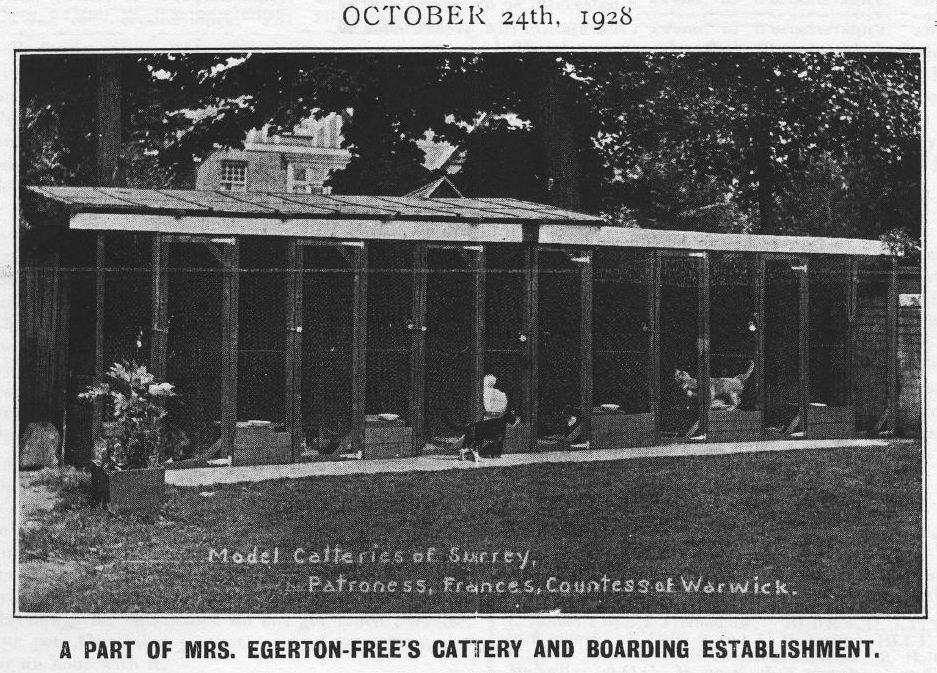
A CATTERY AND BOARDING ESTABLISHMENT (1928)
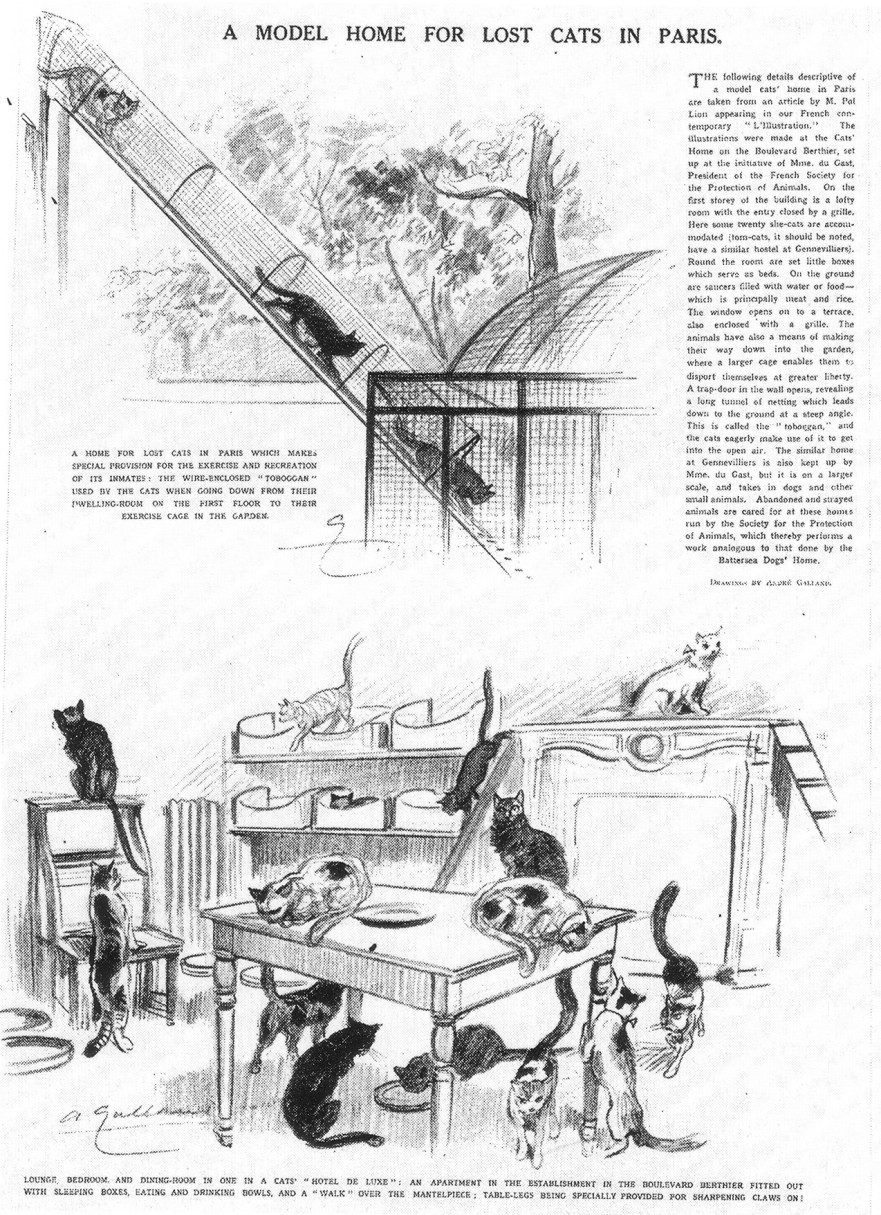
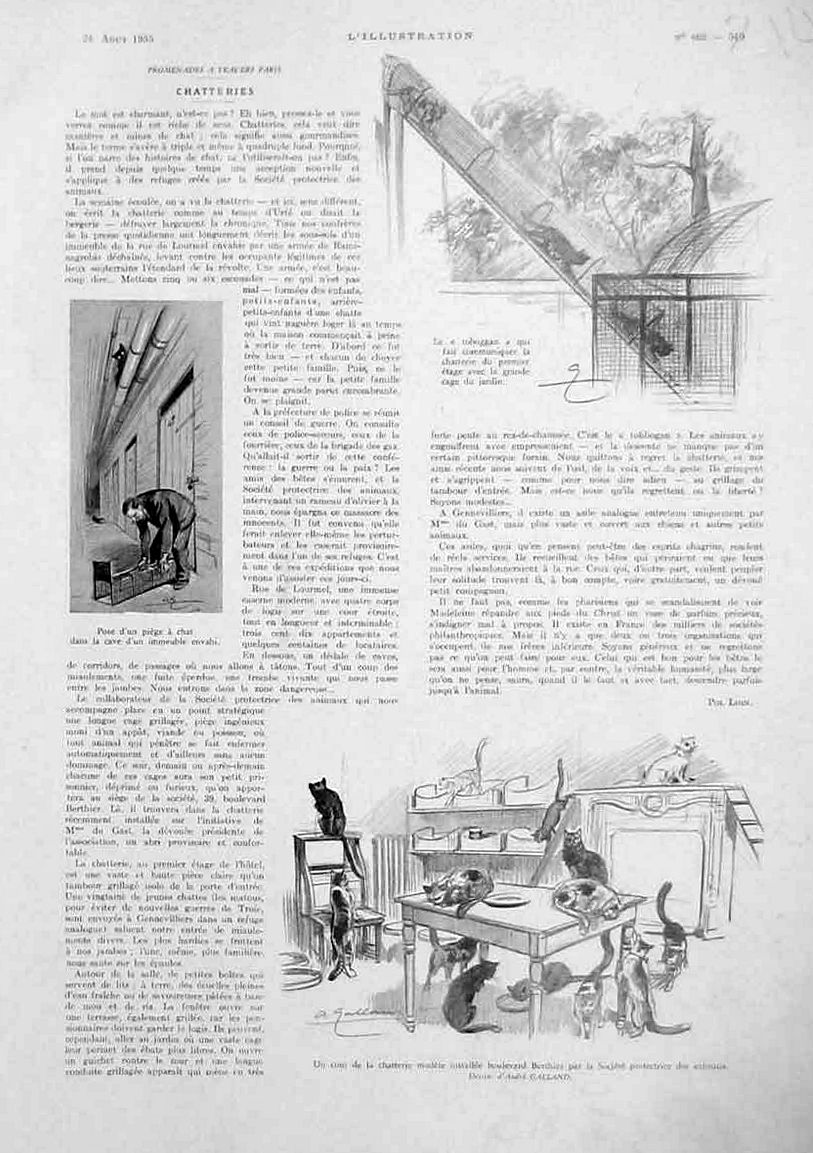
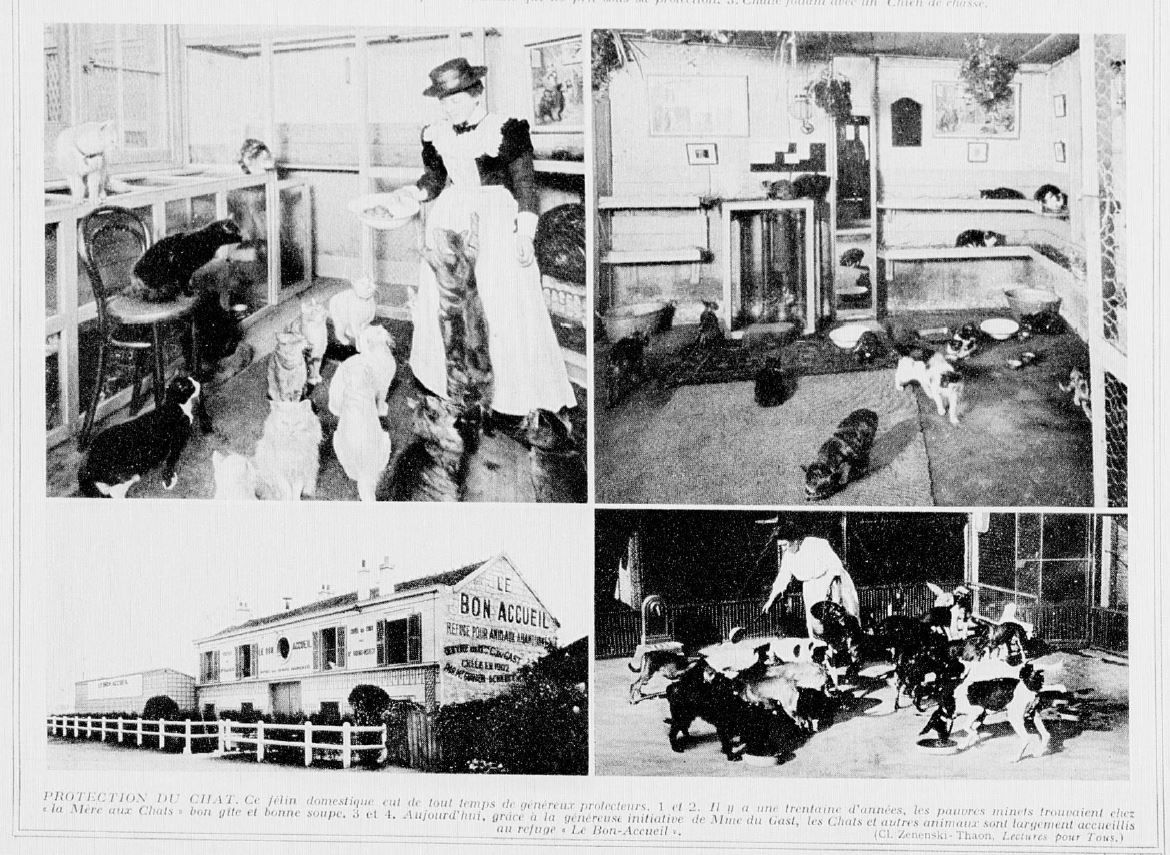
A PARISIAN CATS' HOME (1935)
In 1935,The Illustrated London News reported on a French cats' home. The following details descriptive of a model cats' home in Paris are taken from an article by M. Pollion appearing in our French contemporary L'Illustration." The illustrations were made at the Cats Home on the Boulevard Berthier in Paris, set up at the initiative of Mne du Gast, President of the French Society for the Protection of Animals. On the first storey of the building is a lofty room with the entry closed by a grill. Here some twenty she-cats are accommodated (tom-cats, it should be noted, have a similar hotel at Gennevilliers). Round the room are set little boxes which serve as beds. On the ground are saucers filled with water or food - which is principally meat or rice. The window opens onto a terrace, also enclosed with a grill. The animals have a means of making their way down into the garden, where a larger cage enables them to disport themselves at greater liberty: a trapdoor in the wall opens, revealing a long tunnel of netting which leads down to the ground at a steep angle. This is called the toboggan, and the cats eagerly make use of it to get into the open air. The similar home in Gennvilliers is also kept up by Mme du Gast, but it is on a larger scale and takes in dogs and other small animals. Abandoned and strayed animals are cared for at these homes run by the Society for the Protection of Animals, which thereby performs a work analogous to that done by the Battersea Dog's Home. For rainy days, Mme du Gast had designed an indoor cat walk leading up to and across the mantelpiece, and installed a dining table just so that the cats could sharpen their claws on its legs.
Below are photographs of a rescue cattery run by Mme du Gast. These appeared in a 1935 issue of "La Vie en Campagne" (Life in the Country), the French equivalent of Country Life magazine, and were part of a series of photos of French catteries.
SPECIALIST SOCIETIES
Some of the societies were devoted to tackling cruelty while others provided medical care at reduced cost. A third group tackled specific areas of cat welfare.
The Feline Advisory Bureau (FAB) is concerned primarily with improving veterinary understanding. It also runs a cattery "excellence" register. It funds various veterinary work, including scholarships, and has produced manuals on building a FAB-approved cattery and on setting up and running cat rescue shelters. FAB ("We Know About Cats") provides a wealth of information to breeders, rescuers, veterinary staff and other professionals and volunteers working with cats medical, genetics, behavioural etc.
The Cat Action Trust and the Original Cat Action Trust, both founded in 1977 (they were initially a single society), deals exclusively with feral cats control through neutering, colony management (and relocation in some cases) and advising on providing shelter and food for managed colonies as well as taming and rehoming feral kittens young enough to be tamed. It pioneered the Trap-Neuter-Release method of feral cat control, noting that managed neutered colonies tended to remain numerically stable and dissuaded other ferals from entering the area.
In the 1980s "Cats In Industry" was a Sheffield-based charity dedicated to improving the conditions of an estimated half a million nominally homeless cats "working" as unofficial mousers at factories throughout Britain. The lucky ones were fed by cat-loving employees, but most lived in appalling neglect, unfed and in dirty and dangerous conditions. Few received veterinary care and many were ferals attracted to canteen scraps and the vermin such scraps attracted. Hammond lobbied factory managers to set up proper feeding stations for the cats and to provide veterinary care and vaccinations. Where that failed, she sought individual employees to adopt and take home the tamer cats.
Cats In Industry soon had several small shelters in places such as Middlesbrough, Southampton and South Wales, fundraising sales, food collections, appeals on behalf of working cats and around 500 subscribers. A strong campaigner for neutering, she realised that some factories were simply not going to stump up the 16 neutering fee. An alternative was to add contraceptives to the cats food.
Cats In Industry no longer exists. During the 1990s, there were fewer cats on industrial premises due to health and safety concerns. British heavy industry was also in decline. Some of the major charities were now helping to neuter the cats domestic and feral though many factories had the cats removed by pest controllers. A few premises and postal sorting offices still tolerate a few cats (but not ferals) and these are generally cared for by volunteers on the staff.
LOCAL OR PRIVATE RESCUE GROUPS, SUPPORT GROUPS AND OTHERS
As well as the main charities there are many other privately run groups, not all of which have charitable status. Though most have admirable aims and many have dedicated volunteers and good accommodation, others operate out of overcrowded or dilapidated conditions and do themselves and the cats no favours. Government regulations in the 2000s aims to eliminate those which keep cats in squalid conditions.
The local cat rescue groups include those such Colchester Cat Rescue (Essex), Avon Cat Rescue (Warwickshire), SNIP (Society for Neutering Islington s Pussies, London) and the Moggery (Bristol). Those without charity status rely on donations and membership fees or sponsorship and are often in frequent danger of over-stretching their limited funds due to the sheer numbers of cats needing help or homes in their areas.
There are also individuals who foster and rehome cats from their own homes. Others specialise in hand-rearing orphan kittens or taming feral kittens. Some are connected to shelters, others work entirely independently. Those who work responsibly know their financial and space limits and help however many cats they can, but a few allow themselves to become overrun or are "cat collectors" operating under the guise of rescuers.
As well as the actual rescuers, a number of fundraising organisations exist solely to raise funds for various charities and rescue groups. Some of these are tied to a particular shelter ("Friends of" groups) while others divide what they raise among local shelters. A few shelters sponsor individual projects such as Chelmsford CPL s aid to one of its members in setting up a cat neutering program in Kusadasi, Turkey.
HELPING OUT
If you want to donate to, help or contact a cat-related organisation, first check in local phone directories to see which ones are in your area. Most readily accept financial donations, but for other queries you should contact the group concerned. If you want to help one specific type of cat organisation (e.g. one involved in feral cat work), check the adverts in the back of your country s main cat or pet magazines and check your local newspapers. Many cat or pet magazines list HQ numbers for larger organisations and sometimes those overseas. Cat shows and animal welfare exhibitions are other good places to get contact details.
Many local groups advertise on noticeboards for help or homes community notieboards, vet clinic noticeboards and local libraries are good places to find information.