LONGHAIRS OF THE 19TH CENTURY - RUSSIAN LONGHAIR, ANGORA, SIBERIAN AND NORWEGIAN
Russian Longhaired Cat (Harrison Weir)
In his 1889 book "Our Cats and All About Them", Harrison Weir included this description of Russian Longhairs
The above is a portrait of a cat given me many years ago, whose parents came from Russia, but from what part I could never ascertain. It differed from the Angora and the Persian in many respects. It was larger in body with shorter legs. The mane or frill was very large, long, and dense, and more of a woolly texture, with coarse hairs among it ; the colour was of dark tabby, though the markings were not a decided black, nor clear and distinct ; the ground colour was wanting in that depth and richness possessed by the Persian, having a somewhat dull appearance. The eyes were large and prominent, of a bright orange, slightly tinted with green, the ears large by comparison, with small tufts, full of long, woolly hair, the limbs stout and short, the tail being very dissimilar, as it was short, very woolly, and thickly covered with hair the same length from the base to the tip, and much resembled in form that of the English wild cat.
Its motion was not so agile as other cats, nor did it apparently care for warmth, as it liked being outdoors in the coldest weather. Another peculiarity being that it seemed to care little in the way of watching birds for the purpose of food, neither were its habits like those of the short-haired cats that were its companions. It attached itself to no person, as was the case with some of the others, but curiously took a particular fancy to one of my shorthaired, silver-gray tabbies ; the two appeared always together. In front of the fire they sat side by side. If one left the room the other followed. […] In all my experience I never knew a more devoted couple.
I bred but one kitten from the Russian, and this was the offspring of the short-haired silver tabby. It was black-and-white, and resembled the Russian in a large degree, having a woolly coat, somewhat a mane, and a short, very bushy tail. This, like his father, seemed also to be fonder of animals for food than birds, and, although very small, would without any hesitation attack and kill a full-grown rat.
I have seen several Russian cats, yet never but on this occasion had the opportunity of comparing their habits and mode of life with those of the other varieties ; neither have I seen any but those of a tabby colour, and they mostly of a dark brown. I am fully aware that many cross-bred cats are sold as Russian, Angora, and Persian, either between these or the short-haired, and some of these, of course, retain in large degree the distinctive peculiarities of each breed. Yet to the practised eye there is generally - I do not say always - a difference of some sort by which the particular breed may be clearly defined.
When the prizes are given, as is the case even at our largest cat shows, for the best long-haired cat, there, of course, exists in the eye of the judge no distinction as regards breed. He selects, as he is bound to do, that which is the best long-haired cat in all points, the length of hair, colour, texture, and condition of the exhibit being that which commands his first attention. But if it were so put that the prize should be for the best Angora, Persian, Russian, etc., it would make the task rather more than difficult, for I have seen some "first-cross cats" that have possessed all, or nearly all, the points requisite for that of the Angora, Persian, or Russian, while others so bred have been very deficient, perhaps showing the Angora cross only by the tail and a slight and small frill.
At the same time it must be noted, that, although from time to time some excellent specimens may be so bred, it is by no means desirable to buy and use such for stock purposes, for they will in all probability "throw back" - that is, after several generations, although allied with thoroughbred, they will possibly have a little family of quite "short-hairs." I have known this with rabbits, who, after breeding short-haired varieties for some time, suddenly reverted to a litter of "long-hairs" ; but have not carried out the experiment with cats. At the same time I may state that I have little or no doubt that such would be the case ; therefore I would urge on all those who are fond of cats - or, in fact, other animals - of any particular breed, to use when possible none but those of the purest pedigree, as this will tend to prevent much disappointment that might otherwise ensue.
I advisedly say [Russian] long-haired cat, for I shall hereafter have to treat of other cats coming from Russia that are short-haired, none which I have hitherto seen being tabbies, but whole colour. This is the more singular as all those of the long-hair have been brown tabbies, with only one or two exceptions, which were black. It is just possible these were the offspring of tabby or grey parents, as the wild rabbit has been known to have had black progeny. I have seen a black rabbit shot from amongst the grey on the South Downs.
I do not remember having seen a white Russian "long-hair," and I should feel particularly obliged to any of my readers who could supply me with further information on this subject.
Weir's drawing is not, as some have erroneously written, an early example of the Nebelung. It is a an early Siberian Longhair. The Siberian is a natural Russian breed which has recently been re-imported into the UK and USA, while the Nebelung ("longhaired Russian Blue") is an artificial breed recently developed in the USA and resembles the Russian Blue in conformation.
Russian Longhair (1900, Helen Winslow)
The Russian long-haired pet is much less common even than the Persian and Angora. It is fond of cold weather, and its fur is denser, indicating that it has been used to colder regions. Many of the cats that we see are crosses of Angora and Persian, or Angora and Russian, so that it is extremely difficult for the amateur to know a thoroughbred cat which has not been mixed with other varieties.
The Siberian Cat (Harrison Weir)
In his 1889 book "Our Cats and All About Them", Harrison Weir included this description of a Siberian Cat
I have been shown a Siberian Cat, by Mr. Castang, of Leadenhall Market; the breed is entirely new to me. It is a small female Cat of a slaty-blue colour, rather short in body and legs; the head is small and much rounded, while the ears are of medium size. The iris of the eyes is a deep golden colour, which, in contrast to the bluish colour of the fur, makes them to appear still more brilliant; the tail is short and thick, very much so at the base, and suddenly pointed at the tip. It is particularly timid and wild in its nature, and is difficult to approach; but, as Mr. Castang observed, this timidity may be "because it does not understand our language and does not know when it is called or spoken to." I think it would make a valuable Cat to cross with some English varieties.
The Siberian Cat (Letters, "Our Cats" 3rd October, 1903)
"There is a race of Siberian Cats in Russia, writes a correspondent, who are amenable to professional training to catch rats and mice, which in these parts are particularly large and savage. The demand for rat-catchers produced the cat-man, whose business it is, to breed Siberian cats and train them as Terriers are trained in England. The cats are three or four times the size of English ones"
The Norwegian Cat (Harrison Weir)
In his 1889 book "Our Cats and All About Them", Harrison Weir included this description of a Norwegianian Cat
A correspondent writes: "In your book on Cats you do not mention Norwegian Cats. I was in Norway last year, and was struck by the Cats being different to any I had ever seen, being much stouter built, with thick close fur, mostly sandy, with stripes of dark yellow." I suppose I am to infer that both the sexes are of sandy yellow colour. If so, I should say it is more a matter of selection than a new colour. I find generally in the colder countries the fur is short, dense, and somewhat woolly, and as a rule, judging from the information that I am continually receiving, whole or entire colours predominate.
Angora (Charles H Ross)
In his "Book of Cats - Legends and Stories" (1867), Charles H Ross described the "Cat of Angora, with silvery hair of fine silken texture. Some being yellowish, and others olive, approaching to the colour of the Lion, but they are all delicate creatures, and of gentle dispositions."
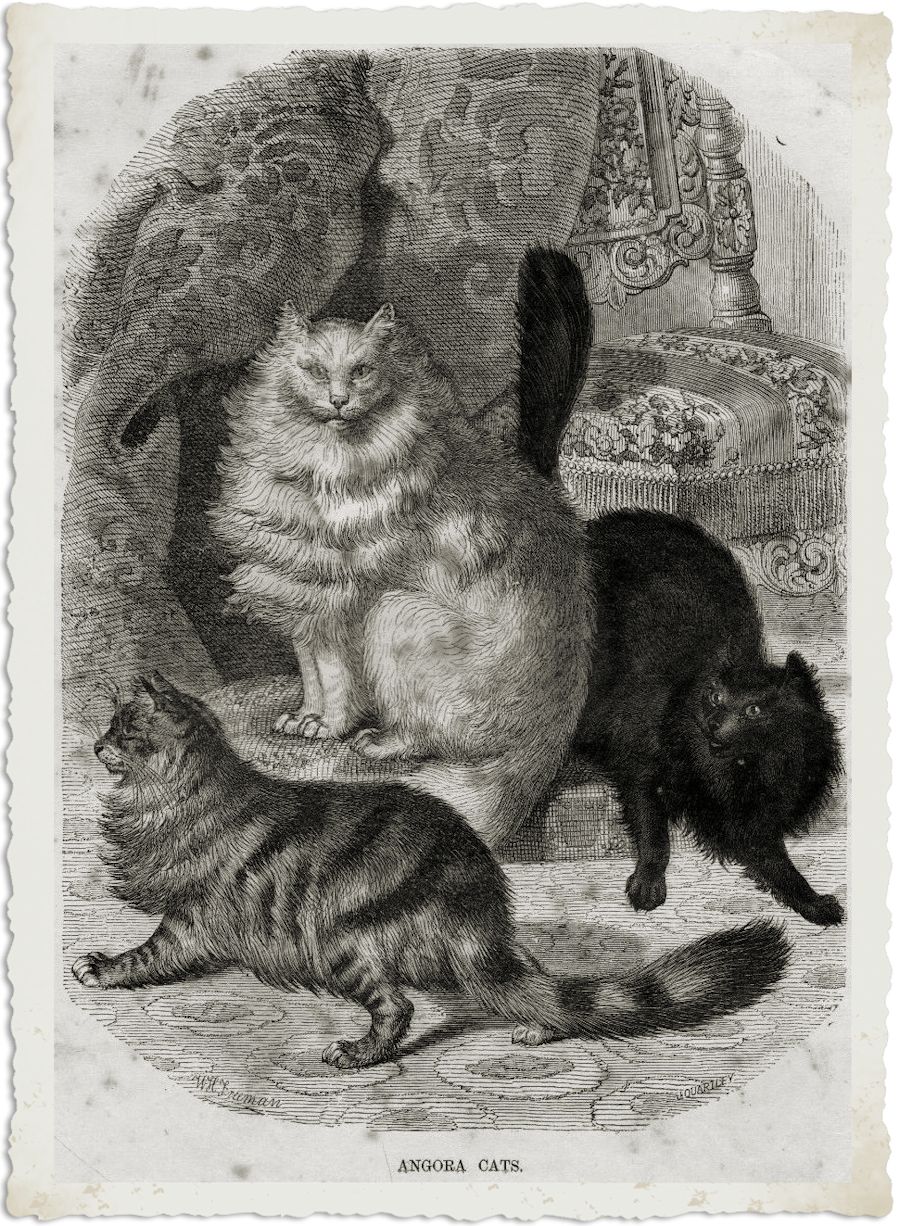
ANGORA OR PERSIAN CATS The Queen, 31st July 1886
Our illustration [too dark to reproduce] represents a family of the long-haired Persian cats. More frequently termed Angoras, because they are generally exported from that city of Asiatic Turkey. These cats are characterised by the length and fineness of their hair, and by their features being more delicate, owing to the jaws being finer than in the common varieties. Once special peculiarity in the imported animals is that their eyes are often of different colours; this is regarded as a great beauty in the East, but not always appreciated in this country/ It is a remarkable fact that the majority of Angora cats that have blue eyes are perfectly deaf, arising from a want of perfect development of the internal ears as well as of the eyes, bot hsets of organs remaining in an imperfect condition.
Angoras are generally to be regarded as gentle creatures, and are often the much-petted denizens of drawing rooms and ladies’ boudoirs; they require, however, considerable cate in their management, their coats must be carefully tended to, being combed and brushed every day. If this is not done, and they are once allowed to get dirty, their long silky hair becomes matted into indissoluble knots, which can only be removed by cutting away, and the beauty of the animal is lost until such time as it has a new coat.
When young they are subject to fits, during which they are apt to dash around wildly, and occasionally to do some mischief to crockery and lighter furniture, especially if they are pursued with an idea of capture. The better plan is to leave them alone, and they seem to subside into a quiescent state. Our picture [to poor to reproduce] represents an interesting family party = a white Angora mother is surrounded by her numerous offspring, whilst a darker specimen sleeps complacently in the background.
Angora (Harrison Weir)
In his 1889 book "Our Cats and All About Them", Harrison Weir included this description of Angora cats
The Angora cat, as its name indicates, comes from Angora, in Western Asia, a province that is also celebrated for its goats with long hair, which is of extremely fine quality. It is said that this deteriorates when the animal leaves that locality. This may be so, but that I have no means of proving; yet, if so, do the Angora cats also deteriorate in the silky qualities of their fur? Or does it get shorter? Certain it is that many of the imported cats have finer and longer hair than those bred in this country; but when are the latter true bred? Even some a little cross-bred will often have long hair, but not of the texture as regards length and silkiness which is to be noted in the pure breed.
The Angora cats, I am told, are great favourites with the Turks and Armenians, and the best are of high value, a pure white, with blue eyes, being thought the perfection of cats, all other points being good, and its hearing by no means defective. The points are a small head, with not too long a nose, large full eyes of a colour in harmony with that of its fur, ears rather large than small and pointed, with a tuft of hair at the apex, the size not showing, as they are deeply set in the long hair on the forehead, with a very full flowing mane about the head and neck; this latter should not be short, neither the body, which should be long, graceful, and elegant, and covered with long, silky hair, with a slight admixture of woolliness; in this it differs from the Persian, and the longer the better. In texture it should be as fine as possible, and also not so woolly as that of the Russian; still it is more inclined to be so than the Persian. The legs to be of moderate length, and in proportion to the body; the tail long, and slightly curving upward towards the end. The hair should be very long at the base, less so toward the tip. When perfect, it is an extremely beautiful and elegant object, and no wonder that it has become a pet among the Orientals.
The colours are varied; but the black which should have orange eyes, as should also the slate colours, and blues, and the white are the most esteemed, though the soft slates, blues, and the light fawns, deep reds, and mottled grays are shades of colour that blend well with the Eastern furniture and other surroundings. There are also light grays, and what is termed smoke colour; a beauty was shown at Brighton which was white with black tips to the hair, the white being scarcely visible, unless the hair was parted; this tinting had a marvellous effect. I have never seen imported strong-coloured tabbies of this breed, nor do I believe such are true Angoras. Fine specimens are even now rare in this country, and are extremely valuable.
In manners and temper they are quiet, sociable, and docile, though given to roaming, especially in the country, where I have seen them far from their homes, hunting the hedgerows more like dogs than cats; nor do they appear to possess the keen intelligence of the short-haired European cat. They are not new to us, being mentioned by writers nearly a hundred years ago, if not more. I well remember white specimens of uncommon size on sale in Leadenhall Market, more than forty years since; the price usually was five guineas, though some of rare excellence would realise double that sum.
Angora (Dr W Gordon Stables)
The traveller and prolific writer on cats, dogs and other subjects, Dr W Gordon Stables, author of "Cats, Their Points and Characteristics and Curiosities of Cat Life" (1874), "Cats, Their Points and Classifications " (1877) and "Cats" (1928) wrote : "On judging of long-haired cats very few words will suffice. The classes, are tortoiseshell and white, tabby, red tabby, pure white, black and unusual colour. These classes must be judged by: Markings, which are wanted as distinct and well arranged as possible. Size - they ought to be large cats. Pelage - ought to be very long, silken and glossy. The eyes should be of the same colour as in the short-haired classes. Miss Hale’s Angora, 'Selim' is a very fine specimen, slate coloured on the body, the face vandyked with white, and a beautiful snowy apron in front. His eyes are green and sparkling, and from his cage he glares out at you with a look of surly grandeur, highly characteristic of his noble breed. The same lady’s 'Zuleika', a pussy imported from Smyrna, is a most lovely and engaging little thing. All white, with small round head, long haired, and pitiful eyes, as if it wanted so much to be petted - in fact just lived to be loved, and nothing else. It is a pet fit for a princess."
Angora (1900, Helen Winslow)
The Angora cat, as its name indicates, comes from Angora in Western Asia, the province that is celebrated for its goats with long hair of fine quality. In fact, the hair under the Angora cat’s body often resembles the finest of the Angora goatskins. Angora cats are favorites with the Turks and Armenians, and exist in many colors, especially since they have been more carefully bred. They vary in form, color, and disposition, and also in the quality of their hair. The standard calls for a small head, with not too long a nose, large eyes that should harmonize in color with the fur, small, pointed ears with a tuft of hair at the apex, and a very full fluffy mane around the neck. This mane is known as the "lord mayor’s chain." The body is longer than that of the ordinary cat in proportion to its size, and is extremely graceful, and covered with long; silky hair, which is crinkly like that of the Angora goat. This hair should be as fine as possible, and not woolly. The legs are of a moderate length, but look short on account of the length of hair on the body. Little tufts of hair growing between the toes indicate high breeding. The Angora cat, in good condition, is one of the most beautiful and elegant creatures in the world, and few can resist its charm. The tail is long and like an ostrich plume. It is usually carried, when the cat is in good spirits, straight up, with the end waving over toward one side. The tail of the Angora serves as a barometer of its bodily and mental condition. If the cat is ill or frightened, the tail droops, and sometimes trails on the ground; but when she is in good spirits, playing about the house or grounds, it waves like a great plume, and is exceedingly handsome. The suppleness of the Angora’s tail is also a mark of fine breeding. A high-bred Angora will allow its tail to be doubled or twisted without apparent notice of the performance.
The Angora does not reach its prime until about two years. Before that time its head and body are not sufficiently developed to give the full beauty and grace of the animal. As a rule, the Angora is of good disposition, although the females are apt to be exceedingly nervous. They are sociable and docile, although fond of roaming about, especially if allowed to run loose. As a rule, they do not possess the keen intelligence of the ordinary short-haired family cat, but their great beauty and their cleanly and affectionate habits make them favorites with fashionable people. The proper breeding of the Angora cat is a regular science. Of the colors of the Angoras, the blue or maltese is a favorite, and rather common, especially when mixed with white.
The white Angora is extraordinarily beautiful, and brings a high price when it has blue eyes and all its points are equally good. The orange, or yellow, and the black with amber eyes are also prize winners. There are the tigers also, the brown tabby, and the orange and white. Mixed colors are more common than solid ones; the tortoise-shell cat of three colors and well mottled being considered particularly desirable.
The Persian cat differs from the Angora in the quality of its fur, although the ordinary observer sees little difference between them. All the longhaired cats originated from the Indian Bengalese, Thibetan, and other wild cats of Asia and Russia. The Persian cat of very great value is all black, with a very fluffy frill, or lord mayor’s chain, and orange eyes. Next to him comes a light slate or blue Persian, with yellow eyes. The fur of the Persian cat is much more woolly than that of the Angora, and sometimes in hot weather mats badly. The difference between a Persian and an Angora can usually be told by an amateur, by drawing the tail between the thumb and first finger. The Angora’s tail comes out thin, silky, and narrow, although it immediately "fluffs" up. The Persian’s tail does not compress itself readily into a small space. The Persian cat’s head is larger, its ears are less pointed, although it should have the tuft at the end and the long hair inside. It is usually larger in body and apparently stronger made, although slender and elegant in appearance, with small bones and graceful in movement. The colors vary, as with the Angora, except that the tortoise-shell and the dark-marked tabby do not so frequently appear. The temper is usually less reliable and the intelligence less keen than the Angora.
Angora Cats in the News of the World’s “Gossip of the Week,” 7th January 1900
An amusing story is told in “To-Day” of Sir H Chermside, who has left for South Africa. For some years he was a consul in Asia Minor, and was very popular there. In a weak moment he sent a couple of lovely Angora cats as a present to a lady in Constantinople. The lady was so pleased with the cats that she asked him to send some more. Sir Herbert gave his kavasse (courier) some money and told him to by two or three. Then came a demand for more cats from Chermside’s friends and he gave the kavasse further funds with which to buy cats. This went on for a coupe of months, and the kavasse got fatter and fatter. One morning, when Sir Herbert came out of the consulate he was surrounded by a crowd of infuriated veiled females, who besought Mahomet to curse him because he had stolen nearly all their cats. It appeared that the kavasse had pocketed Sir H Chermside’s money, gone round with a sack and, in the name of Allah the All merciful, had annexed nearly every cat in the place. Then Sir Herbert handed over the kavasse to the “tender mercies” of the women.
ANGORAS – El Paso Herald, 12th December, 1903
Angora pussies are great pets in Chicago. The annual cat show there is a fashionable affair and splendid specimens of the fluffy, silky, graceful creatures are exhibited. This year the orange colored cats are the particular fad and the benches have a particularly large display of this tawny, rich color with darker stripes. The society ladies of that city take pride in their pedigreed beasties and there are many fine catteries where little fluffy tail-chasing kittens are raised. An Angora cat is about as proud and graceful and aristocratic a living thing as the world knows. They may be gentle and affectionate and even politely interested, they are often full of sprightly fun, but with it all they have a certain regal way of ending the fun, and their polite acceptance of caresses, exactly when they choose, is sometimes most disconcerting.
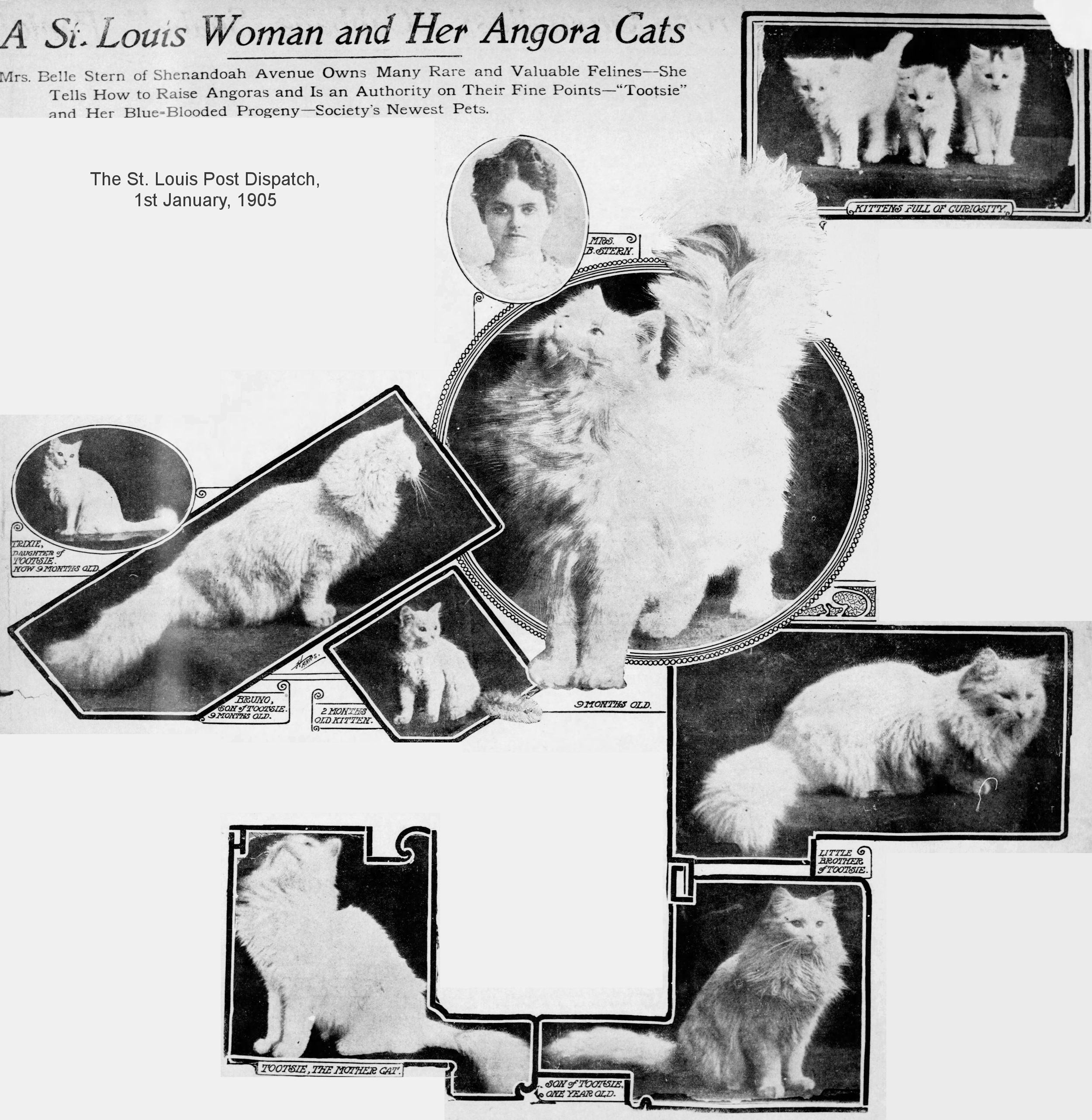
A WOMAN AND HER ANGORA CATS – St. Louise Dispatch, 1st January, 1905
Mrs. Belle Stern of Shenandoah Avenue Owns Many Rare and Valuable Felines — She Tells How to Raise Angoras and Is an Authority on Their Fine Points — “Tootsie” and Her Blue-Blooded Progeny — Society's Newest Pets.
Mrs. Belle Sterne, a St. Louis woman residing at 3959 Shenandoah avenue, owns some of the finest and most valuable Angora cats in this country. They are of the purest pedigree and Mrs, Stern has been offered large sums of money for some of her famous prize winners. But she is devoted to them and prefers to keep them as family pets and companions in her home. She is an authority on Angora cats and their raising.
Society’s never-ceasing search after now fads has recently made the Angora cat the prime favorite of aristocracy. It is the correct pet for the “great lady” who would be “smart.” But it is not for this reason that Mrs. Stern prizes her cats. She loves them because they are beautiful, affectionate and intersting.
A Sunday Post Dispatch representative called at Mrs. Stern’s house was art once surrounded by a purring group of white-coated pets, who climbed upon his knees and sought to impress their visitor with their good nature. Cats, as a rule, are of a somewhat suspicious nature, but these long-haired boudoir favorites showed themselves to be by no means coy.
With perfect confidence of their reception, backed by the knowledge of their wonderful beauty, the vain things were prodigal of their favors and each one outdid the other in the effort to attract attention. Even the dignified mother of the family extended a gracious welcome to the stranger, anxious to show that in spite of age, the youthful spirit was still hers. With playful little bites and gentle pats of their velvet paws the cats sought to ingratiate themselves or by snuggling down in the folds of one’s coat and casting up coquettish glances of mischief they strove to secure another worshiper at the shrine of Isis, goddess of the cat world.
“Tootsie,” conscious of a long pedigree, for she is the daughter of “Ermine,” the prize winner of Boston city, was a little stand-offish at first, as is her manner with strangers, reserving her chiefest attention for her mistress around whose neck she winds herself each cold night and will not be removed But she soon melted under the spell of a few friendly advances. Not only ornamental, unlike gentle “Tootsie,” but useful, for at 7:30 each morning she will uncurl herself and with a gentle paw tap she rouses her mistress. If the first tender touch does not elicit the desired effect, a harder blow is administered. If repeated calls fail to rouse the sleeper, this advocate of the strenuous life will open her dainty claws ever so little and emphasize her signals by a scratch or two.
Mrs. Stern is devoted to her cats and has been very successful with them. Here is what she says about the proper method of raising cats. “The mortality amongst kittens is largely due to ignorance in the proper methods of feeding. Warm milk and oatmeal should be a kitten's diet during the early months of its existence. Care should be taken that the milk is quite sweet. Sour milk causes digestive troubles. Regularity in feeding hours is another important matter. They should be encouraged to eat vegetable food, and many cats will thrive on an almost entirely vegetable diet. Asparagus, celery, corn, bananas and even raw potatoes are popular with many of them. Many people make the mistake of giving cats liver. It is not a food to be recommended and if given at all should be well boiled. Raw meat and raw fish are bad. Both should be cooked and minced. Too much meat causes the skin to get hard and the coat to lose its luster. If a cat is a good mouser, and the Angoras frequently are, they should be allowed to eat their prey and this will be all the meat they want in a raw condition. Never take their quarry away from them or they will become discouraged and will cease to catch.”
Mrs. Stern also gives the following directions as to the treatment of a cat newly arrived in a strange home: “When the new home is reached, have the cat let out very quietly by one person in a quiet room with the door shut. Feed it there and reassure it by petting and kind words. Let it remain in the room for at 24 hours, then gradually let it investigate the new premises, taking care not to allow the animal to be frightened. Do not let it outside the house at first and on no account let it remain out all night. In fact it is a good rule never to force a cat out at night. Remember, its nature demands warmth and therefore it is but humane treatment to allow pussy to have the warmest place in the house. If these directions are carried out, and the cat is well and regularly fed and kindly treated, it will soon accustom itself to its new quarters. Cats are timorous creatures and a sudden fright will make them frantically anxious to get away from their new abode and to thoroughly frighten an Angora is to ruin its disposition.”
It is generally considered unwise to take from a cat the mouse she has caught, as it tends to discourage hunting efforts. Mrs. Stern, however, invariably prevents her eats eating their quarry, but substitutes a few words of praise and possibly the gift of some more satisfactory dainty. For house pets this is a good plan, as it does away with the smell which follows mouse eating.
The result is that Mrs. Stern’s cats now kill their capture and bring it to their mistress to show their cleverness, but never attempt to eat it. “Tootsie,” though an enthusiastic mouse catcher herself, sacrificed her sporting instincts to her kittens as soon as the first litter were old enough to be interested in such matters.
Her method was simple. Taking her young along with her, she would station them in the neighborhood of a likely mouse lair and then, having “put up” a mouse, she would watch the kittens work under her careful direction. If they failed, the experienced mother would pounce down and secure the mouse, and then display it to her brood with an air of boredom , as much as to say: “See how simple.” But more remarkable still, mindful of her upbringing, she would actually discountenance any inclination on the part of her young ones to eat any mouse they succeeded in catching and would gravely seize the slain mouse and, followed by her family, would seek out her mistress and deposit the mouse before her, knowing that the forthcoming reward would be more wholesome and equally agreeable to the kittens.
"Cats and babies need a good deal of attention,” says Mrs. Stern, who has a youngster of her own. “The cats, however, seem pleased with their new associate and will play for hours. When the fat baby stretches his chubby hands for some plaything, the playful cats will pat the object out of baby's reach. Painfully and laboriously the infant will then crawl after it, only to again see its treasure patted out of reach once more. This will occur half a dozen times, when baby will raise a hair-raising howl of anguish. Then his feline playmates are satisfied and turn their attention to some other form of mischief.
"An intense curiosity is a prevailing characteristic of the Angora cat. Their inquisitiveness is only equaled by their vanity. In fact they possess all the qualities usually attributed to the fair sex, and like to be appreciated as much as any school girl.
“ For their vanity my cats have full justification, for they are all pedigreed stock whose ancestors came over in the cat equivalent to the ‘Mayflower.’ Good reason to be proud they have, too, in the fact that their names are registered in the records of the feline ‘Four Hundred;’ that is, the Chicago Cat Club book or in the Boston Club. No cat who has any pretensions to good breeding but has her name in these highly respectable visiting lists and for one's young ones to be excluded from these club pages would cast serious stigma upon ‘Mrs. Tootsie,' a stigma which her succeeding offspring would have difficulty in living down.”
On the principle that “evil communication corrupts good manners,” these playmates of the junior Stern are not permitted to mix in indiscriminate company or wander upon the street. Such exercise as they need is obtained in demure walks in the back garden where, as carefully nurtured as young ladies, they are under the watchful eye of their mistress. Here in St. Louis there is ample material for an annual cat show.
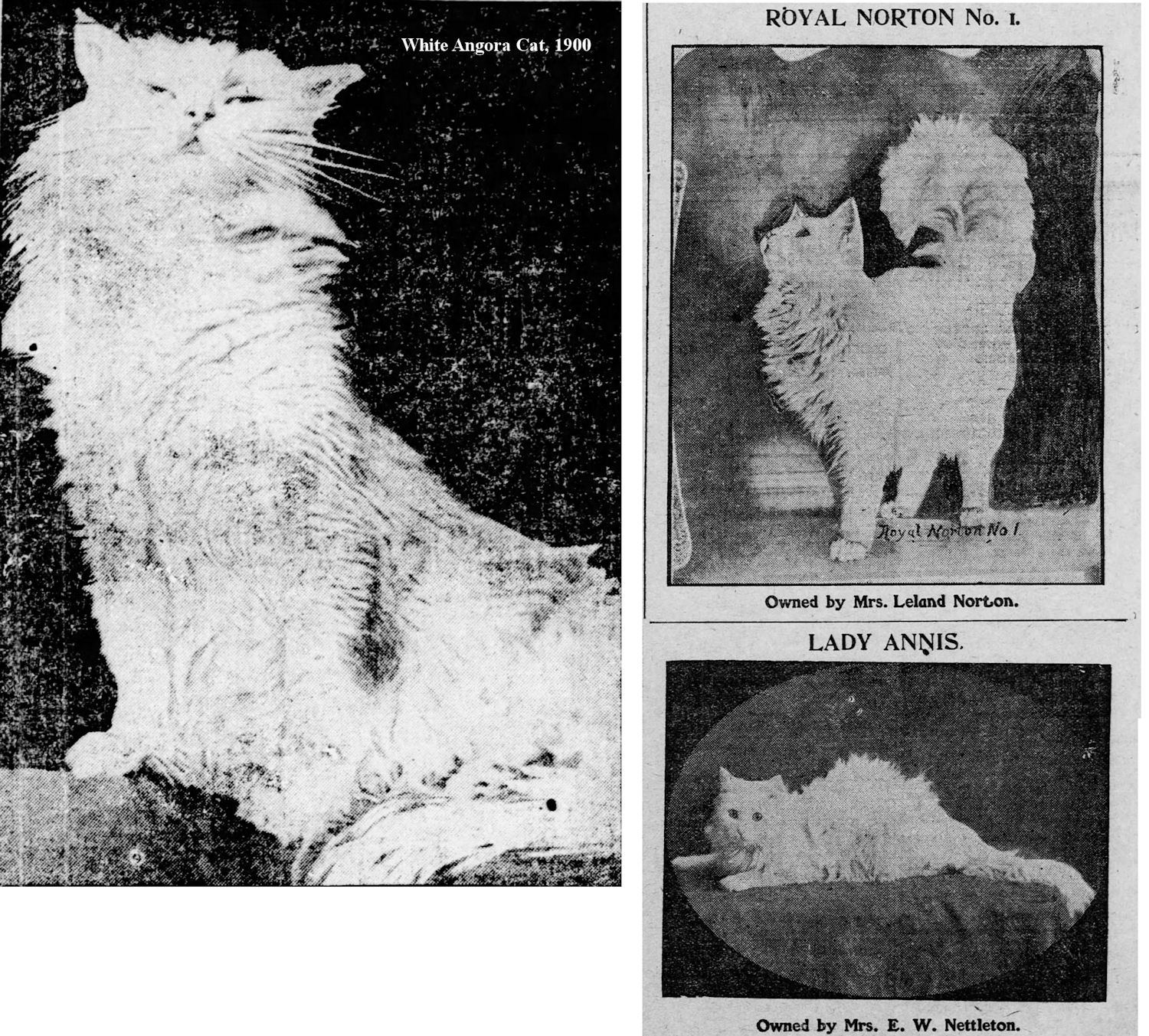
Mrs. Stern has a granddaughter of the most famous of Angora cats, “Royal Norton,” whose value was $3000. Mrs. Stern has half a dozen other direct descendants of the famous royal feline, yet the species is little known here. Only the other day a man seeing one of Mrs. Stem's pets seated in the window, inquired “What kind of a dog is that, anyhow?” Learning that it was but a cat, he offered 50 cents for the animal, that he might take it home to show his youngsters. As the particular kitten was of royal blood, his value was nearer $50 than 50 cents.
The Angora has a tail as extensive as that of the fox. Around his neck is a ruff like a lion’s and the whole body is covered with long hair which makes people mistake the species for the better known Persian cat, whose fur, however, is not so fine, and who lacks much of the grace and poise of the rarer kind. The Angora is also the gentlest of cats and unlike most long-haired cats, is a tolerably good mouser. He is also much more robust than most highly bred pets, particularly when they are white. He possesses the instinct of self-preservation to a remarkable degree in that he will not feed on a diet that is not for him. and when suffering from any disorder will physic himself on grass or the umbrella plant This plant should never be absent from the home of the domestic race, particularly if a town resident where grass is scarce. Being a hardy plant, it will live and thrive in the living room of any house, if placed in a jardinière with plenty of water in a saucer beneath the earth, so that the surrounding soil may never dry out around the roots.
Quite apart from the beauty of this species, its perfect good temper is probably an explanation of its great and growing popularity. The Persian is a close relation of the Angora cat and comes from the same quarter of the globe, but his value is much less. The black Persian is the most valuable of his kind, while the white Angora is the most highly prized of his species.
The “points” of an Angora cat are, briefly, these: A small head, with rather short, well-defined nose, more angular than the Persian variety. The eyes should be large and full and harmonious in color with the coat of the animal; that is, the white cats should have blue or slate-colored eyes, the black and bluish cats should have orange or golden eyes, the brown tabbies should have sea-green or gray eyes. The ears are rather large, with a tuft of hair at the tip. The ears do not look large, being imbedded in the long hair of the crown of the head and should dip forward. The body should be of moderate length, but very graceful and covered with soft, silky hair, slightly mixed with a woolly texture and inclined to be wavy, but exceedingly fine. They should have a full, flowing mane.
The tail, which is the cat’s chief glory, should be long, curving upwards toward the end. When standing erect, the tail often stands almost perpendicular, and if the tail droops it is a sign of inbreeding or sickness. The legs should be of moderate length and well covered with soft hair, with tufts on each foot. The foregoing description of the points of this species of the feline race agrees with the treatise of John E. Diehl of Philadelphia. He maintains the body and legs should be of moderate length. While Rush S. Huidekoper of the New York College of Veterinary Surgeons holds that the body should be long and legs somewhat short.
Gentle, intelligent, winsome and affectionate, the Angora cat has come to stay. Although America may be said to be in its infancy in the matter of cat culture, interest here is growing rapidly in the breeding of highly pedigreed felines. The first national exhibit of cats in the United States was held at the Madison Square Garden in New York City in 1895, when about 300 specimens were shown. In Boston there are now annual cat show» held in the Mechanics’ building.
The Angora cat, like the long-haired goat of the same name, is native in the western part of Asia Minor and is to be found all along the eastern coast of the Mediterranean. It is thought probable that the cat held by the ancient Egyptians as being sacred to Isis was of the Angora breed. While there are several varieties of the Angora cat, the correct thing is to favor only the white ones. The cream, gray, black or tabby cats are not thought so much of and do not fetch anything like the high price given for white Indeed, Mr Harrison Weir, the great authority on cats, does not believe that the long-haired tabby cat belong to the Angora breed at all.
At the close of the New York Poultry and Cat Show a few weeks ago, the prize winning Angora, “White Tsarovitch,” was sold for $500 and Miss Alva Pollard, most of whose cats are of the colored variety, disposed of four of her pedigree Angoras at prices ranging from $50 to $200 each.
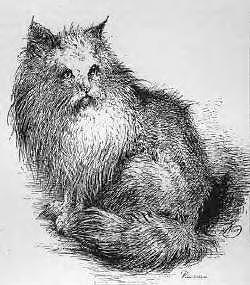 The above is a portrait of a cat given me many years ago, whose parents came from Russia, but from what part I could never ascertain. It differed from the Angora and the Persian in many respects. It was larger in body with shorter legs. The mane or frill was very large, long, and dense, and more of a woolly texture, with coarse hairs among it ; the colour was of dark tabby, though the markings were not a decided black, nor clear and distinct ; the ground colour was wanting in that depth and richness possessed by the Persian, having a somewhat dull appearance. The eyes were large and prominent, of a bright orange, slightly tinted with green, the ears large by comparison, with small tufts, full of long, woolly hair, the limbs stout and short, the tail being very dissimilar, as it was short, very woolly, and thickly covered with hair the same length from the base to the tip, and much resembled in form that of the English wild cat.