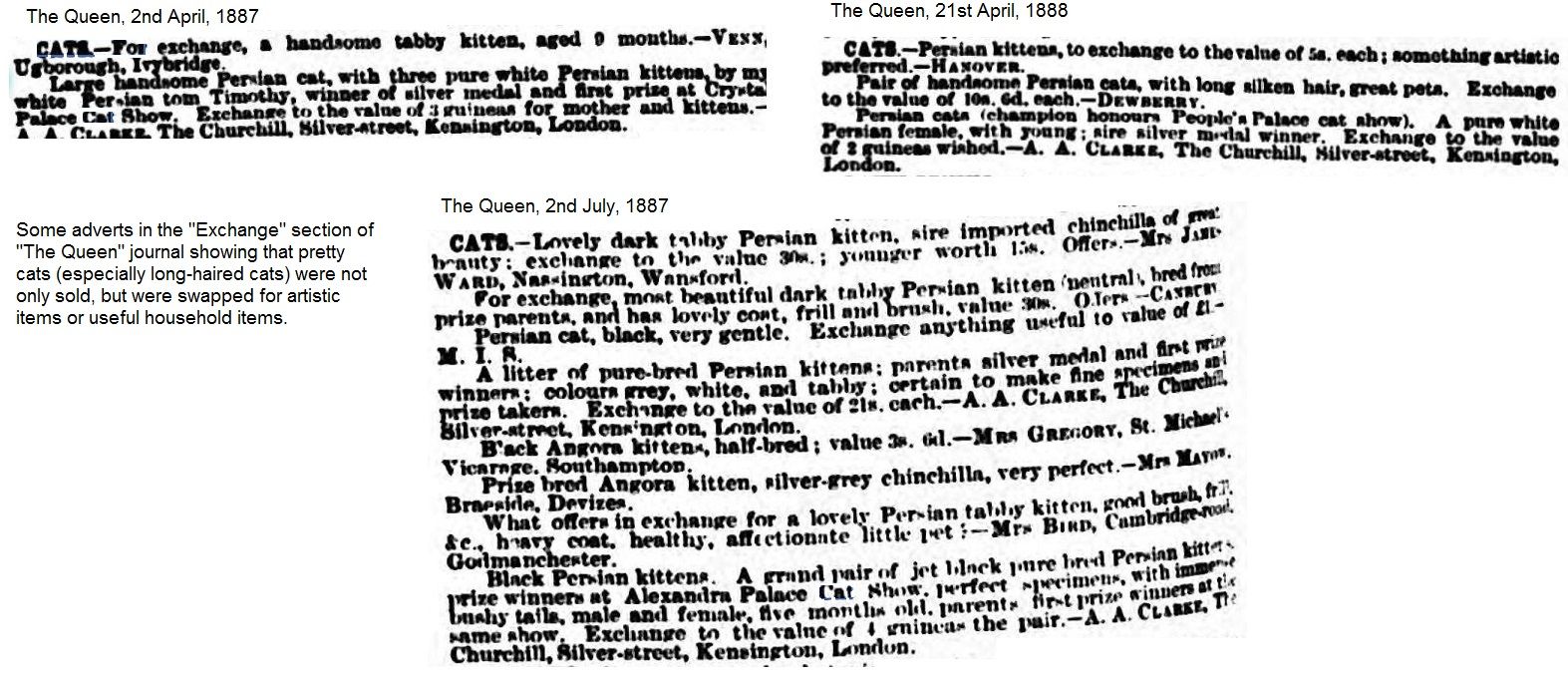
LONGHAIRS OF THE 19TH CENTURY - GENERAL OBSERVATIONS
The Persian Cat - Harrison Weir (Our Cats and All About Them, 1889)
This differs somewhat from the Angora, the tail being generally longer, more like a table brush in point of form, and is generally slightly turned upwards, the hair being more full and coarser at the end, while at the base it is somewhat longer. The head is rather larger, with less pointed ears, although these should not be devoid of the tuft at the apex, and also well furnished with long hair within, and of moderate size. The eyes should be large, full, and round, with a soft expression; the hair on the forehead is generally rather short in comparison to the other parts of the body, which ought to be clothed with long silky hair, very long about the neck, giving the appearance of the mane of the lion. The legs, feet, and toes should be well clothed with long hair and have well-developed fringes on the toes, assuming the character of tufts between them. It is larger in body, and generally broader in the loins, and apparently stronger made, than the foregoing variety, though yet slender and elegant, with small bone, and exceedingly graceful in all its movements, there being a kind of languor observable in its walk, until roused, when it immediately assumes the quick motion of the ordinary short-haired cat, though not so alert.
The colours vary very much, and comprise almost every tint obtainable in cats, though the tortoiseshell is not, nor is the dark marked tabby, in my opinion, a Persian cat colour, but has been got by crossing with the short-haired tortoiseshell, and also English tabby, and as generally shows pretty clearly unmistakable signs of such being the case.
For a long time, if not now, the black was the most sought after and the most difficult to obtain. A good rich, deep black, with orange-coloured eyes and long flowing hair, grand in mane, large and with graceful carriage, with a mild expression, is truly a very beautiful object, and one very rare. The best I have hitherto seen was one that belonged to Mr. Edward Lloyd, the great authority on all matters relating to aquariums. It was called Mimie, and was a very fine specimen, usually carrying off the first prize wherever shown. It generally wore a handsome collar, on which was inscribed its name and victories. The collar, as Mr. Lloyd used jocosely to observe, really belonged to it, as it was bought out of its winnings; and, according to the accounts kept, was proved also to have paid for its food for some considerable period. It was, as its owner laughingly said, "his friend, and not his dependent," and generally used to sit on the table by his side while he was writing either his letters, articles, or planning those improvements regarding aquariums, for which he was so justly celebrated.
Next in value is the light slate or blue colour. This beautiful tint is very different in its shades. In some it verges towards a light purplish or lilac hue, and is very lovely; in others it tends to a much bluer tone, having a colder and harder appearance, still beautiful by way of contrast; in all the colour should be pure, even, and bright, not in any way mottled, which is a defect; and I may here remark that in these colours the hair is generally of a softer texture, as far as I have observed, than that of any other colour, not excepting the white, which is also in much request. Then follow the various shades of light tabbies, so light in the marking having scarcely a right to be called tabbies, in fact, tabby is not a Persian colour, nor have I ever seen an imported cat of that colour - I mean firmly, strongly marked with black on a brown-blue or gray ground, until they culminate in those of intense richness and density in the way of deep, harmonious browns and reds, yet still preserving throughout an extreme delicacy of line and tracery, never becoming harsh or hard in any of its arrangements or colour; not as the ordinary short-haired tabby. The eyes should be orange-yellow in the browns, reds, blues, grays, and blacks.
As far as my experience extends, and I have had numerous opportunities of noticing, I find this variety less reliable as regards temper than the short-haired cats, less also in the keen sense of observing, as in the Angora, and also of turning such observations to account, either as regards their comfort, their endeavour to help themselves, or in their efforts to escape from confinement.
In some few cases I have found them to be of almost a savage disposition, biting and snapping more like a dog than a cat, and using their claws less for protective purposes. Nor have I found them so "cossetty" in their ways as those of the "short-coats," though I have known exceptions in both.
They are much given to roam, as indeed are the Russian and Angora, especially in the country, going considerable distances either for their own pleasure or in search of food, or when "on the hunt." After mature consideration, I have come to the conclusion that this breed, and slightly so the preceding, are decidedly different in their habits to the short-haired English domestic cat, as it is now generally called.
It may be, however, only a very close observer would notice the several peculiarities which I consider certainly exist. These cats attach themselves to places more than persons, and are indifferent to those who feed and have the care of them. They are beautiful and useful objects about the house, and generally very pleasant companions, and when kept with the short-haired varieties form an exceedingly pretty and interesting contrast; but, as I have stated, they certainly require more attention to their training, and more caution in their handling, than the latter. I may here remark, that during the time I have acted as judge at cat shows, which is now over eighteen years, it has been seldom there has been any display of temper in the short-haired breeds in comparison with the long; though some of the former, in some instances, have not comported themselves with that sweetness and amiability of disposition that is their usual characteristic. My attendant has been frequently wounded in our endeavour to examine the fur, dentition, etc., of the Angora, Persian, or Russian; and once severely by a "short-hair." Hitherto I have been so fortunate as to escape all injury, but this I attribute to my close observation of the countenance and expression of the cat about to be handled, so as to be perfectly on my guard, and to the knowledge of how to put my hands out of harm's way. If a vicious cat is to be taken from one pen to another, it must be carried by the loose skin at the back of the neck and that of the back with both hands, and held well away from the person who is carrying it.
Curious Long-Haired Cat - Harrison Weir (Our Cats and All About Them, 1889)
The above engraving and description of a very peculiar animal is from Daniel's "Rural Sports," 1813 : "This Cat was the Property of Mrs. Finch, of Maldon, Essex. In the Account of this Lusus Naturæ, for such it may be deemed, the Mother had no other Likeness to her Production, than her Colour, which is a tawny Sandy, in some parts lightly streaked with black; She had this, and another Kitten like it, about two Years since. The fellow Kitten was killed, in consequence of being troublesome, to the Mistress of the House, where it was presented. This is a Male, above the usual Size, with a shaggy Appearance round its Face, resembling that of the Lion's in Miniature. The Hair protruding from the Ears, formerly grew, like what are termed Cork-screw Curls, and which are frequently seen, among the smart young Water-men, on the Thames; the Tail is perfectly distinct, from that of the Cat Species, and resembles the Brush of a Fox. The Mother, has at this time (1813), three Young ones, but without the least Difference to common Kittens, neither, indeed, has she ever had any before, or since, similar to That here described. The Proprietor has been offerend, and refused One Hundred Pounds for theis Animal."
This was either a cross with the English wild cat, which sometimes has a mane, or it was an accidental variation of nature. I once bred a long-haired rabbit in a similar way, but at first failed entirely to perpetuate the peculiarity. I think the above simply "a sport."
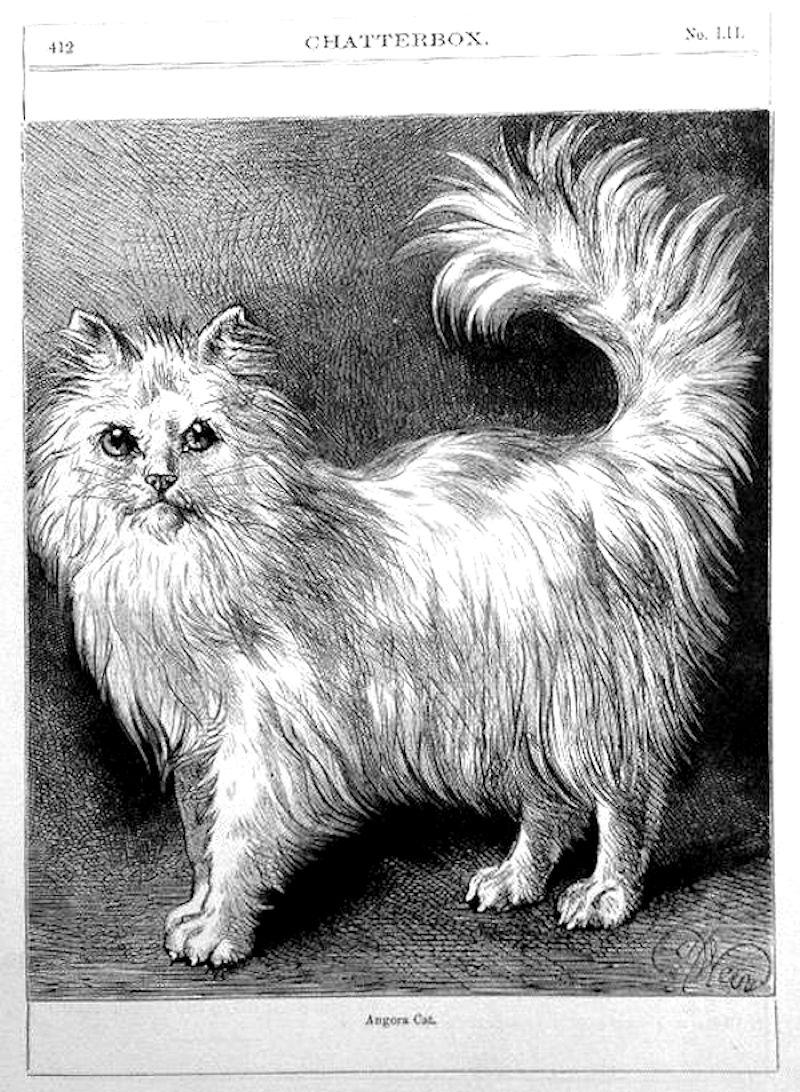
Long-Haired Cats - Harrison Weir (Our Cats and All About Them, 1889)
I have now concluded my remarks on the long-haired varieties of cats that I am at present acquainted with. They are an exceedingly interesting section ; their habits, manners, forms, and colours form a by no means unprofitable study for those fond of animal life, as they, in my opinion, differ in many ways from those of their "short-haired" brethren. I shall not cease, however, in my endeavours to find out if any other long-haired breeds exist, and I am, therefore, making inquiries in every direction in which I deem it likely I shall get an increase of information on the subject, but hitherto without any success. Therefore, I am led to suppose that the three I have enumerated are the only domesticated long-haired varieties. The nearest approach, I believe, to these in the wild state is that of the British wild cat, which has in some instances a mane and a bushy tail, slightly resembling that of the Russian long-hair, with much of the same facial expression, and rather pointed tufts at the apex of the ears. It is also large, like some of the "long-haired" cats that I have seen ; in fact, it far more resembles these breeds than those of the short hair.
I was much struck with the many points of similitude on seeing the British wild cat exhibited by the Duke of Sutherland at the first cat show at the Crystal Palace in July, 1871. I merely offer this as an idea for further consideration. At the same time, allow me to say that I have had no opportunity of studying the anatomy of the British wild cat, in contradiction to that of the Russian, or others with long hair. I only wish to point out what I term a general resemblance, far in excess of those with short hair. I am fully aware how difficult it is to trace any origin of the domestic cat, or from what breed ; it is also said, that the British wild cat is not one of them, still I urge there exists the similarity I mention ; whether it is so apparent to others I do know not.
Home Pets, Management Of Long Haired Kittens, Lloyd's Weekly Newspaper, 7th May 1899
The tenacity of life pertaining to the feline race generally is unfortunately not to be reckoned on by those who attempt to breed and rear long-haired kittens. The short- haired kitten is as hardy as any domestic animal, and appears to possess the nine lives commonly allotted to him. But the Persian is very different. The more highly bred he is, and the more promising, and the better looking he is in his early infancy, the more likely will he be to sicken and die. From about three to six months old is the time when special attention is necessary for these pretty little pets. The beautiful specimens that are to be seen at the cat shows, and the perfect condition in which they are exhibited, are the result of a large amount of care, and skill, and anxiety on the part of their owners. Many ladies have regular catteries built for their pets, with a separate larder for their food, and a regular attendant to clean the feeding utensils and otherwise minister to the health and comfort of the cats. But one or two Persian cats kept in the house in the ordinary way will often prove to be healthier and hardier, and their kittens will he more easily reared, than those on which so much money and time have been expended.
Many of the female Persian cats are very good mothers, and will rear their young ones without any trouble. But now that fashion decrees that Persians are to be as large as possible it is the custom to leave only a couple of kittens with the mother and to place the rest of the litter under a strong common cat, which will act as foster-mother. When a cat is bringing up Persian kittens she must be well fed three or four times a day. Bread and gravy mixed with finely-chopped meat, any of the manufactured infants' foods, and a good supply of fresh milk will be suitable diet. A little fish for a change, some cooked green vegetables, and some liver once or twice a week will be advisable. The kittens should not be removed from their mother before they are three months old. After they are five weeks old they will require some food for themselves is addition to the milk supplied by the mother, such as cow's milk given warm with a little sugar in it, and some infants' food made into a thick pap.
When they are taken away from the mother they can have a little minced meat- not, pork, nor veal, nor anything high or tainted - fish, such as boiled cod or plaice, green vegetables, and coarse oatmeal soaked, and mixed with warm milk. A handful of fresh grass daily does good. The kittens should not be allowed out of doors in wet weather, but on dry, fine days they should have as much exercise as possible. It is essential that all the feeding utensils be clean, and that the food should all be fresh and sweet, and not stale or sour. Alter the kittens are two months old they will be all the better if brushed for a few minutes three or four times a week with a hairbrush with rather long bristles. This will keep the coat glossy and fine, and help to keep away insect vermin. If any kitten is delicate a few drops of chemical food mixed with the dinner, or a raw egg beaten up, given for a week or so daily, will often produce an improvement. When necessary to give med cine to a cat or kitten wrap the patient in a cloth or shawl, so that every part, except the head, is covered. Then place the cat on someone's knee to hold, and with a firm hand open the mouth wide. Only a few drops should be poured down the throat at a time, either out of a small bottle or spoon.
Longhaired or Persian Cats - Frances Simpson (Book of the Cat, 1903)
In classing all long-haired cats as Persians I may be wrong, but the distinctions, apparently, between Angoras and Persians are of so fine a nature that I must be pardoned if I ignore the class of cat commonly called Angora, which seems gradually to have disappeared from our midst. Certainly, at our large shows there is no special classification given for Angoras, and in response to many inquiries from animal fanciers I have never been able to obtain any definite information as to the difference between a Persian and an Angora cat. Mr. Harrison Weir, in his book on cats, 1889, states that the Angora differs somewhat from the Persian in that the head is rather smaller and ears larger, fur more silky with a tendency to woolliness. It is, however, my intention to confine my division of cats to long-haired or Persian cats, and short-haired or English and foreign cats. In both these breeds there are "self-coloured," "broken-coloured," and "any other coloured" varieties.
In the foregoing references to the diagram of the cat I have touched upon the points of the animal, which are practically the same as regards the form of body and limb in both long- and short-haired breeds of cats [note: the preceding chapter had illustrated the ideal conformation of the show cat]. In comparing the dispositions of these two breeds, I think it is generally allowed that Persian cats are not so amiable, or so reliable in their temper, as the short-haired varieties. I am inclined to think, however, that they are more intelligent, and have a greater instinctive desire to make themselves at home in their surroundings. They are apparently as keen hunters of prey as the short-haired cats. When we come to the question of stamina and general health, I certainly think the Persian must, so to speak, "go to the wall."
It is a common belief that, in human beings, if the hair grows long and thick it is a sign of great strength and good constitution; but as regards cats the longer the coat the weaker the animal. This I have specially noticed in Persian kittens, and I have remarked that little mites with unusually long fur are most difficult to rear, and suffer from extreme delicacy. Perhaps in-breeding amongst Persian varieties has been more carried on than with the short-haired breeds, which are allowed a greater freedom of choice, and therefore are the result of natural selection.
Apart from the question of health and strength, Persian cats require a great deal more care and attention on account of the long fur. In the spring Persian cats begin to shed their coats, and this process continues through the summer months, and it is not till about October that the new fur begins to grow again. Persian cats may be considered in their finest condition during the months of December and January. It is a wise provision of Nature that during the coldest months these somewhat delicate cats should have their warmest clothing. It has often been a matter of surprise that cat shows should ever be held in the summer, when long-haired pussies present a most unkempt and moth-eaten appearance. In this condition they are not likely to win converts to the cult of the cat; but from an educational point of view these unclothed specimens give the judge an opportunity of displaying his ability, for it needs a really capable judge with experience, knowledge, and good common-sense, to allow for absence of coat, and to place the awards accordingly. Under summer skies shape and bone will have their innings, whereas a grand winter coat may hide a multitude of sins that even the eagle eye of the most astute judge may fail to discover.
At the same time, for a breed of cats called "long-haired" the coat ought to demand the greatest consideration; for what is the good of the most perfect shape in a Persian cat, if it is exhibited out of coat and almost like an English short-hair in a class set apart for long-haired specimens? No doubt many breeders of Persians have been led through disappointment to join the ranks of short-hair breeders, for it is indeed very vexatious and tantalising, after having entered a grand-coated cat a month before a show, to find your precious pet persistently scratching out her fluffy frill and shedding the chief glory of her breed before the eventful day when you had hoped to reap golden awards.
As regards Persian kittens, the change of coat takes place between the ages of three and six months. In some cases long-haired kittens will cast their fur to such an extent as to present the appearance of an uneven short-haired specimen, whereas in others the shedding process is so gradual that the transition from a kitten to a cat is hardly more discernible in the long- than in the short-haired breeds. Any severe illness may cause the fur to come out of Persian cats at any season of the year, and the growth of the new coat will be retarded by poor condition of the skin. In both long- and short-haired cats, as in other animals, the teeth are the chief guide in deciding the age, and a kitten may be said to become a cat after six months, when the adult dental process is completed, and the second set of teeth has become established. And here I would quote from Mr John Jennings' interesting book on "Domestic or Fancy Cats" in support of my twofold classification:
"Of the many varieties or breeds of the cat with which we are now familiar, it must be remembered that, however crossed, selected, re-crossed, domesticated, or what not, we have but two breeds on which the super-structure of what is known today as the 'classification of varieties' has been reared - viz the long-hair or Eastern cat, and the short-hair or European. The term breed is even here used advisedly, for whatever the outer covering or coat, colour, or length of fur, the contour of each and all is practically the same. Nor is this confined to mere outline. Take the skull, for example, which measured in the usual manner with shot, making due allowance for difference in size, is not only in the different varieties of either long- or short-hair, but even in the wild cat the anatomy is similar, the slight variation being in a great measure explained by its different conditions of life and diet, and is in unison with the fact of how even the ordinary domestic cat will undergo a change in taking up a semi-wild, outdoor existence."
At the present time there is not doubt that long-haired cats are the more popular, and judging by the entries at out large shows, the numbers may be taken as four to one [i.e. compared to short-hairs and foreign cats]. A slight reaction has set in since short-haired societies have been formed, but the fascination for fluffy pets and fluffy pussies will, I think, always predominate, for the less attractive points of the English domestic cat do not appeal so strongly to the heart and the eye of the general public.
It may be remarked by the readers of "The Book of the Cat" that very few pictures of short-haired cats are reproduced; and it is just because the long-haired pussies are so much more attractive that they are brought into greater prominence in this work. It is more difficult to obtain nice photographs of short-haired cats, probably because the owners of these less expensive pets do not think it is worth while to spend their money or go to any trouble over having a good picture taken. As regards the coloured plates appearing in this work, care has been taken to instruct the artists to bring out as prominently as possible the special points of the cats, long- and short-haired. It is the first time that coloured plates of the different kinds of cats have been attempted; and it is hoped that, as types of each breed, these will prove useful to fanciers and instructive to the cat-loving public.
Neuter Cats (Frances Simpson)
It has been my experience in the past year or two that the demand for neuter cats, or, in other words, household pet pussies, is on the increase; and I am inclined to believe that if some fanciers made a speciality of these cats they might do a thriving trade. As it is, owners of male kittens do not care to undertake the trouble and responsibility of having them gelded, or doctored, as this process is sometimes called, and novices in purchasing are always very anxious that the operation should have taken place before they become possessed of their pets [something equally true in the 21st century!]. A selling class for neuters at our large shows would not be at all a bad idea, but the age should be limited to eight months, or at most ten months, as it is only natural that purchasers should desire pussies before they reach the prime of life, so that they may grow up as pets in the home. For reasons that are easily understood, it is necessary, if you wish to have a house-pet of unimpeachable manners [a euphemism for "not spraying"], to have your cat doctored when he arrives at years of discretion [sexual maturity].
For my own part I consider between five and eight months the best time for a cat to be gelded, but I have often known successful operations taking place much later. It is, however, most important that the tom should not previously have shown any desire to mate. In all cases a cat should be kept on low plain diet for two to three days before being neutered, and it is more humane to pay the extra fee for the use of an anaesthetic.
I have been told on good authority that if a female cat is to be made neuter she ought to be allowed to have one litter before the operation is performed [Simpson was sadly reciting a myth in this respect]. Neuter cats are essentially for the "one cat" person. They undoubtedly make a grand show when exhibited, but those who are possessed of these pet pussies are generally very disinclined to let them run the risks and discomforts of a show pen. I have advocated having neuters shown only in the ring, on the lead. If this course were adopted, I think owners would not mind exhibiting their precious cats, as they could be sent or taken home after their turn around. Certainly neuters are the only cats that ought to be led into the ring, and in this way their fine proportions and generally heavy coats can be seen and judged to the best advantage. It is too often a practice with fanciers to have the worst of the litter kept for a pet and made neuter, and therefore we see many blues with light green eyes, and cats with the blemish of a white spot, in the classes set apart for gelded cats; and if a beautiful, almost perfect, neuter is exhibited, fanciers are apt to protest at what they consider is a "grave mistake." From the lips of some noted and over-wrought breeders of Persian cats I have heard the exclamation, "I shall go in for neuters only!"
This has been called forth, perhaps, by a succession of failing litters or by a rampageous stud cat that has fought with the neighbour's tom or has wandered off on amorous thoughts intent, perhaps never to return, or on returning to bring disease to the cattery. Certainly, for a thoroughly comfortable domestic pet there is nothing like a neuter cat. They are more affectionate, and with children more docile, not less keen in catching rats and mice, and they are proverbially very clean in their habits. One great advantage that neuters have over the other long-haired breeds is that they retain their lovely coats nearly all the year round. In spite, however, of the many points in favour of neuter cats, they are nevertheless rather looked down upon in the fancy. Certainly, at our shows no cats are more attractive to visitors than the big burly neuters, and I would fain see a better classification for these really fine animals.
A specialist society was started in 1901 by an admirer of these cats, but either through lack of energy or want of enthusiasm the work was not carried on, and the club died a natural death. It remains for some other fancier with a love for pet pussies to start a society, for as it is the neuters fare badly at our shows, the classes provided never numbering more than two, and the special prizes being few and far between. Formerly neuters were judged by weight, and I remember some specimens exhibited at the Palace that really looked like pigs fatted up for market. It was in 1886 that the classification for neuters at the Crystal Palace show ran thus; "Gelded cats, not judged by weight, but for beauty of form, markings etc." Happily, therefore, this state of things has been abolished, and though neuters should be big, massive cats, yet they need not, and should not, be big lumps of inert fat and fur. It is true that a big show cat appeals to the non-exhibitor, and visitors to our shows are always greatly impressed with huge animals over filling their all too small pens. The heaviest and biggest neuter I have ever seen was possessed by Mrs Reay Green. This enormous silver turned the scale at 20 lb. I believe the record weight at the Crystal Palace was 25 lb.
It is a libel to say that neuter cats are lazy and uninteresting. I have always possessed a neuter, either a blue or a brown tabby, and these beloved pets have ably fulfilled their duties as mice-catchers of the establishment. My "Bonnie Boy," who but recently joined the noble army of neuters, is as keen as a knife, and will sit for hours watching a likely hole, and never a mouse escapes his clever clutches. He kills them instantly, and then amuses himself for hours dancing about and throwing his dead prey with wild delight into the air. Then again, he is, I am sorry to say, just as destructive with the poor London sparrows, and many a time I have had to chastise my pet for stalking the game in our little back garden.
Miss H Cochran, writing of neuters, says: "There are, without doubt, a great number of people who like to keep a cat, especially a Persian, for a pet pure and simple - one that will be the admiration of all, and of service in ridding the house of mice and rats. They will attain a greater size, and in nine cases out of ten retain all the pretty habits and antics of their kittenhood. Neuter cats are often very troublesome in a large cattery; they fight with each other and with the queens, which have a poor chance against their superior size. I think they do it for fun." [sounds more like problems of overcrowding than a result of neutering!]
In Fur and Feather "Zaida" thus writes of neuters:- "Undoubtedly it is a crying mistake for neuter cats to be allowed to compete in open classes, but personally I should be delighted to see more classes for them at shows and much greater interest taken in them. Sometimes one is tempted to think the ordinary run of cats has deteriorated in general beauty, remembering the splendid animals, both English and foreign, which we used to see in friends' houses in our childhood; but the real explanation lies in the fact that formerly 'house cats' were almost entirely kept as pets, and handsome kittens were obtained for the purpose. Nowadays anything not good enough for breeding from is made a neuter, and fanciers undoubtedly look on them with a certain contempt. Why should this be more the case with cats than with horses? For a perfect household pet the neuter cat holds its own, if only the public would universally acknowledge it. But too often every purchaser of a kitten starts breeding, and multiplies a race of weedy, ill-kept animals, who do little credit to their owner. A cat with kittens is undoubtedly a charming sight; but a female cat is more or less of a worry, and is, besides, only in coat for a very short time each year. Then a tom cat roams, fights, and is often objectionable, but the stay-at-home cat is always a thing of beauty, never requires periods of seclusion, will mouse and rat with the best, and be a credit to any establishment. In short, we should like to see more of them, not fewer, and a neuter class for every colour in a show. In many a household, cats are disliked through the ill-advised action of some member of the family in starting breeding with more zeal than knowledge, and without proper convenience. If a lovely neuter, or even two or three, reigned in their glory, there would be an end to the trouble, to the groans of the other members of the family, to the 'wasn't engaged to wait on cats' of the servants."
In the schedule of the Beresford Cat Club show, held at New York, January, 1903, the classification for gelded cats reads thus: "Class 25, neuter, white or black; Class 26, neuter, blue or smoke; Class 27, neuter, any colour tabby with white." It will be seen, therefore, that in America a much more liberal classification is given for long-haired neuters, and for short-haired there are three classes provided. I do not know, nor have I heard of any remarkable American neuters, and no photographs have been received by me for reproduction in this work.
If we go back some years in the fancy, I remember Miss Sangster's "Royal Hector," a blue of great celebrity; also same owner's "Royal Bogey," a handsome black with a white star. Miss Boddington's cobby, woolly-coated white "Ba Ba" appeared later in exquisite form, winning well till he was eleven years old [once again these appear to be cats with faults, there follows a list of various winning neuters]
In judging neuters, I think it is rather a mistake to go too much by points. I consider size should be a most important factor, also coat and general effect. Of course, in close competition points would come into question; but I really think that a large, heavily coated neuter, whose colour was a trifle unsound, or whose markings or eyes were below par, should not be placed below a small mean-looking cat who, however, excelled in these points.
Louis Wain, writing on a general survey of the Crystal Palace show of 1900, referring to the neuter class that he judged, says: "Neuters have suffered somewhat through the extended schedule of the 'whole' cats. At one time it was quite a usual thing for exhibitors to have their cats neutered to preserve the natural beauties of a fine cat, and very often a really handsome cat was neutered because he stood no chance in a class of twenty or thirty cats, and yet would take first as a neuter in a class of six or eight. The neuter classes have not grown as have the other classes. As 'home' cats neuters should be encouraged, and I feel sure that many are kept at home in fear of the dreaded 'blues,' which are usually unbeatable."
Mr Wain also complains of the poor classification for neuters at our shows, and on this particular occasion he states that the cats were such extremely fine animals that they needed classes of their own for him to do justice to their merits. Certainly there ought at least to be three classes provided for neuters at our large shows, viz.: Neuters, self-coloured (blue, black, and white); neuters, tabby, "any colour"; and neuters, "any other colour".
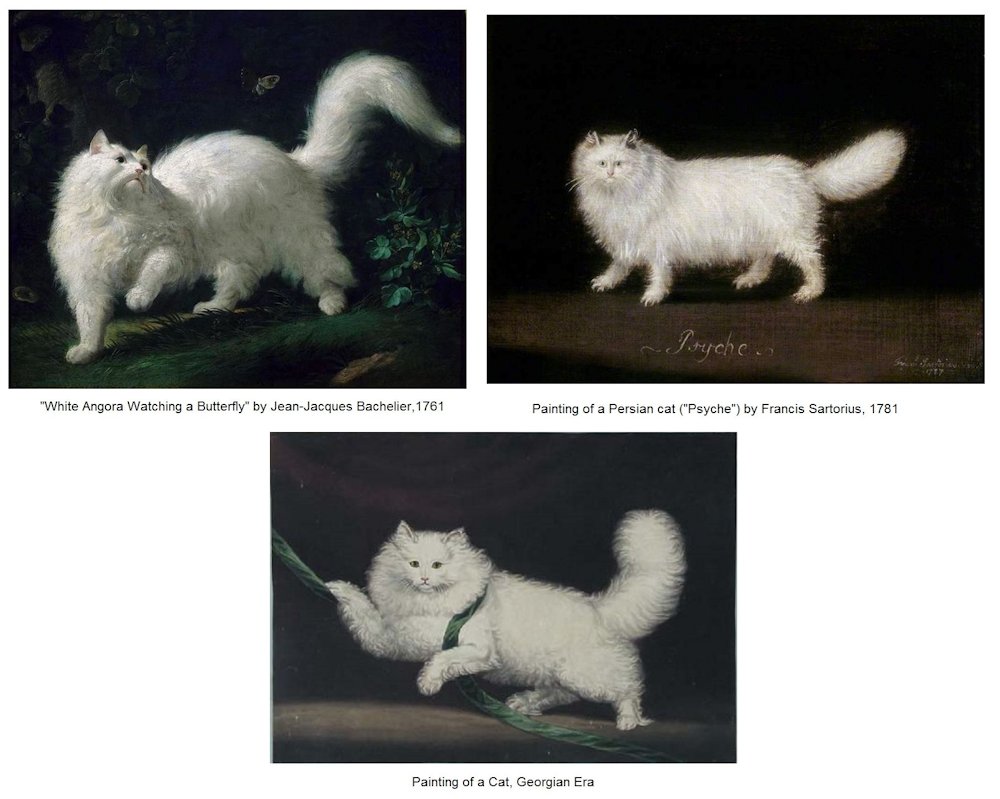
CONCERNING VARIETIES OF CATS - LONGHAIRS
Concerning Cats (1900, Helen Winslow)
American Helen M Winslow was the editor of "The Club Woman" and the author of "Concerning Cats" (published 1900), a book on cats and the cat fancy in America. At that time, the American cat fancy lagged greatly behind the British scene and her comments are less extensive than those of Frances Simpson a few years later.
Few people realize how many kinds of Cats there are. The fashionable world begins to discuss cats technically and understand their various points of excellence. The "lord mayor’s chain," the "Dutch rabbit markings," and similar features are understood by more cat fanciers than a few years ago; but, until within that time, it is doubtful if the number of people who knew the difference between the Angora and the Persian in this country amounted to a hundred. It is but a few years since the craze for the Angora cat started. These cats have been fashionable pets in England for some years back, and now America begins to understand their value and the principles of breeding them. Today, there are as handsome, well-bred animals in the United States as can be found abroad. The demand for high-bred animals with a pedigree is greatly increasing, and society people are beginning to understand the fine points of the thoroughbred.
The Angora cat, as its name indicates, comes from Angora in Western Asia, the province that is celebrated for its goats with long hair of fine quality. In fact, the hair under the Angora cat’s body often resembles the finest of the Angora goatskins. Angora cats are favorites with the Turks and Armenians, and exist in many colors, especially since they have been more carefully bred. They vary in form, color, and disposition, and also in the quality of their hair. The standard calls for a small head, with not too long a nose, large eyes that should harmonize in color with the fur, small, pointed ears with a tuft of hair at the apex, and a very full fluffy mane around the neck. This mane is known as the "lord mayor’s chain." The body is longer than that of the ordinary cat in proportion to its size, and is extremely graceful, and covered with long; silky hair, which is crinkly like that of the Angora goat. This hair should be as fine as possible, and not woolly. The legs are of a moderate length, but look short on account of the length of hair on the body. Little tufts of hair growing between the toes indicate high breeding. The Angora cat, in good condition, is one of the most beautiful and elegant creatures in the world, and few can resist its charm. The tail is long and like an ostrich plume. It is usually carried, when the cat is in good spirits, straight up, with the end waving over toward one side. The tail of the Angora serves as a barometer of its bodily and mental condition. If the cat is ill or frightened, the tail droops, and sometimes trails on the ground; but when she is in good spirits, playing about the house or grounds, it waves like a great plume, and is exceedingly handsome. The suppleness of the Angora’s tail is also a mark of fine breeding. A high-bred Angora will allow its tail to be doubled or twisted without apparent notice of the performance.
The Angora does not reach its prime until about two years. Before that time its head and body are not sufficiently developed to give the full beauty and grace of the animal. As a rule, the Angora is of good disposition, although the females are apt to be exceedingly nervous. They are sociable and docile, although fond of roaming about, especially if allowed to run loose. As a rule, they do not possess the keen intelligence of the ordinary short-haired family cat, but their great beauty and their cleanly and affectionate habits make them favorites with fashionable people. The proper breeding of the Angora cat is a regular science. Of the colors of the Angoras, the blue or maltese is a favorite, and rather common, especially when mixed with white.
The white Angora is extraordinarily beautiful, and brings a high price when it has blue eyes and all its points are equally good. The orange, or yellow, and the black with amber eyes are also prize winners. There are the tigers also, the brown tabby, and the orange and white. Mixed colors are more common than solid ones; the tortoise-shell cat of three colors and well mottled being considered particularly desirable.
The Persian cat differs from the Angora in the quality of its fur, although the ordinary observer sees little difference between them. All the longhaired cats originated from the Indian Bengalese, Thibetan, and other wild cats of Asia and Russia. The Persian cat of very great value is all black, with a very fluffy frill, or lord mayor’s chain, and orange eyes. Next to him comes a light slate or blue Persian, with yellow eyes. The fur of the Persian cat is much more woolly than that of the Angora, and sometimes in hot weather mats badly. The difference between a Persian and an Angora can usually be told by an amateur, by drawing the tail between the thumb and first finger. The Angora’s tail comes out thin, silky, and narrow, although it immediately "fluffs" up. The Persian’s tail does not compress itself readily into a small space. The Persian cat’s head is larger, its ears are less pointed, although it should have the tuft at the end and the long hair inside. It is usually larger in body and apparently stronger made, although slender and elegant in appearance, with small bones and graceful in movement. The colors vary, as with the Angora, except that the tortoise-shell and the dark-marked tabby do not so frequently appear. The temper is usually less reliable and the intelligence less keen than the Angora.
The Russian long-haired pet is much less common even than the Persian and Angora. It is fond of cold weather, and its fur is denser, indicating that it has been used to colder regions. Many of the cats that we see are crosses of Angora and Persian, or Angora and Russian, so that it is extremely difficult for the amateur to know a thoroughbred cat which has not been mixed with other varieties.
There is in this country a variety known as the "coon cat," which is handsome, especially in the solid black. Its native home is in Maine, and it is thought by many to have originated with the ordinary cat and the raccoon. It grows somewhat larger than the ordinary cat, with thick, woolly fur and an extremely bushy tail. It is fond of outdoor life, and when kept as a pet must be allowed to run out of doors or it is apt to become so savage and disagree-able that nothing can be done with it. When it is allowed its freedom, however, it becomes affectionate, intelligent, and is usually a handsome cat.
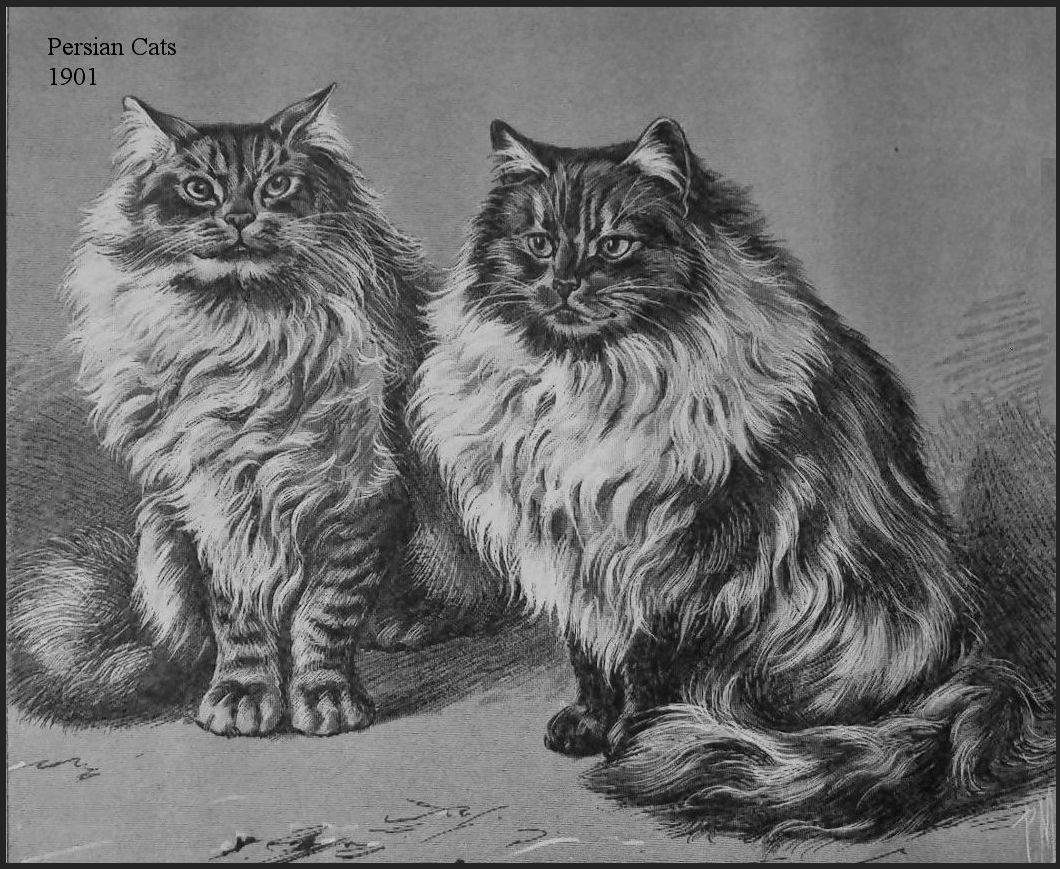
PERSIAN CATS - New York Sun, January 1905
Bitterne Chiffon lay in her cage at the cat show and dozed gracefully. James Conlisk of Gowanda, whose wife owns the thousand dollar cat, stood in the aisle nearby to see that nobody pulled Chiffon’s tail, which stuck out through the bars.
“All I know about cats,” said Mr. Conlisk, a rosy cheeked old gentleman, “is what I’ve learned from my wife. Ever since she got the cat fad I’ve been a busy man, with hardly time to hunt as many rabbits as I'd like. Yes, it’s true that one of the fanciers at the show, a physician, offered Mrs. Conlisk $1,000 for Bitterne Chiffon, but she didn't care to part with her. We imported Chiffon a year ago last June fromn the catteries of Miss B. White Atkins in England. She's by Tintagel out of Silverine, both of celebrated Persian stock, and she’s a grand cat, probably the best in America and perhaps the best in the world.
“There are various kinds of Persian cats — you hear them spoken of usually as Angora — and this one is a silver. To be more definite in the description, Chiffon is a chinchilla, very light in color. Her eyes are the really handsome thing about her. Wake up, there, Chiffon, and show your eyes!”
Chiffon wouldn’t do that, but she yawned and stretched, sticking her paws out between the bars.
Mr. Conlisk, first making sure that Mrs. Conlisk was not about, took a pencil from his pocket and gave Chiffon a sly poke in the ribs. This had the effect desired. The car glared out at her annoyer with eyes that were a wonderful bottle green and a mile deep. The pupils swelled in the glare of the lights.
“She won at Crystal Palace, London, where they have some great cats," said Mr. Conlisk, “and she won in New York and Washington last year. Then she's won all kinds of firsts at Rochester and other places, and, of course, she’s been first at this show. We have only four cats in the show, one younger than Chiffon winning in the juvenile class, but we have a lot of them at home. There’s imported Bitterne Silver Chieftain, who's just about the name among cats as Hamburg among horses. He’s too old for show purposes. He's the grandsire of Jack Frost, one of the winners here now. He has emerald eyes. One of his kittens will bring $75 or so.”
“Are Persians bard to keep well?"
“Not at all,” said Mr. Conlisk. “They are comparatively hardy — at least, mine are, for I let them have the run of the barn and they scamper about the fields. They are very good hunters.”
The thought of a thousand dollar cat being chased around the barnyard by s two dollar ki-yi [mutt] was interesting, but Mr. Conlisk said that his dogs made friends with the cats.
“And we don't have to wash them, although their long hair is likely to get soiled. They are very cleanly, and all they require is brushing.”