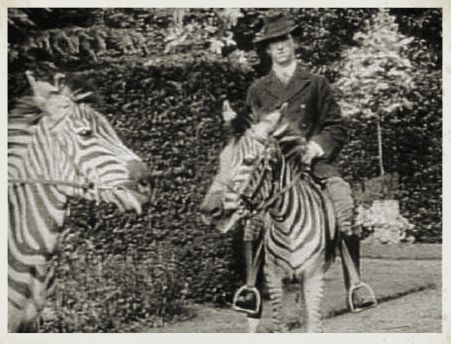
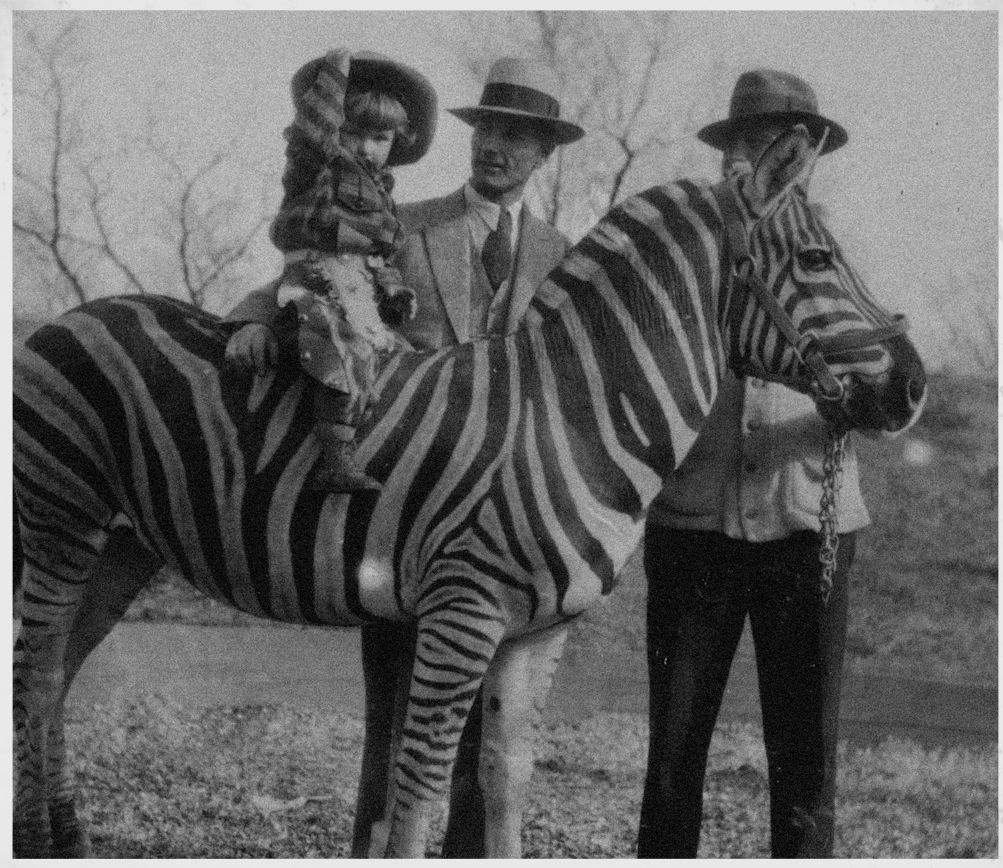
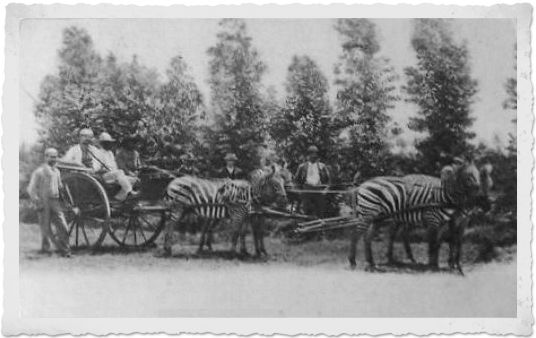
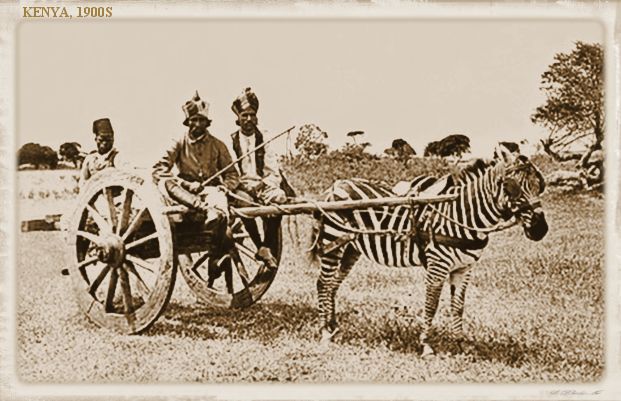
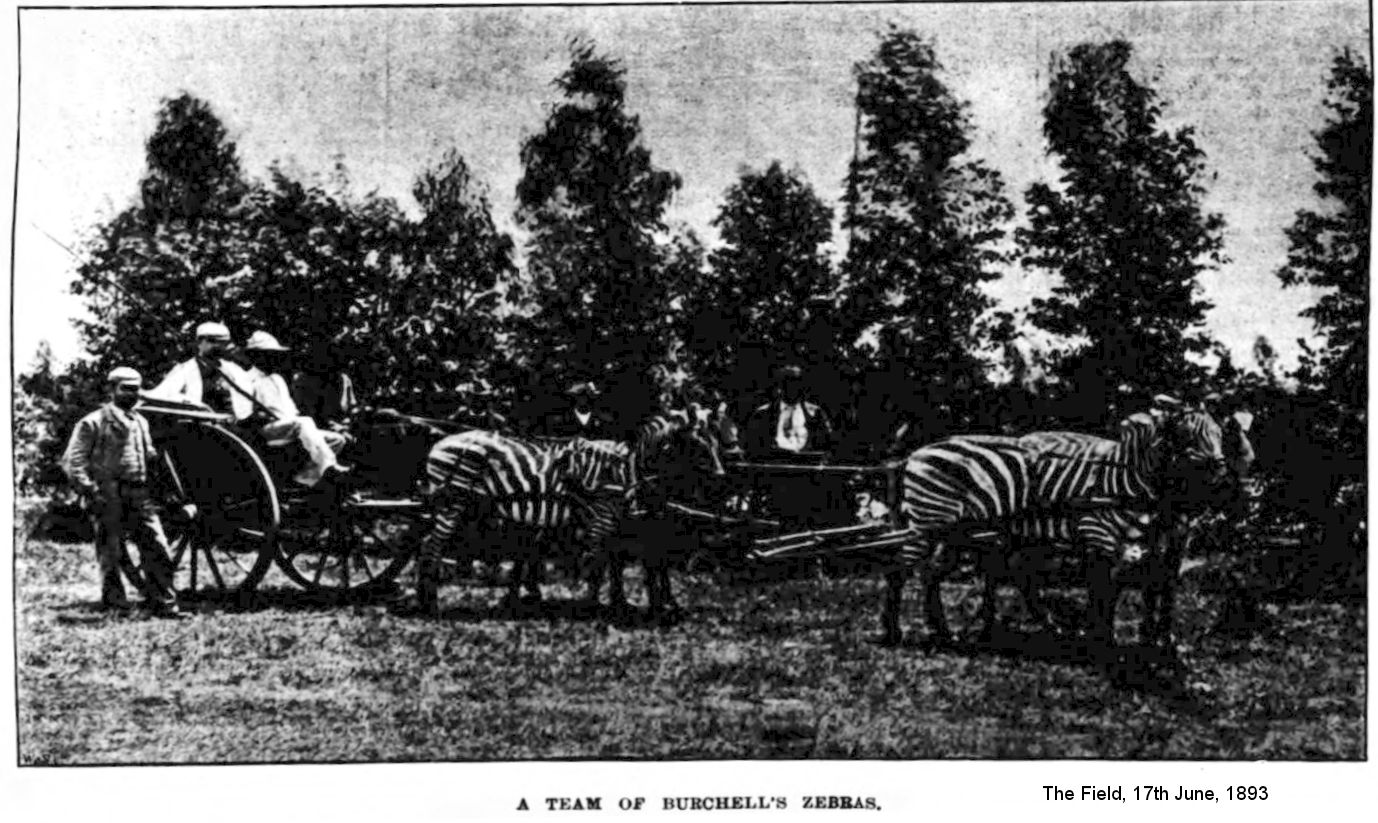
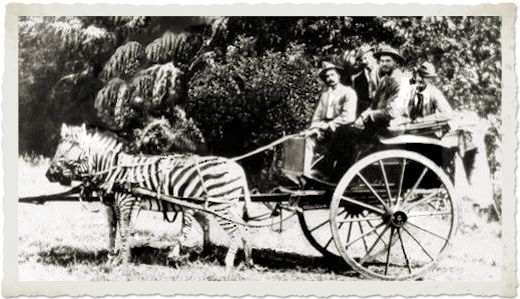
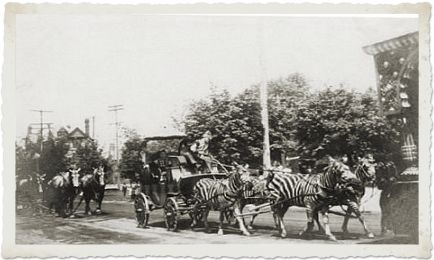
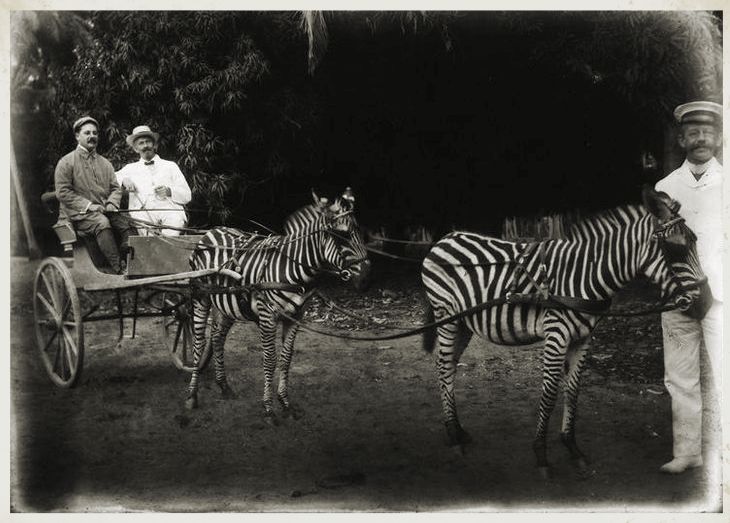
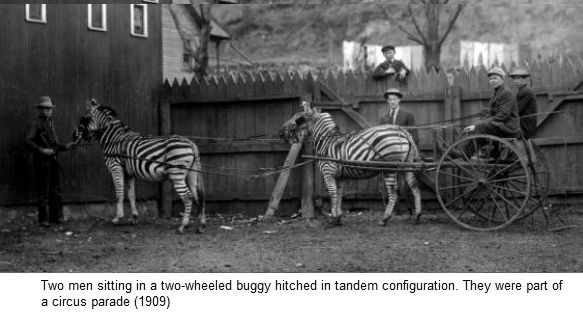
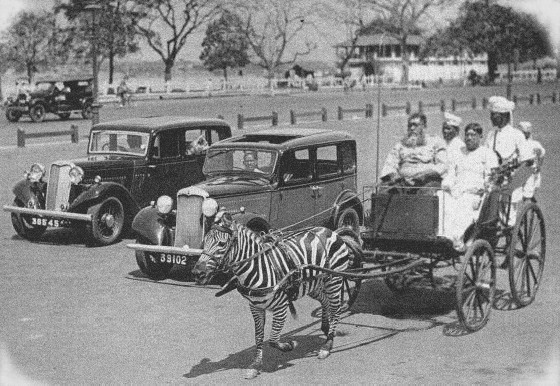
Because of their resemblance to the familiar horse, there has always been great interest in taming and training zebras as riding and harness animals. In the 1760s, French naturalist Buffon belived that zebras could replace horses and there were rumours in Paris that the Dutch had already trained a team of zebras to pull a cart. Eccentric aristocrats around the world had zebr-carts at various times in the 19th Century. These photos are from the late 19th century and early 20th century.
Why was there such an interest in taming zebras in the late 1800s/early 1900s? There are several reasons. Britain was a colonial power and colonists tried to turn local fauna to their own use, often because imported European livestock didn t thrive in the new conditions. Acclimation societies wanted to add new animals to the list of animals useful to man; the prevailing view was that the Christian god had made the animals for humans to use. Acclimation societies imported new species into European countries as potential additions to useful livestock. Circuses and showmen wanted to present something exotic to the paying public. Accomplished horsemen, eager to demonstrate their prowess in the saddle, wanted the challenge of taming and training the seemingly intractable zebra. One zebra four-in-hand was the result of a bet and took 2 years to accomplish, indicating a social class with plenty of leisure time. Aristocrats and rich eccentrics sought novelty. However, as the motorcar gained in popularity, horses began to disappear from the roads and so did the zebras. The bored and wealthy could now show off their wealth by owning motorcars instead of breaking exotic equids to harness.
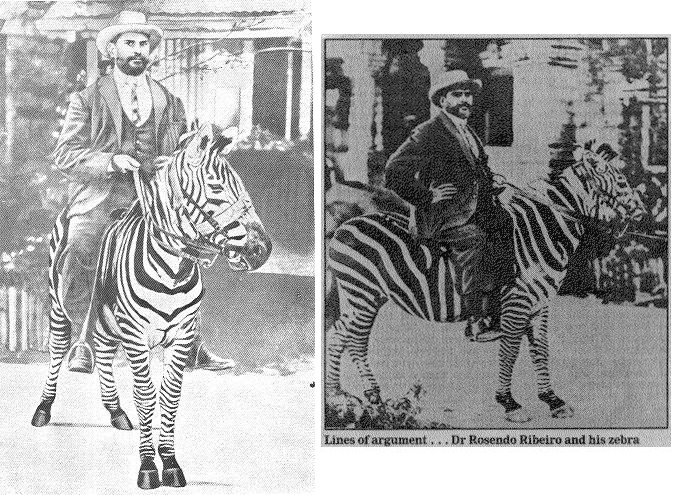
Rosendo Ribeiro, the first doctor in Nairobi, Kenya, bought a zebra in 1907, and visited his patients on zebra-back. He was a familiar sight in the straggling township. He later sold it to Bombay Zoo for 800 Rupees.
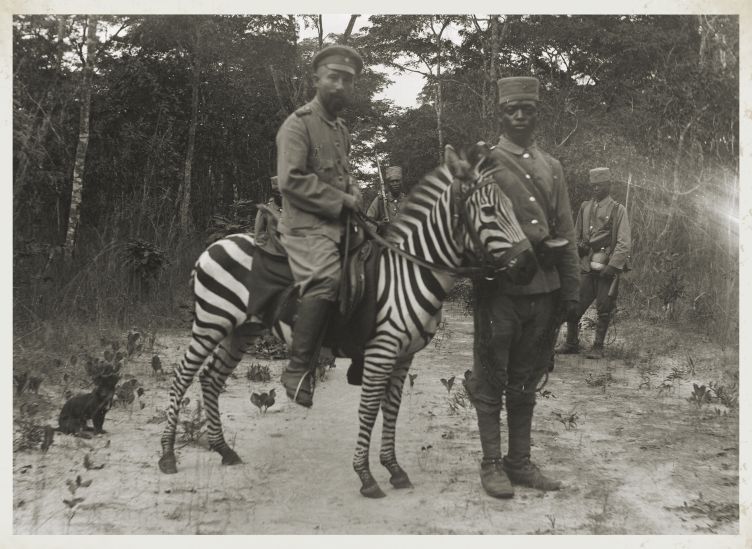
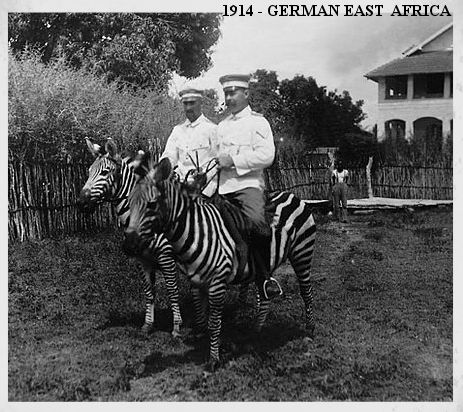
A German soldier riding a zebra in Zanzibar (East Africa). The German army was particularly interested in taming zebras for riding, pack animals and draught animals. They also had a programme of crossing Chapman's zebras with horses to create a hybrid that was resistant to the diseases that killed horses, but which zebras were resistant to.
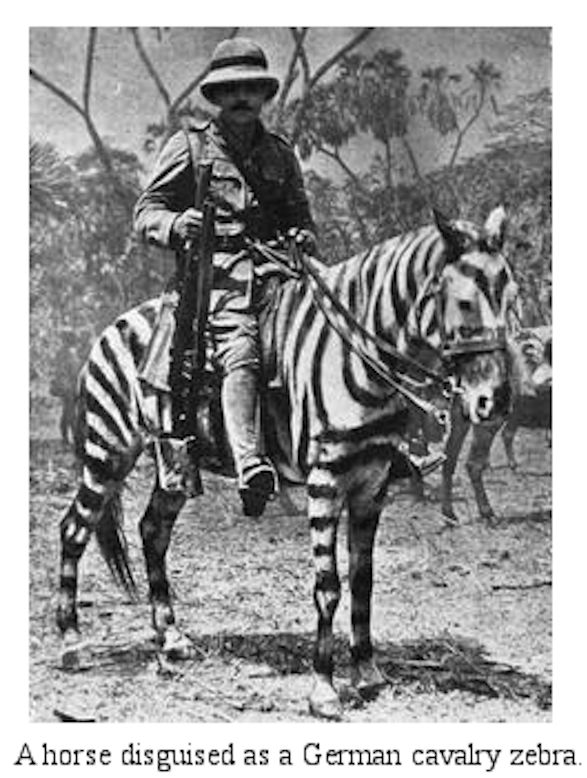
A German soldier riding a cavalry horse disguised as a zebra.
Zebras in German East Africa.
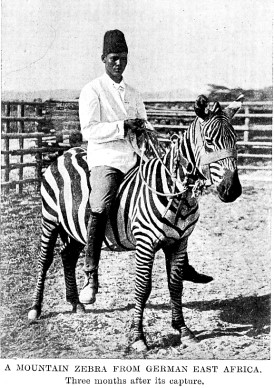
From Animal Life and the World of Nature (1902-1903): The photograph of the zebra with a native on his back has been sent to us by Mr Carl Hagenbeck of Hamburg. The animal is a new mountain zebra from German East Africa. The photograph was taken within three months of its capture, and the fact that it is being ridden is interesting as once more disproving the statement that these animals are untameable.
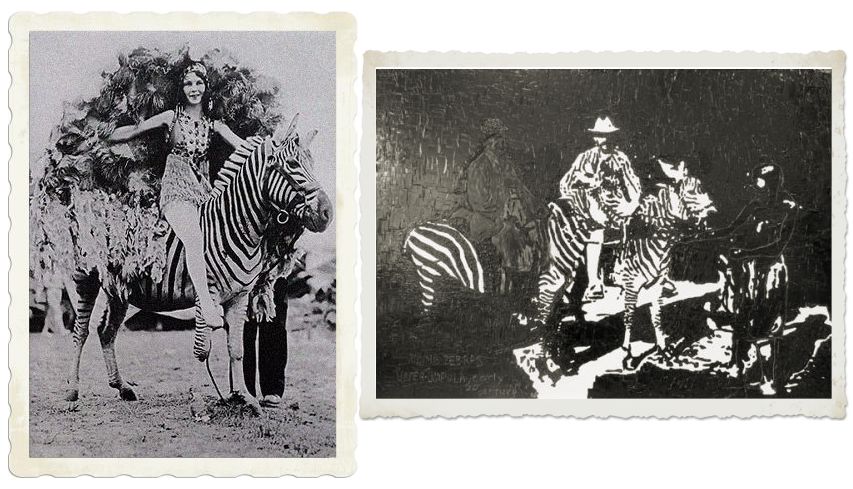
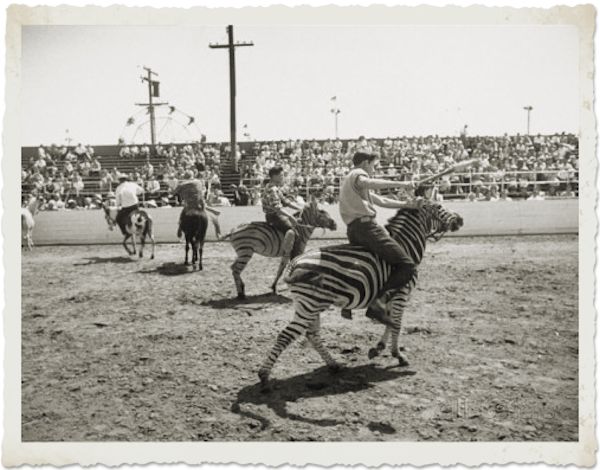
Zebra riding was a popular act in circuses in the late 1800s/early 1900s....
... and also among those wanting to show off their horsemanship.
This photo is often captioned "Zebra racing", but the zebras appear to be in a display with other horses.
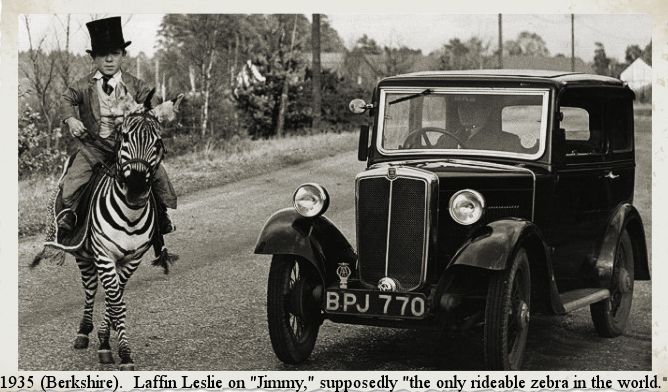
Leslie Laffin in 1935. This was supposedly the only rideable zebra in the world. Presumably a circus act out for exercise and publicity.
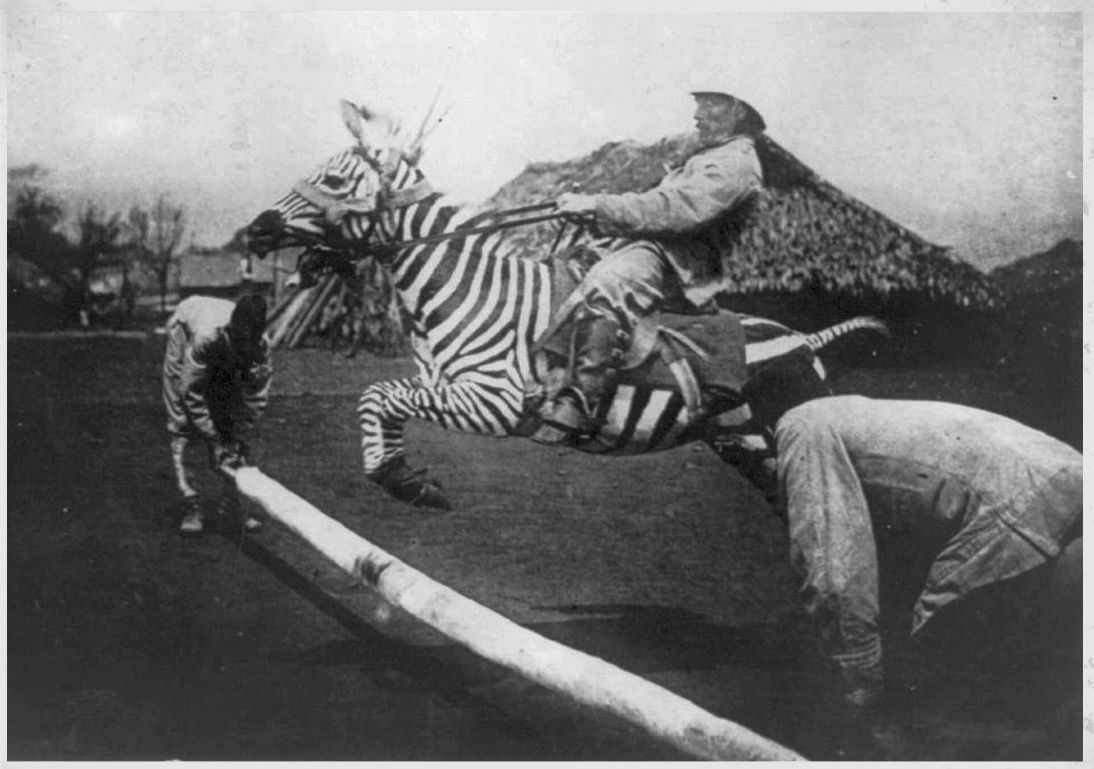
Jumping and trick-riding on zebras. The use of the "backward seat" at that time made this unpleasant for the zebra (and for horses, of course). The photo was taken in Africa.
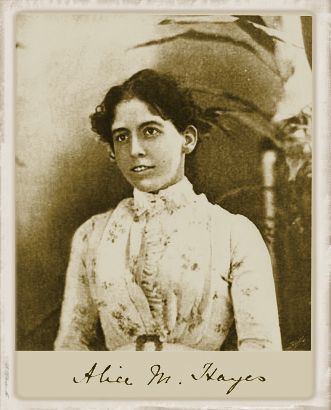
HORACE AND ALICE HAYES
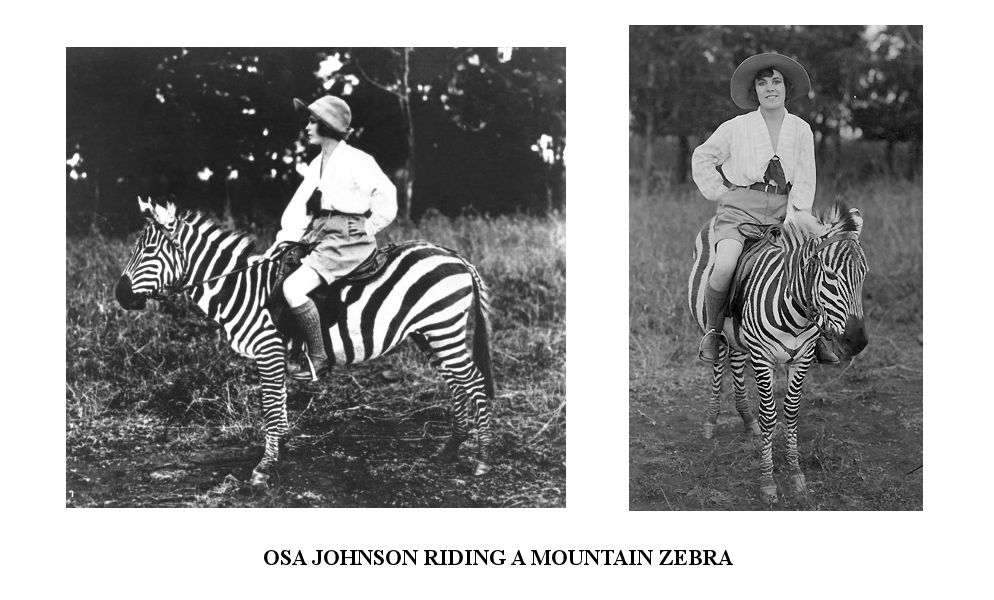
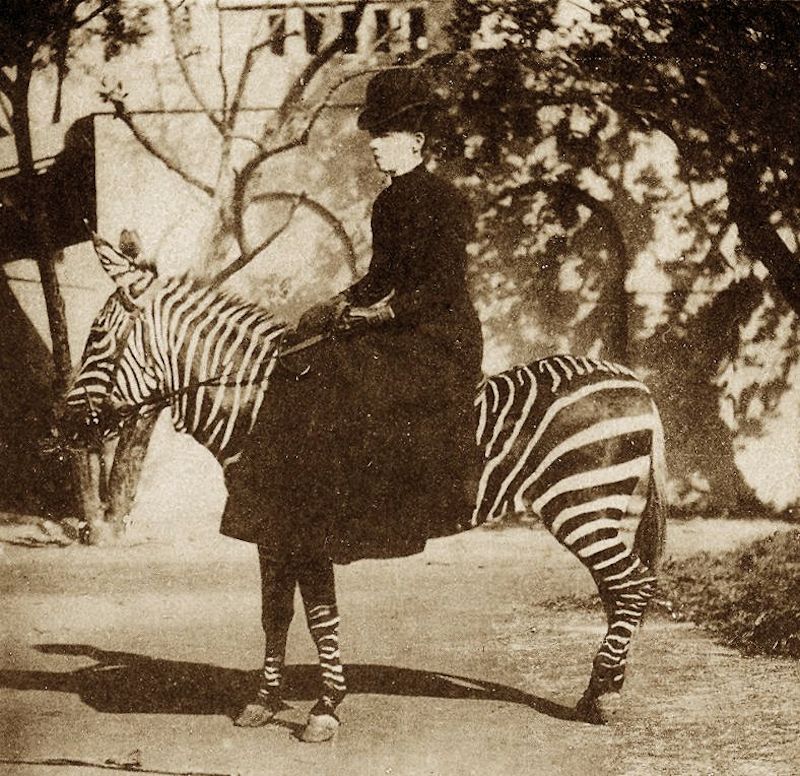
Originally published in 1877, Captain M (Matthew) Horace Hayes's "Veterinary Notes for Horse Owners"became the standard work on equine health care and, now revised, remains in print today. He also wrote "Among Men and Horses" (1894) and Illustrated Horse-Breaking (1905). Hayes was an army vet and he and his wife Alice travelled widely in the course of his work. Alice was an accomplished rider and the author of "The Horsewoman - A Practical Guide to Side-Saddle Riding" (1893, 1903) edited by her husband. She rode a variety of difficult horses, so it's no surprise that she rode zebras (broken by Horace). In "The Horsewoman" she wrote "RIDING DIFFICULT HORSES. - General Remarks Shying Stumbling Dancing and Prancing Throwing up the Head Habit-shy Jibbing Shouldering Backing Pulling Refusing Boring Kicking Buck-jumping Rearing" and went on to describe the zebra under the heading "KICKING.":
The most awkward kicker I ever rode was a mountain Zebra, which my husband broke in at Calcutta. He kicked very neatly without lowering his head, and, as the slightest touch on his ears drove him nearly out of his mind, I had great difficulty in avoiding them, as he kicked with a sort of peculiar wriggle which complicated the performance for me, because I had had no practice on a kicking zebra, and had to pick up my knowledge as I went on. It was no use trying to rein him back; for he had a neck like a bull, with a small rudimentary dewlap, and at every kick he gave, he made a noise like a pig grunting. His skin was the best part about him, and was as lovely and soft to the touch as the finest sealskin. As I believe I am the only woman who has ridden a mountain zebra, this photograph is probably unique. It ought to be a better one, seeing the trouble I took to make my obstinate mount stand still; but he seemed to regard the camera as an infernal machine destined for his destruction, and flatly refused to pose nicely for his portrait. He was far too neck-strong to make a pleasant mount for a lady. Kickers, as I have already said, should never be taken into any hunting field.
Other contributors to her book remarked about the zebra: "The lady friend of the two little girls wrote about our [the Hayes's] work in the 'Queen' of June 17, 1893, as follows: "I made the acquaintance of the authoress of The Horsewoman one morning in Ward s Man ge [...] Mrs. Hayes herself, as may be supposed, looks every inch a workman in the saddle. She has ridden in most quarters of the globe; and, as if she sighed for other worlds to conquer, and were blas e about all sorts and conditions of horses, she rode a zebra at Calcutta which was broken within an hour by her husband sufficiently to be saddled and bridled. Her experiences on his back are entertainingly set forth in her book The Horsewoman, which is well worth the reading, not only for its hints on horsemanship, but for the many amusing sporting anecdotes. "
("The Queen" magazine was a British "high society" women's weekly magazine established in 1861. Its full title was "The Queen, the Ladies' Newspaper." WThe June 17 1893 issue featured the zebra-riding exploits of Alice Hayes. No doubt the exploits of an army wife were thrilling to Victorian ladies and far removed from features such as "the shape of this season's bustle". It evolved into "Harpers & Queen" and then into "Harper's Bazaar" (the original Harper's Bazaar was founded in 1867).)
In his book Illustrated Horse-Breaking Horace Hayes wrote:
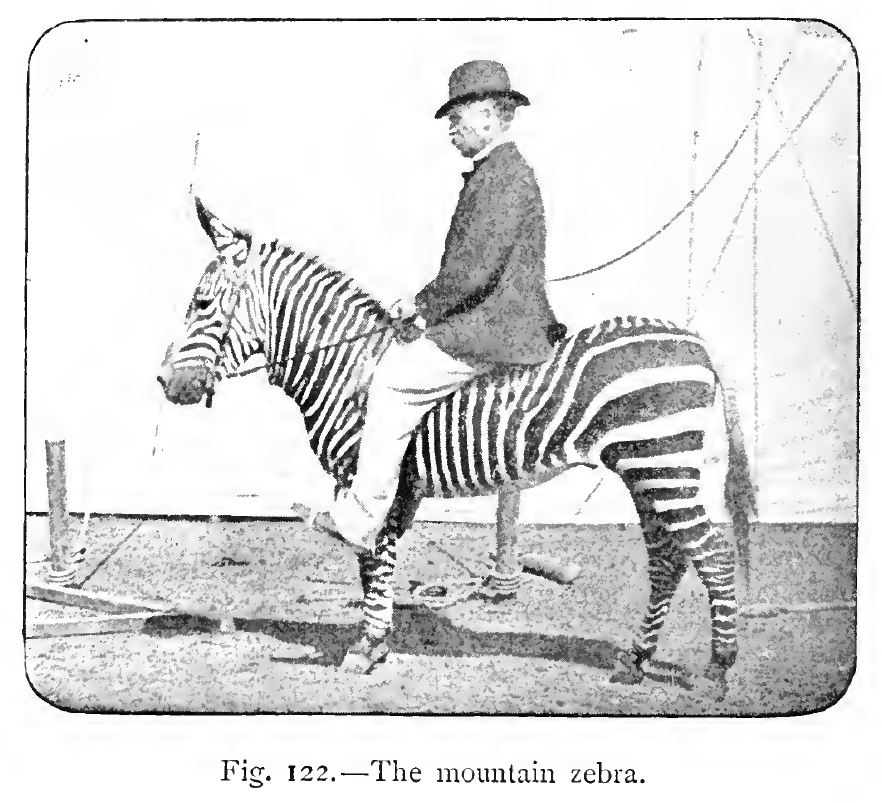
MULES AND ZEBRAS. These animals are so stiff in the neck that there is great difficulty in giving them a good mouth. Mules, as a rule, are timid animals which take time to make up their minds to do anything unusual, and are consequently apt to be misunderstood by men who treat them as if they were high-couraged and impulsive horses. Mules, I have found, possess more affection than horses for those who are kind and sympathetic to them. Many of them are fine natural jumpers, and show particular care to avoid " chancing " their fences. I don't think that mules are harder to make quiet than horses. Of all asses, the mountain zebra (see Fig. 122) is the most difficult to break; as he is sulky, stupid, and has an almost immovable neck. I have found the Burchell s zebra, which is more nearly akin to the horse than any other ass, comparatively easy to break.
Fig. 122. " The mountain zebra.
In a later edition of that book, the section was expanded into "MULES, ZEBRAS AND THE PRJEVALSKY WILD HORSE." and the following was added after the illustration:
"I did some interesting breaking in of zebras at the Zoological Gardens last March. The first animal I took in hand was Jess, a Grevy zebra mare, which was about nine years old. She stands nearly fifteen hands high and is a very powerful animal. The first problem was how to get a head-stall or halter on Jess in her loose box. A peculiarity about zebras is the extreme sensitiveness of their ears, in which respect they are entirely different from the normal horse. In South Africa and on the Russian steppes I never had any difficulty in haltering a semi wild horse, which had been driven into a krall or small enclosure, by the aid of a halter on a long pole, as already described. But the slightest touch on the ears drives a zebra almost mad. Consequently, this horse-haltering plan is not successful with zebras, unless they are lassoed in the first instance, and thus brought more or less under control.
Having haltered the zebra, the next step in her breaking was to take her outside into a small enclosure, which was considerably hampered by the presence of trees in the centre. To obtain more control, it was necessary to put the loop of a rope round the fore pastern, so that the striped lady might not give me a playful or vicious pat when I went up to her. With horses there is no trouble in adjusting this loop, by, as I have already described, placing it on the ground and making them step into it, at which moment a pull on the rope promptly lassoes the pastern of the too confiding fore-leg. Every zebra I have handled has viewed this loop with great distrust, and evidently understood the purpose for which it was placed on the ground. Consequently, a breaker has to be very artful in order to circumvent these reasoning Equidae. In their struggle for existence they have to be much more intelligent than the domestic horse, a fact which we can readily see by their larger brain capacity, which is well shewn by their broad and " bumpy " forehead.
When a fore-leg has been noosed, it is safest to raise it off the ground, which can be easily done by passing the rope over the animal's back, under its breast, and then pulling it. Having thus secured the zebra I tied her " head and tail " in the manner already described, and after a short exhibition of play, she readily submitted to driving by means of the long reins. The " leading rein crupper " quickly taught the mare to lead, and the young soldier attendant was soon riding her about the enclosure and on friendly terms with his mount. In the afternoon of that day I adopted similar tactics with another but younger Grevy zebra mare, and before evening she allowed herself to be ridden quietly.
Next morning, Jess, who had been haltered during the night, so as to save the trouble of catching her, was produced in the enclosure, and seemed so amiable that I trusted her too much, as I saw when the very badly-fitting saddle came too far forward and pinched her withers, with the result that she promptly bucked her rider off. In this respect I made a mistake in not providing myself with my Australian buck-jumping saddle; for our ordinary English saddles are of comparatively little use when a horse or zebra starts bucking.
We must bear in mind that the greatest difficulty in subduing zebras is their extreme cunning in refusing, under ordinary circumstances, to exhaust themselves by " playing up," which horses do in a way that would make a zebra smile. I found it expedient with this powerful animal to make her lie down until she arose submissive and quiet to be ridden without any trouble. The younger zebra evinced very little desire to assert her authority. Jess, however, was far less trouble to break in than a Mountain zebra stallion which I made quiet for my wife to ride in Calcutta, probably because my Calcutta pupil had only been in captivity a short time.
After the mares were reduced to obedience I was asked to handle a Grevy zebra stallion, which gave me some trouble in his efforts to bite and kick. He finally allowed himself to be mounted, and made no attempt to bite my hand when I placed it in his mouth. I was very sorry to hear that this zebra died about four days after his breaking lesson. As I knew nothing about this unfortunate occurrence, I cannot do better than give the following extract from a letter I received from Mr. Pocock, who is the Superintendent of the Zoological Society's Gardens :" " I was very much astonished to hear on Sunday morning that our zebra stallion was down, because he seemed all right on the Thursday and Friday following the breaking, and it was not till Saturday that signs of weakness began to show themselves in the fore-quarters, as was testified by his toppling and dropping momentarily on to his knees. He was not handled at all after the Wednesday when you broke him. To what extent the death was attributable to the breaking, if indeed it was at all connected with it, it is quite impossible to say. The post mortem examination revealed no sign of any internal injury, though the organs were carefully examined.
For information concerning the different varieties of zebras I would refer my readers to Points of the Horse."
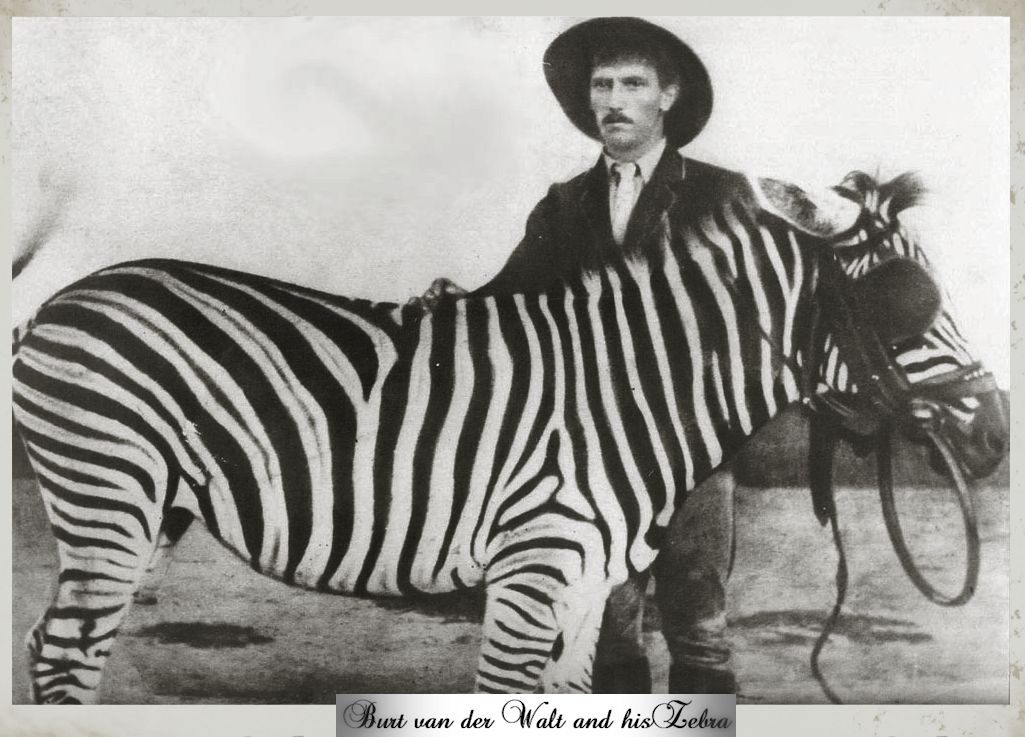
And in "Points of the Horse" (and reprinted in various natural history books) Hayes mentioned his wife's zebra-riding: "I may mention that I once undertook to saddle and get ridden an old entire zebra (equus zebra. Fig. 257), whose feet were becoming gradually deformed, on account of its not permitting them to be pared down from time to time. In less than an hour after I had turned it into the ring of Frank Fillis's circus, which was then in Calcutta. I had its feet rasped down to a proper level, and had it saddled and bridled for the first time in its life. It was then ridden by Steve Margarett (a brilliant Australian rough-rider) and by my wife. This was certainly the first occasion a lady ever rode this variety of zebra, which has the reputation all over the world of being unrideable. Although I was able to quickly teach it to carry its unwonted burden quietly, I made far less progress in giving it a "mouth" during the two days I had it in hand, than I would have done in half an hour with any wild Colonial horse caught for the first time on a "run;" the reason being that the zebra's neck was so stiff and strong, that I was unable to bend it in any direction. I soon taught it to do what i wanted in the circus ; but when I rode it outside, it took me wherever it liked. In fact, I had not the slightest power to either stop or guide it."
On Burchell's Zebra Horace Hayes relates: ' On account of the fact that this zebra when in a wild state, possesses immunity from the effects of the bite of the tsetse fly, which is a carrier of death to horses, I strongly advocated, when in South Africa, the taming and employment for harness or saddle of these animals in 'fly' infested districts. ....As the Burchell's zebra is comparatively easy to break in, and as it will breed in confinement, there is but little doubt that it will in time become domesticated. ...it will prove a valuable means of conveyance in South Africa. During one of my horse- breaking performances in 1892, at Pretoria, the capital of the Transvaal, I made a young Burchell zebra, after about an hour's handling, quiet to carry a rider. In doing this, I did not throw the animal down, nor did I resort to any of the usual "heroic" horse'taming methods.'
On the Quagga Horace Hayes relates: '... Up to the end of the first half of last century it was found in immense numbers in South Africa, and appears to have become extinct about the year 1870. The last specimen in England died in the London Zoological Gardens in 1864. It was a strong, somewhat heavily built animal, slow of pace for a wild member of the Equidae, and comparatively docile. " A pair of imported Quaggas were in the early part of the last century driven about London in a phaeton by Sheriff Parkins. Lieut. Col. C. Hamilton Smith, in his unpublished volume on Equidae, 1841 states that he drove one in a gig, and that its mouth was as delicate as that of a horse. He further stated that it had better quarters and was more horse-like even than Burchell's zebra, and added: 'It is unquestionably the best calculated for domestication, both as regards strength and docility' " (Tegetmeier and Sutherland) Owing to its deficiency in speed and alertness, and to the value set on its hide by the Boers and on its flesh by their Hottentot servants, it was finally exterminated by the settlers and natives. No attempt was made by naturalists to save this animal from extinction.'
Horace Hayes exploits were also reported in The Tablet of 19th March 1904:
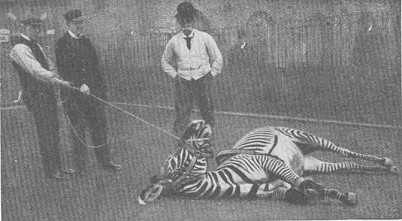
"Captain Horace Hayes, the well-known authority on equitation, made some experiments on the Grevy zebras in the Zoological Gardens to show the efficacy of his method in breaking them to harness. The animals selected were a nine-year-old mare called "Jess," and another younger and far more tractable animal. After some preliminary stroking with a pole about the mane and ears, a halter was got on, and the animal under treatment was allowed to pass from the box into the paddock. At this stage Jess became excited, rushed violently to and fro, and cut her forehead against the enclosure. The further process of taming consisted in hobbling one of the forelegs, while also restraining the use of a hind leg so as to render her helpless, in which state she was gently thrown and bitted, the bit being covered with gutta percha. She was then driven by Captain Hayes, and ridden by one of the attendants, appearing to be quite manageable in her new capacity. The other mare gave very little indication of spirit of any kind, save a tendency to kick when on the ground. No violence was used, and the effect would seem to be produced by the shock to the animal's nerves caused by throwing it with hobbled limbs. It should be remembered that these zebras were in poor condition, and to a certain extent domesticated by having lived under artificial conditions. The task would, of course, be more difficult with one fresh from its wild life. The Franciscan Sisters on their way to Uganda witnessed attempts on a large scale for the capture and taming of zebras in East Africa, but we do not know what success attended them. One of the great incentives to the experiment is the immunity of the zebra in its wild state to the bite of the tsetse, although it has not been ascertained whether this valuable quality will survive under domestication. Another motive for taming the zebra is the desire to preserve so beautiful a creature from extermination, which will certainly be its fate within a very few years, unless it can be successfully reared in captivity. It must either serve man in some capacity or disappear before his advance into its haunts in the African wilderness. Its South African congener, the quagga, is already gone, with many other beautiful and interesting forms of life that swarmed on the veldt before the advent of the white man his destroying rifle."
The 1900s photo shows a "savage" zebra being broken to harness at the Zoological Gardens (Horace Hayes). Zebras were not hard to break to harness or saddle, but they were more easily spooked than horses.
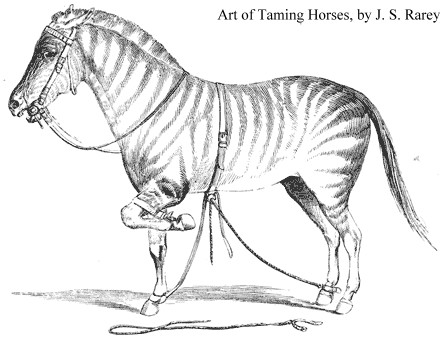
According to "A New Illustrated Edition of J. S. Rarey's Art of Taming Horses," "For conquering a vicious, biting horse, there is nothing equal to the large wooden gag-bit, which Mr. Rarey first exhibited in public on the zebra. A muzzle only prevents a horse from biting; a gag, properly used, cures; for when he finds he cannot bite, and that you caress him and rub his ears kindly with perfect confidence, he by degrees abandons this most dangerous vice [...] If he is a violent, savage, confirmed kicker, like Cruiser, or Mr. Gurney s gray colt, or the zebra, as soon as he is down put a pair of hobbles on his hind-legs, like those used for mares during covering. (Frontispiece of Zebra.) [...] When you have to deal with a horse as savage a kicker as Cruiser, or the zebra, a horse that can kick from one leg as fiercely as others can from two, in that case, to subdue and compel him to lie down, have a leather surcingle with a ring sewed on the belly part, and when the hobbles are buckled on the hind-legs, pass the ropes through the rings, and when the horse rises again, by buckling up one fore-leg, and pulling steadily, when needful, at the hind-legs, or tying the hobble-ropes to a collar, you reduce him to perfect helplessness; he finds that he cannot rear, for you pull his hind-legs or kick, for you can pull at all three legs, and after a few lessons he gives in in despair. [...] These were the methods by which Cruiser and the zebra were subdued. They seem, and are, very simple; properly carried out they are effective for subduing the most spirited colt, and curing the most vicious horse."
ZEBRA CARTS, CARRIAGES AND WAGONS
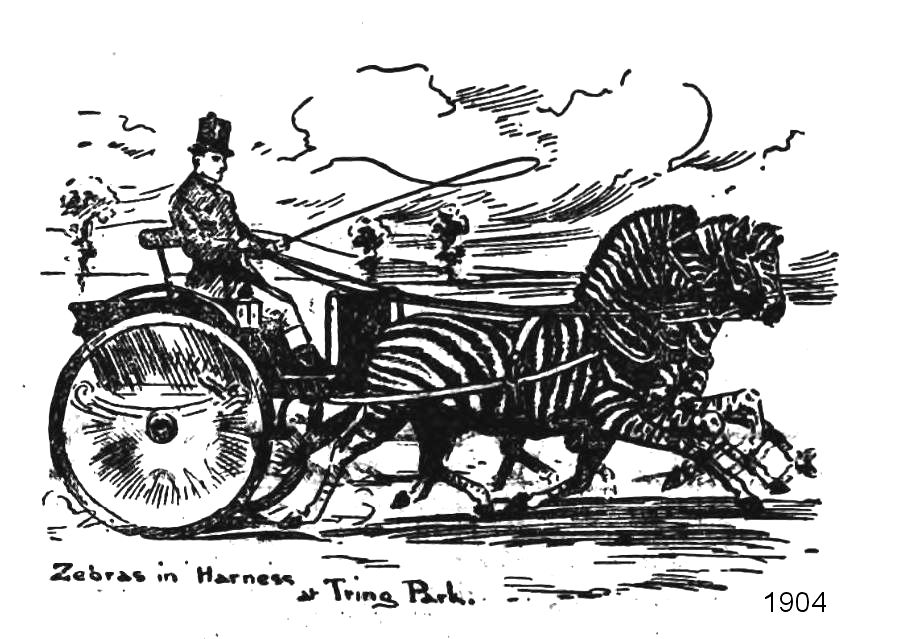
LORD ROTHSCHILD
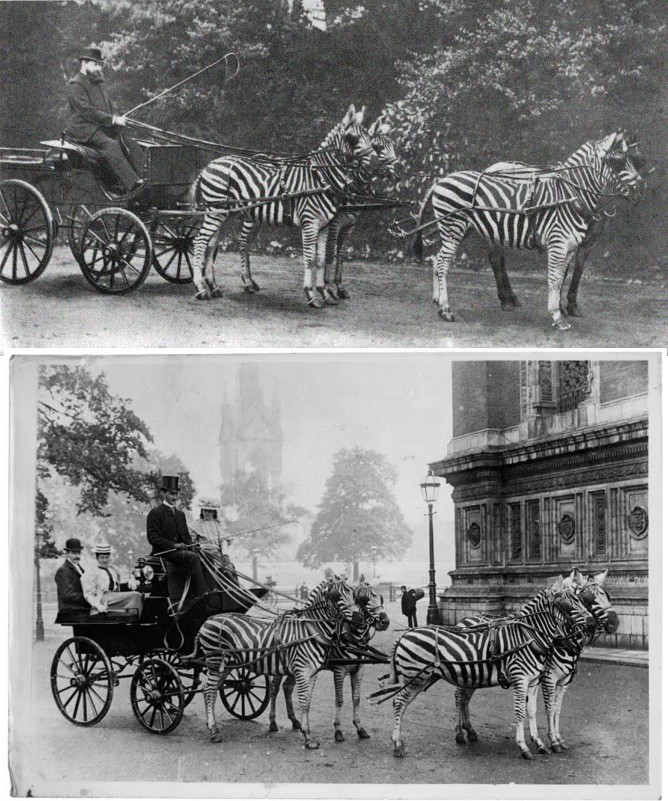
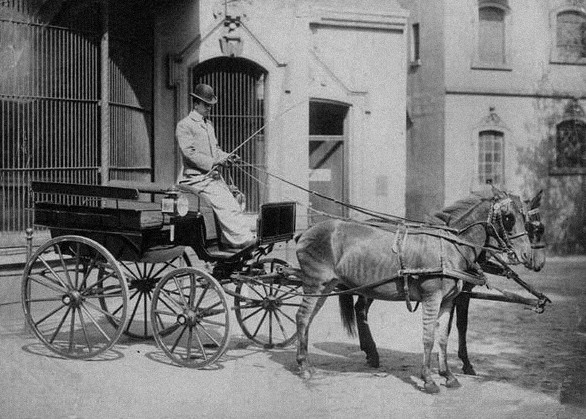
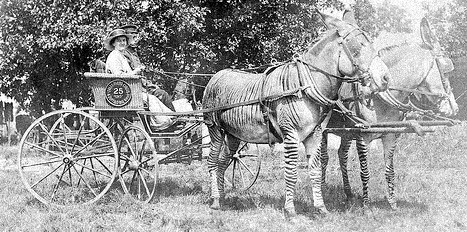
In the late 19th century, it was fashionable to train zebras to pull carriages. In the top photo, the three zebras are kept steady by a pony harnessed at the front. In the lower picture there are four zebras and the story of a wager. In the year 1898, in one of the many mews just off Cromwell Road, Kensington, lived Mr Hardy, who was a noted horserider and trainer, being one of the three men who had succeeded in riding the "French Rocking Horse". This was a device used by the French Cavalry. It had every possible movement of a wild horse not in the best of tempers. Leopold de Rothschild, who knew of Hardy's ability, was talking to friends of this achievement and said that he was willing to make a stake on his ability to train any animal resembling a horse. One of his friends took up this boast, and a stake was made that Hardy could not train a team of zebras to pull a coach through London. When after much trouble, the necessary beasts were obtained, Rothschild went to Hardy and told him the conditions of the wager. Hardy agreed to train them. The zebras were taken to Kensington and after 2 years hard work, Hardy informed Rothschild that his task was completed and that the team were ready for the road. At six o'clock one morning a strange sight was seen in London when, for the first time, a team of zebras were seen pulling a coach through London.
In the late 19th century, it was fashionable to use zebras where one would normally use a horse or pony. Above is Lord Walter Rothschild who had a penchant for harnessing zebras.
THE BARON OF PARANA
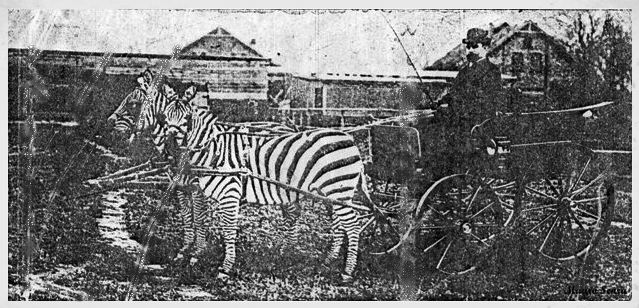
The Baron of Paran was born in the Rio de Janeiro province in 1847 and inherited the family s estate Fazenda do Lordello located in Porto Novo. He also successfully developed the zebroid and here is a photo of him with a "victoria" buggy drawn by zebras Canon and Carabine. These zebra stallions had been bought in 1892 from the Paris Jardin d'Acclimatation for the Baron's zebroid-breeding programme. Later on, some of the Baron's zebroids were exported to Paris and could be seen pulling carriages.
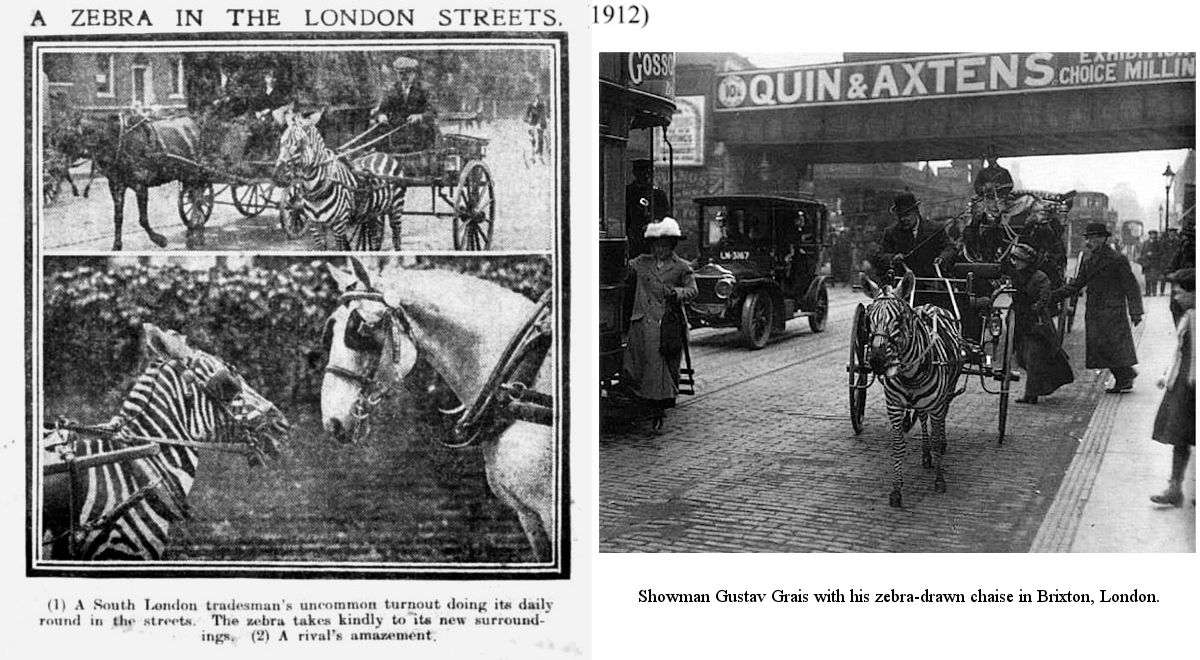
MR GUSTAV GRAIS
According to The Standard (London), 13th August 1912, "A zebra harnessed to a pony-chaise, seen driven along the side of Clapham Common. The zebra belonged to the music-hall artist, Mr Gustav-Grais. Having survived a fire it was stabled at Brixton and is seen here on its daily exercise route in South London" Gustav Grais was born Gustav Eichler in Marienburg West Prussia in 1860. When he settled in England, he changed his name to Grais. A showman and circus daredevil, he set up a circus of baboons and zebras.
GEORGE GREY
In the mid-19th century, Governor George Grey imported zebras to New Zealand from his previous posting in South Africa, and used them to pull his carriage on his privately owned Kawau Island. In 1862 Grey bought Kawau Island in the Hauraki Gulf. He imported many exotic plants and animals in an ambitious plan to transform it into an earthly paradise. His menagerie included kangaroos, wallabies, antelopes, monkeys, zebras, gnu, emus, peafowl and kookaburras. Sadly we have no illustrations of his zebra-drawn carrige.
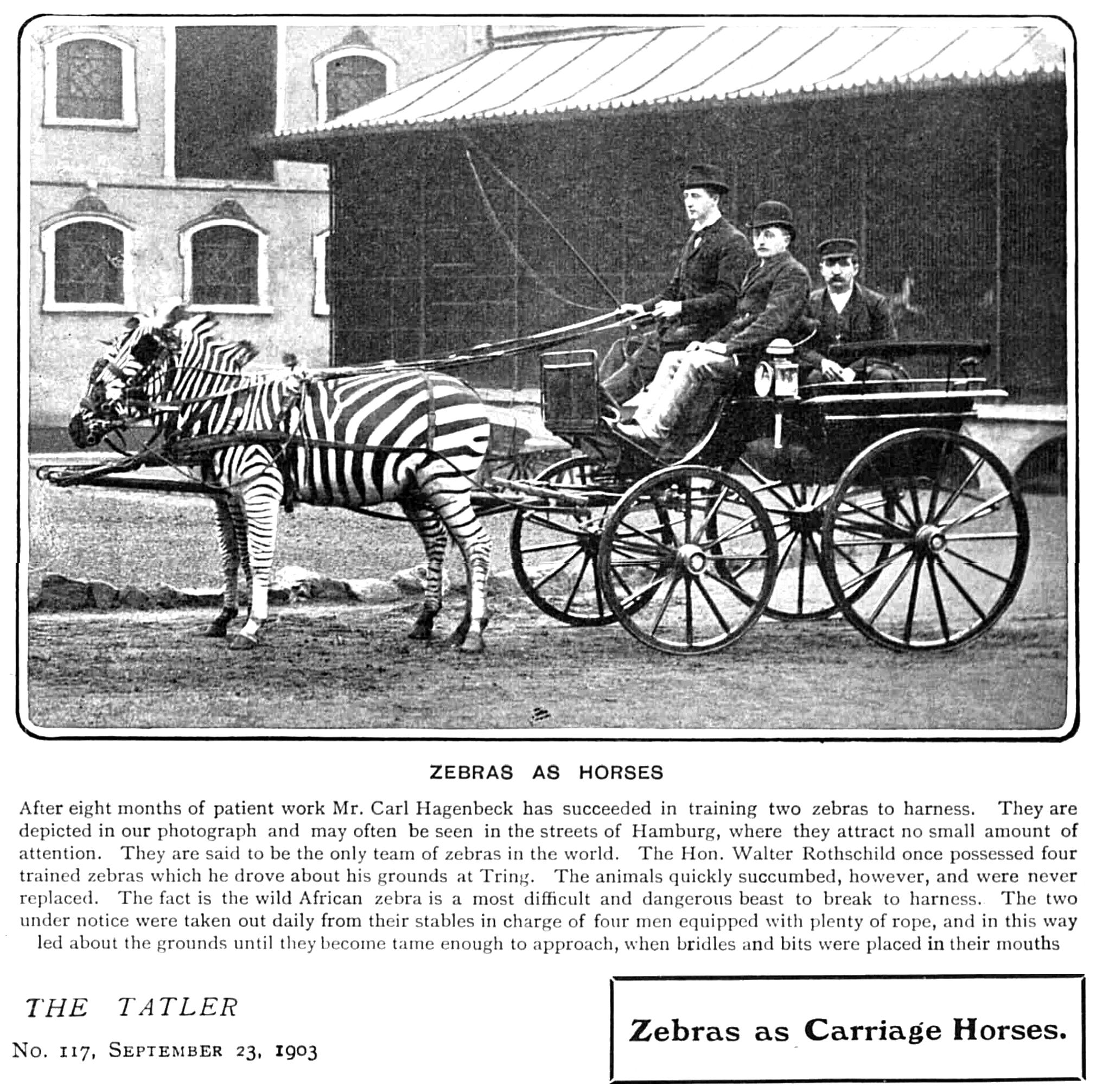
KARL HAGENBECK
ZEBRA-HYBRID CARTS
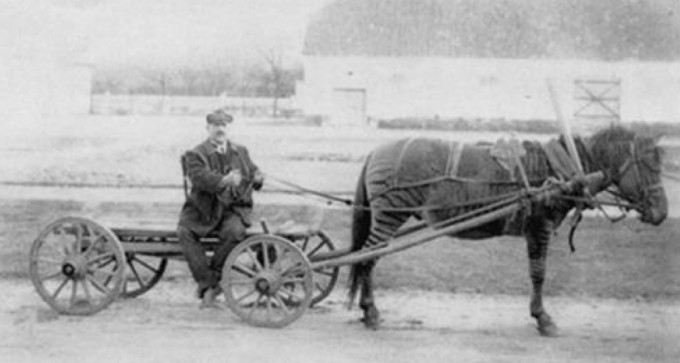
A number of colonial powers experimented with zebra-horse hybrids in Africa. It was hoped that the hybrids would be better suited to the African climate and better suited to saddle or harness. Others, such as zebra-ass hybrids, were bred by circuses or purely to give a stylish carriage mule.
Two zebra-pony hybrids in harness
Two zebra-ass hybrids in harness (1915)
Russian zebra-pony hybrid drawing cart.
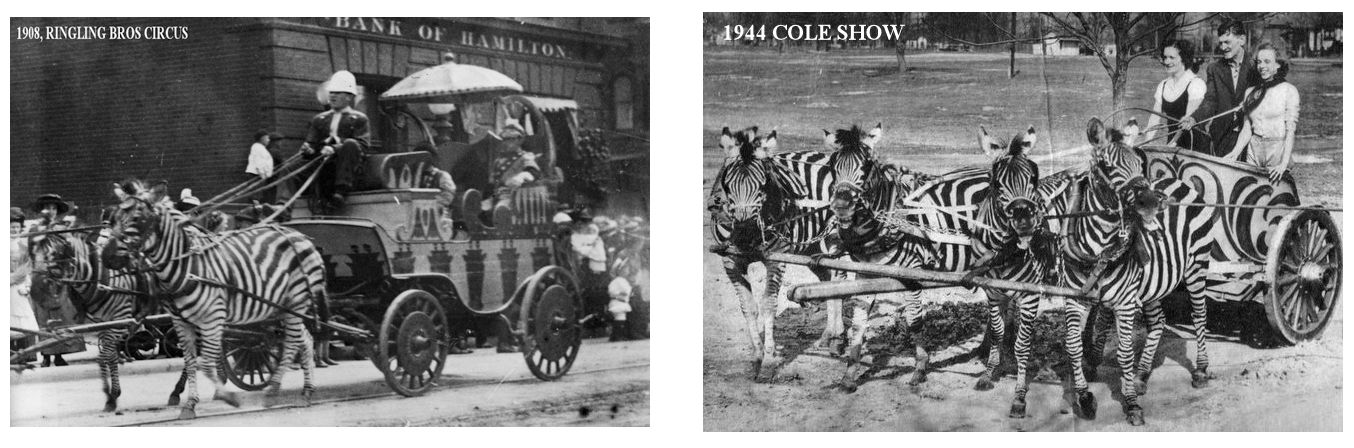
CIRCUSES
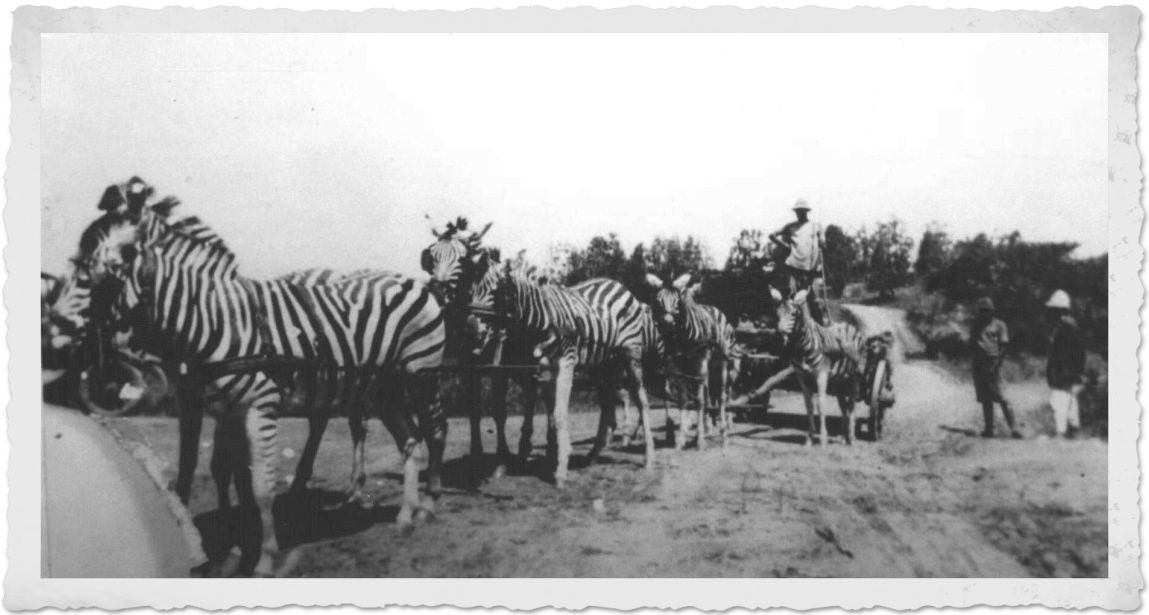
ZEBRA CARTS IN AFRICA
Imported horses fared badly in Africa due to the climate and endemic diseases. The obvious (to colonists) solution was to domesticate native African equids. Horses had co-evolved with Europeans for thousands of years and had become domesticated, but zebras had never undergone that process and regarded humans as predators. They were also anatomically different from European horses, having stiff necks and very low withers. Nevertheless, many were successfully broken to saddle or harness. Once broken, they were tractable in harness, but their wild instincts made them easily spooked and they couild be ferocious kickers and biters. Many zebra teams included pairs of mules which had steadier temperaments. Hybrids were also bred, particularly in German East Africa where they were used for hauling gun carriages. In the long run, the zebra has not been domesticated in its native land, but the continuing interest in zebras for saddle and draught means they are being selectively bred in the USA. While individual zebras may become quite tame, rigorous section may eventually give rise to a domestic variety.
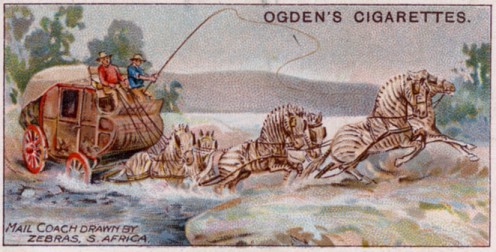
A 1910 "Ogden's Branch of the Imperial Tobacco Co." cigarette card depicts a South African scene of a wooden mail coach drawn by six zebras crossing a river. The information on the back of the card says "The Mashonaland Zebra Mail Team. Owing to the horses and mules on the Mashonaland mail route in South Africa not being able to bear the unhealthiness of the climate, and dying in alarming numbers, zebras kicked and bit furiously, but soon became tractable in harness and pulled well together. A team is shewn as crossing a river near Fort Tuli."
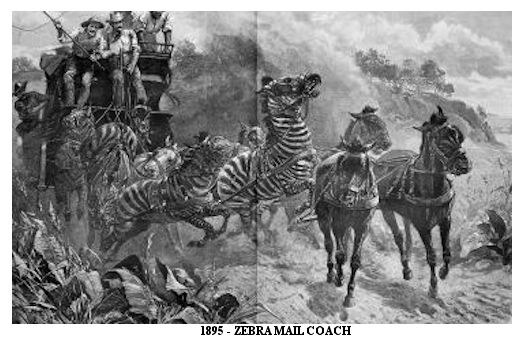
This depiction shows a zebra mail coach pulled by a pair of mules and 4 zebras.
A team of 6 zebras.
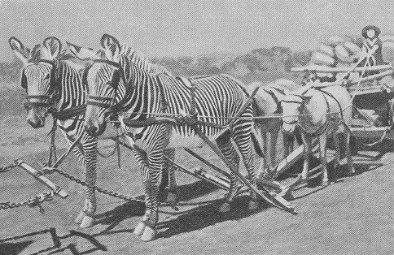
Grevy's zebra of East Africa is immune to tsetse fly and colonists once viewed it as a substitute for the mule. Though easily broken to harness, the zebra has less endurance than the mule and is more liable to panic if startled. This 1920s photo shows zebra pairs harnessed between mules in Kenya.
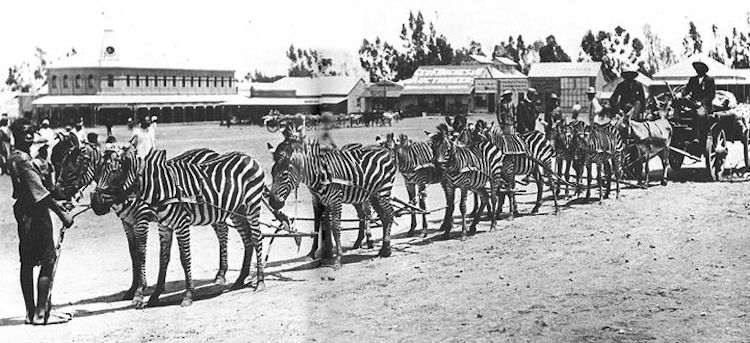
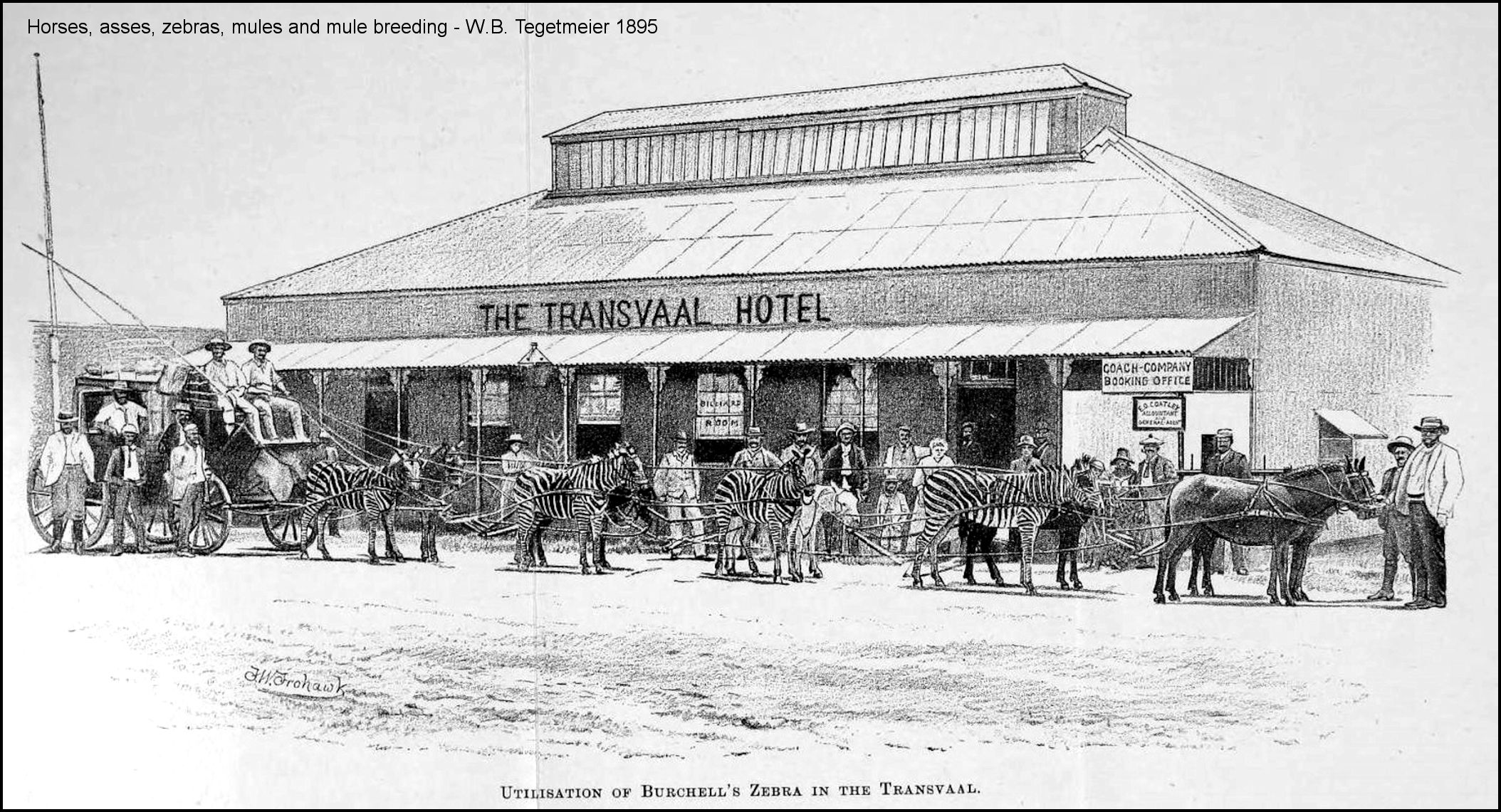
THE UTILISATION OF THE ZEBRA. (The Field, 11th March 1893). SOME time back I recollect reading an article in your columns upon the quagga, which, the writer stated in no doubtful tones, lately become extinct. Whether this conclusion was arrived at too hastily and upon insufficient data as some people think is uncertain, but to me the mere suspicion that any of our ferae naturae are being exterminated and lost to us forever is always tinged with a certain amount of melancholy regret. I, for one, have never looked with indifference upon the wholesale slaughter of wild animals which has hitherto marked the progress of civilised man, nor do I think it such an inevitable consequence as to excuse us from making serious efforts to avert it.
Our present domesticated animals can be counted on the fingers of one hand almost, and surely some of those who are blessed with the time and money to try experiments might reclaim and preserve some few of the many wild animals that are still left to us before it is too late. If the quagga be extinct, however, our readers will be pleased to bear that an effort is being made in the Transvaal to domesticate and use its near congener, the zebra, for purposes of draught. On hearing that Messrs Zeedesberg , the coach contractors, who run passengers and mails from Pretoria in the Transvaal to Fort Tuli in Mashonaland, had been successful in their efforts in training the zebra, I determined to make full inquires when next in Pretoria.
Pretoria, the capital of the Transvaal, is a very pretty little town situated about thirty-five miles to the north of Johannesburg, and, as the sittings of the High Court are held there, it was not long before I found myself, in company with others, journeying towards it in a coach and ten horses, the usual method of travelling out here. Mr James Zeedesberg, whom I met by appointment the next afternoon, told me that his firm about two months ago bought eight half-grown wild zebras from a hunter named Groblaar. Groblaar caught them in a wild state between four and five months ago by riding after and lassoing them. During the last month they have been in training for harness, with the result that four of them are perfectly quiet and well trained, and the remaining four partially trained. The place where they are located is at the station in Petersberg, in the district of Zoutpansberg, Transvaal. It appears they are a little timid at first when the harness is being put on; but afterwards they are all right, and Mr Zeedesberg believes in a month or two's time they will be as steady as horses. They pull well and are very willing, and never jib, a vice which is very prevalent in the horses of this country. In fact, one of them will do his best to pull the whole coach himself.
As you will see by the photograph which I send you, they are now being used in one of Messrs Zeedesberg's coaches; and Mr James Zeedesberg says they are so satisfied with the experiment, so far as it has gone, that he is going to extend it, with the object a ultimately substituting them for mules, as the zebra is free from that scourge of South Africa commonly called "horse sickness," which any of your readers who have been out here will know costs an enormous amount to coach proprietors in horse flesh during the summer season. In some parts of the low country it is quite sufficient for a horse to be left out all night in the veldt (grass) to ensure its death from this dreaded disease.
The zebras, when inspanned (harnessed to the coach), stand quite still and wait for the word to go, they pull up when required, and are perfectly amenable to the bridle, and are softer mouthed than the mule. They never kick, and the only thing in the shape of vice which they manifest is that, when first handled, they have an inclination to bite, but as soon as they get to understand that there is no intention to hurt them they give this up. Four of these zebras are now inspanned and driven in a team together, and are as reliable and good as the best mules ; the other four, being older, require little more time to get them perfectly trained. The illustration shows four zebras inspanned with mules in one of the coaches at Petersberg.
The intention is to buy more and run them regularly in the upcountry coaches from and to Mashonaland, and this will not be done as a useless experiment, but with a practical object, and if it succeeds, as Mr Zeedesberg believes, it will the means of saving them hundreds of pounds, which they now lose annually through horse sickness. Later on attempts will be made to cross them with the horse, with the object of getting a larger and handsomer mule than the ordinary cross with the donkey, and probably superior in every way.
It will be interesting to watch the progress of these experiments, which may bring about a new and important industry, for if the cross between the zebra and the horse can be brought about without difficulty, it will not be long before these animals will be preferred to ordinary mules, numbers of which are shipped out here from Monte Video, while those who are interested in natural history will only be pleased at the chance of adding the zebra to the list of our few domesticated animals.
When I was a boy the temper and nature of the zebra was summed up in the word "untameable, but, like the old fable of the ostrich hatching her eggs in the sun, the time has come when we must regret the readiness with which everything found is old authorities on natural history is taken for gospel. Should your readers be sufficiently interested to wish to know how this matter is proceeding, perhaps at a later date I may trouble you again for a little space In your journal. HAROLD STEPHENS, Johannesburg, Transvaal, December, 1892
(This experiment is one of such an interesting character that we have pleasure in reproducing the photograph which has been forwarded by Mr Stephens ED.)
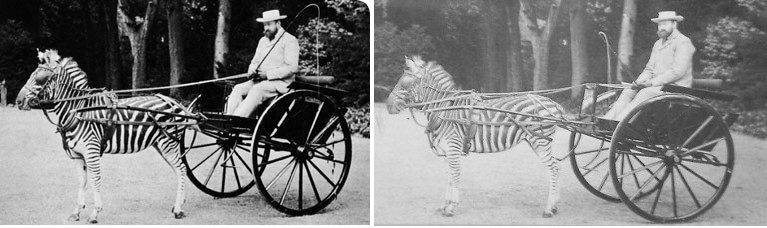
WILD HORSES, ASSES, AND ZEBRAS. HYBRID EQUIDAE. By W. B. TEGETMEIER. (The Field, 17th June 1893) It is apparently only at the present time that the Cape colonists have arrived at the conclusion that Burchell s zebra is a desirable beast of draught and of burden. This fact, however, may be regarded as being very distinctly demonstrated. A number were introduced into Europe a short time since, and soon of these are now being driven, and, to show their docility, I have very great pleasure in reproducing the photograph to which I alluded last week, showing four Burchells driven in a four-in-hand in a two-wheeled Cape cart. This demonstrates the fact that they can not only be employed in teams with other animals, as shown in the drawing in the Field of March 11, but that they can be used alone. Burchell's zebras are now on sale in the Cape at prices averaging about 10, and I know of an instance of an eminent zoologist entering into negotiations for the introduction of a number of Burchell's zebras, not for the purpose of exhibiting in zoological collections, but to demonstrate their utility as beasts of draught, to ascertain their prolificacy in this country with their own and other species, and their capabilities of adaptation to the conditions of life that here obtain.
VARIOUS ZEBRA CARTS AND RIDERS AROUND THE WORLD
The passion for having exotic animals in harness spread around major European and US cities. Some of the well-to-do in other colonised countries, such as Brazil, India and New Zealand, liked the novelty of these striped horses. Rothschild, Parana and Grey have already been mentioned. Here is a gallery of other zebra-carts.
A zebra cart in Calcutta in the 1930s.
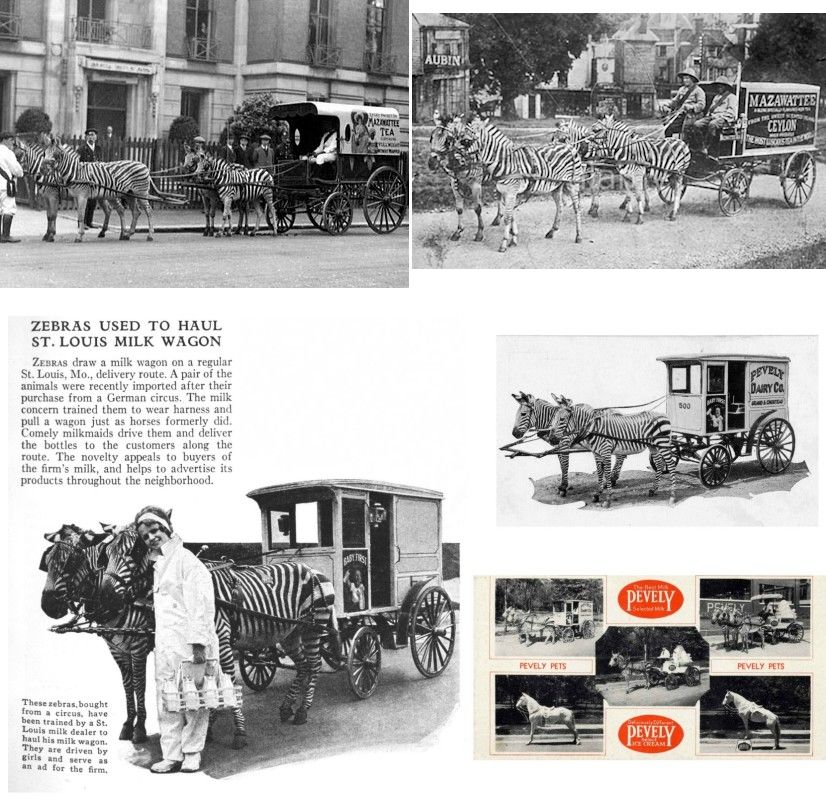
ZEBRA-DRAWN DELIVERY CARTS
The top images show the Mazawattee Ceylon Tea Delivery Cart. The sight of a tea delivery cart pulled by 4 zebras would certainly have stuck in the mind and served as good advertising for the company. Images below those show the Pevely Dairy Company in St Louis also had a zebra-drawn delivery cart. The zebras were eyecatching and served as advertising.
A famous pair of harnessed zebras in the USA were Hans and Tanta who belonged to the Pevely Dairy Comapny. They were captured in Southwest Africa, near the city of Windhuk, and trained at the Hagenback Circus at Altona-Stellingen in Germany. In July 1929, at the age of 3 years old, they went to the Pevely Dairy Company in St Louis. Due to their early capture and training, Hans and Tanta were exceedingly gentle and well trained. In the 1930s, they became a familiar sight pulling the Peverly Dairy Co milk delivery wagon through the streets of St Louis.
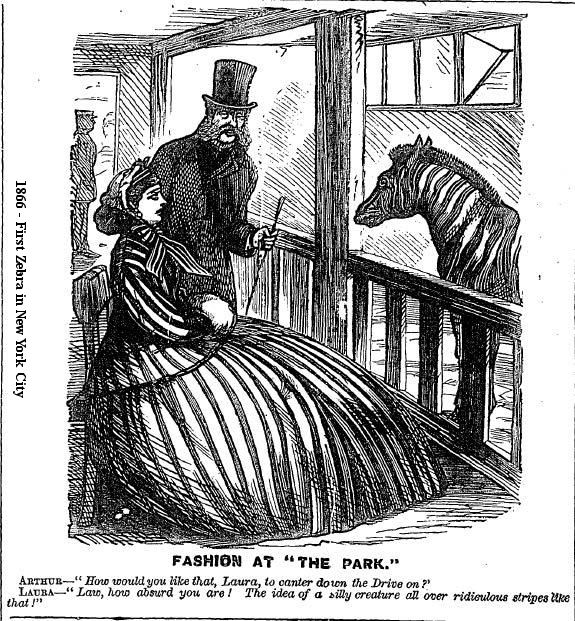
From 1866, a pithy comment about riding striped horses. This was the first Zebra in New York City.