|
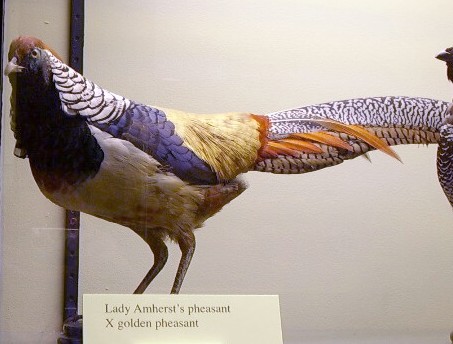
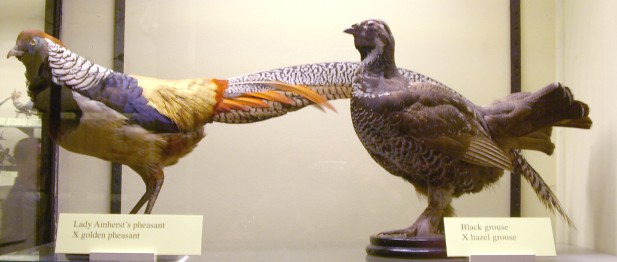
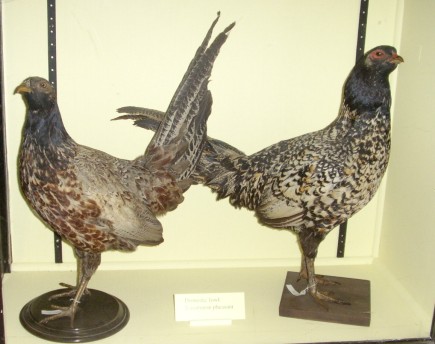
Lady Amherst's Pheasant x Golden Pheasant |
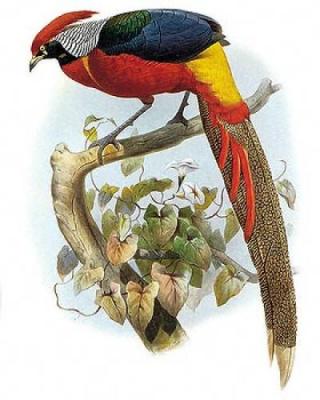
Hybrid Ornamental Pheasant (Joseph Wolfe) |
|
HYBRID FOWL (GALLERY) |
My main interest is in mammal hybrids, so these hybrid bird images are provided purely for readers' interest. Photos taken May 2006 at Rothschild Museum, Tring with additional information about hybrids between chicken, pheasant and grouse species. While mammalian hybrids tend to produce sterile males and may produce fertile females, the situation is reversed in birds with females often lacking functioning ovaries while males may be fertile.
|
Lady Amherst's Pheasant x Golden Pheasant |
Hybrid Ornamental Pheasant (Joseph Wolfe) |
Poll (1910) and Serebrovsky (1929) described the following fowl hybrids in the Berlin Zoological Museum: Turkey x Guineafowl; Peafowl x Guineafowl, Domestic Fowl x Guineafowl; Domestic Fowl x Pheasant; crosses between different species of Pheasant. Taxidermy specimens of similar crosses are at the Rothschild Zoological Museum in Tring, England.
GROUSE AND PHEASANT HYBRIDS
Hybrids have been obtained between the "ornamental" species of pheasants e.g. Lady Amherst's, Silver and Reeves Pheasants.
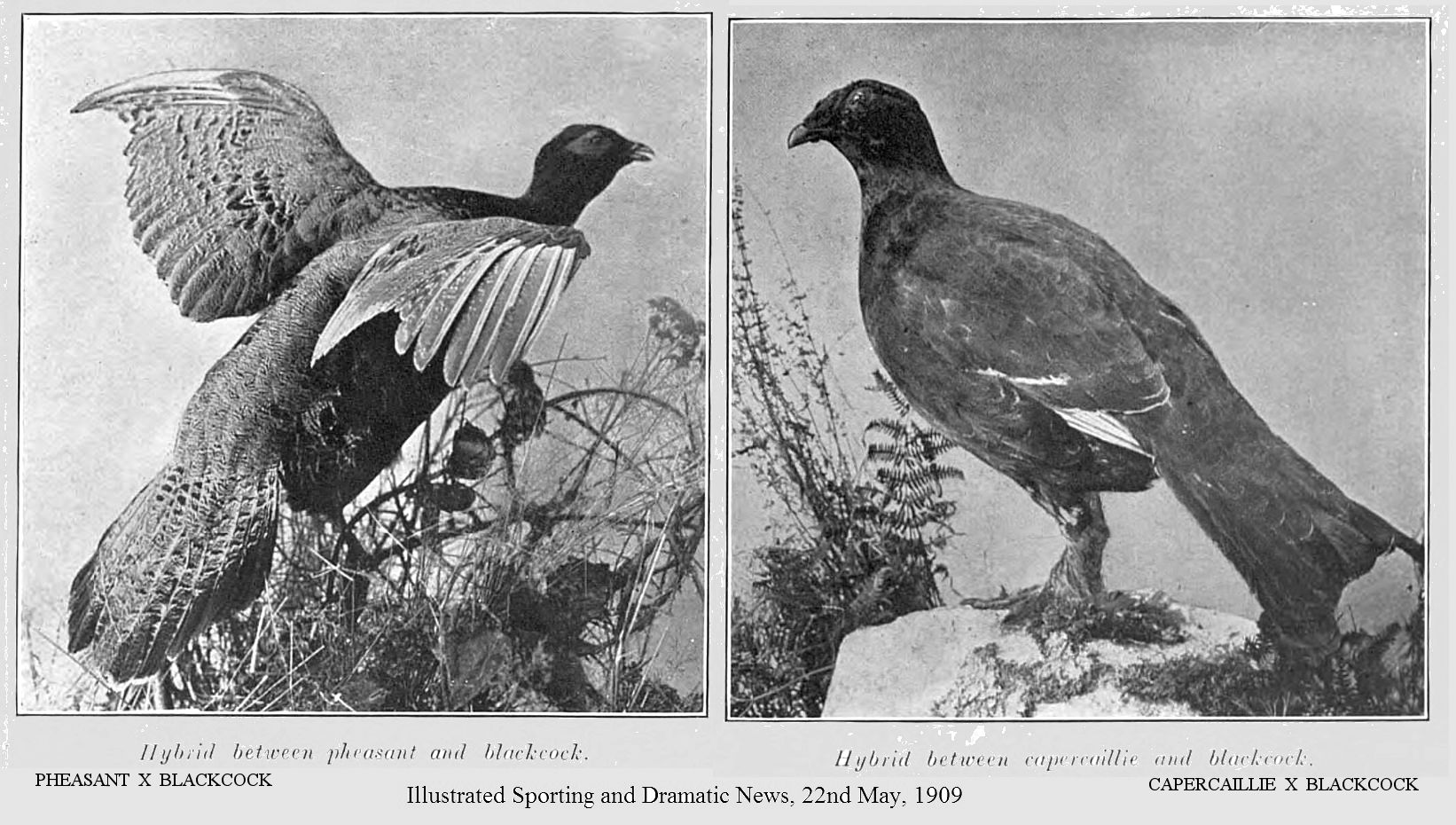
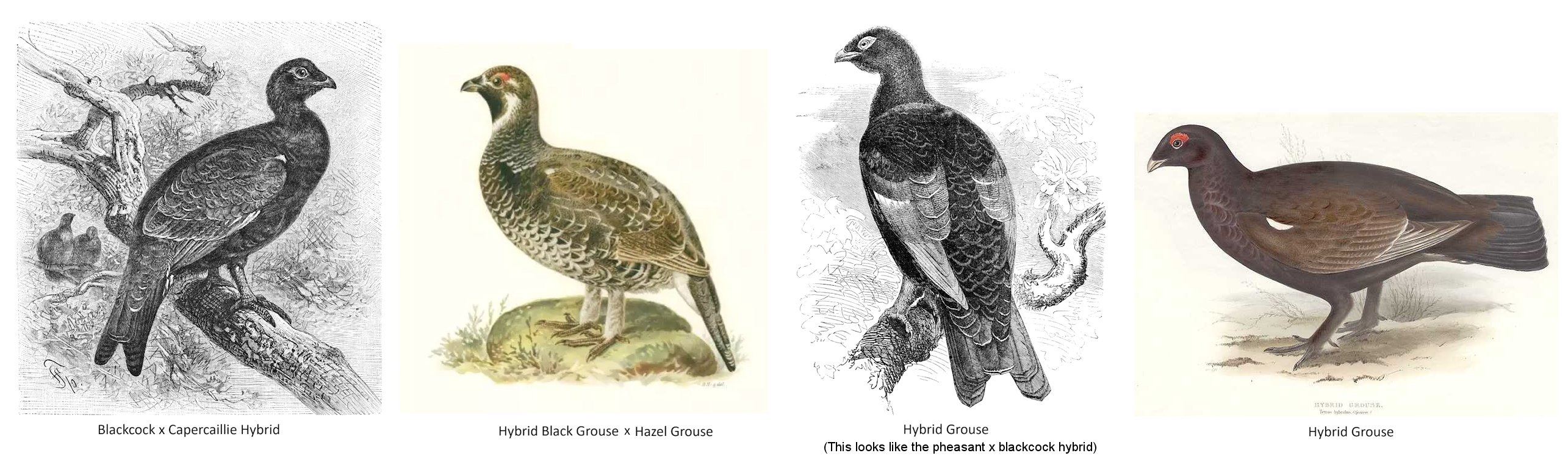
Numerous natural pheasant and grouse hybrids have been reported. These include:
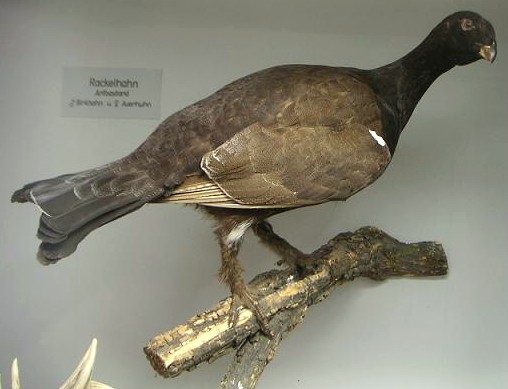
- Capercaillie or Wood Grouse/Mountain Cock (Tetrao urogallus) and Black Grouse (Lyrorus tetrix) in the UK (Handbk Brit. Birds, 5: 210)
- Dusky or Blue Grouse (Dendragapus obscurus) and Ring-necked Pheasant (Phasianus colchicus) near Portland, Oregon, USA (Anthony, 1899. Auk, 16: 180)
- Sharp-tailed Grouse (Pedioecetes phasianellus) and Prairie Chicken (Tympanuchus cupido) (1918. Wilson Bulletin, 30: 1-2, plate)
- Willow Ptarmigan (Lagopus Lagopus) and Spruce Grouse (Canachites canadensis) (Taverner, 1932. Annual Report, 1930, National Museum of Canada, p. 89 with plate)
- Dusky or Blue Grouse (Dendragapus obscurus) and Sharp-tailed grouse (Pedioecetes phasianellus) at Osoyoos, British Columbia, 1906 (Dr. John W. Aldrich)
- Ring-necked Pheasant (Phasianus colchicus) and Prairie Chicken (Tympanuchus cupido) at Ellendale, North Dakota, 1933
DOMESTIC FOWL HYBRIDS
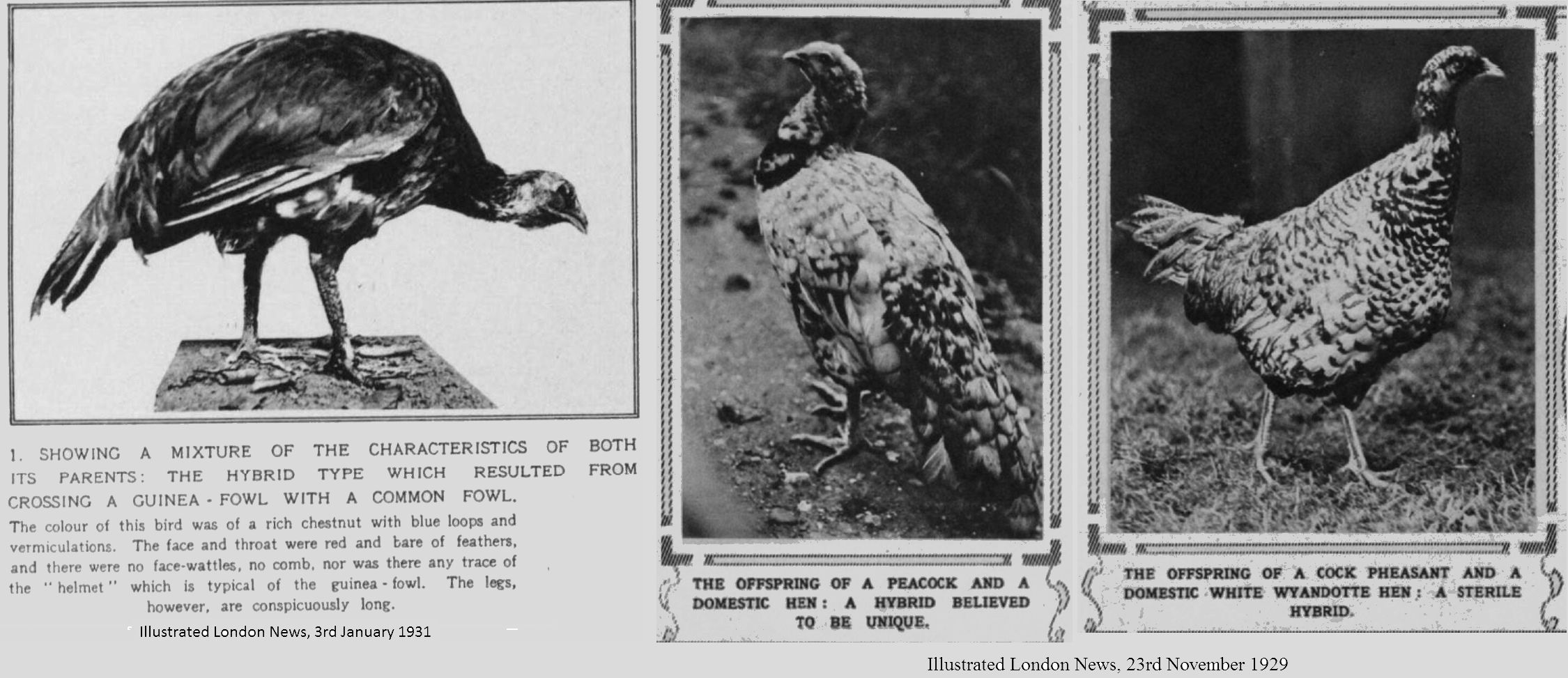
The Illustrated London News, 19th December 1953, gives this account of poultry hybrids: An outstanding example of hybridisation is given by Krick, writing in the Bull. Acad. Malgache for 1942-43. He mentions a hybrid from a domestic cock and a guinea-fowl. It is of especial interest because of the incongruity of the parents and also for the detailed account of the offspring. This hybrid was black when first hatched, but became progressively white. It had the head of a cock, but was without comb or wattles. The lateral caruncles, well developed in the guinea-fowl, were only faintly outlined. There was a well-marked bib under the beak and the upper neck, and the nostrils were surrounded by a reddish-brown skin. The body was long, as in the guinea-fowl, but there was long tail that continued the line of the body backwards. The feet were black, with light patches, and they carried no spurs. Occasionally reddish-brown feathers appeared in the plumage, and the call was more nearly that of a guinea-fowl. In other words, the characters of the parents, the one belonging to the genus Gallus and the other to the genus Numidea, were fairly evenly divided in the offspring. The last interesting point mentioned by Krick was that this hybrid lived amicably with guinea-fowl but showed marked hostility to domestic poultry.
Domestic fowl (Gallus gallus domesticus) have been crossed with Guineafowl (Ghigi, 1936) and also with Ring-necked Pheasants (Phasianus colchicus). Domestic Fowl x Pheasant hybrids have occurred naturally (Wheeler, 1910; Cutler, 1918, Serebrowsky, 1929; Yamashina, 1942; Shaklee and Knox, 1954; Asmundson & Lorenz, 1957). Domestic chickens and quail (Coturnix coturnix japonica) have been hybridised using artificial insemination (Mitsumoto and Nishida, 1958; Wilcox and Clark, 1961).
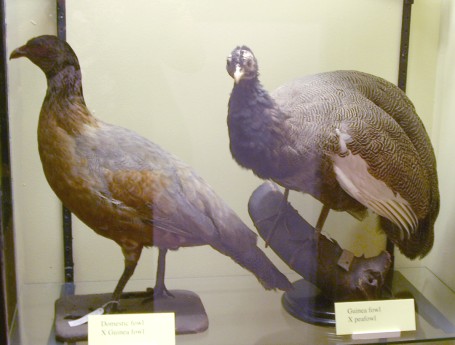
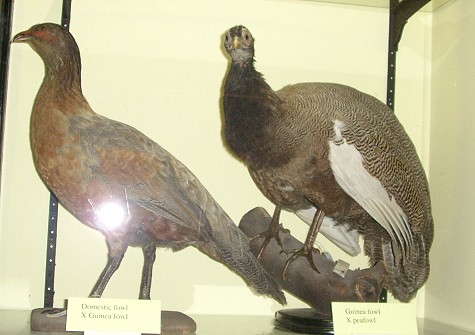
Left: Domestic fowl x Guineafowl. Right: Guineafowl x Peafowl |
|
A.P.Grey's "Bird hybrids" lists numerous crosses between Domestic fowl and other types of fowl. They can be crossed, and produce fertile offspring, with silver pheasants, red junglefowl and green jungle fowl. They have also produced hybrids with peafowl, chachalacas, capricale, grouse, quail, currassows, pheasants and guans.
|
Hybrids of domestic fowl with pheasants |
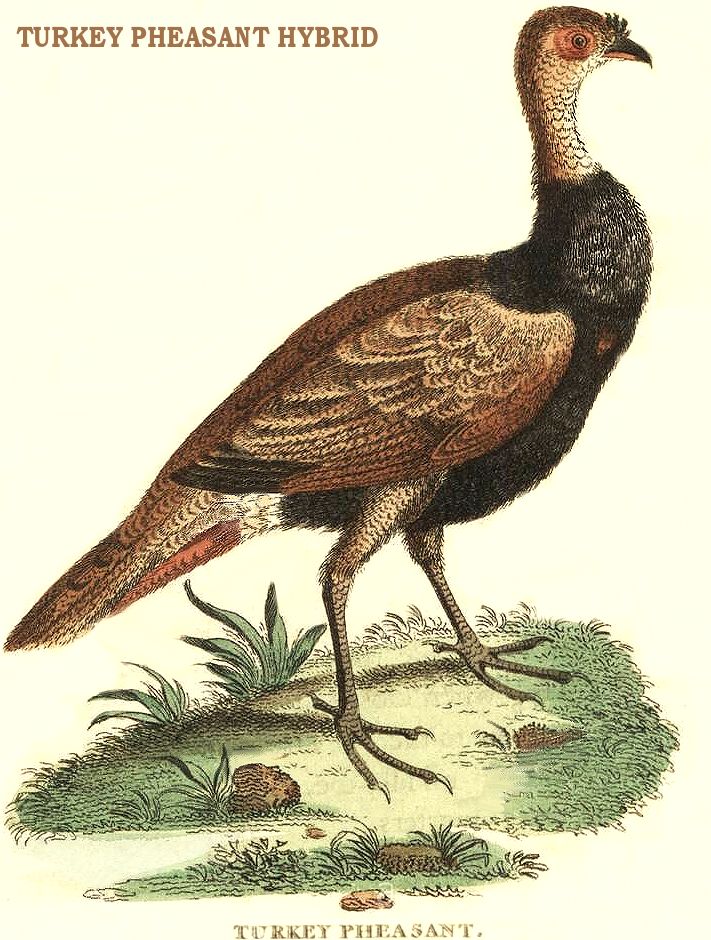
TURKEY-CHICKEN HYBRIDS
There have been attempted crosses between domestic turkeys (Meleagris gallapavo) and chickens (Warren and Scott, 1935). According to Gray (1958) in 12 studies no hybrids hatched. Other reports found only a few fertile eggs were produced and very few resulted in advance embryos (Ogorodii, 1935; Quinn et al. 1937; Asmundson & Lorenz, 1957). According to Olsen (1960), 23 hybrids were obtained from 302 embryos which resulted from 2132 eggs. Dark Cornish cockerels and Rhode Island Red cockerels successfully fertilised turkey eggs. Harada & Buss (1981) reported hybridisation experiments between Beltsville Small White Turkeys and two strains of chickens. When male chickens inseminated female turkeys, both male and female embryos form, but the males are much less viable and usually die in the early stages of development. When male turkeys inseminated female chickens, no hybrids resulted although the unfertilised chicken eggs began to divide. According to Olson (1960) turkey-chicken crosses produced all males.
MW Olsen, US Dept of Agriculture, successfully bred turkey x chicken hybrids from Beltsville Small White turkey hens artificially inseminated with semen from Dark Cornish male chickens. Morphological evidence of the hybrid status of the birds (Olsen, M. W., J. Heredity, 51, 69 (1960)) included the fact that the adult hybrids' dark plumage resembled that of the chicken, being dominant over the recessive white colour of the turkeys. Serological studies on their red cells also provided evidence of the birds being hybrids.
It appears that turkey sperm cannot fertilise chicken eggs, but can trigger cell division in unfertilised eggs. Reports of natural hybrids between female chickens (including bantams) and male domestic or wild turkeys are anecdotal and not supported by DNA studies. Where unusual chicks have occurred, it is most likely to be due to recessive genes in the parents (or possibly to hybridising with guinea fowl or wild pheasants).
|
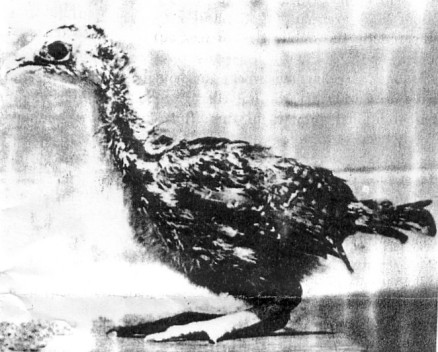
4 week old Turkey x Chicken hybrid | |
|
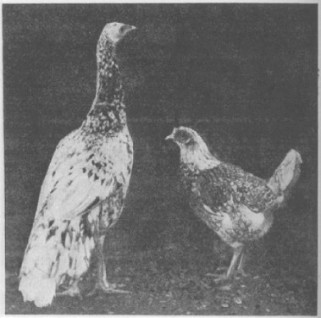
On the left is a hybrid of peacock x chicken. On the right is its chicken mother (1929). |
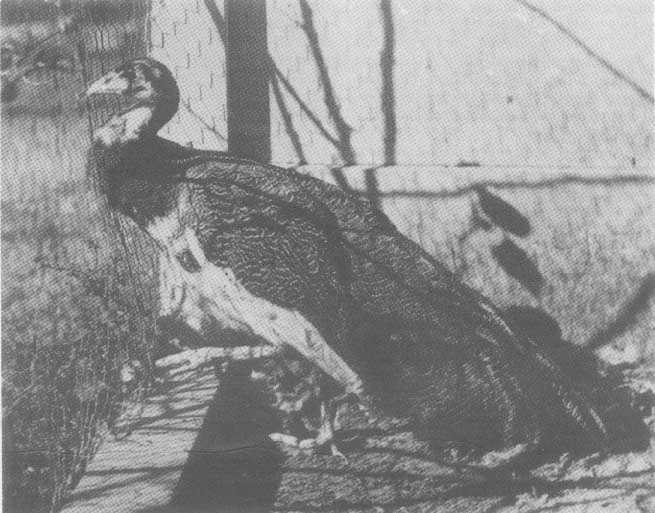
3 year old female Peafowl x Guineafowl Hybrid. |
SCIENCE PRODUCES A 'CHURK' The Turkey- Chicken Hybrid (Coventry Evening Telegraph, 10th November 1960)
A CHICKEN and a turkey have been crossed to make the "churk." There are only three of them. The father is a dark Cornish chicken; the mother, a white Beltsville turkey. The history-making cross of two families of birds was achieved by Dr. Marlow Olsen of the poultry research branch of the US Department of Agriculture at Beltsville, near Washington. He says that the chicken-turkey cross has the long neck and the white skin of its turkey mother and the general size and dark colouring of the feathers of its chicken father. Its long neck Is feathered but without wattles. Its legs are like those of a young turkey. It would not be practical to produce the hybrids commercially since they were very difficult to bring through the hatching stage and keep alive. Some 2.900 eggs were processed to produce the live birds. All the "churks" have some defects such as crooked legs or beaks. Another abnormality, Dr. Olsen said. Is that the hybrid birds' feathers grow In a twist, probably because of unequal growth in the cells. The hybrids are weak individuals, he added, and have only about half the intelligence of the parent stock. They are kept in a separate pen by themselves because they would be pecked to death if mixed with other poultry, either chicken or turkey. The "chuck" is a silent bird. It has neither the "gobble, gobble" the turkey parent nor the crowing of the rooster father. It lets out a chirp something like a chicken, but only when it is disturbed. The hybrids are all male birds, and unable to reproduce themselves. The reason for this is the different number of chromosomes in chickens (six pairs) and turkeys (nine pairs). The hybrids get a single set of chromosomes from each parent (six from the chicken, nine from the turkey). Thus, they end up with 15 chromosomes that cannot pair up and produce offsprings. This means that a turkey and chicken would have to be cross-bred every time a "churk" is to be produced. The "churk" was produced by accident. Dr. Olsen said, after geneticists had tried unsuccessfully. Scientists also experimented with hybrids of ring-necked pheasants, turkeys and domestic fowl. None of which ever hatched. Dr. Olsen's chicken-turkeys showed up in a batch of turkey eggs he had fertilised artificially from dark Cornish chicken stock in trying to produce parthenogenic, or fatherless turkeys.
MISCELLANEOUS
The Peafowl (Pavo cristatus) from Asia and the Common Guineafowl (Numida meleagris) from Africa have been crossed (Poll, 1910; Serebrovsky, 1929; Ghigi, 1936).

A supposed Turkey x Pheasant hybrid was reported by Edwards (1761).
There are 2 peafowl species: the Indian or Blue Peafowl (Pavo cristatus) and the Green Peafowl (Pavo muticus) which has 3 or more subspecies though the subspecies are highly mongrelized in captivity. The familiar White Peafowl and the Pied White Peafowl are mutations of the Indian Blue Peafowl. The two species hybridise in captivity and the resultant hybrids are called the Spalding Peafowl. They are intermediate in type, colour and temperament. The colouration depends on which variety of Blue Peafowl is used in the hybrid and on the degree of back-crossing to a parental species.
HYBRID WATERFOWL
DUCKS
Duck hybrids include various hybrids between Tufted Duck, Greater Scaup, Pochard, Ferruginous Duck and Ring-necked Duck. Other documented hybrids included Baikal Teal x Northern Pintail, Ruddy Duck x White-headed Duck, Ruddy Shelduck x Shelduck, White-faced whistling duck x Plumed Whistling Duck, Hooded merganser x Smew, Eurasian Wigeon x American wigeon. A far more extensive list of hybrids between duck species is contained in the Handbook of Avian Hybrids of the World by Eugene M McCarthy (2006).
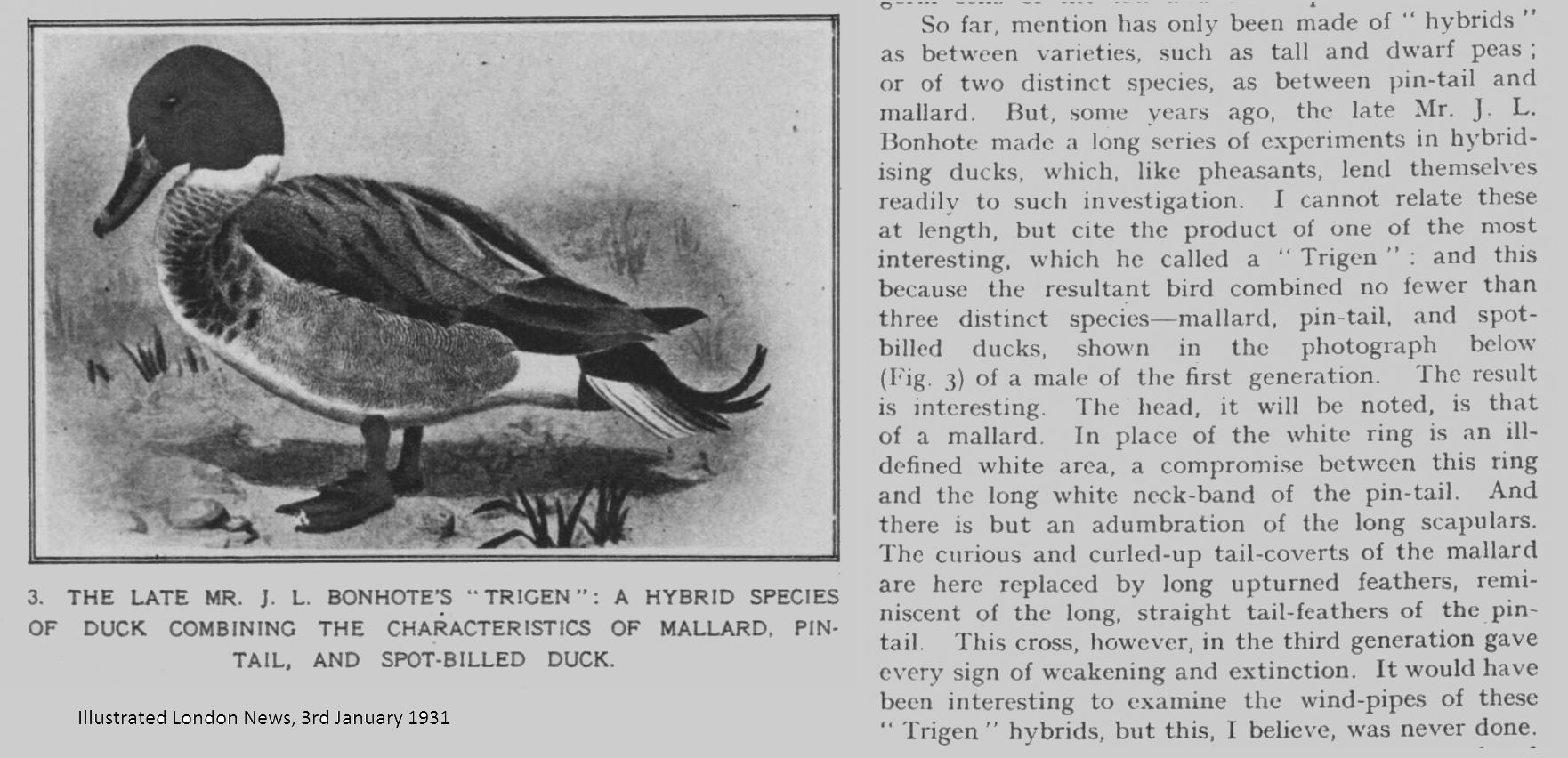
The Mallard is notoriously well able to hybridise, particularly with other ducks of the Anas genus. Mallards have hybridised with the the following species: New Zealand Black Duck, Muscovy (Musk) Duck, Northern Pintail, American Black Duck, Pacific Black Duck, Florida Duck, Meller's Duck, Yellow-billed Duck and the New Zealand Gray Duck among others. The Mexican Duck has become so mongrelised with Mallards as to be questionable as a distinct species. The Mariana Mallard was derived from Mallard Pacific Black Duck hybrids, but became extinct in the 1980s. Not all Mallard hybrids are successful, being less well adapted to an ecological niche than the pure non-Mallard parent. Mallard x Laysan Duck hybrids tend to be unsuccessful compared to the pure Laysan Duck. Mallard x Hawaiian Duck hybrid offspring are less well-adapted to native habitat. The Mallard also breeds freely with domestic ducks to produce fertile offspring, many of which are descended from Mallard stock (some biologists therefore prefer to call this intergrades), for example with Aylesbury (heavy-set white ducks) and White Campbells. Mixed populations of feral domestics, wild Mallards and intermediate types are found on many lakes and ponds.
The photos show a number of hybrids between Mallards and domestic ducks; these are intra-specific hybrids (hybrids between subspecies) since the domestic ducks are descended from wild Mallards. This is equivalent to the situation in wolf/dog hybrids as the dog is a domesticated subspecies of wolf mating back to the ancestral species. The Muscovy (Cairina moschata) x Mallard (Anas platyrhyncos) is an inter-species hybrid. The Domestic Muscovy duck is itself a hybrid of wild Muscovy females and males from the South American Comb Duck and White Winged Wood Duck. Muscovy x South American Comb Duck pairings produce sterile females and poorly fertile males (about 1 in 30 males may be fully fertile) while Muscovy x White Winged Wood Duck pairings produce fertile males. In Taiwan, domestic Muscovies are crossed with domestic Mallards to produce the commercially important Mule Duck.
|
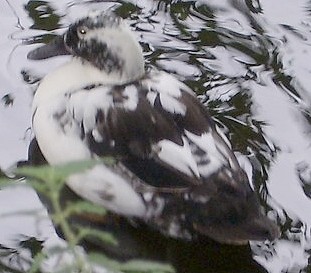
Pied "Mallard" duck (Chichester Park, Ipswich, Sept 2006). This may be the result of hybridisation with domestic Muscovy ducks (it is very similar to a hybrid Mallard x Muscovy in the Natural History Museum). |
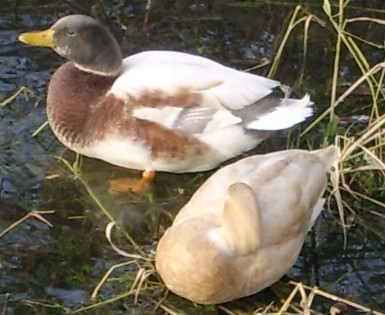
Male and female hybrids between Mallard and Aylesbury or White Campbell (domestic white) duck. The female has a bright yellow beak. These ducks were heavy set compared to others in the area leading me to suspect Aylesbury parentage. The polygamous Aylesbury duck is descended from the monogamous Mallard. |
|
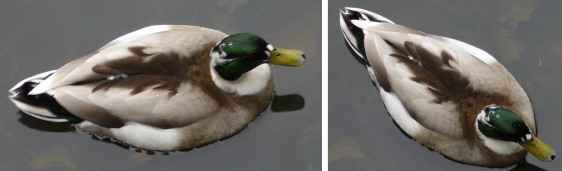
Male hybrid of Mallard and domestic duck. Possibly the parentage includes one of the pom-pom crested domestic Mallards. |
|
|
A trio of Mallard x domestic duck crosses, with a mix of white and wild-type colouration, at Richmond, London. They live among normal wild-type Mallards. |
|
|
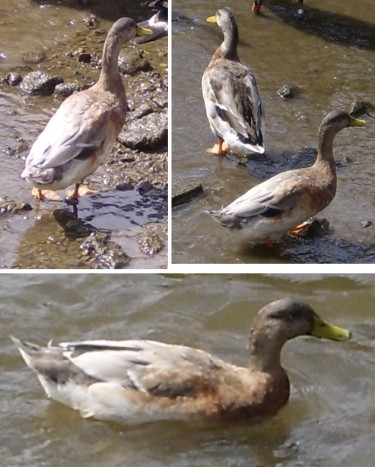
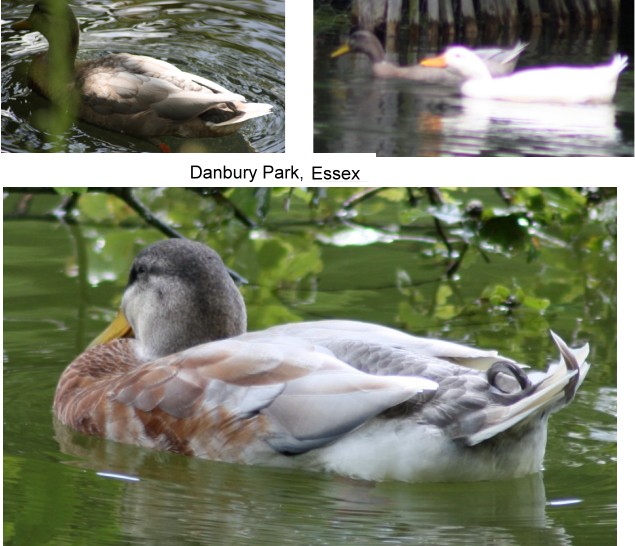
Mallard x domestic duck crosses on the lake in Danbury Park; these keep apart from the wild-type Mallards. One is an attractive pastel colour, the others are shades of brown with a brown head rather than a green one. |
|
|
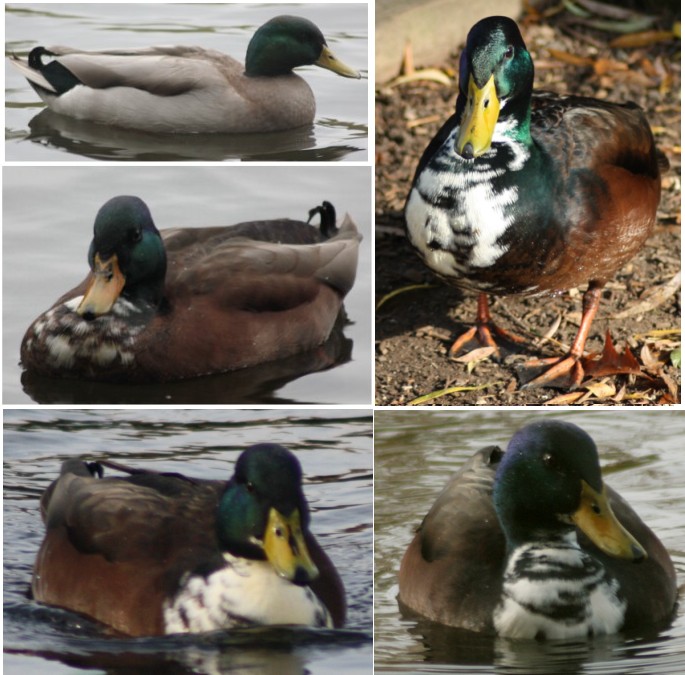
Mallard x domestic duck crosses on the lake in Central Park, Chelmsford; these mix freely with the wild-type Mallards. Two White Campbell type ducks also live with the wild Mallards. The hybrids include white chested and speckled-chested birds and one with no neck ring. |
|
Muscovy ducks (and the domesticated form known as the Barbary duck) are South American ducks that have been imported into many regions and established feral populations. A cross of a Mallard male mated to a Muscovy female produces progeny that has the Mallard plumage color for the most part (Morley A. Jull (1952). Hybrid Ducks. World's Poultry Science Journal, 8 , pp 191-191). In Taiwan and Europe, sterile hybrids called Mule Ducks, have been bred from Muscovy x Mallard (Ref: Dr Ed Hoffmann, Canning, N.S., Canada Dec. 1993 ) In Taiwan, the Kaiya breed (derived from Mallard stock) is used and Mule ducks have been bred for almost 300 years. Incubation time of mule-bearing eggs is 32 days. The hybrids are calm, tame, quiet and do not fly. The mule females lack functioning ovaries and grow as large and fast as the Mule drakes. The Mule drakes may have limited fertility. The domestic Kaiya (White Pekin x Tsiaya cross) is buff, but carries genes for other colours/patterns which are passed to the Mule offspring. These colours were introduced from White Pekin ducks whose colour masks other colours. White Mule Ducks can be bred from a white form of Tsiaya (another domestic breed) mated to Muscovy drakes. Both Muscovy and Kaiya species have genes for the white colour, but these genes are in different places on the chromosomes, so mating a white Kiaya and a white Muscovy can produce coloured offspring.
The same situation is seen in the Mallard/domestic hybrids. The domestic white ducks can still carry genes to produce other colours, it is just that those colours are masked by the white colour. Once the white ducks start breeding with Mallards and the hybrids breed among themselves (being so closely related they are fertile), those hidden colours start showing up in the offspring giving pastels, browns, buffs and various patterns
GEESE
The Canada Goose has formed hybrids with a number of different species: Canada Goose x Greylag Goose, Canada Goose x Emperor Goose, Canada Goose x Red-breasted Goose, Canada goose x White-fronted Goose, Canada Goose x Barnacle goose. It may also have bred with the domestic white Embden Goose where wild or semi-tame Canada geese have taken up residence in public parks or farmyards with tame geese are kept. Canada Geese have also hybridsed with Mute Swans.
SWANS
The Mute Swan can hybridise with the Trumpeter Swan and with fertile hybrid Trumpeter/Whistling Swans (known as Trumpling Swans). Trumpeter Swans can hybridise with Tundra Swans. The Mute Swan and Black Swan can hybridise resulting in very large, black-and-white speckled adults that look smoky-grey from a distance. Mute Swans have also hybridsed with Canada Geese.
Whooper Swans have been illegally released by private breeders into the wild in eastern Minnesota during the 1990s. A number of fertile Whooper Swan x Trumpeter Swan hybrids had also been released as the breeder considered them unfit for sale to collectors or to other breeders. Whooper Swans are not indigenous to the region. It is believed that the native Trumpeter Swan population now contains a percentage of Whooper Swan genes.
HYBRID PIGEONS
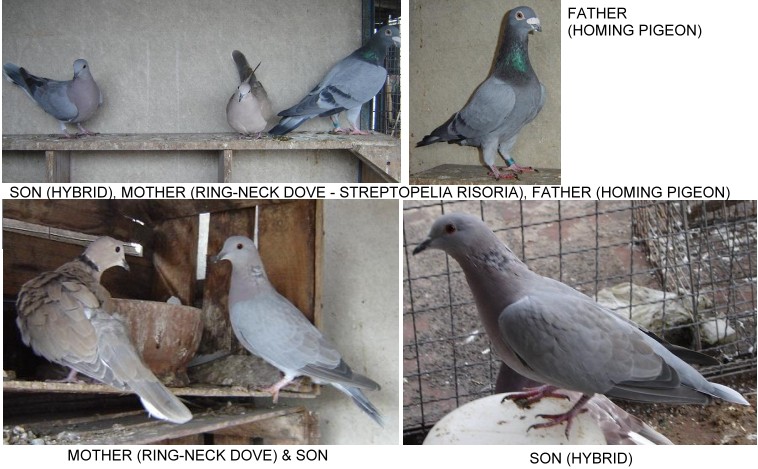
Carlos Alvarez (Mexican biologist and homing pigeons racer) provided these photos of a hybrid homing pigeon (Columba livia) and Ring neck Dove (Streptopelia risoria). The hybrid is bigger than the mother (the ring neck dove) and smaller than the father (homing pigeon). It looks like the ring neck dove but bigger in appearance, and the color is blue-grayish. The markings are more similar to the mother, but without a well marked ring neck, only some dark feathers here and there on the neck. In Mexico the Ring Neck Doves is non-native so the mother must have been an escaped aviary bird (they are bred and used by magicians). The dove turned up around 2006 when Carlos' flock came back from their daily flight. The dove followed them into the loft and appeared accustomed to pigeons. Carlos kept her because of her song and was surprised when she paired with a pigeon and produced a hybrid offspring.
|
|
In response to the common query whether town pigeons can interbreed with Wood pigeons, male Common Pigeons (feral pigeon, Rock Dove) have produced fertile hybrids with female Wood Pigeons.
Male Common Pigeons mated to female European Collared Dove (Streptopelia decaocto) may produce infertile hybrids. However, hybridisation tests were made using the domesticated Ringneck (Ring) Dove (S risoria) which may be derived from either the European Collared Dove (S decaocto) or the African Collared Dove (S roseogrisea) and which interbreeds freely with both species of collared dove.
For those with an interest in hybrids involving the now extinct Passenger Pigeon, CO Whitman crossed a male Passenger Pigeon with a female domestic Ringneck Dove, resulting in infertile hybrids (hybrids lacked gonads). No other hybrids are reported and therefore hybridisation with another pigeon species and back-crossing to the last few pure-bred Passenger Pigeons might not have saved the Passenger Pigeon's genes.
Excerpts about Hybrid Fowl from Charles Darwin's "Origin of Species" (6th Edition)
"...from observations communicated to me by Mr. Hewitt, who has had great experience in hybridising pheasants and fowls, that the early death of the embryo is a very frequent cause of sterility in first crosses. Mr. Salter has recently given the results of an examination of about 500 eggs produced from various crosses between three species of Gallus and their hybrids; the majority of these eggs had been fertilised; and in the majority of the fertilised eggs, the embryos had either been partially developed and had then perished, or had become nearly mature, but the young chickens had been unable to break through the shell. Of the chickens which were born, more than four-fifths died within the first few days, or at latest weeks, 'without any obvious cause, apparently from mere inability to live;' so that from the 500 eggs only twelve chickens were reared."
"Although I know of hardly any thoroughly well-authenticated cases of perfectly fertile hybrid animals ... the hybrids from [...] Phasianus colchicus with P. torquatus, are perfectly fertile. ... The hybrids from the common and Chinese geese (A. cygnoides), species which are so different that they are generally ranked in distinct genera, have often bred in this country with either pure parent, and in one single instance they have bred inter se. This was effected by Mr. Eyton, who raised two hybrids from the same parents, but from different hatches; and from these two birds he raised no less than eight hybrids (grandchildren of the pure geese) from one nest. In India, however, these cross-bred geese must be far more fertile; for I am assured by two eminently capable judges, namely Mr. Blyth and Captain Hutton, that whole flocks of these crossed geese are kept in various parts of the country; and as they are kept for profit, where neither pure parent-species exists, they must certainly be highly or perfectly fertile. "
Excerpts about Hybrid Fowl from Charles Darwin's "The Variation of Animals And Plants Under Domestication"
"I owe to the kindness of this excellent observer the opportunity of inspecting some neck-hackles and tail-feathers from a hybrid between the common fowl and a very distinct species, the Gallus varius; and these feathers are transversely striped in a conspicuous manner with dark metallic blue and grey, a character which could not have been derived from either immediate parent. "
"Mr. Hewitt, who has had great experience in crossing tame cock-pheasants with fowls belonging to five breeds, gives as the character of all 'extraordinary wildness' (13/42. 'The Poultry Book' by Tegetmeier 1866 pages 165, 167.); but I have myself seen one exception to this rule. Mr. S. J. Salter (13/43. 'Natural History Review' 1863 April page 277.) who raised a large number of hybrids from a bantam-hen by Gallus sonneratii, states that 'all were exceedingly wild.' Mr. Waterton (13/44. 'Essays on Natural History' page 917.) bred some wild ducks from eggs hatched under a common duck, and the young were allowed to cross freely both amongst themselves and with the tame ducks; they were 'half wild and half tame; they came to the windows to be fed, but still they had a wariness about them quite remarkable.'"
"Mr. Brent, who has crossed canary-birds with many kinds of finches, has not observed, as he informs me, that the hybrids were in any way remarkably wild: but Mr. Jenner Weir who has had still greater experience, is of a directly opposite opinion. He remarks that the siskin is the tamest of finches, but its mules [hybrids with canaries] are as wild, when young, as newly caught birds, and are often lost through their continued efforts to escape. Hybrids are often raised between the common and musk duck, and I have been assured by three persons, who have kept these crossed birds, that they were not wild; but Mr. Garnett (13/45. As stated by Mr. Orton in his 'Physiology of Breeding' page 12.) observed that his hybrids were wild, and exhibited 'migratory propensities' of which there is not a vestige in the common or musk duck. No case is known of this latter bird having escaped and become wild in Europe or Asia, except, according to Pallas, on the Caspian Sea; and the common domestic duck only occasionally becomes wild in districts where large lakes and fens abound. Nevertheless, a large number of cases have been recorded (13/46. M. E. de Selys-Longchamps refers ('Bulletin Acad. Roy. de Bruxelles' tome 12 No. 10) to more than seven of these hybrids shot in Switzerland and France. M. Deby asserts ('Zoologist' volume 5 1845-46 page 1254) that several have been shot in various parts of Belgium and Northern France. Audubon ('Ornitholog. Biography' volume 3 page 168), speaking of these hybrids, says that, in North America, they 'now and then wander off and become quite wild.') of hybrids from these two ducks having been shot in a completely wild state, although so few are reared in comparison with purely-bred birds of either species. It is improbable that any of these hybrids could have acquired their wildness from the musk-duck having paired with a truly wild duck; and this is known not to be the case in North America; hence we must infer that they have reacquired, through reversion, their wildness, as well as renewed powers of flight. "
"... the utterly sterile male hybrids from the pheasant and the fowl act in the same manner, "their delight being to watch when the hens leave their nests, and to take on themselves the office of a sitter." (13/57. 'Cottage Gardener' 1860 page 379.) "
"...No one has compared, for instance, the fertility of Gallus bankiva and of the domesticated fowl, when crossed with a distinct species of Gallus or Phasianus; and the experiment would in all cases be surrounded by many difficulties. "
"Mr. Hewitt gives it as a general rule with fowls, that crossing the breed increases their size. He makes this remark after stating that hybrids from the pheasant and fowl are considerably larger than either progenitor: so again, hybrids from the male golden pheasant and female common pheasant "'re of far larger size than either parent-bird.' (17/39. Ibid 1866 page 167; and 'Poultry Chronicle' volume 3 1855 page 15.)"
FURTHER READING:
Textual content is licenced under the Gnu Free Documentation Licence (GFDL)
|
BACK TO HYBRIDS & MUTANTS INDEX |