|
LYNX AND BOBCAT HYBRIDS |
BOBCAT/LYNX HYBRIDS (BLYNX, LYNXCAT)
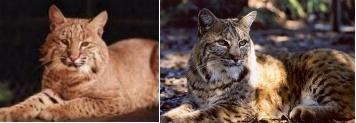
Bobcats can be crossed with lynxes. The outcome depends on which lynx sub-species is used - the European (Spanish) Lynx is more heavily spotted than the Canadian lynx. Bobcats are usually reddish brown with dark spots, but grey or bluish bobcats and black bobcats are sometimes found. Lynxes vary from tawny with dark spots through to sandy with minimal spotting. Bobcat/lynx hybrids vary in appearance since southern sub-species of lynx are more heavily spotted than northern sub-species of lynx. Canadian Lynx have been crossed with Spanish Lynx - they are subspecies of the same animal.
>
“Trappers and ‘hide-handling outfits’ had grading systems decades ago for top quality lynx and bobcat pelts, and the records include occasional mention of ‘lynxcats.” (The Daily Sentinel, Grand Junction, Colorado, 5th June 2003, page 7A). Until the 1990s, none of these were scientifically confirmed to be hybrids. Some of the odd-looking cats might have been colour morphs of either bobcat or lynx (depending on the region). This raises the risk that if indiscriminate killing of the unusual cats could wipe out genetic variation in endangered lynx.
Canada lynx is a protected species in 14 US states constituting the southern part of its historic range. Bobcats and hybrid lynx-bobcats are not protected by these laws. Hunters refer to the hybrids as "lynxcats" while cryptozoologists have termed the hybrid a "blynx".
A male lynx-bobcat hybrid was trapped west of Greenville, Maine in 1998 by a trapper seeking bobcats. It had long ear tufts characteristic of the lynx, but small feet more suggestive of a bobcat. This was Maine’s first known lynx-bobcat hybrid according to the Rutland Daily Herald, 31st August,2003. It was radio-collared and released. Dismissed as a fluke, it was found dead of starvation (allegedly due to a badly fitted radio collar) several months later.
A female hybrid was trapped and killed in 2002 near Telos Lake, Maine. Three kittens were observed near the trapped cat, proving the fertility of the hybrid. In feline hybrids, the females are generally fertile while the males may be sterile.
In November 2002, a hybrid was picked up along Highway 61 north of Duluth near the Knife River after it had been killed by a car, according to the Daily Sentinel, Grand Junction, Colorado, 5th June 2003. At first it appeared to be a lynx, but its feet were a little smaller, its ear rufts and legs were slightly shorter, its fur was somewhat mottled and its tail tip was not entirely black.
A hybrid was taken by a trapper in January 2003 near Hibbing, Minnesota. It more closely resembled a bobcat.
In November 2003, a cat intermediate between bobcat and lynx (lynx-like, but with bobcat spots) was witnessed in Illinois, 500 miles from normal lynx territory and possibly an escaped pet.
In August 2003 research scientists confirmed the discovery of hybrids between wild Canada lynx and bobcats in the Moosehead region of Maine, USA. DNA analysis of hair and tissue samples of 2 suspected hybrids were tested at the USDA Forest Service's genetics laboratory in Missoula, Montana. The hair and tissue samples came from two suspected hybrids – one male, one female - which had the long ear tufts and black tipped tails of a lynx, but the larger bodies and smaller feet of the bobcat and were described as “funny looking bobcats” by the state wildlife biologist. Few bobcat samples from Maine had been analysed for signs of hybridisation, so the extent of hybridisation is not known.
Three hybrids were identified in north-eastern Minnesota when 19 lynx DNA samples were submitted for testing. These were the first genetically confirmed hybrids outside of captivity and all were the result of matings between female lynx and male bobcats.
Maine's bobcat populations had been increasing since 1993; lynx were at the peak population in their natural cycle. The hybrids could be the result of high numbers causing the two species to move into each other's ranges or the result of human activity causing the two species to come into contact more often. Where a bobcat has ended up in lynx territory (or vice versa), the hybrid offspring will back-cross to purebred animals and the "alien" genes will simply be absorbed into the general population, swamped by the indigenous species' genes. It is also possible that lynx and bobcats have always interbred on occasions over the last 10,000 years, strengthening the genetic diversity of both species. Where the two species meet on overlapping ranges, there is the possibility of introgressive hybridisation leading to an intermediate form.
According to Schwartz et al (2004), the researchers contacted felid fur farms that claimed to have tried breeding lynx and bobcats in captivity. Only one claimed success in breeding hybrids but stated that subsequent attempts to backcross these to lynx and bobcats had failed. Other fur farms were often unsure which species of lynx (Lynx canadensis, Lynx lynx, or Lynx pardinus) they had attempted to breed with bobcats. The researchers had not found any hybrids born of male lynx mating with female bobcats.
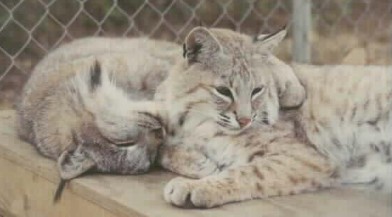
Above: Bobcat and Canadian Lynx together at Conservators Center, Inc (Photo: Mindy Stinner)
Homyack, Vashon, et al (2008), reported on the physical characteristics of five of seven Canada lynx-bobcat hybrids detected near the southern extent of the lynx’s geographic range in Maine, Minnesota and New Brunswick. Observation of a female hybrid with three kittens, as well as placental scars in the reproductive tract of a second animal, indicated that the hybrids were reproducing successfully.
Seven hybrid animals (5 female, 2 male) were detected in Maine, Minnesota and New Brunswick between 1986 and 2003. In northern Maine, fur-trappers captured two females with foothold traps in Nov. 1998 and 2002 in Somerset and Piscataquis Counties, respectively. The 1998 animal was anaesthetised, fitted with a radio-collar and released. The 2002 female was observed with three kittens for several minutes; the trapper killed this animal. Three bobcat-lynx hybrids (1 female, 2 males) were detected in Minnesota from Feb.–Dec. 2002. In February, a hair sample from a male hybrid was collected from a resting bed in Cook County, Minnesota. A road-killed female animal near Knife River on Highway 61 in St. Louis County, Minnesota was collected in November 2002. A fur-trapper captured a male hybrid in Itasca County, Minnesota in December. A fur-trapper captured an adult female hybrid in Victoria County, north-western New Brunswick in December 2003. This is now in the collection of the New Brunswick Museum. This female hybrid had two placental scars in her reproductive tract. In addition, a New Brunswick Museum skeletal specimen from a female “lynx with an unusual coat was found to be a hybrid by DNA analysis; it had been killed at Freeze Lakes, Northumberland County, in north-eastern New Brunswick in November 1986. In general, the hybrids tended to be more reddish than pure lynx and also tended to have spots.
Considering the number of hybrids documented after trapping (5 out of 7 in the study by Homyack, Vashon, et al), further hybrids are probably being killed by trappers, but are not being recognized or reported by agency personnel, trappers or biologists. There were also conservation implications for the protected lynx and legal implications because CITES considers the hybrids subject to the same protection as the most endangered of the parents, in this case the lynx.
Koen, Bowman et al (2014) looked at hybridization and introgression (repeated backcrossing) across the geographic range of the two species. They found that the prevalence of genetic introgression was relatively low (7 of 2851 individuals (0.24%)) with evidence of backcrossing of the hybrids to both lynx and bobcat depending on which species was more prevalent in the contact zone. Three introgressed males reported in New York were likely descendants of male bobcats and hybrid females (they had lynx markers in their mitochondrial DNA). Because mitochondrial DNA is only passed on by females, these markers will be lost in any offspring sired by these males. An introgressed animal from Manitoba was likely a descendent of a male and female bobcat, but one of the grandparents (but not the maternal grandmother, because it had bobcat mitochondrial DNA) was probably a lynx. The southern range boundary of the Canada lynx is retreating northwards due to climate change, and bobcats are extending their range northwards.
- Dayton Daily News, Ohio, 10th June 2003, page E3
- Rutland Daily Herald, Vermont, 31st August,2003, page B7
- The Bangor Daily News, Maine, 28th August 2003, page A1.
- The Daily Sentinel, Grand Junction, Colorado, 5th June 2003, page 7A.
- Jessica A. Homyack, Jennifer H. Vashon, Cade Libby, Edward L.Lindquist, Steve Loch, Donald F. Mcalpine, Kristine L. Pilgrim, Michael K. Schwartz. Canada Lynx-bobcat (Lynx canadensis 3 L. rufus) Hybrids at the Southern Periphery of Lynx range in Maine, Minnesota and New Brunswick . The American Midland Naturalist, 2008, 159:504–508.
- Schwartz MK, Pilgrim KL, McKelvey KS, Lindquist EL, Claar JJ, Loch S and Fuggiero LF (2004). “Hybridization between Canada lynx and bobcats: Genetic results and management implications.” Conservation Genetics 5: 349–355.
- Erin L. Koen, Jeff Bowman, Jillian L. Lalor, Paul J. Wilson, Continental-scale assessment of the hybrid zone between bobcat and Canada lynx, Biological Conservation, Volume 178, 2014, Pages 107-115, ISSN 0006-3207,
MIXED BREEDS from PENNSYLVANIA WILD CATS| By Henry W. Shoemaker, Altoona, Pennsylvania. The Altoona Tribune Publishing Co. 1916
MIKE SULLIVAN, a very intelligent bar clerk at Johnsonburg, Elk County, called the writer's attention to the length of the tail of a mounted cat in the hotel at that prosperous lumber town. "A great many wild cat hides, taken in Elk, McKean, and Forest Counties are shipped to a fur dealer in town," said Sullivan, "and I have been struck by the length of their tails. I put a foot rule on this one, and it measured exactly twelve inches. That cat, I am told, weighed forty-one pounds. We have quite a few varieties of cats in these parts. First of all, there is the Canada Lynx, grey in color, with tabs on his ears and hair on the soles of his feet; a big, fierce fellow, often weighing fifty pounds. He has always been a scarce cat, even the Indians say he was never plentiful. Secondly, there is the true wild cat, or 'Bob' cat, reddish in color, mottled like a fawn, smaller than the Canadian Lynx, but with a longer tail. Thirdly, there is the tame cat gone wild—escaped from lumber camps and the like. Some of these grow very big, and in one or two generations are brindled and bushy tailed. Many people call them 'coon cats.' Then we have the fourth kind, the mixture, hybrid or mongrel, whatever you call it, between the Canada Lynx and the Wild Cat, or Bay Lynx. In my opinion, that cat on yonder shelf is a cross between a lynx and a Bob Cat. Old hunters tell me that the product of that cross has a longer tail than either lynx or Bob Cat—a throwback to the type of long ago. There may also be crosses between lynxes and Bob Cats and tame cats gone wild; it happened in the old country, why not here?"
The above observations, which have also been advanced by C. W. Dickinson, of Smethport, have a considerable element of common-sense to them. In deer breeding there is a tendency to throw back to good-headed, or poor headed ancestors, as the case may be. In South Carolina there are frequent cases of palmation in the deer, due to some English fallow bucks liberated by planters in the Eighteenth Century. A cross between two varieties of short-tailed lynxes might provide a longer tailed type. In other respects the cat in the Johnsonburg house showed an accentuation of characters. Its hind legs were apparently twice the thickness of the front legs, and very much longer. It was an unsymmetrical animal. Perhaps much of this was due to faulty taxidermy, but that would not account for the length of the tail. Its color, a darker grey than the true lynx, was almost of a drab hue. It was darker about the head, but there were no regular spots. The Canada Lynx early succumbed to changed conditions in his faunal zone, the forest fire, the clearing, the drained swamp, the passing of the northern hare, but for a time his blood will live on in the crossbreed with the more adaptable Bay Lynx. As these long tailed cats are said to be plentiful in the wilder sections of Northwestern Pennsylvania, it may be that this new race will possess the power to best endure existing conditions though S. N. Rhoads says that such a cross would be infertile.
CARACAL/LYNX HYBRIDS
The 1997 LIOC cat census listed 3 hybrid cats of "Caracal/Lynx" type. However, purebred caracals are sometimes called "caracal lynxes" because of their tufted ears so these were probably not genuine hybrids. No such hybrids were reported on the 1998 survey, suggesting the earlier identification was an error based on terminology.
SERVAL/LYNX HYBRIDS
The Orlando Sentinel in 2004 reported Jana Londre of Boca Raton as having owned a caracal and a lynx-serval hybrid since 1992.
BOBCAT/OCELOT HYBRIDS
Although these hybrids have been bred in captivity, they are unlikely to occur in the wild. These have adjoining ranges which overlap in Mexico and the southern USA. A hybrid is unlikely as they prefer different habitats and have different lifestyles. Bobcats inhabits woodland, scrub, semi-desert and swampland. Ocelots prefer denser cover and are more arboreal.
Their sizes are similar. Bobcats average 36 inches (90 cm) long including tail; 14 -15 inches (36-38 cm) at the shoulders and weigh 16-30 pounds (7-14 kg). Ocelots can reach 38 inches (100 cm) excluding tail and weigh 20-33 pounds (10-15 kg). Spotted subspecies of bobcat occur and retained juvenile spotting is also possible.
The LIOC newsletter for September 1966 boasted "A Really New Cat - An Ocelynx!" Details came from a letter dated Aug 11 1966 from John C. Ebner of Wichita Falls, Texas. Ebner wrote "I have a new little kitten that is now three months old and whose daddy is an ocelot and his mother is a bobcat. We are calling this kitten an ocelynx. although I guess it might be a bobelot. He weighed six pounds today when I had him declawed. We are most anxious to see him grow. Right now he looks more bobcat than ocelot. His name is 'Bruni' for the Texas town where he was born." A newspaper cutting from the same time period outlined an Ocelot x Bobcat cross-breeding programme at Ranier State School, Buckley. Washington, under the direction of Dr HC Thuline.
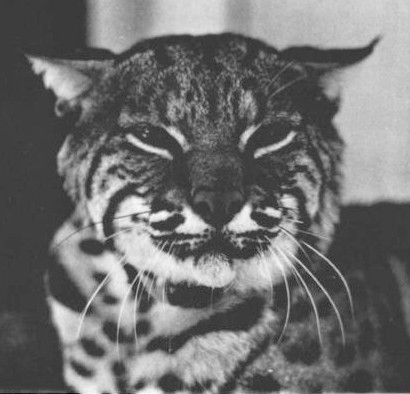
A breeder in Texas specialised in bobcat-ocelot crosses in the late 1960s one of which is pictured courtesy of the Long Island ocelot Club.
An advert appeared in the Long Island Ocelot Club Newsletter Nov/Dec for 1969 saying: "Ocebob, bobelot or whatever you choose to call them, they are with us and AVAILABLE ! Gertrude Troop [Troop's Pet Shop, Bruni, Texas] advises that she has had and will have from time to time, ocelot x bobcat kittens bred from her Mexican Ocelot and a Texas bobcat. Both parents are about four years old. Ocebob kittens sell for $200 each." Gertrude Troop appears to be the source of the ocebobs mentioned in the newsletters.
Regularly featured in the Long Island Ocelot Club Newsletter from 1967 into the 1970s was Fenwyck, the Ocebob owned by Ginny and Jim Story of Southern California. Fenwyck was one of Troop's first ocebobs, bred in 1967. Ms Story also owned an ocelot (Seymour) and a puma (McCavity). Fenwyck showed an interest in McCavity and the Storys believed a successful mating would produce the world's first "ocebobacougalot". (As an F1 hybrid, Fenwyck would have been sterile). In the newsletter of Nov 1968, Fenwyck was described as a really beautiful cat having spotted/striped body of the ocelot yet head and tail of the bobcat, although his tail was long for a bobcat.
In the LIOC newsletter for March-April 1975, Story wrote: "Fenwyck is a Texas ocebob, 8 years old and one of Gertrude Troop's first litters in a successful mating between her bobcat and ocelot. He was 5 months old when I bought him for $75 in Azuza, from a young man who couldn't handle him and didn't know what he had. I'd just lost my very first ocelot tragically to three dogs, but I was determined that his death would not be in vain; I had learned from my bumbling mistakes as many of us have and the Fenwyck is shy. I respect his independence and free spirit . He will not allow me to pet him and others to come close, but this is his home and the two females who grew up with him and share his life.
In the LIOC newsletter for Jan-Feb 1970, another ocebob called Maggie was described. Maggie was a very young ocebob bred by Troop and owned by WR (Bill) Boyle of Tacoma, Washington. Boyle wrote "She arrived from Gertrude Troop, Bruni, Texas, in mid-November. She is about 7 weeks old, weighs close to 2 pounds and is as tame as any domestic kitten. She was raised from birth by hand and bottle. I might add that my vet said she is extremely healthy and free of parasites."
BOBCAT/JUNGLE CAT HYBRIDS
Long Island Ocelot Club newsletter of July/August, 1971 an item by by John M Jackson noted that in spring 1970, the Jacksons were very actively involved in an attempt to breed the jungle cat (F chaus) to the bobcat though this was totally unsuccessful. Singh (a proven fertile three-quarter chaus hybrid) spent a week with a bobcat 40 miles from the Jackson's home, but escaped into the middle of San Fernando Valley where he remained at large for 11 days and travelled 10 miles further away before being live-trapped by a farmer whose chickens he was decimating.
BOBCAT/PUMA HYBRIDS
I have been asked if puma/bobcat or puma/lynx hybrids are possible in the wild. This followed the appearance of an apparently “nearly puma-sized” cats with the short tail and pointed, white-marked ears of a bobcat, but the tawny coat of a puma. There are no authenticated hybrids between the two species.
Bobcats are variable in their markings. Although most people are familiar with spotted bobcats, those spots can be so small as to be speckles; from a distance, such cats may look solid-coloured. Like the puma, the bobcat can also have a white muzzle and “eyeliner” markings. The presence of a frill, even a light one, around the neck confirms that the pictures show a large, rather gracile bobcat with speckled markings. Another giveaway in favour of the bobcat is the short white-tipped tail and lighter muscling of the hindquarters.
Sometimes you get bobcats that haven’t developed a ruff, or frill (in the same way you sometimes get lions that don’t develop a mane). Without the ruff altering its profile, bobcats have rather long necks and smallish heads, which combines with the spotted or speckled body to give a rather cheetah-like appearance. Seen in profile, the bobcat has a narrower, sharper nose, compared to the broader, more rounded features of the puma.
REFERENCES AND FURTHER READING
For more information on the genetics of colour and pattern:
Robinson's Genetics for Cat Breeders & Veterinarians 4th Ed (the current version)
For more information on genetics, inheritance and gene pools see:
The Pros and Cons of Inbreeding
The Pros and Cons of Cloning
For more information on anomalous colour and pattern forms in big cats see
Karl Shuker's "Mystery Cats of the World" (Robert Hale: London, 1989 - some of the genetics content is outdated)
|
BACK TO HYBRID & MUTANT BIG CATS INDEX |