|
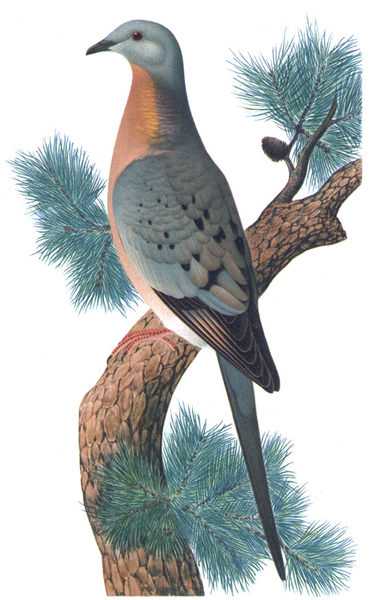
Male |
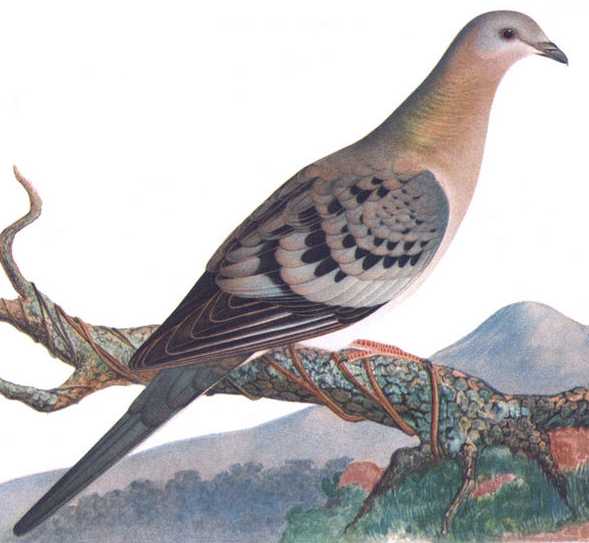
Female |
PASSENGER PIGEON
The Passenger Pigeon (Ectopistes migratorius) was once probably the most numerous bird on Earth. In the 19th Century, there were between 1 and 4 billion Passenger pigeons - up to 40% of the total number of birds in North America. It occupied the millions of acres of primary forest across North America east of the Rockies, overwintering in the southern US. When a flock migrated, it could be up to a mile wide and up to 300 miles long. These flocks were so dense that they darkened the sky for hours or days. According to an early settler in Virginia: "There are wild pigeons in winter beyond number or imagination, myself have seen three or four hours together flocks in the air, so thick that even have they shadowed the sky from us." These flocks were so densely packed that a single shot could bring down 30-40 birds. He birds could be brought down and killed just by hitting them with pieces of wood as they flew over hilltops. The bird's only natural predators were hawks and eagles. As they flew, they covered settlements with droppings, once an important way of spreading seeds, but viewed as a nuisance by settlers.
|
Male |
Female |
The Passenger resembled the Mourning Dove, but was larger and lacked the black spot on the side of the neck. The head and rump were slate blue, the back slate grey and the breast wine red. As with most birds, the male's colours were brighter than those of the female. It had long, slender bluish wings and a grey and white pointed tail 8 to 9 inches in length. It had a short, slender black bill suited to a diet of acorns, beechnuts, chestnuts, various fruits, grains and insects. Its wings and tail meant it was built for flight and could probably reach speeds up to 70 mph.
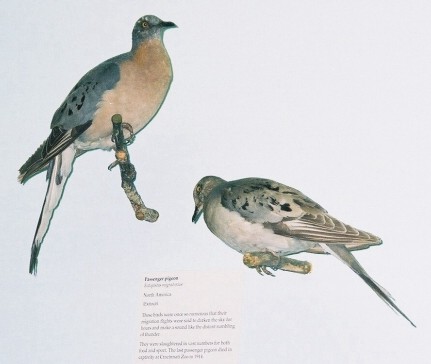
Pair of Passenger Pigeons at Natural History Museum, London |
Passenger Pigeons were highly social and bred in large colonies covering from 30 square miles to around 800 square miles of forest, with up to 100 nests in a single tree. The weight of nests and roosting birds broke branches or even toppled trees. The ground beneath the colonies ended up covered by several inches of droppings. The flimsy nests were made of small twigs, laid loosely together. The parents jointly incubated a single egg each year and tended the single chick for about 2 weeks. Then the chick, still unable to fly, was abandoned by the parents as the flock moved on. The chicks dropped to the ground to fend for themselves until they began to fly a few days later. During this time, they were vulnerable to human hunters and animal predators.
The Native Americans captured the pigeons in large nets and by the 1630s the settlers of New England were also netting them. The young squabs were regarded as a delicacy while the adults were sought after for both meat and feathers. At this stage, hunting was sustainable. In 1805, a brace of Passenger pigeons sold for 2 cents. They were often the only meat available to 18th and 19th Century slaves and servants and were served in most restaurants.
As with extinct species such as the Quagga (a zebra) and Great Auk (a bird), its huge numbers invited over-hunting in the belief that there would always be more. Its lifestyle also invited predation by introduced predators and opportunists such as dogs, cats, rats and pigs. Tens of thousands of the birds in nesting colonies were taken daily and shipped to markets in the east. The invention of the telegraph allowed the colonies and flocks to be reported.
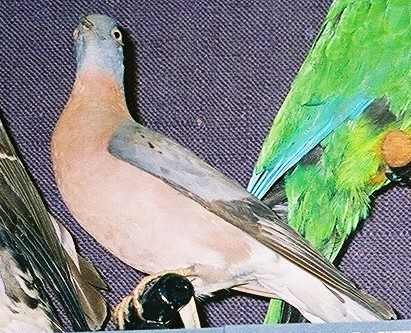
Passenger Pigeon at Rothschild Zoological Museum, Tring, England |
Some Passenger Pigeons were sent to zoos and private collections in Europe and this might have been a chance to conserve them, but for the belief they would always be numerous. In the Proceedings of the Zoological Society, 1833 we find this: A Note by James Hunt, one of the Society's Keepers, was read. It related to the breeding of the Passenger Pigeon, Ectopistes migratorius, Swains., in the Society's Menagerie. "A pair of these birds began to build their nest on the '25th of April, 1832, having been three or four days in selecting a proper place in a fir-tree in the inclosure appropriated at the Gardens to the Pigeons. The female was the nest-builder. The male bird performed the most laborious part of the work: he collected and conveyed to the spot all the materials, principally sticks and straw, of which the nest was composed. He alighted on the back of the female with each fresh supply, so as not to disarrange any part of the nest which she had formed. They began their task in the morning, and completed it the same evening. One egg was laid on the morning of the 26th, and the female commenced sitting immediately. A young bird was hatched in sixteen days. The male relieved the female during the period of incubation." other instance of the breeding in this country of the Passenger Pigeon occurred nearly at the same time in the Menagerie of the President [of the Zoological Society.].
After 1830 the pigeons were hunted for sport, hog feed and even for agricultural fertiliser. In the 1870s, 250,000 Passenger pigeons a year were released from live traps for shooting practice. Its decline began in earnest with the onset of large-scale commercial hunting carried out by well-organised trappers and shippers supplying cheap meat to the developing cities on the east coast of the USA. The opening of railroads linking the Great Lakes area with New York meant 300,000 Passenger pigeons were sent to New York during 1855 alone. The most devastating killings were during the 1800s and 1870s. Th figures were recorded as a normal part of commerce: 23rd July, 1860 (23 July) saw 235,200 birds sent east from Grand Rapids in Michigan; 1874 saw 1,000,000 birds shipped east from Oceana County in Michigan; 1876 saw 1,600,000 shipped east from Oceana County (400,000 per week during the season). In 1869, Van Buren County, Michigan, shipped 7,500,000 birds to the east. In 1880, 527,000 birds were shipped east from Michigan.
As well as over-hunting and introduced predators, forest clearance and agriculture contributed to the Passenger pigeon's extinction. By the 1850s, this once numerous bird was in serious decline. As late as 1854 a resident of Wayne County, New York wrote: "There would be days and days when the air was alive with them, hardly a break occurring in the flocks for half a day at a time. Flocks stretched as far as a person could see, one tier above another."
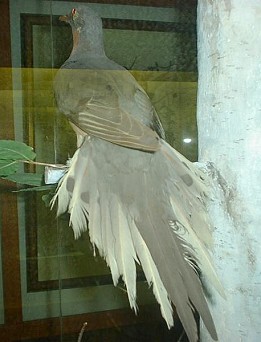
Male Passenger Pigeon |
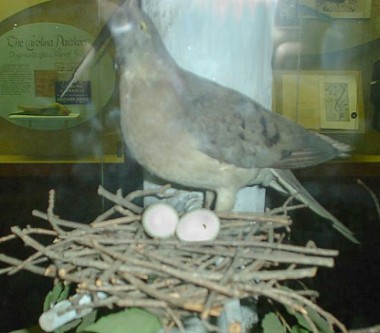
Female and nest |
The entry in Harmsworth Natural History (1910) reads: Another section of long-tailed pigeons is represented only by the well-known passenger-pigeon Ectopisles migratorius of North and central America, characterised by the length of the wings exceeding that of the tail, and the narrowness of the latter, in which the tips of the feathers are pointed. In the male the head and upper parts of the body are bluish grey, spotted with black on the wings; the quills brownish black with grey edges, the chin whitish grey, and the breast cinnamon-rufous shading into pale purplish on the rest of the under parts, and white on the under tail coverts. The back and sides of the neck glitter with golden and violet metallic colours. In the female the upper part of the breast is brownish, shading into white on the abdomen and the rest of the under parts.
The vast numbers by which this pigeon was formerly represented have greatly diminished during recent years. Mr. Brewster writes that in Michigan “we found that large flocks of pigeons had passed there late in April, while there were reports of similar flights from almost every county in the southern part of the state. Although most of the birds had passed on before our arrival, the professional pigeon-netters, confident that they would finally breed somewhere in the southern peninsula, were busily engaged getting their nets and other apparatus in order for an extensive campaign against the birds. Our principal informant said that the last nesting of any importance in Michigan was in 1881, a few miles west of the Grand Traverse. It was only of moderate size, perhaps eight miles long.
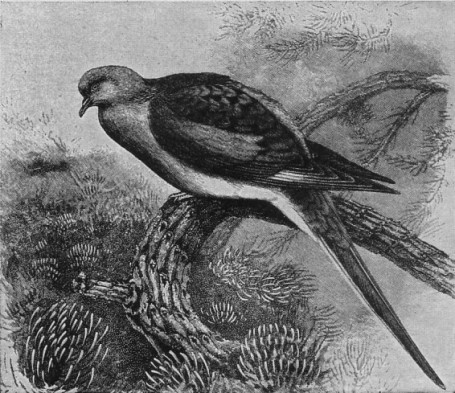
Passenger Pigeon in Harmsworth Natural History |
“Subsequently, in 1886, Mr. Stevens found about fifty dozen pairs nesting in a swamp near Lake City. He does not doubt that similar small colonies occur every year, besides scattered pairs. In fact, he sees a few pigeons about Cadillac every summer, and in the early autumn young birds, barely able to fly, are often met with singly or in small parties in the woods. Such stragglers attract little attention, and no one attempts to net them, although many are shot. The largest nesting he ever visited was in 1876 or 1877. It began near Petosky, and extended north-east past Crooked Lake for twenty-eight miles, averaging three or four miles wide.
“The birds arrived in two separate bodies, one directly from the south by land, the other following the east coast of Wisconsin, and crossing at Manitou Island. He saw the latter body come in from the lake at about three o’clock in the afternoon. It was a compact mass of pigeons, at least five miles long by one mile wide. The birds began building when the snow was twelve inches deep in the woods, although the fields were bare at the time. So rapidly did the colony extend its boundaries, that it soon passed literally over and around the place where he was netting, although, when he began, this point was several miles from the nearest nest. Nestings usually start in deciduous woods, but during their progress the pigeons do not skip any kind of trees they encounter. “The Petosky nesting extended eight miles through hardwood timber, then crossed a river-bottom wooded with arbor-vitae, and thence stretched through white-pine-woods about twenty miles. For the entire distance of twenty-eight miles every tree of any size had more or less nests, and many trees were filled with them. None were lower than about fifteen feet above the ground.
“Pigeons are very noisy when building. They make a sound resembling the croaking of wood-frogs. Their combined clamour can be heard four or five miles away when the atmospheric conditions are favourable. Two eggs are usually laid, but many nests contain only one. Both birds incubate, the female between 2 o’clock p.m. and 9 or 10 o’clock the next morning; the males from 9 or 10 o’clock a.m. to 2 o’clock p.m. The males feed twice each day, namely, from daylight to about 8 o’clock a.m., and again late in the afternoon. The females feed only during the forenoon.”
The last nesting birds were reported in the Great Lakes region in the 1890s. Most of the remaining 250,000 Passenger Pigeons were killed for sport in a single day in 1896; the shooters knew they were shooting the last wild flock and this gave the sport a special "last chance to shoot" thrill. The last wild reported individuals were shot at Babcock, Wisconsin in 1899, and in Pike County, Ohio on March 24th, 1900 by a 14 year old boy. At the time, the hunters were aware that the birds had become scarce in the wild. Like the Great Auk, the reduced numbers meant the birds bred less successfully. In small groups, the birds often did not initiate courtship. The single egg meant they bred slowly and the numbers never had a chance to recover.
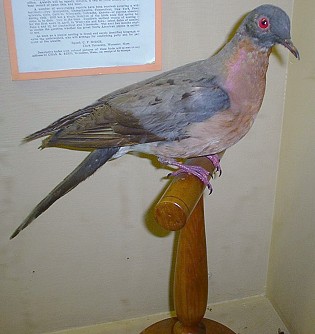
Martha |
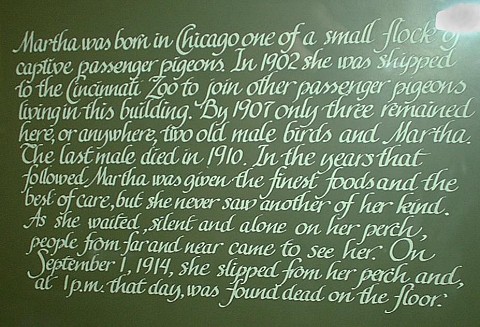
Martha's Plaque |
A few Passenger pigeons remained in captivity after 1900. The very last one was a female named Martha who died at Cincinnati Zoo at about 1:00 pm on September 1, 1914.
CO Whitman crossed a male Passenger Pigeon with a female domestic Ringneck Dove, resulting in infertile hybrids (hybrids lacked gonads). No other hybrids are reported and therefore hybridisation with another pigeon species and back-crossing to the last few pure-bred Passenger Pigeons might not have saved the Passenger Pigeon's genes.
You are visitor number