BRIEF HISTORY OF CHELMSFORD CATS PROTECTION (LEAGUE)
The first known mention of Cats Protection League activities in Essex is this report from the Chelmsford Chronicle, 16th November 1934, long before the founding of a local branch: CATS AS SCARECROWS CRUELTY CHARGE DISMISSED. On Friday at Chelmsford Petty Session, E. E. Farringdon, Esq., in the chair, James Buchanan, Fristling Hall, Stock, pleaded not guilty to cruelly ill-treating two cats between Oct, 14 and 18. Mr. D. Ward represented the defendant, and Mr. D. Ryan appeared for the Cats Protection League. Mr. Ryan, Inspector for the Cats Protection League, in evidence, said he visited Hall on Oct. 18, and in a field about 30 or 40 yards from the road found a cat tethered in a place where wheat had been sown. The material round the cat's neck was white cotton about 3ft. long, attached to a peg which was driven into the ground. There was box 18 inches long and 15 inches high to which the cat had access. He saw another cat fair condition pegged to ground with cord about 3ft. long. This cord was round the cat's neck. He went to defendant and said : " You are cruelly ill-treating two cats by making scare-crows of them on your farm." Defendant replied: "It good for them, and they must remain there until the grain comes through."
Witness and P.s. Mumford removed the two cats, which were handed over to defendant's wife. In witness's opinion it was wanton cruelty. In reply to Mr. Ward, witness agreed that the defendant denied there was any cruelty. Witness added that apparently it was a practice in the district, and it was desirable that it should be wiped out. In answer to Mr. Ward, witness did not know if the material with which the cats were tied was old stockings. P.s. Mumford, Ingatestone, said defendant told him his trade paper recommended stuffed cats as scarecrows. Witness told defendant they were not dealing with stuffed cats, but domestic animals, and advised him to remove them. Defendant said, "I shan't remove them. Get on with it; what you like. I can go to prison, it will a change from farming. Replying to Mr. Ward, witness said he considered the cruelty was the exposure to which the cats were subjected. The Chairman: Is it usual to chain or tie a cat up? Witness: I have never heard of it. (Chairman) Do you consider it cruel tie a cat up? (Witness)I think it is cruel to tie up any domestic animal in an exposed condition.
Mr. Ward, addressing the Bench, said Buchanan had been plagued with rooks. He had read in a farming journal that stuffed cats were excellent scare-crows. He did not want to shoot his own cats, and so he tethered them there with excellent results. He was not the only one who did it. Defendant had done it for a considerable time in full view of the public, and no one had complained except a lady from London and Mr. Ryan. There was no more cruelty tying up a cat than a dog. Farmers had had a bad time, and if they could find something that protected them from pests they should not be stopped from using it as long as it was done in a proper way. Defendant said had tried every method of scaring rooks, but found it unavailing except for a few hours. The cats were tied with silk stocking. The box was removed from the cats each morning and replaced at night. He did not think he was doing anything cruel. When Mr. Ryan called witness thought he had come for a subscription.
Reginald H. Spalding, Great Baddow, said he had kept Siamese cats for years, and during the day they were on a line because they were so nervous. There was difficulty in training them. Francis G. Haines, Margaretting, said the cats seemed contented, and in his opinion they had adequate shelter. It struck him that this was a new method of scaring rooks, and he was interested in it. He did not think it cruel. After a retirement the Chairman said the Bench found that defendant did not have guilty knowledge, and the case would dismissed. The Bench, however, did not approve of this method of scaring crows. Domestic animals should not be tied in this manner.
When I worked as a volunteer, I found that visitors to Chelmsford Cats Protection's rescue shelter and fundraising events often asked how the Chelmsford and District Group of the Cats Protection League came into existence. The story of the Group had been told in snatches in old newsletters and regular reports in the CPL Headquarters publication THE CAT, but until this 1993 "history" there had been no definitive history of the Group. This history was originally produced (as an official history) in 1993 to celebrate the 30th birthday of Chelmsford Cats Protection (formerly Chelmsford Cats Protection League) and was also provided to Cats Protection HQ for the files. In 2000, a few updates were made to this introduction and to the last part of the history covering the period after 1993, but otherwise this article remains unchanged.
Brief histories of the Group were set down in 1983, the Group's 20th Anniversary, and again in 1988 to celebrate their Silver Jubilee year; but a lot of the story could not be fitted into a single page of print. In 1993, I pieced together this more complete history from newsletters, reports and correspondence and this booklet attempts to provide a more detailed - and illustrated - chronicle of the events which culminated in Chelmsford CP's magnificent Shelter. The shelter beginnings were far more humble as you will see.
At the time of original compilation, every attempt was made to ensure that this account is accurate and unbiased although several inconsistencies in previous histories came to light during its preparation. Sadly, it is impossible to mention by name all of the very many dedicated volunteers who have been involved over the years. As the original leaflet stated back in 1993, the branch was very grateful to all of the 'unsung heroes'. This history stops after 2000, but the shelter's work continues and you are advised to visit the official Cats Protection website for current information and contact details.
A BRANCH IS BORN
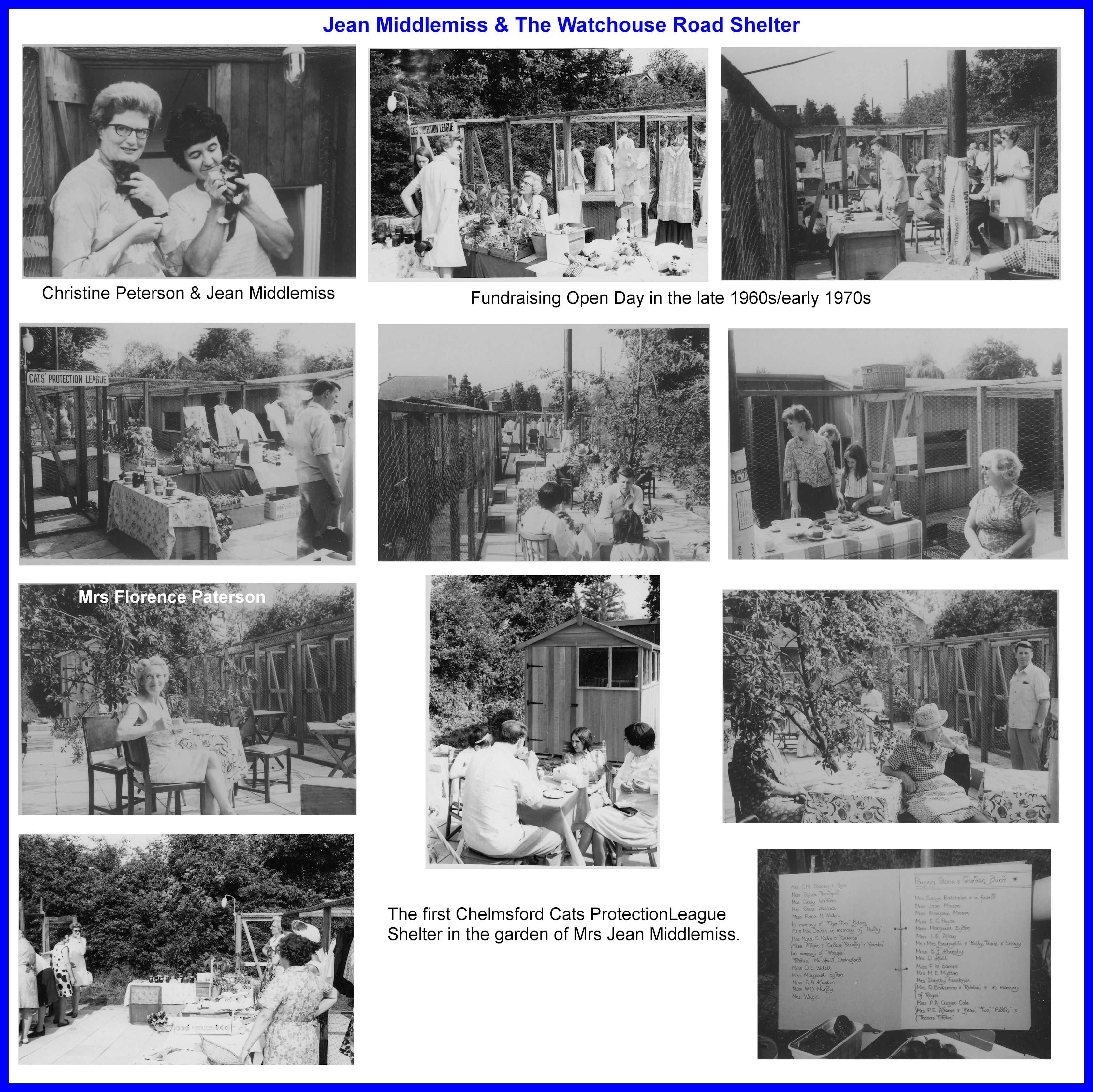
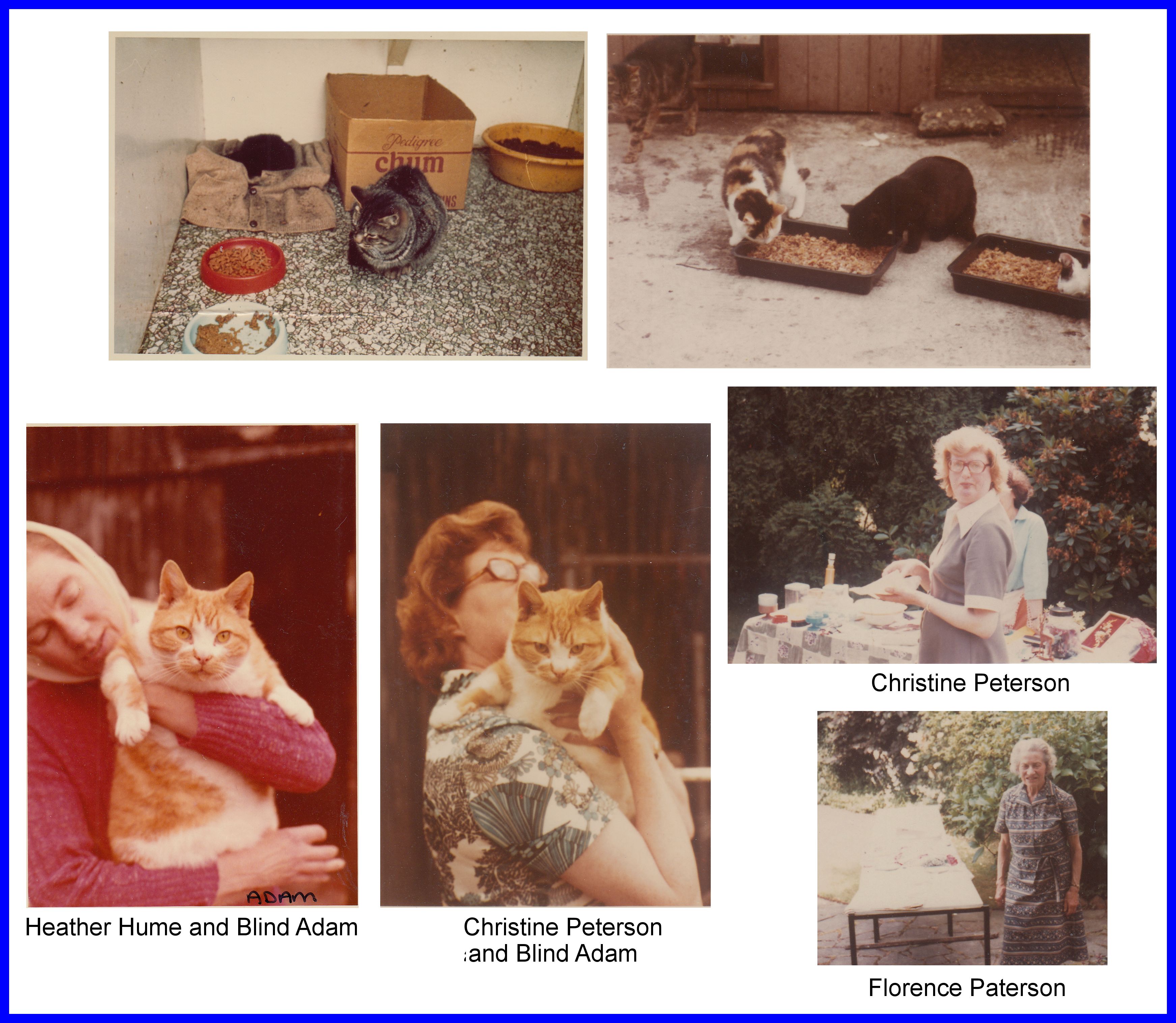
Chelmsford & District CPL was conceived in 1963 under the direction of Mrs Jean Middlemiss. Mrs Middlemiss had been doing cat-rescue work from her home at 335 Springfield Road for several years and felt that the time had come for Chelmsford to have an official cat rescue organisation. She wrote to local newspapers appealing for cat lovers to meet at her home with the aim of forming a Chelmsford Branch of the CPL. About 12 people attended the meeting, including Mrs Christine Peterson (now Christine Howe). A second meeting was held a month later and Jean Middlemiss was appointed Secretary of the new Branch, a position she occupied until her death in 1977. Mrs Connie Morgan, who remained an active member until her death in the 1990s, and the late Mrs Florence Paterson ("Chief Transport Fairy") also joined in those early days.
In those days, all CPL Branches had to prove themselves viable and self-financing before gaining official recognition so for the first few years, the Chelmsford Branch operated without assistance from CPL HQ ... and without their own shelter.
Until 1970, homeable cats were boarded at Mrs Groves's Bushmoor Kennels, Galleywood, on the outskirts of Chelmsford. Boarding cost half a crown per cat per day (2 shillings per cat per day if it was there for long). No healthy cat was put to sleep. Funds were raised by Whist drives and sales held at the Antiques and Coffee shop on Springfield Road behind what is now Debenhams and at the Plough Inn, Springfield Road. A local vet kindly gave the Branch very favourable rates and plenty of time to settle bills in consideration of the Branch's often erratic finances.
The July 1967 issue of the HQ magazine THE CAT mentions a Coffee Evening at the Plough Inn, attended by celebrity cats owned by Mrs Colville of Hornden-on-the-Hill. Famous felines included 'Brumas' the white cat better known as Arthur, 'Dotty' the James Bond cat from Thunderball, and also 'Nelson' the Cadburys 'Lucky Numbers' cat who had himself been a stray and who became the Chelmsford CPL mascot; frequently attracting people to fundraising events.
In November 1968, Chelmsford CPL achieved short-lived fame as the result of a chance comment to a local newspaper. Suddenly the Branch found itself featured on Anglia TV as "having 200 cats in a cattery, costing £200 a month to keep and destined to be put to sleep within the first fortnight". An article in the Daily Sketch gave the more realistic figure of 50 cats being boarded. As a result, several cats were homed and a number of donations arrived. None of the cats were in actual danger of being put to sleep, although bills were crippling.
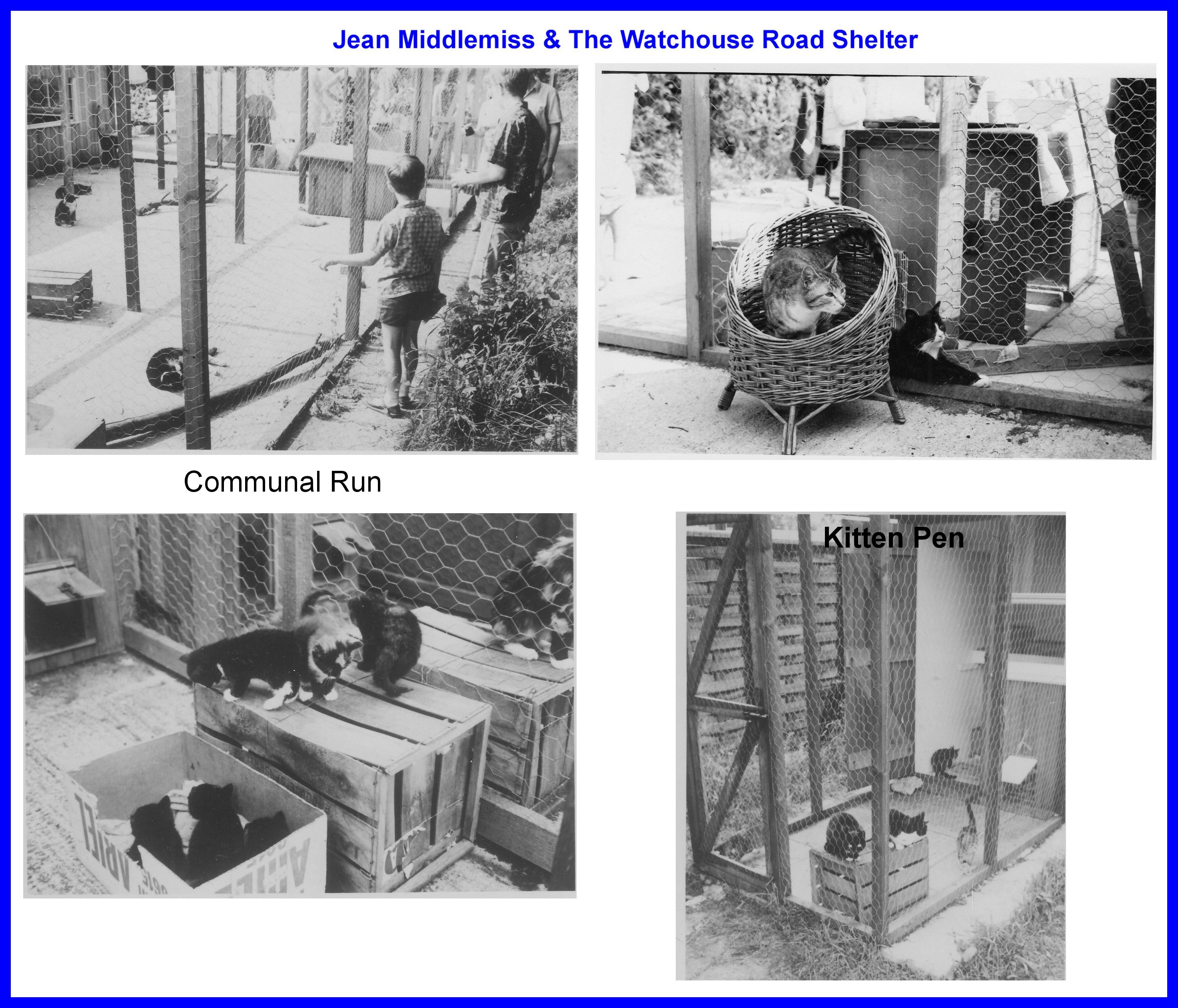
The June 1969 Newsletter mentioned the problem of relying on a boarding cattery for accommodation for 30 or more homeable cats at a time. Further homeable cats were lodged in volunteers' bathrooms, cloakrooms, bedrooms and kitchens.
"Life would be a lot easier if only we could have our own Shelter. Boarding all our 'unwanteds' in a private boarding kennels is a very expensive item, even though we are fortunate enough to pay a somewhat reduced rate for each cat. As hard as we work to raise funds we are always in debt; we could obviously cut the cost a lot by doing it ourselves - if only we had the initial cost of the actual cattery building, we could cope with the running ourselves. This is a pipe dream I suppose at the moment, but we would be able to help so many more needy cats which at the moment we have regretfully to turn away. Our hearts are willing but our bank account is not!"
Later that year, Jean Middlemiss moved to 112 Watchouse Road, Galleywood. This property had a large enough garden for a shelter and the September/October Branch News sounded optimistic:-
"...we are nursing a secret which we hope to reveal in our next report. A hint - our own shelter, in our Secretary's garden, has at last become a possibility IF ONLY we can get enough people to help us get it started."
But for some disastrous boarding bills the Branch would have embarked on the building of the much-needed Shelter during 1970 as this extract from the January/February Branch Report explains:-
"... we would now be well on the way to having our own Shelter. We actually have the garden, our more than willing Mrs Jean Middlemiss to run it, and the offer of some rather dilapidated sheds. It was always our intention to start off our Shelter in a very modest way, mainly housing kittens which are more vulnerable healthwise than adult cats, and also the more nervous cats who need a lot of personal attention and loving care to 'bring them round'. But now, due to our terrible financial difficulties we can't even contemplate starting this new venture which would mean so much to us and the hundreds of unwanted cats in mid- and North-Essex. We could do even more for them than we already do, if only we had our own Shelter. Amongst other things, boarding bills would be drastically reduced, and how very much easier our transport problems would be to organise. To make a firm foundation for the sheds, to move them from where they are to 112 Watchouse Road, to repair, heat and insulate them out nicely for our cat guests, probably wouldn't cost a great deal of money, but we can't do a thing about it with the debts we already have. So near, and yet so far."
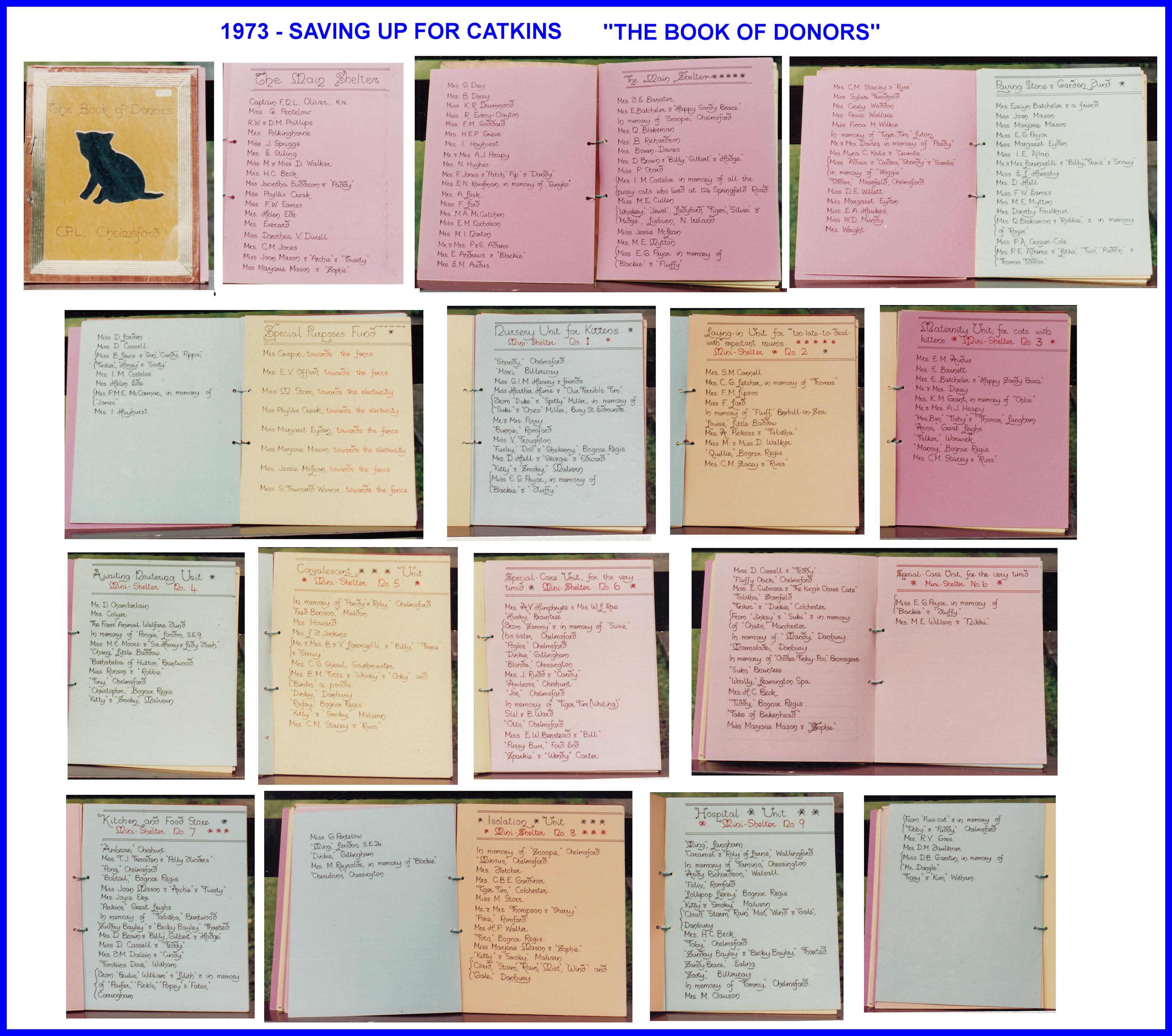
While planning permission was being considered, Christine Peterson began a 'Book of Donors' listing the supporters who contributed towards the building of the new shelter. Donors were able to contribute towards nine specific causes including 'The Laying-in Unit for Too-late-to-deal-with Females' and the 'Food Store Fund'. Each donor had their name recorded for posterity and many donations were made in the names of donor's cats, many of which had been rescue cats.
The saga continued in THE CAT in March/April 1970:-
"The foundation of our shelter is a reality instead of a dream. We have been 'planning' for the past two weeks and we hope we have no difficulties in getting planning permission. We plan to erect a wooden shed 24' x 10' on a concrete base, fully insulated to keep the warm in and the cold out. Infra-red heating and Vinolay floor for easy cleaning and two sort-of-shelves with cubby holes round the interior walls. The cats will be able to snuggle up there in the wood-wool/blanket lining provided. We will have a few baskets on the floor for those that prefer them. A complete wired-in 'compound' about two or three times the area of the shed built on concrete for hygiene will connect with the shed. This will be the main part of the Shelter.
We shall need several wooden sheds (mini-shelters) one, a nursery unit for kittens, two, for mums with kittens, three, for expectant mums and four, for cats awaiting neutering and five, for cats recovering from neutering operations.
The most important need of all is to have an isolation unit and a hospital unit. New arrivals will be in isolation for a specified period and when cleared will be able to join the others in the main Shelter. We shall also need a kitchen/store-room and a large area of Mrs Middlemiss's garden will have to be fenced in."
The plans sounded ambitious, but in the previous year almost 600 cats and kittens had been in the care of the Branch and many of these had been boarded at Bushmoor. Although the initial expense of building a shelter would be high, it would reduce the need to rely on catteries to care for the cats and would make visiting the cats far easier.
Outline planning permission was granted that summer and the planning committee met in June to discuss the Shelter plans. At least £400 was needed to complete the shelter. By September 1970, planning permission had been granted for the main shelter and mini-shelters. There was initial opposition from neighbours concerned that cats would be roaming loose to foul gardens and cause accidents. How on earth could we show prospective owners our cats if the cats were running loose all over Galleywood? Once it became clear that the cats would be securely housed in purpose-built pens, much of the opposition died down.
Although the builders promised faithfully to have the shelter complete before Christmas, four months later it was still only partly finished and boarding bills were eating into the money donated towards the new Shelter. By April 1971 the Shelter was at last open and running and was preparing for its first Open Day.
The first Sponsorship Scheme was launched in November 1971 to find permanent 'Aunts' and 'Uncles' to contribute regularly towards the upkeep of resident unhomeables. In return for a photograph and regular contributions, the first sponsors were allowed to name their chosen cat. Pusskin was elected Chief Spokescat and, with a little help from Christine Peterson, wrote a regular piece for the Newsletter telling sponsors what had been happening at the shelter. Pusskin was a great deal more outspoken than other contributors to the Newsletter, and rather prone to exaggeration, and should sometimes have been censored! For many years he was a great favourite with the 'Aunts' and 'Uncles' who could rely on Pusskin to tell them what was REALLY going on.
Over the next year or so, Mrs Middlemiss's back garden was paved and more sheds and runs were built, allowing the Branch to rescue and rehome more cats. It was no longer necessary to board cats at catteries. A number of Shelter Open Days were held with fundraising stalls and refreshments. However, while the new shelter was initially successful, there were soon renewed complaints from neighbours in Watchouse Road and in nearby Barnard Road. The cats were not roaming loose or causing accidents, but they were noisy and "caused unpleasant smells".
The shelter was kept immaculately clean and a tape-recording presented as proof of the continual noise caused by the cats was, in fact, made during feeding time when the cats were eager to be fed. The council, however, agreed that the shelter was causing unnecessary nuisance to neighbours. It was clear that the Branch would have to look elsewhere for more suitable and hopefully more permanent premises. This was partly due to the growing number of cats needing shelter and partly due to the increasing antagonism of close neighbours. It seemed that Chelmsford CPL had outstayed its welcome in Watchouse Road.
THE TURBULENT YEARS
In 1973 with the support of CPL HQ, and after protracted negotiations, the Branch purchased a bungalow with land at Battlesbridge, Essex, which was christened 'Catkins'. Initial planning permission was granted, conditional upon the closure of the Watchouse Road shelter, and the Branch began preparing 'Catkins' for use. The October 1973 Newsletter reported that
"we still await building planning permission to build our new, big, airy and splendid new Shelter ... At present the position is that the original Shelter [at 112 Watchouse Road] is still bursting at the seams. There are 'a few' cats at 'Catkins', Battlesbridge - the site of the new Shelter, and there are many cats which we care for throughout a large area of Essex."
Chief Spokescat Pusskin provided a detailed account of the planned 'Catkins' Shelter in the same Newsletter.
"Here we are with the most marvellous future. A property, purchased, and on it there is a neat little bungalow for Mr and Mrs Richardson, a garden and an orchard, in all about three quarters of an acre - and the ladies have wonderful plans drawn for it. All sorts of lovely buildings for us (well, high-class sheds really). Three will be very large with huge compounds for cats ready to go to good homes. Then there will be 10 separate 'Mini-Shelters' for special cats such as those waiting for kittens or waiting for a visit to the Pussies Family Planning Department I told you about once, and those that are a bit timid but won't be for long. Then there will be a kitten house and playground for orphan kittens, isolation units for pussies with something 'catching', a hospital unit near the bungalow for poorly pussies without something catching and perhaps recovering from a visit to THAT place. There'll be a food store, a kitchen, a box store and even a cloakroom for you when you come on Open Days. There'll also be a special shed for all those difficult cats ... who will never get a home as nobody wants them. They will feed and sleep in that shed but have the freedom of the orchard, surrounded by a cat-proof fence. Won't it all be splendid when we get the planning permission and it can be built. We all thought it would have happened by now, but the ladies are very poor through having to feed so many of us."
"Did you know that the name of the new Shelter is 'Catkins'. The ladies thought it would be a good idea not to call it anything VERY obviously to do with cats' protection because people would be coming from miles around to dump cats in the garden and scuttle off (as they do), and as the new Shelter is on a busy main road, they feared that Mr and Mrs R would be picking up poor dead pussies very often."
However, finances got steadily worse with money going into the building of 'Catkins' as well as on the running of the Watchouse Road Shelter. Committee members began to disagree and then resign. In November 1973 the Branch wrote that it looked as if it was not going to weather the crisis and that it might have to be wound up through lack of money and lack of local support. Somehow, the Branch struggled through 1974, having had two planning applications for 'Catkins' rejected. In February 1975 the Branch "lost" its Committee due to internal disagreements; this seemed no more than an inconvenience as remaining members had to shoulder an increased workload, but it led to serious problems a few years later.
Full planning permission was officially granted for 'Catkins' in 1975, on the third attempt, after 2 years of battling with red tape. However, costs had escalated over those 2 years and the magnificent shelter originally envisaged was not to be. As much as possible of the Watchouse Road shelter was to be moved to 'Catkins' in Battlesbridge and the new shelter was to begin in a very modest way.
"At long last we have some good news." the March/April 1975 Branch News reported, "After two years of battling non-stop with 'red tape' we have two days ago received planning permission for the new Shelter at Catkins, Battlesbridge, which is about 10 miles away from Chelmsford but actually much more central for the huge area of Essex which we cover. It is, alas with mixed feelings that we receive our good news. We shall no longer be able to have the magnificent Shelter we had planned two years ago. Costs have so escalated that it would be quite impossible now."
"We could go on and on saying 'if only' this and that had or had not happened, but now we shall look to the future and if it is possible strive harder than ever to shelter and find homes for cats. We shall move all we can of the present Shelter as the wood and paving stones are so precious, but we shall have to start the new one in a very modest way. We hope that over the next few years we can add to it and improve it. Things must get better rather than worse."
By June 1975, the first of the 3 main compounds had been built and foundations for the other 2 were being laid although these would not be completed for some time due to financial concerns. 37 cats remained at Watchouse Road and would make the 10 mile journey to the new shelter at Battlesbridge.
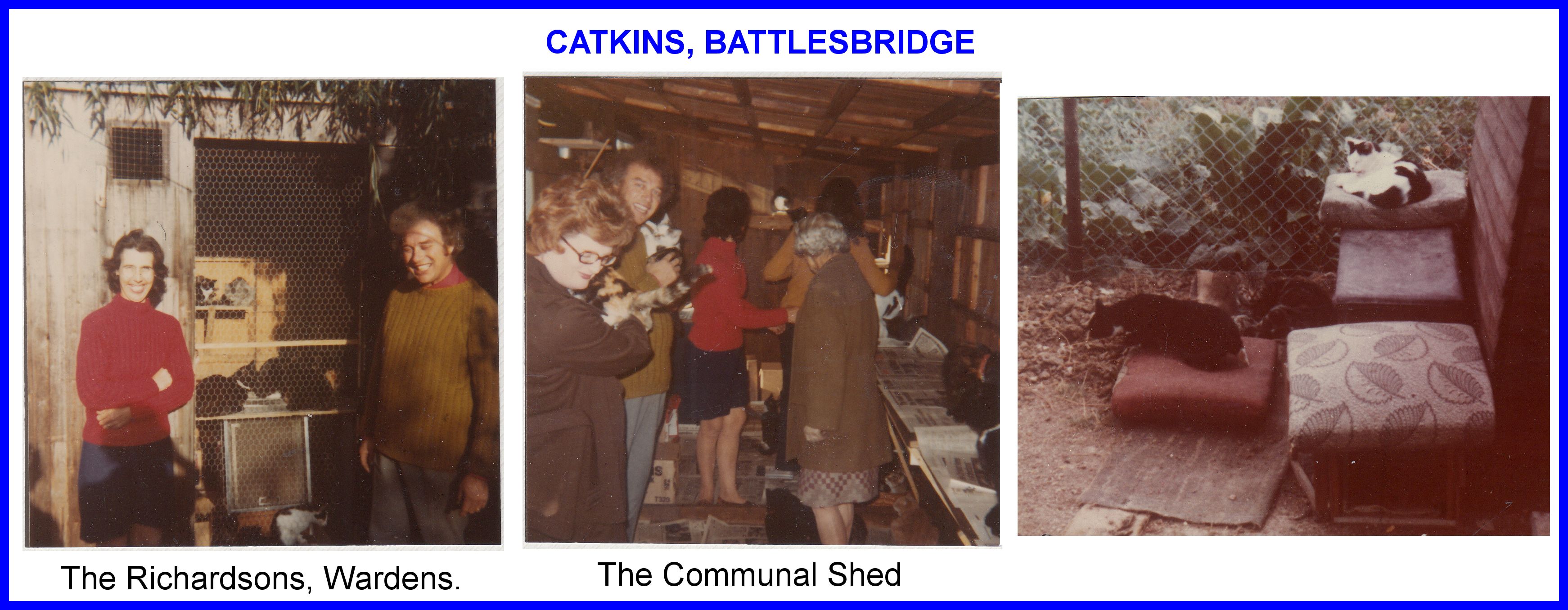
A number of cats, including some of the 'Pontlands ferals' (the original colony numbered 200) were moved hastily to the incomplete 'Catkins' as the deadline for the closure of Watchouse Road approached. However, by October 1975, the financial situation had worsened with mounting bills. It soon became evident that CPL Chelmsford would not be able to afford the cost of modifications, extension and upkeep of the bungalow, nor the salary of the warden, and consequently HQ agreed to take over the responsibility for 'Catkins', thereby relieving the Chelmsford Branch of the expenses.
In October 1975 Mrs de Clifford, CPL President, wrote "the only course is for HQ to take over the running of 'Catkins'". Two months later, this was confirmed in another letter from HQ, this time from Mr Parratt, stating "it is obvious that only HQ will be able to maintain 'Catkins".
Sadly, despite the Branch's policy of never destroying a healthy cat, there was no option but to put the feral cats to sleep. The Book of Donors was suspended, uncompleted. As a consequence of losing Catkins, cats in the Chelmsford area were again without temporary shelter before being found new homes. Christine Peterson wrote, in an early 1976 newsletter, "After we 'lost' 'Catkins' - and thankfully CPL Headquarters took over - we started again from the beginning. We had one week to close down our Shelter at 112 Watchouse Road because this was the condition upon our receiving planning permission for 'Catkins' to be built."
A SHELTER IN THE STORM
With closure of Watchouse Road imminent and 70 cats still in care there, the future looked bleak for the Chelmsford CPL. 30 of the cats were elderly unhomeables and these were moved to Basildon with Audrey Skennerton and to Great Tey with Audrey Parsonson where they were maintained by sponsorship. In view of the urgent need to close the Watchouse Road Shelter, a frantic search was made for new premises. The Branch was in dire financial straits and Jean Middlemiss resorted to selling plants from her garden wall to raise money for the cats. Watchouse Road no longer had permission to operate as a cattery, but there was nowhere for the remaining cats to go while they awaited homes and so the Branch risked the wrath of the neighbours and the authorities while it searched for somewhere to go.
Chelmsford CPL's 'shelter in the storm' was the late Walter Rolfe who was walking his dog in Watchouse Road when he saw Jean selling plants from her garden wall. They began chatting and Wally immediately offered the use of his large garden in Galleywood. So, early in 1976, after this chance meeting, Wally and Dorothy Rolfe's extensive garden in Galleywood became the new rescue shelter.
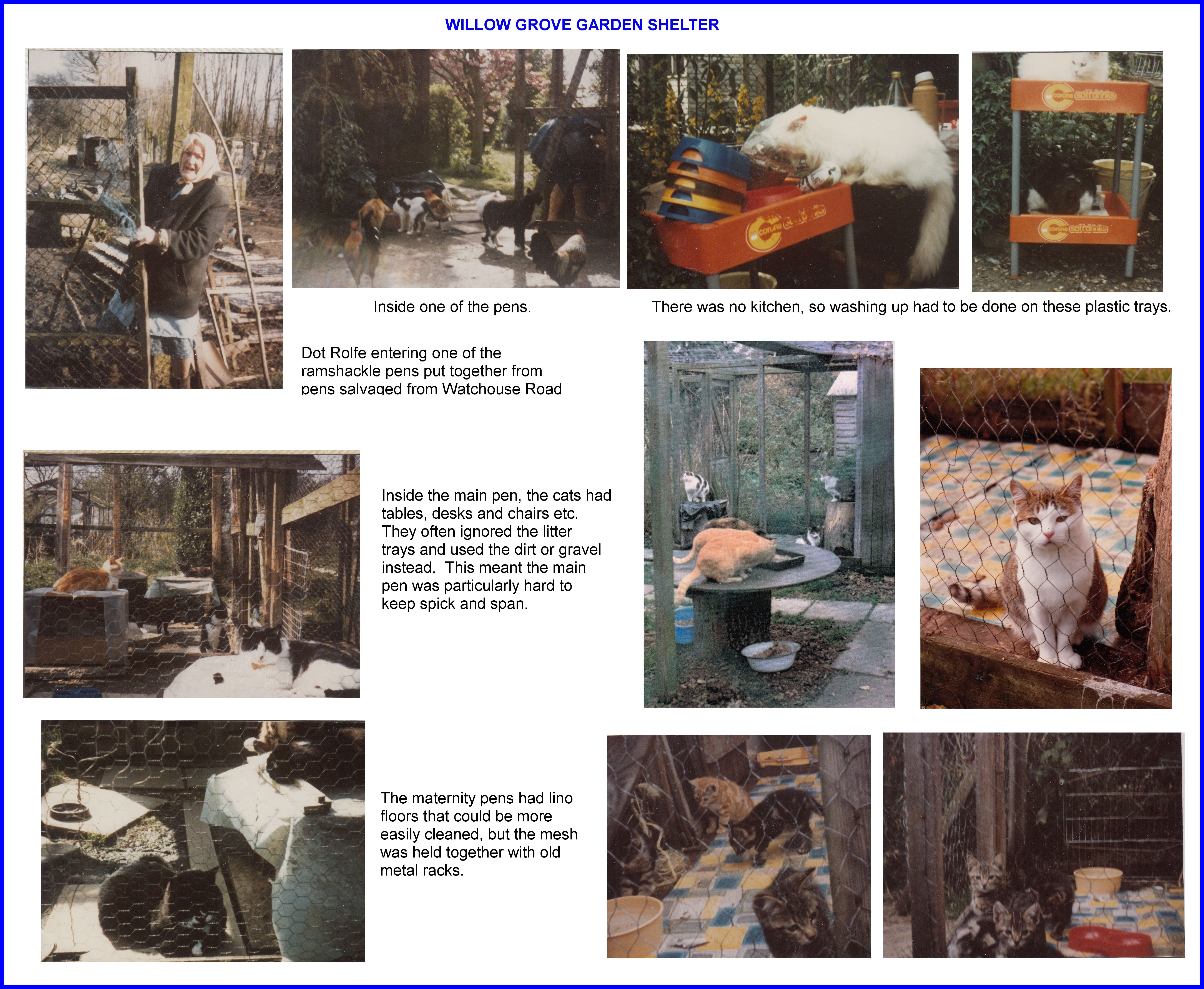
"These good people were more than willing to take on the task of caring for our homeable cats and so very hurriedly we put together four rather makeshift sheds using timber retrieved from Watchouse Road. We surrounded them and roofed them with wire netting. It all looks very ramshackle and primitive, but at least the cats have freedom. We are now trying very hard to raise enough money to buy two more sheds which will be outside the present enclosed area. One will be an Isolation Unit for we have found (to our sorrow) that cats must be isolated on arrival for at least two weeks. And kittens are so very vulnerable when enclosed with adult cats, so we must have a separate kitten unit."
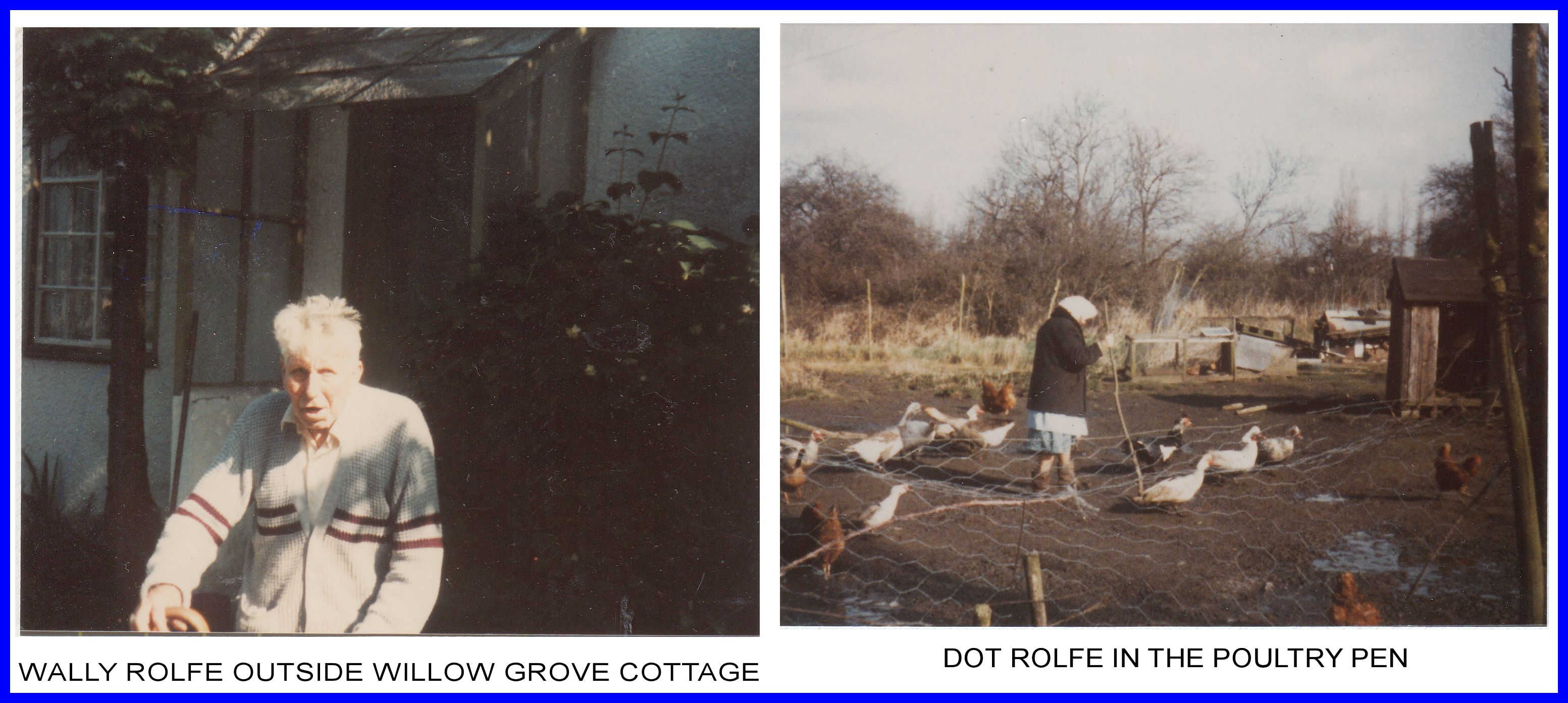
These makeshift sheds were hurriedly erected in Wally and Dorothy's three and a half acre back garden using whatever hadn't already been removed from the Watchouse Road Shelter for use at Catkins. This emergency shelter was indeed ramshackle and primitive, but for the remaining cats it was a reprieve. An Isolation Unit and a Kitten Unit were urgently needed, but the money had run out and to make matters worse, there were disagreements over which areas of Essex could be used for the Chelmsford shelter fundraising and which could be used by 'Catkins' without them appearing to poach donations from each other.
There were further clashes with 'Catkins', or as it was called at that time the 'Essex Cat Centre', over the fact that callers to 'Catkins' were referred to the almost penniless Chelmsford shelter because 'Catkins' was full! Chelmsford Branch wrote an urgent letter to CPL Headquarters, requesting that 'Catkins' activities became primarily concerned with Romford, Ilford and areas south-east of Chelmsford where there were no other CPL shelters, but there was continued ill-feeling between committee members who had stayed with the Chelmsford & District Branch and those who had joined the 'Catkins' committee.
The Chelmsford Branch had been officially disbanded in February 1975 during the 'Catkins' problems although it still continued in an unofficial capacity. Several ex-committee members had gone on to join the Willowtree Animal Sanctuary and thence to The Essex Cat Centre. The Chelmsford and District Branch protested that these ex-Chelmsford committee members were using Chelmsford CPL venues and tactics in their fundraising. Meanwhile, impoverished, disillusioned but determined, what remained of the Chelmsford Branch set about rebuilding what they had lost. The loss of 'Catkins' was a great setback as a great deal of money had been ploughed into the Battlesbridge Shelter. The committee had been disbanded and there was even confusion on the status of the Branch as Christine Peterson mentioned in a letter to Major Garforth at HQ: "Perhaps we should remain a Group - which Mr Parratt, we think, made us when he disbanded the Committee".
To quote from the June 1976 Newsletter: "... it was decided that CPL Chelmsford, and the magnificent new shelter "Catkins" at Battlesbridge should be run independently. The reasons being that our poor little Chelmsford Branch could not afford to maintain Catkins, and we were terribly disillusioned when it was decided that our permanent cats should not have a degree of freedom, grass, trees, earth, within the perimeter fence. It is bound to be successful with Mrs de Clifford taking a personal interest and we hope that when it is publicly "launched", someone, somewhere, will think kindly of the two people who caused it to exist." Those were the final words on the subject.
By June 1976, Chelmsford CPL were operating out of 3 'emergency' shelters - that in Chelmsford and those at the homes of Mrs Skennerton in Basildon and Mrs Parsonson in Great Tey. Additional cats were once again being housed in bathrooms and cloakrooms at members' houses. By this time Jean Middlemiss, the founder member of CPL Chelmsford was seriously ill with cancer and was confined to bed. By September she was too ill to write and the main running of the Group fell to Florence Paterson and Christine Peterson. Because of Jean Middlemiss's serious illness, the formation of a 'Branch' was postponed and Chelmsford remained a 'Group'.
The report sent to THE CAT for November/December 1976 opened thus: "At last our report is in time to let all our good friends and supporters know that we are still in existence, and that the homeable cats and kittens - dozens of them - are all happily enjoying their natural surroundings at our new Shelter. The past few months, which have included the transfer of all the cats from Watchouse Road to the new shelter and to our other two Shelters for 'permanent residents' have been absolutely hectic and we feel exhausted but still determined to make the best of things."
CPL Chelmsford, still in existence but unsure of its status, struggled into its 14th year in 1977 with 100 cats in 3 shelters throughout Essex. Planning Permission was required for the rescue shelter. The Planning Application was made by the Group's Solicitors in September 1977 and, as with all such things, moved slowly.
In early 1977, a Braintree man, Frank Kirby, left a little over £15,000, plus his own cat, to the Chelmsford 'Branch' of the Cats Protection League. However, because the Branch had been officially disbanded and re-established at 'Catkins' in Battlesbridge, the money went to Headquarters. All such legacies bequeathed to the League are paid into an account held by HQ on behalf of the Branch or Group concerned. There was uproar from the 'splinter group' in Chelmsford about this. Chelmsford CPL feared that the money would be paid not to them, but to the 'Catkins' shelter that they had founded. Christine Peterson argued that the Chelmsford 'Branch' was alive and well and that the bequest was clearly intended for them.
"The money is rightfully ours. Mr Kirby left it specifically to the Chelmsford Cats Protection League."
Although CPL Chelmsford, based at Galleywood, was still recognised by HQ and its reports were still printed in THE CAT, its exact status was suddenly unclear. To begin with, CPL Chelmsford did not own the proeprty in which the shelter was located and there was no Planning Permission allowing them to operate a rescue shelter from the premises. Any major expenditure on buildings would be wasted should Planning Permission be refused.
Major Garforth (Director, CPL HQ) argued that the Chelmsford 'Branch' had been disbanded and re-established in Battlesbridge but that HQ would respect Mr Kirby's wishes and use the money for the benefit of cats in the Chelmsford area, but he could not say how much of the money would go to the Chelmsford 'Group' at Willow Grove. Several local newspapers reported the committee split between 'Catkins' and which was dismissed as "When you get a lot of women together you always get some argy-bargy"! Chelmsford CPL had repeatedly argued that despite the committee having been disbanded in 1975, work had continued without a break and that the Branch itself had not been disbanded, but had merely suffered a change in status; furthermore, 'Catkins' was run entirely by Headquarters and not by the Chelmsford Group/Branch and that the wording of the bequest had specifically mentioned 'Chelmsford Cats Protection League'. After much debate and even a mention in the Daily Mail, it was agreed that the money should go to the Chelmsford 'Group' operating from Willow Grove.
Sadly, in April 1977, at the age of 51, Jean Middlemiss lost her long fight against cancer and did not live to see the matter resolved nor the new sheds which finally arrived at : 3 for Isolation Units and 2 larger ones for Kitten Units.
By August 1977 it was agreed that the legacy did indeed belong to Chelmsford CPL () and that it should be held in a trust to be invested in a building society to provide income to Chelmsford. The final sum was just under £14,000 which was to be placed in a high interest account by trustees. The Branch received a further legacy that month. Miss Christina Wilson, one of the Branch's founder members, bequeathed £3725 to Chelmsford & District CPL. £2908 was received by Chelmsford CPL after the deduction of £817 in settlement of debts incurred at the 'Catkins' shelter at Battlesbridge. This money proved extremely useful at a time when funds were so desperately needed.
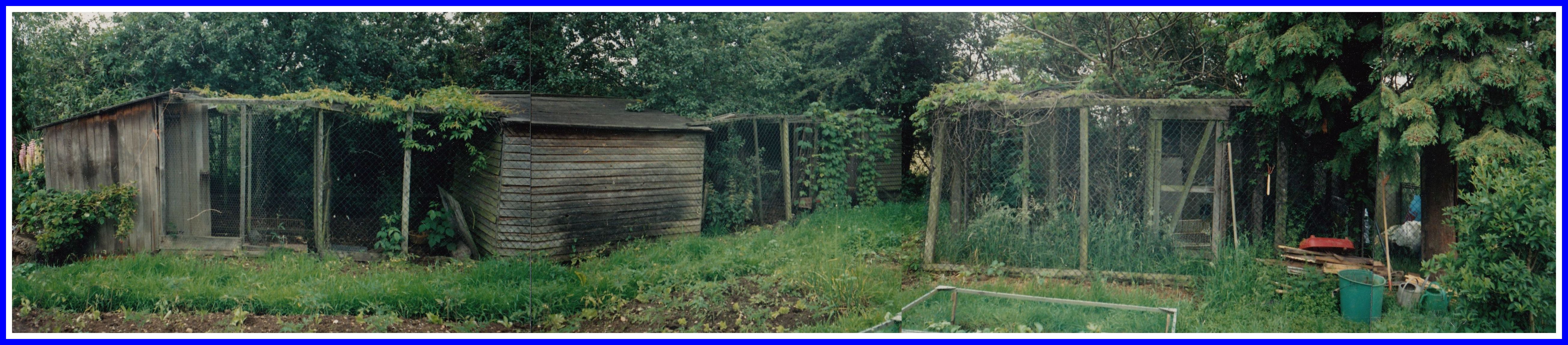
In January 1978, temporary Planning Permission was granted subject to a number of conditions: the building of a car turning area, no-one to encroach on neighbouring property and the clear marking of the premises as '' to comply with the local Planning Authority. This permission was valid until December 1978. It seemed that the fate of the shelter depended on the usual planning permission struggle against the objections of neighbours while the shelter managed on a shoestring. The cats were comfortable, but there were worries about enough food being available and the runs were in need of repairs which the shelter could ill-afford. Counting the cats at Basildon and Great Tey, and the late Mrs Middlemiss's 9 cats, Chelmsford Group were feeding 130 cats daily.
Looking back on correspondence from that difficult time, it is still unclear as to the exact status of CPL Chelmsford. The terms Group and Branch were being used almost interchangeably and much of the time the issue was neatly sidestepped by not using either term! The fact that some of the members of the Chelmsford Branch had left in order to join 'Catkins' made it hard to see where CPL Chelmsford ended and 'Catkins' began. In June 1978 Major Garforth wrote to advise Chelmsford CPL that the Executive Committee of the CPL had confirmed that Chelmsford CPL should be classified a Branch rather than a Group.
In April 1979 the Kirby bequest was still hitting problems and Major Garforth wrote:
"As regards the legacy, I have been chasing up the various Solicitors concerned in order to try and get this matter resolved [...] I do hope that soon we will be able to get possession of it and then we will have to think how it is to be used in order, hopefully, to find you a shelter."
Also in April 1979 Chelmsford Branch heard that the renewal Planning Permission had been refused because of complaints from close neighbours about excessive traffic and about hygiene. Dorothy and Wally Rolfe had devoted their lives to the destitute cats they cared for and a heartbroken Wally, then 71, told local papers: "I have put my whole heart and soul into this. It was the biggest thrill of my life when I was asked to have these cats. I shall be afraid to have any animals at all here now. I don't feel like staying here. There is another acre here that I would willingly allow them to use."
Neighbours had complained about the excessive use of a shared access, general nuisance, loss of privacy, bonfires which caused a foetid odour, and rats. The council immediately halted the erection of the new sheds (which were to become the 'Nine Pens'). HQ was asked to lodge an appeal on behalf of Chelmsford CPL. It was pointed out that there were stables and other livestock nearby which would almost certainly attract rats and cause smells. Letters from supporters appeared in the local papers, stating that the presence of the cats would deter rather than attract rats. A proper incinerator was in use to minimise the nuisance caused by the burning of old bedding and cat litter. However, in September 1979 an Enforcement Notice demanded that the shelter should be removed.
Planning Appeals were finally heard in October the following year. The Inspector for the Department of the Environment, who had listened to evidence from the CPL Group and the Borough Council, sent his report:- "SUMMARY OF DECISION. The Enforcement Notice is being quashed. Your clients' Section 36 appeals are being allowed and, subject to restricting conditions, planning permission will be granted." Additional improvements were required - parking space, as well as the turning area, and two industrial waste containers. CPL HQ came to the rescue, contributing towards these expensive items as well paying the legal costs incurred during the appeal. The formal notice of Planning Permission was issued by Chelmsford Borough Council in January 1981 and the council gave the go-ahead for the Group to start with the improvements to comply with instructions from the Minister of State for the Environment - including arrangements for refuse collection now that bonfires were banned and keeping the number of cats under 50. Only when the various conditions attached to the Planning Permission were met could Chelmsford CPL begin to improve and extend the shelter.
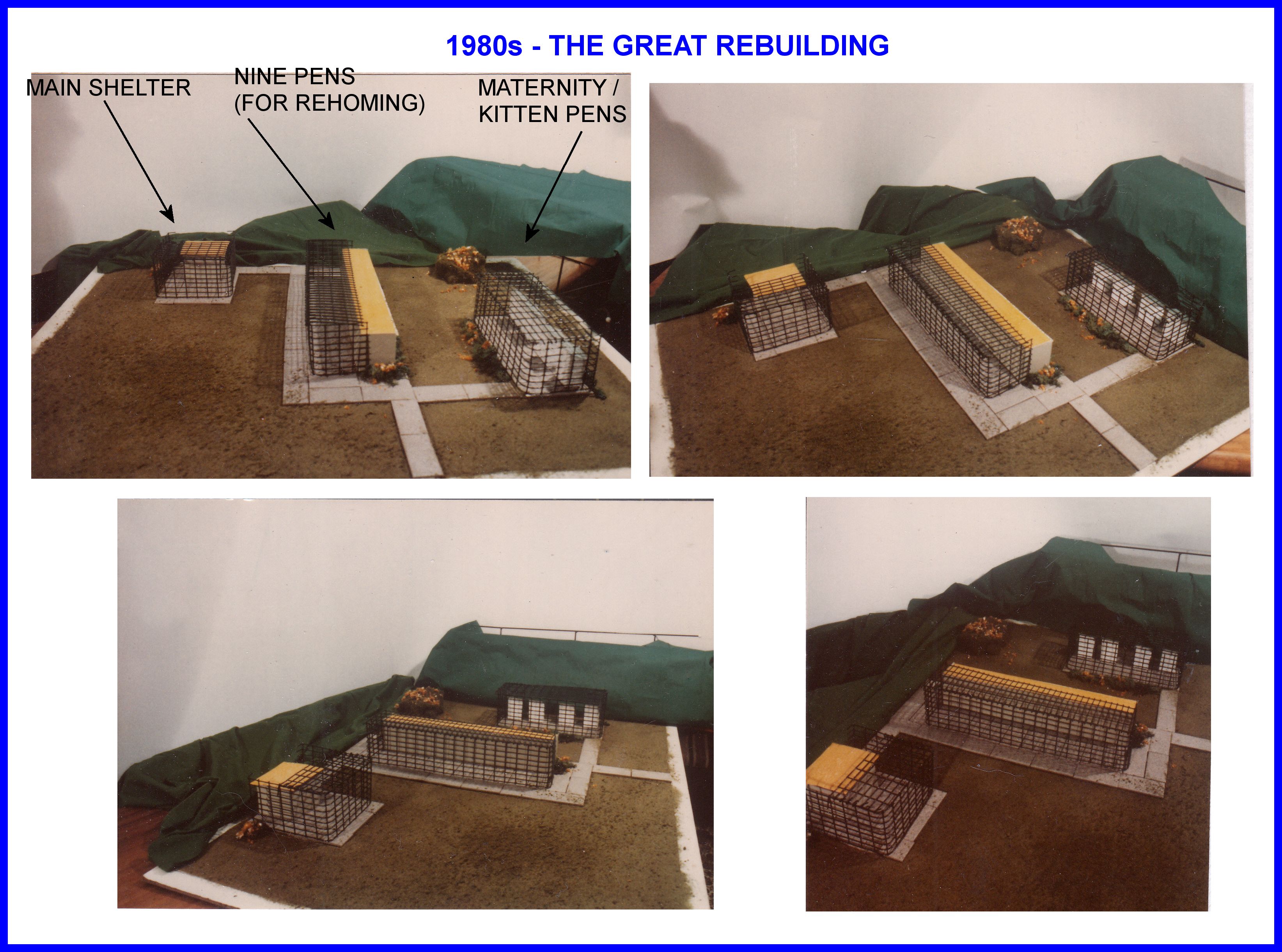
Tabletop model of the proposed shelter showing the "Main Shelter" (communal pen) at top left, the block of nine pens in the centre and a communal pen containing mini-shelters (chalets) to the right.
Unfortunately, by this time bills were 12 times greater than the balance in the bank account and an estimated £6000 was needed in order for the Branch to comply with planning restrictions. Despite the planning decision, the neighbours had not given up and sometimes resorted to physically obstructing workmen carry out improvement work. The actual cost of meeting Planning conditions eventually amounted to a little under £4000. A further complication arose after the purchase of two industrial waste containers as council vehicles equipped to empty them were unable to turn around in the small parking area!
The go-ahead was at long last given for the shelter to be improved and extended. Isolation Units were planned and the derelict orchard at the end of the garden was to be cleared to make way for the new buildings. Homeable cats had to occupy individual runs to minimise the spread of infections such as cat 'flu and enteritis. All enclosures, including those housing permanent cats, had to have concreted or paved bases after several cats died from an unknown poison picked up from the soil.
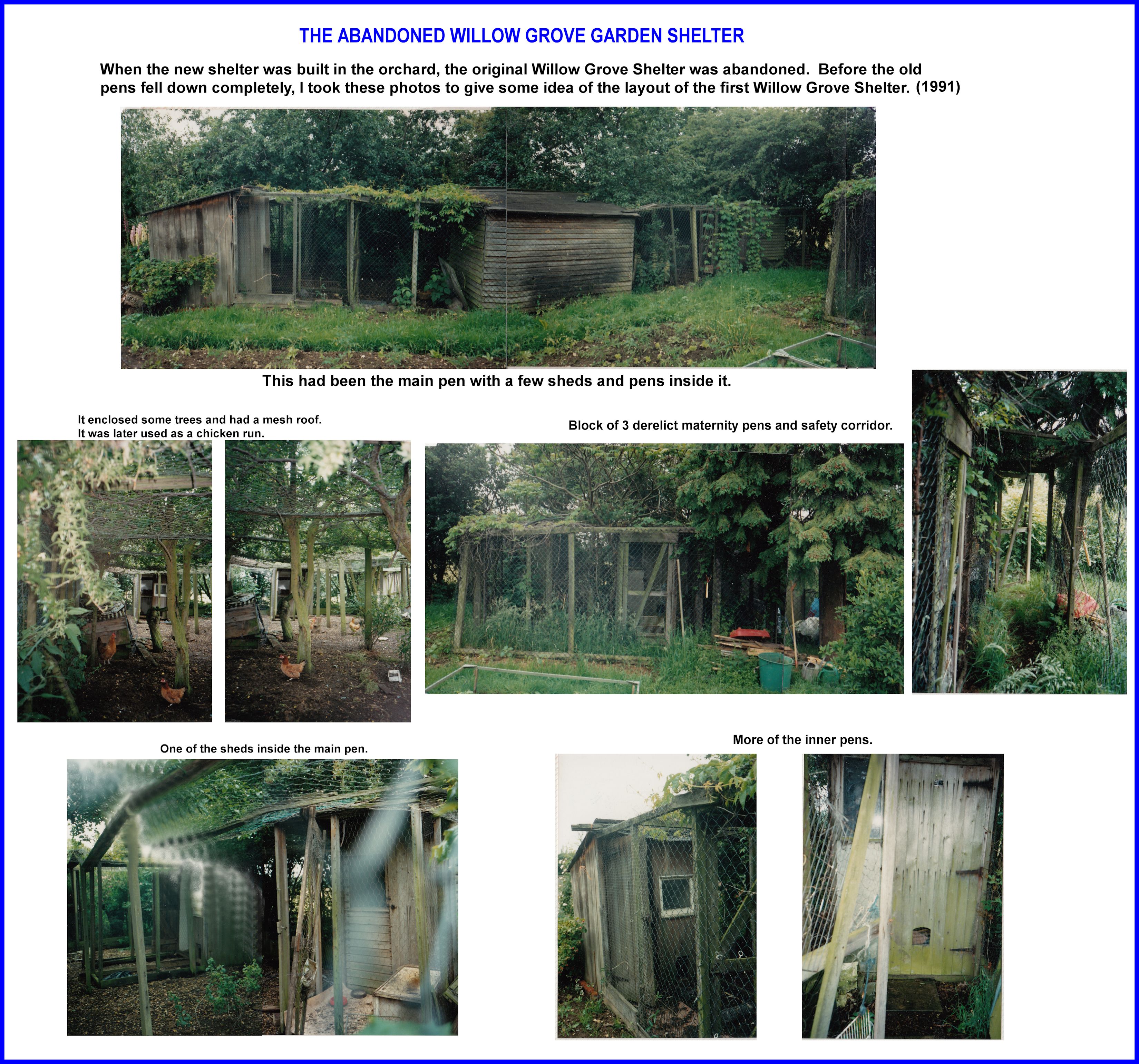
It was decided to completely rebuild the rescue shelter at the end of the Rolfe's garden, well away from neighbouring houses in the hope of avoiding conflict with neighbours. The much-patched shelter had only been intended as emergency accommodation and the "ramshackle and primitive" sheds and runs were difficult to keep clean and in need of constant repair.
THE GREAT REBUILDING
The 1981 rebuilding plans comprised the pens now known as 'The Big Pen' which provides grace-and-favour accommodation for a number of unhomeable cats and the 'Nine Pens' for homeable cats. In January 1982 things really began moving; helpers had been recruited to help Dorothy Rolfe, then in her 70s, care for the cats. In the Newsletter of June 1982, Christine Peterson explained all:-
"So in January this year we thought things were at last looking up. But no - our building problems had only just begun. The heavy snows not only brought down much of the shelter wiring, but also hastened the collapse of some of the sheds, which in any case had been 'botched up' from wood retrieved from Watchouse road, our original shelter, many years ago. Cats were escaping through minute gaps -as we know they can. We needed to concrete all the ground surfaces because of that mystery disease in the Autumn of last year, the cause of which was never discovered. So we took a long cool look at what we actually had, and what we needed. We were fighting a losing battle trying to patch and mend the near-derelict Shelter, so we decided that there was only one answer. Rebuild it all in the orchard, where we were already pledged to erect the four Isolation Units for which we now had planning permission. We knew it would cost many hundreds of pounds.
In February, work commenced on the clearing of the ground. I'll try to describe briefly how the re-sited Shelter will look. The site, well away from the bungalow at AND the neighbours' properties, has a field to the left and orchard to the bottom and right. We'll have one Main Shed for the semi-permanent cats - these are the ones that we always hope will get a good home, but they have been with us for a long time and remain unchosen because they are timid, very elderly, two are spastic, one is three-legged. These cats are happy enough where they are except that we continually seek the right person with enough love and time to care for one of them. Then, looking over the field, because that is the direction which gets most sunshine, will be a row of nine 4' x 4' cat houses with individually wired 6' long runs and safety corridor. To the right, and well away, will be the four Isolation Units with runs. Does it all sound nice so far? It will be better still because all the area between and around the Shelters will be lawn and shrubs, and there will be a paved walk from the entrance to the Shelter at the Orchard end. We'll move our little Kitchen cabin where the food is prepared and, if funds allow, build a sort of car port so that our good helpers can wash up all the cat dishes under cover. Imagine their difficulty in all that snow last Winter! As it is now, water has to be carried from bungalow, but it is a pipe dream (literally) to have water brought up to the Shelter IF funds again will allow.
How far have we got with our plans? The ground is cleared and levelled and we are waiting for the hundreds of paving slabs to arrive. The Shelters will be put on these and the runs will be slabs - just in case one day in the far distant future we have to pick everything up and go elsewhere! The wooden sheds, which are being made for us in Norfolk, are almost finished. We haven't ordered the wiring yet, but we'll need hundreds of pounds worth of posts, plastic coated wire netting and corrugated perspex roofing and partitioning. Writing it all down like this seems a financial nightmare. It is a nightmare really, because we have nowhere near enough money to complete the new Shelter at present and the cats are STILL escaping (We get most of those back after hours of searching, because they know that home, albeit so humble and temporary, is best)."
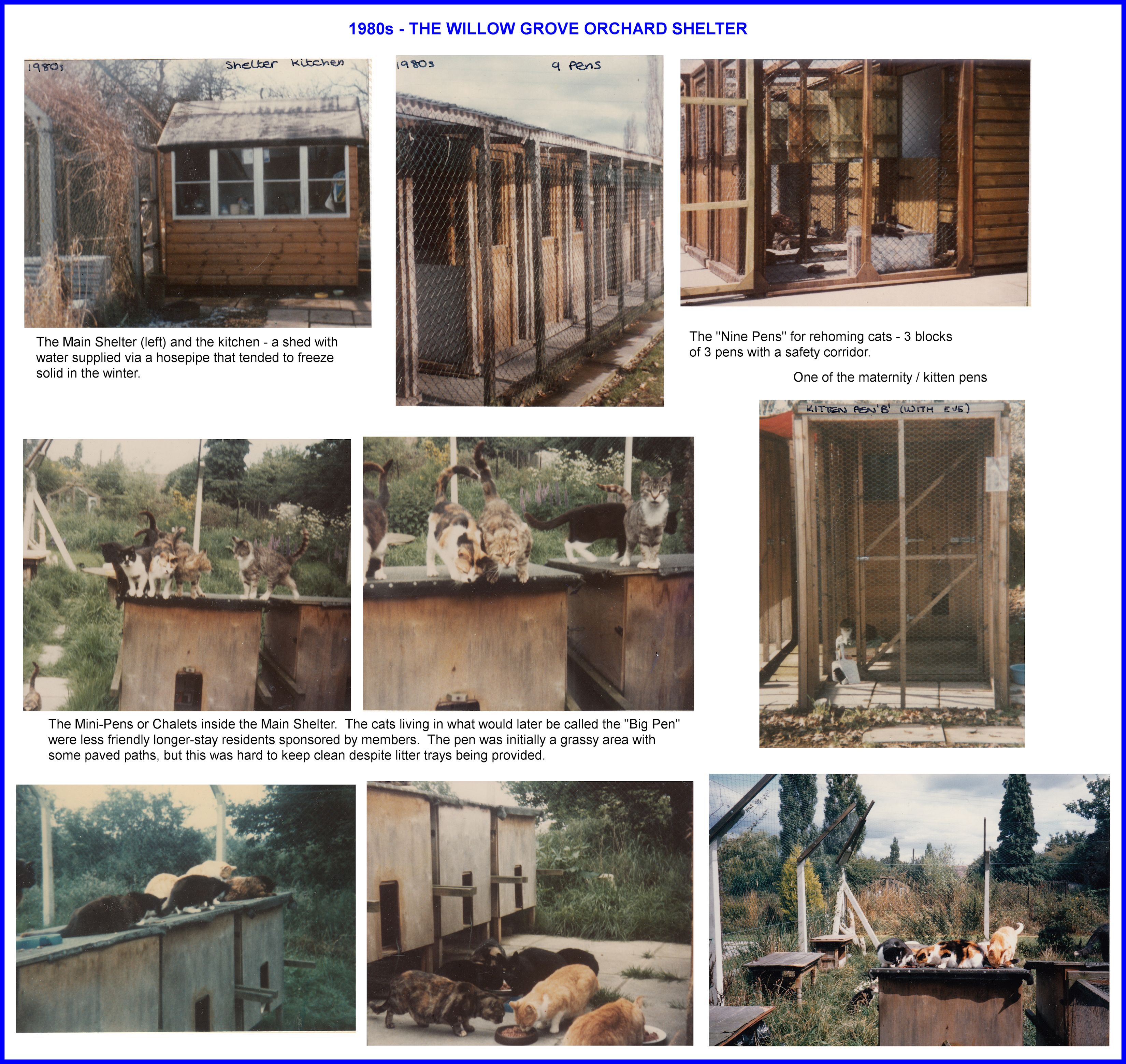
The November 1982 Group News in THE CAT gave mixed news about the new shelter:-
"The shelter is almost complete. The unusually wet summer which we endured at the beginning delayed the ground work considerably as the land would not drain, but here we are in early Autumn with the ground in the orchard cleared, levelled and turfed, the areas for the cat pens paved and awaiting the frames for the fencing, the cat pens and Isolation Units to accommodate 50 cats erected and waiting to be insulated and lined for warmth - it is all coming along very well. Financially the whole thing has left us severely skint."
1983 was Chelmsford and District CPL's 20th Anniversary. The March 1983 Newsletter reported that the shelter was well on its way to completion:-
"We hope that by the summer it will be completed. The very many friends who have contributed to the enormous cost will like to know of its progress. In one word, SLOW, but nevertheless coming along nicely. Delivery of the basic cat houses is only the beginning of the work to be done. The sheds have to be weatherproofed outside, lined with insulation and a washable surface inside, sturdy runs and compounds have to be made, and what seems like acres of plastic-coated wire netting put up everywhere to make the Shelter escape-proof -which the present falling-down certainly isn't.
First of all, the large overgrown orchard was cleared, levelled and turfed and a water pipe and pathway were laid up to the new Shelter site. Paving slabs were laid as bases for the new sheds and runs. This took many months and cost £4000. Then, months later, we took delivery of nine 4' x 4' sheds, in blocks of three, these to be the everyday accommodation for all the nice homeable cats and kittens. These sheds have to be insulated with polystyrene and lined with washable melamine coated hardboard so that the cats shall be warm and cleanly housed. Finally, they will have an easy to clean floor and a shelf or two for beds and a cat's eye view to outside. Each shed has its own very well built individual long run with a gate leading into a safety passage so it SHOULD be impossible for cats to escape. Those nine cat houses are nearing completion and we pray that they are ready very soon for the kitten season is almost upon us. The timber has been treated with cat-safe Cuprinol as opposed to highly toxic creosote, and the plastic-coated wire netting to divide and cover the runs overall has been delivered and awaits someone to nail it on and do a very thorough job of work so that no limbo-dancing copy-cats or small kittens can get out through the bottom. There is still a fair bit of work to be done on the nine 'General Shelters'.
Then there is the 'Main Shelter' for the permanent and o.a.p. cats - the ones who will be much happier to stay with us for a variety of reasons - all to do with their background, histories and personalities. We are buying them a lovely big shed which will also be lined, cleanly floored and fully furnished for these special cats. Outside their house, they will have a very large compound measuring 45' x 30', surrounded by 'monkey fencing' - the sort they use to keep lions and tigers in at the zoo! Any cat so desperately wanting to leave home would have to walk upside down, hanging on, backwards. I've no doubt we'll find one or two who can. The fence probably won't stop other clever cat climbers getting IN, but they will be very welcome if they too are desperate for one reason or another. All the work for the 'Main Shelter' is now underway. We were a bit upset when horses from the adjoining riding stables broke in and wrecked our newly laid turf a few weeks ago, but you should see it now that the construction people are at work - and in any case it won't look so beautifully turfed when our cats are in residence. Some cats will not use the communal litter trays!
The Kitchen Unit for food preparation and washing up, a storage shed for food, litter, cartons, carrying baskets etc is awaiting erection, and after that the remaining task will be to provide the Isolation Units and several small pens for emergency use. The Isolation Units are meant to be for cats waiting to be neutered or spayed, cats who need to be isolated when they come in to make sure they are healthy, or very rarely we pray, cats with a serious illness. The small pens, not yet ordered, will be fairly plain and not with all the insulation, lining, sturdy runs etc. Just a 3' x 3' wooden hutch, with a cat door, a lift-off roof, standing on legs well off the ground, and with a run 3' wide by 4'6" long. Very, very useful and very portable. These will be for all the emergency entrants we get without prior notice - mainly at night, such as cats dumped on our doorstep, mothers and kittens in cardboard boxes or worse, plastic bags, and left in lay-by's, accident cases often brought in by the police, cats we take in "because if you don't I'm having it put down tomorrow" and so on. The 'Mini-Pens' will be very much in use. We think they will cost about £40 each and we could do with eight or ten."
The cats were moved into the new shelter in September 1983 although one individual was reluctant to move and took several days to capture! At this point, Dorothy Rolfe indicated her wish to retire from full time responsibility for the shelter and a daytime Warden was sought. In October 1983 the Chelmsford and District CPL proposed to become a GROUP rather than a BRANCH. This would allow a more informal basis for operation. The change of status was agreed by HQ in November. Christine Peterson became the temporary Co-ordinator for the Group. Unfortunately, in 1983, the Group also lost most of its key committee officers through illness and retirement; Dorothy Rolfe badly needed a rest, Florence Paterson (nearly 80) had undergone major surgery and reluctantly had to give up the very demanding Co-ordinator's job, Treasurer Len Spensley had a foot amputated and was unable to continue with the transport of heavy items to sales and to the shelter, Christine Peterson had suffered a stroke in July and was advised to 'slow up a bit'. As a result, many new officers were appointed for 1984: Jackie Jennens (Co-ordinator), Christine Davenport (Treasurer), Cathy Buckledee, Avril Hodgkins and Jenny Surrey. Christine Peterson 'retired' to the post of Membership and Appeals Secretary, which allowed her to maintain contact with the many supporters she had built up countrywide since the founding of the group 21 years previously.
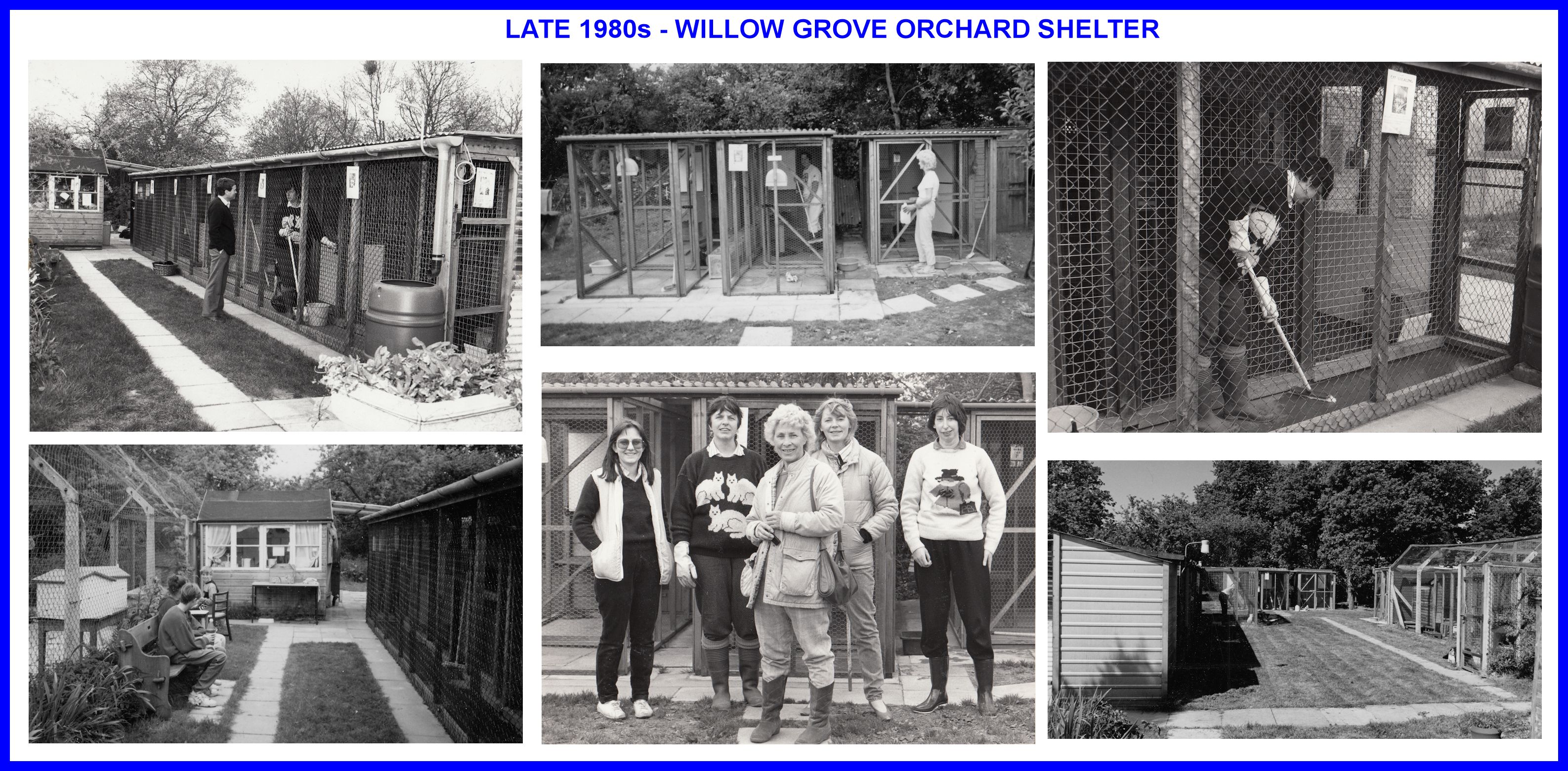
By March 1984 only the two Isolation Pens and two Kitten Pens remained outstanding on the list of building works. By September only the 'Sick Bay' was uncompleted; the wire-fencing had been erected, but the two new sheds had not been delivered. At long last finances were looking healthy after a series of successful fundraising events and the virtual completion of the Shelter. After all the struggle and hard work which resulted in the building of the 'Main Shelter' and 'General Shelter', came a period of consolidation and improvement to facilites. In 1987, it was arranged for CPL HQ to purchase the old orchard area (on which the Shelter now stands) from Mr and Mrs Rolfe, ensuring the future of the shelter. HQ met 90% of the cost, the balance being met by the Group.
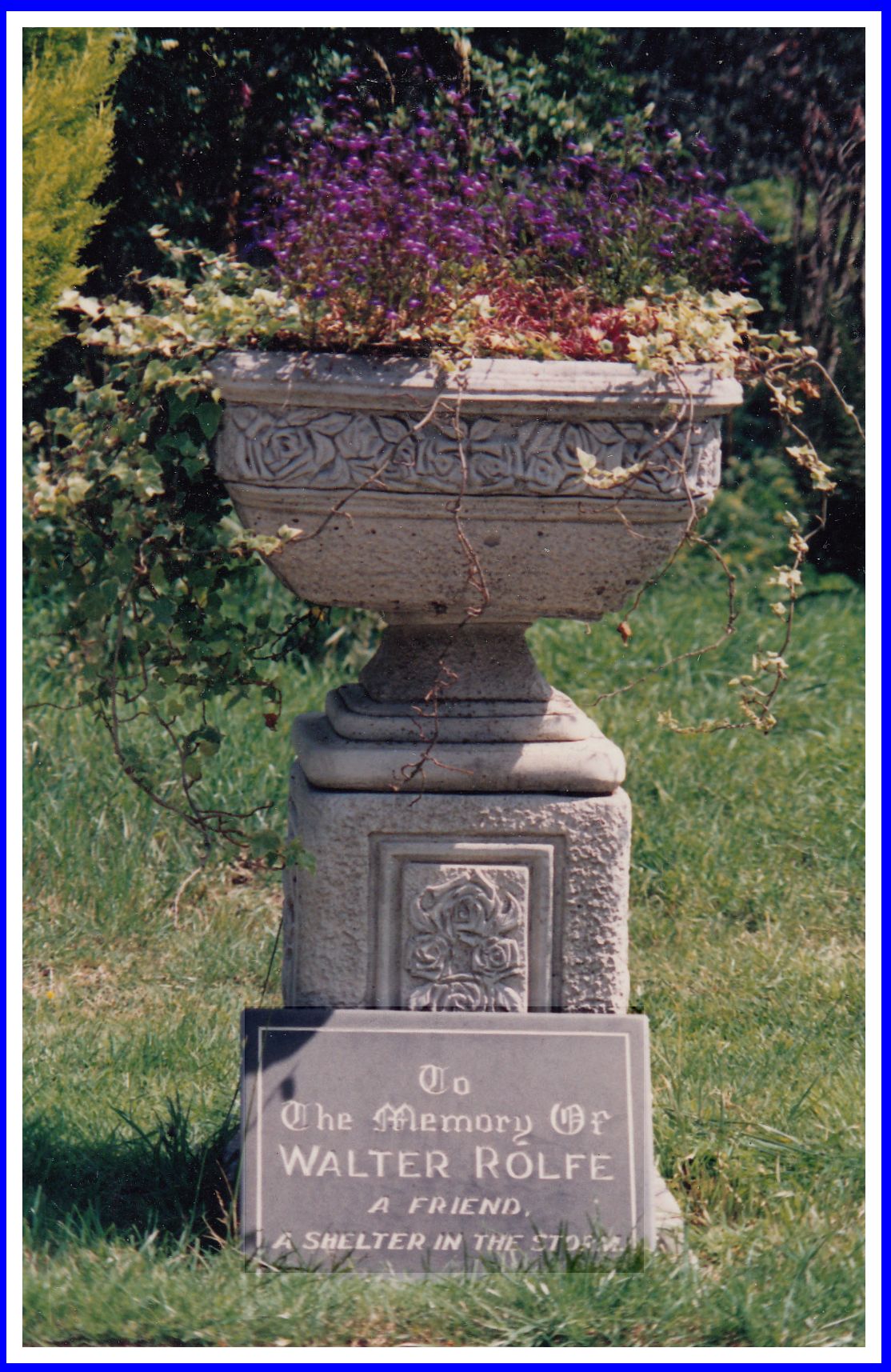
In May 1987, Florence Paterson, one of the Branch's founding members, died. She had been in very poor health for some time, but had been active into her 80s homing cats despite failing sight and hospital operations. In 1988 another of the Branch's great historical figures was commemorated when a memorial to the late Wally Rolfe, a 'Shelter in the Storm', was placed at the entrance to the Shelter proper, close to the 'Nine Pens' and the 'Main Shelter' (now known as the 'Big Pen').
In 1987/88 a 6-cage Isolation Block was erected. 4 new kitten pens were built at the rear of the shelter, bringing the total to 6 kitten pens. In 1989 the 'New Pen' was built to accommodate further unhomeables and semi-ferals. Both the New Pen and the Big Pen were fully paved to make them more hygienic and the New Pen was fully wired over to prevent escapes as some OAPs had managed to surmount the formidable obstacle of expert-designed monkey fencing.
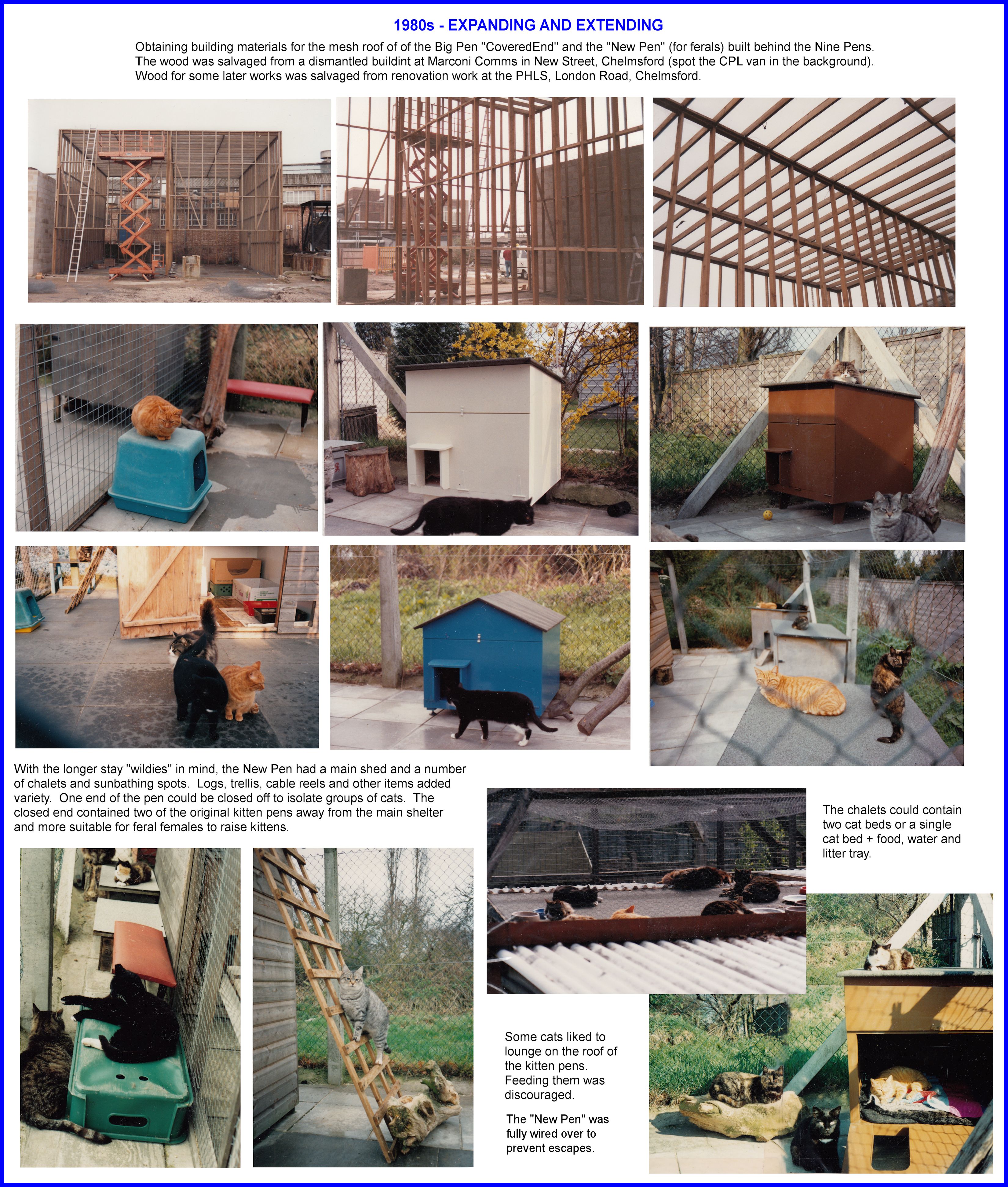
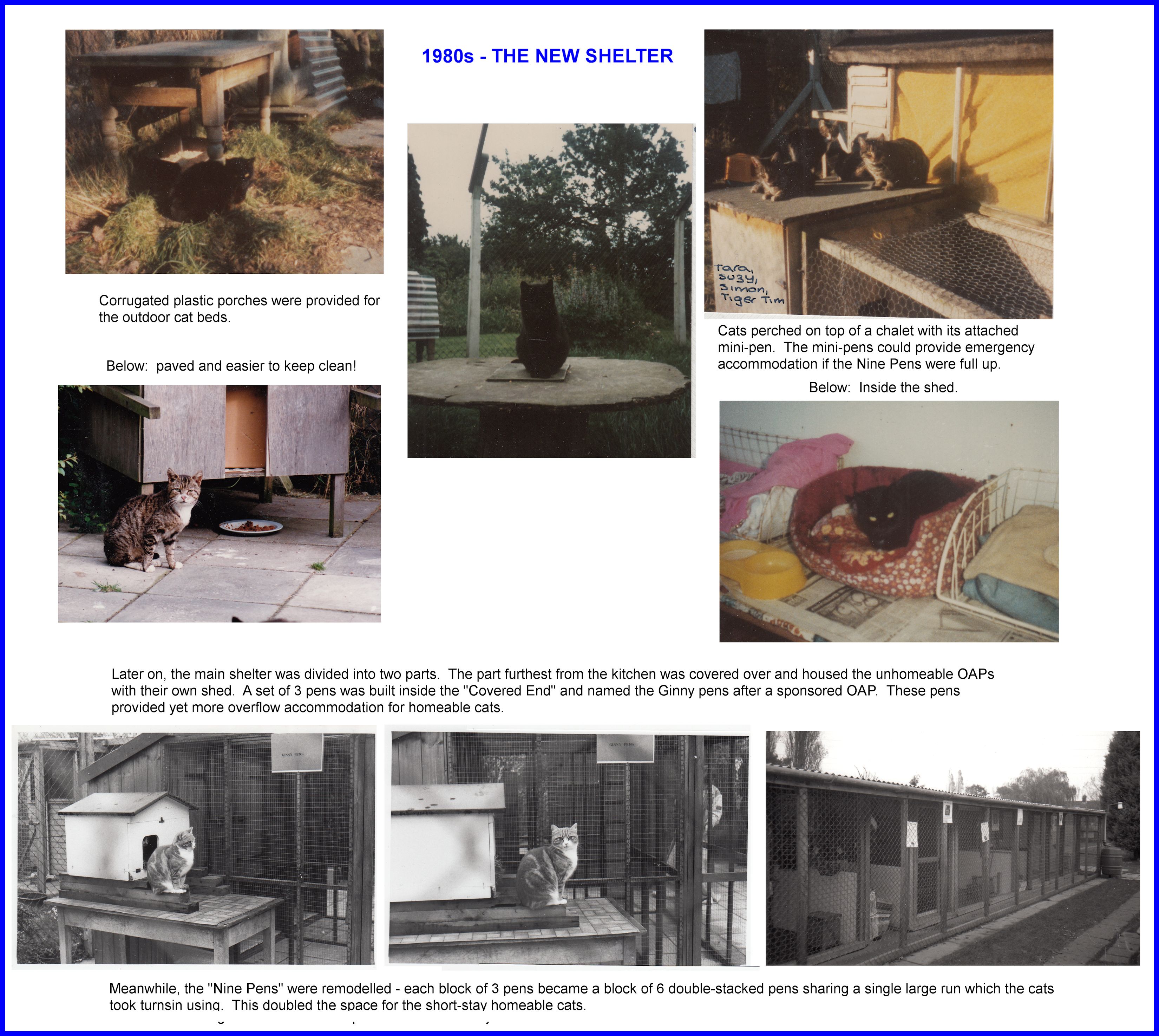
The 'Nine Pens' had originally been built so that each pen had its own run. To meet increased demands, the Nine Pens were converted into 18 smaller one-up one-down pens, each housing one cat or occasionally two cats from a single household. The front runs were remodelled so that six pens shared a single large run which made cleaning easier and replaced the Mini-Pens. Two further kitten pens were built (situated inside the New Pen), bringing the total to eight and heating had been installed in several of these as well as in the Isolation Unit. A block of 3 portable pens with runs was erected inside the Big Pen as emergency housing in the same way as the original mini-Pens. They were named the 'Ginny Pens' in memory of a sponsored cat.

In July 1989, the indefatigable Christine Howe (formerly Peterson) formally retired from the post of Membership and Appeals Secretary. She had been in the thick of the action right from that original meeting in 1963 and had soldiered on through thick and through thin with Jean Middlemiss, Florence Paterson and then Walter and Dorothy Rolfe. During Jean's illness, Christine became the driving force who refused to give up even in 'our darkest hour' - from the refusal to renew Planning Permission at Watchouse Road to the disbanding of the Committee and the 'loss' of Catkins, through to the fight to obtain Planning Permission for and the subsequent 'Great Rebuilding'. Over her 26 years of service to the Group she has been Secretary, Co-ordinator, Chairman, Newsletter Writer and Editor, Treasurer and Fundraiser extraordinaire. She has been deeply involved for 21 years, from 1963 to the end of 1983, and not much less involved from 1984 to 1989 - and for many years she continued to work hard behind the scenes. The post of Membership/Group Secretary was taken over by Lynn Whitmore who was already running a very successful sponsorship scheme to find 'Aunts' and 'Uncles' for the unhomeable and feral cats cared for by the Group. She was succeeded as Membership/Group Secretary in 1992 by Sheila Jordan. Another of the Group's founder members, Mrs Connie Morgan, remained active on the fundraising side until her death in the late 1990s.
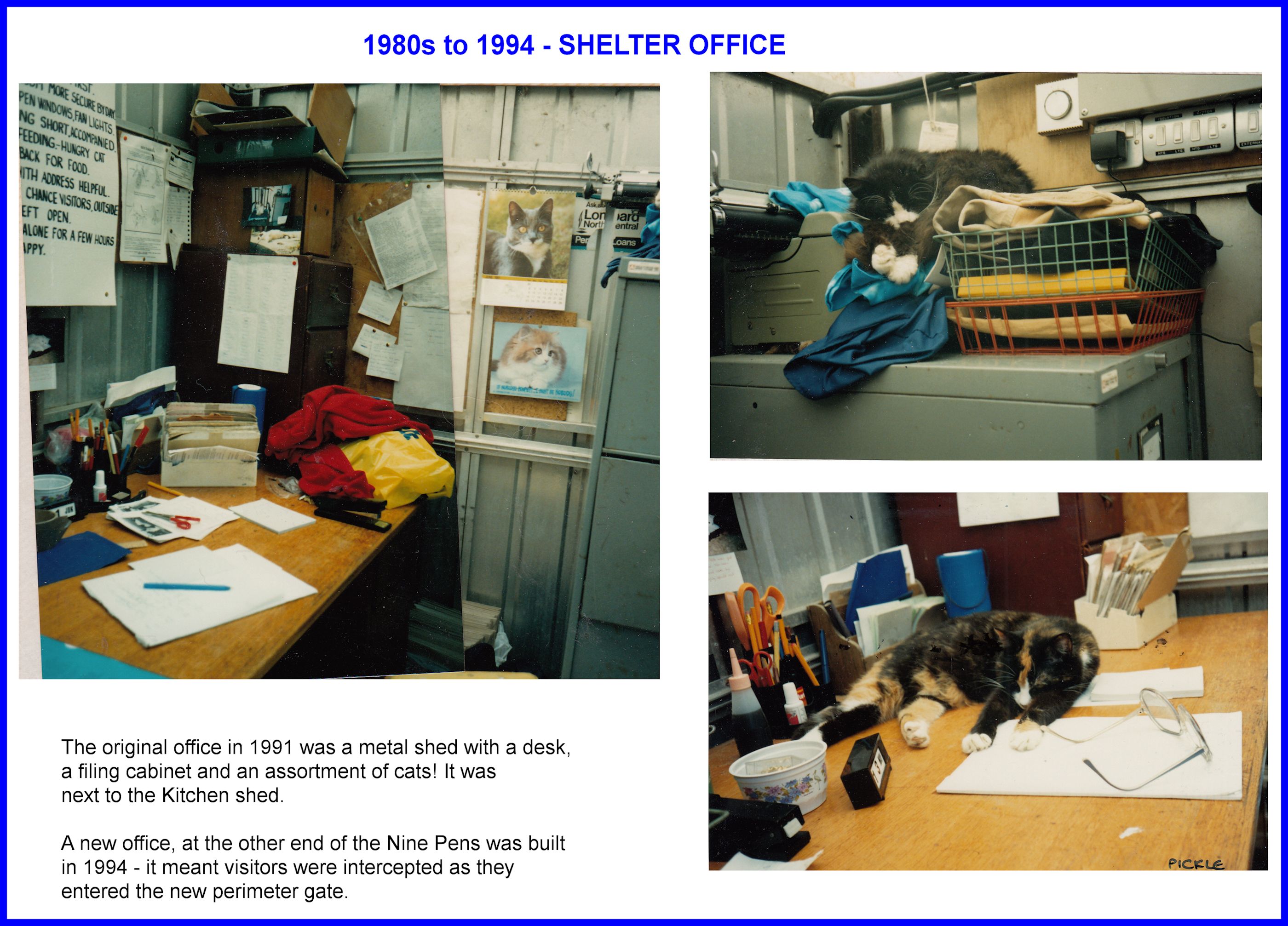
To keep the Group's flag flying whilst on errands of mercy, a Rascal van was purchased in December 1989. It displays the CPL logo and Chelmsford & District Group's name on both sides. The van not only enables the Group to rush cats to and from the vet, it is used for fundraising and for transporting huge quantities of cat litter, building materials and other items needed to keep the Shelter running and maintained.
In 1991, the Big Pen was divided across the middle. One half was covered over with wire mesh and used to home young semi-feral cats which had been neutered and stood a good chance of becoming tame. The uncovered end houses OAPs and cats unlikely to escape over the high fencing designed by an expert in Zoo enclosures who had not reckoned on agile and determined felines. An old but agile cat named "Blackie" simply came and went as he pleased over the top of the fence, the overhang proving no obstacle to his ingenuity.
The 1990s saw substantial improvements in facilities at the shelter, both for the cats and for the voluntary helpers who are the lifeblood of the Group. Electricity for heating and lighting was laid on in November 1989 and the Isolation unit and several of the Kitten pens were heated. A mains water supply arrived in December 1991; a great improvement on the old 'hose' system which used to freeze up in winter. With the arrival of mains water, a water heater was also installed, removing the need to boil kettles of water for scrubbing the pens. The addition of a telephone in January 1992 gave the shelter better contact with the outside world and the resurfacing of the entrance driveway in February 1992 allowed the outside world to reach the shelter more easily. During 1992, back runs were added to the 'Nine Pens' to allow more of the cats to get exercise.
Although the improvements added considerably to running costs, it is hard to imagine how the shelter managed without electricity, mains water, telephone or van. By its 30th Anniversary, the shelter stood as a tribute to all the many helpers and supporters over the last 30 years in the cause of cat rescue. In Spring 1992, the Chelmsford shelter was chosen as one of the locations used in a CPL HQ training video; a fitting tribute to all those who had, over the years, worked so hard to overcome the many setbacks.
1993, the Branch's 30th Anniversary Year for which this history was originally compiled, was not the end of the story. Further improvements to the shelter were planned and took place during that year: the erection of a new Recovery Unit for non-infectious or post-operative cats, with runs so that recuperating cats can exercise; and initial plans were made for a chain-link perimeter fence so that cats which do manage to escape from their pens cannot escape from the grounds. There was a breakout in 1992 when a stray dog broke through the wiring of the 'Covered End' of the Big Pen in search of cat-food and as well as keeping escaped cats in the grounds, a perimeter fence would keep dogs, horses and burglars, out.
| Click on image for large size view of the old Willow Grove shelter in the 1990s | |
 |
 |
 |
 |
 |
 |
 |
 |

In 1993, a safety corridor was added to the back runs of the 'Nine Pens' and a link passage enabled volunteers to get from the front of these pens to the back without having to go outside - especially useful in rain or snow. At the same time, a third isolation unit was added behind the bathroom; this accommodated non-infectious cats such as accident victims, especially those who needed a little moderate exercise to help them recover. At the beginning of 1994, the entire Big Pen was wired over to make it more secure and to give the cats from the 'Covered End' more space, by allowing them the run of the whole pen. Following three burglaries in which money and quantities of cat food were stolen and property was damaged, plans for a barbed-wire topped perimeter fence were finalised and constructed in 1995.

The next few years saw improvements made to existing facilities. The Nine Pens were maintained with new flooring put into each pen. An old Kitten Pen was demolished and two new ones built in its place. A large food storage shed was built on the site of the demolished Kitten Pen. At the same time, the old sheds in the grounds outside the perimeter fence were gradually being dismantled and there were plans to remove (i.e. dismantle!) the old blue caravan that was used for storing bric-a-brac - the expense and difficulty of removing it gave it many stays of execution. A new, much larger, Office was built closer to the perimeter fence's entrance gate. This intercepted visitors as they entered the shelter. A fence and "Staff Only" gate from the back run to the New Pen, and a similar one in front of the kitchen, kept unaccompanied visitors away from the kitten pens. The main entrance to the Nine Pens was moved the end near the old office and repositioned half way along the front safety corridor on the outside of the "Staff Only" gates. The front safety corridor itself was improved with wooden boards at the base, improving its structure and its appearance.
It was also important to secure the land upon which the shelter stood to prevent any land disputes when Willow Grove Cottage became vacant. The cottage grounds were partitioned from, and sold to, the shelter. Each had a separate entrance. This evenutally allowed the cottage to be sold separately with no problems over a right of way between the cottage and the shelter. The car park and driveway were resurfaced and providing additional parking spaces. At the shelter itself, the kitchen and old food store were both demolished and a single large shed was built in their place. The portable Ginny Pens were no longer maintainable up to the standard of the Nine Pens or other free-standing pens and by removing the runs, they became additional chalets for the cats in the Big Pen. Other little touches were added including climbing trees for the cats in the communal pens.
In the early 2000s, my circumstances changed greatly - I became a single income household and had to give up as a shelter volunteer in order to work more overtime. So my personal photographic history stops early in the 2000s. In the years afterwards, the shelter that was familiar to me was demolished and a new purpose-built cat adoption centre took its place. The new main reception and homing pens were completed in January 2007. By 2013, Chelmsford CP had been trying to replace the "Faith" and "Hope Pens" (New Pen and Big Pen). In May of that year a discussion took place in the committee meeting and it was agreed to incorporate the renewal of Faith and Hope with the replacement of the remaining eight timber-framed pens. The old wooden pens were, by then, in poor condition and becoming increasingly difficult to clean and keep hygienic, let alone repair and maintain. By then, Head Office advised that the Branch had sufficient funds to carry out this replacement. By Autumn 2013, the Branch had produced plans of the whole site showing the existing layout along with drawn plans of the proposed layout for the new pens. Quotes were received for all the building works and a Full Planning Application was submitted to Chelmsford Planning Department.
In the Spring 2014 Newsletter, Margaret Mimpress described the 50th Anniversary tea. "Last October our branch celebrated 50 Years of helping cats in the Chelmsford area and beyond. We decided to mark the occasion with an afternoon tea at the Miami Hotel in Chelmsford. We thought it would be a good idea to invite our Deputy Mayor andDeputy Mayoress along, who were delighted to attend. The afternoon started with our nervous committee arriving at the hotel to make sure all was well and before long, all the guests - volunteers and staff, past and present - started to arrive and sit down and meet their friends for a good chat and to catch up on times past. Then the Deputy Mayor and Deputy Mayoress' chauffer driven car arrived and two of our committee members greeted them at the door and showed them to their seats. At that point the afternoon tea started with sandwiches, scones, cream and jam with cake to follow and of course cups and cups of tea, which was enjoyed by all. The afternoon was finished with the Deputy Mayor giving a speech and going around to talk to all of the volunteers, then she cut the celebration cake which was kindly iced by one of our volunteers. Little did our founder member envisage way back in 1963 that we would be celebrating our 50th Anniversary in 2013.
Faith Pen (New Pen) had become unusable and Hope (Big Pen) was becoming dangerous to use. The pens had been built in the 1970s. The original eight wooden kitten pens were becoming irreparable and were hard to keep clean and hygienic due to their age and construction (what had been state of the art in the 1970s had become out-dated nearly 40 years later). Part of the planned rebuilding was to re-locate those two pens at the same time as building new kitten pens. It was important to phase the redevelopment so that no kitten pens were out of operation during the works. The contract to produce the new kitten pens went to Pedigree Pens. The design was based on one of the original wooden pens, a design that had proven itself over almost 40 years, but the materials were very different! The Building Contract was awarded to St. Louis Design and the Electrical Contract to Danbury Electrics.

Phase 1 of the rebuilding began in April 2014, and was to install the bases for eight kitten pens ready for their delivery on 29th May 2014. These pens were erected and completed by 7th June 2014 and the next task was to install power (for heating), lighting and the flooring and to scrub them down ready for the first occupants. By the end of June, all the mums and kittens were transferred to the new kitten pens. Phase 2 began in July 2014 and started with the construction of two bases for the new Faith and Hope pens. These were equipped with power, lighting, paving and flooring as well as the enclosures. These were completed by September 2014. At the same time, the overgrown vegetation was cleared and the diseased trees – the remains of the Rolfe’s orchard – were removed. The cleared area was levelled and turf was laid. One pen, “Carol’s Pen” was designed as an isolation pen for ill, nervous or problem cats.
In 2014, long-standing members Kathleen Cook (who ran the book stall at fayres) and Joyce Lorimer (coincidentally my old deputy headmistress at Chelmsford County High School) passed away.
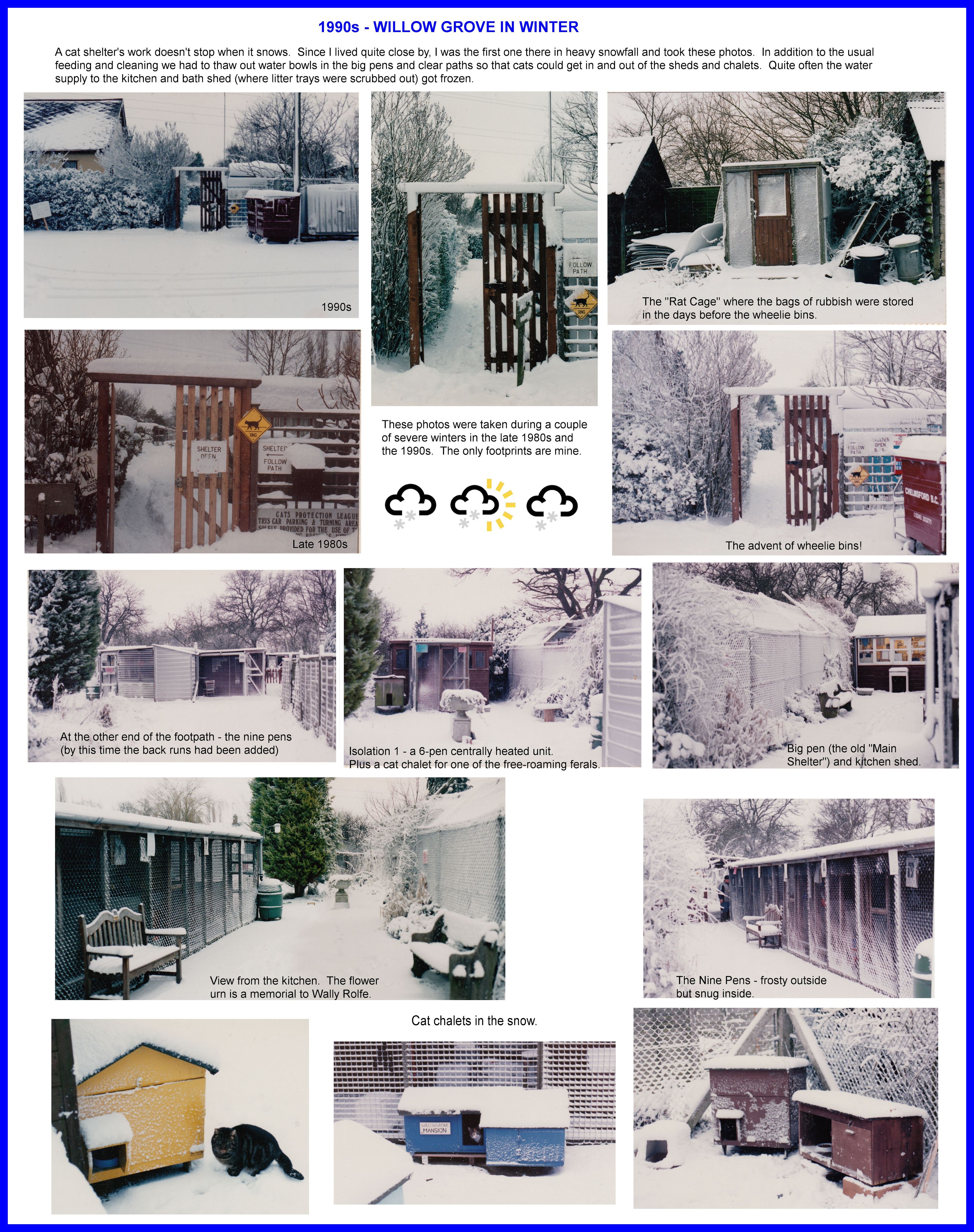
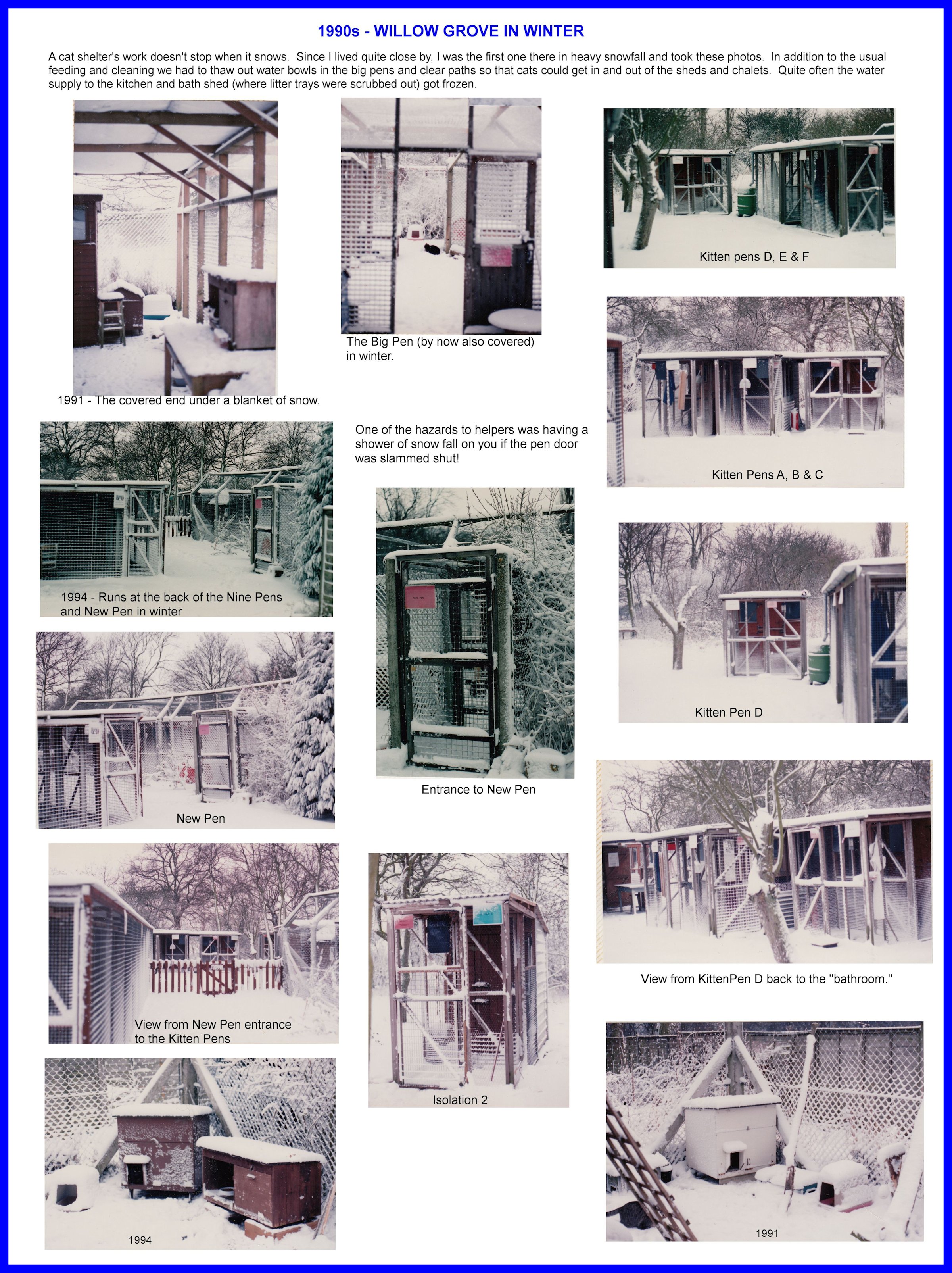
n 2016, I scanned my photograph collection for the benefit of those who might want to see some of Chelmsford CP's history.

| Click on image for large size view of Willow Grove in the Winters of 1991 and 1994 | |
 |
 |

Moving into the 2000s, the grounds were completely redeveloped. A new brick-built Adoption Centre was built in place of the Nine Pens. The empty communal pens became overgrown in the same way as the old Willow Grove Garden Shelter. Over time, everything from the old shelter was cleared so all that remains are photographs taken by helpers and supporters from that era. On the site of the old kitten pens, Pedigree Pens Ltd installed ten bespoke maternity pens for the Chelmsford and District Adoption Centre. Built of white PVCu, these were more hygienic and easier to sterilise than the plyboard-lined wooden pens and they were also fire retardent. In 2013, the Group/Branch/Adoption Centre celebrated its 50th Anniversary - a tribute to the perseverence of all those who fought for its survival at various times in its history.
DAILY ROUTINE IN 1993
These photos were taken as part of the Group's publicity - partly to show supporters and donors what was involved in the day-to-day running of the shelter, and partly to let would-be volunteers see what needed doing. The publicity boards also had a fair number of "helper cuddling cat" photos to show that it was not all hard labour. They also showed kittens being hand-fed and cats being dosed from a spoon. After the experience of a would-be helper who complained "you always give me the dirty jobs" (and lasted only one morning) it seemed a good idea to let people know what was involved. There was a policy of not letting under-16s work at the shelter unless they were accompanying a parent. A number of Duke of Edinburgh scheme youngsters spent a year volunteering.

FETES, FAIRS AND FUNDRAISING


2017 - AN UPDATE
Photos taken at the 2017 Family Fun Day. Click on each image to see it full sized.


